
The Ultimate Guide to Getting Your Project Management Certification in Sweden: All You Need to Know in 2026-2027
Sweden rewards project managers who can turn consensus-heavy decisions into clean execution, especially across IT project management, construction project management, healthcare project management, and government project management. A certificate helps when it proves judgment, delivery discipline, stakeholder fluency, and measurable project control.
This guide shows how to choose the right credential, prepare with purpose, and convert certification into interviews using the complete PM career roadmap, PMP exam domain guide, agile project manager roadmap, and project management career path guide.
1. How Project Management Certification Fits Sweden’s 2026-2027 Hiring Market
Swedish employers usually care about two things at the same time: your ability to lead through structured process and your ability to keep people aligned without creating noise. That is why a strong certification plan should connect your credential to delivery evidence, such as governance notes, sprint metrics, procurement logs, risk decisions, stakeholder maps, and post-project lessons. A candidate with a certificate plus proof assets will usually look stronger than a candidate who only lists training. Start with the project manager roadmap, strengthen your vocabulary through the project execution glossary, sharpen control language with monitoring and control terms, and build interview examples from project reporting best practices.
The biggest mistake in Sweden is treating certification as a badge rather than a signal of workplace readiness. Swedish teams often expect calm facilitation, clean documentation, predictable follow-through, and respectful stakeholder handling. That matters in Stockholm tech teams, Gothenburg automotive and industrial programs, Malmö digital teams, public-sector transformation, energy work, telecom delivery, and healthcare operations. Your certification choice should support the roles you are targeting. PMP can help when you need broad delivery credibility, PRINCE2 can support governance-heavy environments, IPMA can fit competence-based career proof, Scrum credentials can help product and software teams, and portfolio training can support senior tracks. Use the Certified Scrum Master guide, product owner roadmap, project portfolio manager guide, and PM director roadmap to match your target lane.
2. Which Project Management Certification Should You Choose in Sweden?
The right certification depends on the job family you want, the proof you already have, and the hiring filter you need to beat. PMP works well when you want broad recognition across international employers, complex delivery, stakeholder leadership, and cross-functional project control. PRINCE2 fits structured governance, decision gates, public-sector work, vendor-heavy programs, and environments where process clarity matters. IPMA can be especially useful in Sweden because it emphasizes competence levels and experience maturity. Agile and Scrum certifications make sense for software, product, digital transformation, and hybrid delivery roles. Compare your target roles through the PMP exam domains guide, PRINCE2 exam pitfalls guide, Scrum Master guide, agile coach roadmap, and international PM guide.
A practical Sweden-specific rule: choose the certification that fills the weakest trust gap in your profile. A software PM with strong sprint experience may need governance language. A construction coordinator may need scheduling, procurement, and budget discipline. A public-sector applicant may need decision-gate confidence. A consultant may need diagnostic frameworks and executive-ready reporting. A remote applicant may need proof that they can run async delivery without losing stakeholder alignment. Use the remote PM career guide, consultancy firm guide, construction PM software guide, agile metrics guide, and project financial management glossary to close the gap before applying.
For 2026-2027, certification value will rise for candidates who can explain how they use methods in real work. Swedish hiring managers usually hear plenty of generic claims: “I managed stakeholders,” “I led agile projects,” “I delivered on time,” and “I handled risk.” Those phrases become stronger when you attach numbers, artifacts, and decisions. Instead of saying you managed stakeholders, show a stakeholder engagement rhythm. Instead of saying you reduced risk, show the risk trigger and response. Instead of saying you improved delivery, show cycle time, escaped defects, budget variance, or decision turnaround. Build this proof with the stakeholder engagement glossary, risk mitigation terms, earned value management guide, resource allocation terms, and conflict resolution glossary.
3. Step-by-Step Certification Roadmap for Sweden in 2026-2027
Start by defining the role you want in plain terms: IT project manager, construction project manager, product owner, Scrum Master, healthcare PM, government PM, remote PM, consultant, or portfolio leader. Then audit your current profile against the job description. Highlight missing language around scope, budget, risk, vendor control, agile ceremonies, stakeholder engagement, reporting, governance, and benefits realization. The fastest certification path begins with target-role clarity, because the wrong certificate can burn months without improving interview quality. Use the IT PM roadmap, government PM roadmap, healthcare PM roadmap, product owner guide, and construction PM guide.
Next, map your experience to certification eligibility and exam readiness. For PMP-style preparation, document projects where you led or coordinated scope, schedules, teams, risks, communications, procurement, and delivery outcomes. For PRINCE2-style preparation, practice tailoring governance, roles, business justification, stage control, change control, and exception handling. For IPMA-style preparation, build a competence story around people, practice, and perspective. For Scrum credentials, move beyond terminology and show how you helped teams improve backlog flow, sprint discipline, impediment removal, and stakeholder expectations. Study with the PMP resources guide, PMP mistakes guide, Scrum glossary, agile estimation guide, and Kanban terms guide.
Then build a 30-day proof portfolio while studying. Create one risk register, one stakeholder map, one status report, one change request example, one sprint or schedule plan, one decision log, and one post-project review. This gives you interview stories and LinkedIn material without depending only on the certificate line. Swedish employers often appreciate candidates who communicate plainly and show practical evidence. A proof portfolio also helps candidates with international backgrounds, career gaps, non-Swedish experience, or role transitions show transferable strength. Use the project closure glossary, Gantt chart guide, RFP/RFQ/RFI guide, vendor management glossary, and project templates guide.
The fastest certification ROI comes from fixing one blocker, then building proof assets that make your project judgment visible.
4. How to Turn Certification Into Interviews, Salary Growth, and Senior PM Roles
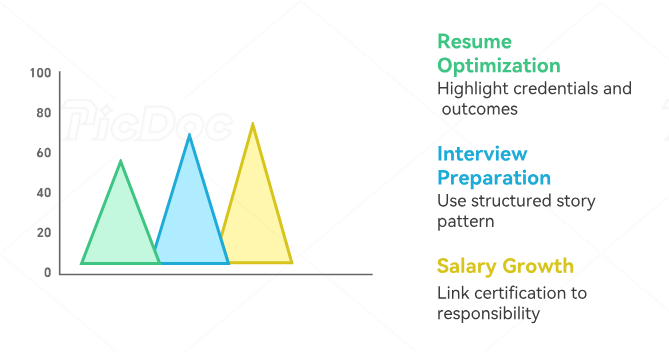
Certification starts helping when your resume converts it into business confidence. Your CV should show the credential, the methods you can apply, the project environments you understand, and the outcomes you helped create. A strong Sweden-focused PM CV should avoid bloated task lists and highlight delivery problems you solved: unclear scope, slow approvals, vendor delays, stakeholder conflict, backlog churn, weak reporting, poor risk visibility, budget drift, or messy handovers. Use role-specific language from the project management consultant guide, remote PM guide, PM director roadmap, VP of PM guide, and CPO roadmap.
A strong interview story follows a tight pattern: context, constraint, decision, action, measurable result, and lesson. For example, a weak answer says, “I managed risk on a vendor project.” A stronger answer explains the delivery risk, shows how you found it, names the response, explains who approved it, shows what changed, and closes with a practical lesson. That style works well for Swedish employers because it sounds grounded, collaborative, and low-drama. Prepare stories across scope control, stakeholder alignment, budget management, agile delivery, procurement, governance, and recovery work. Use the risk register guide, project financial management glossary, leadership and communication glossary, quality management terms, and ISO standards guide.
Salary growth comes from matching certification with higher-value responsibility. A certificate can help you move from coordinator to project manager, from project manager to senior PM, from Scrum Master to agile project management consultant, from delivery manager to PMO leader, or from single-project work to portfolio leadership. The real lever is responsibility: bigger budgets, harder stakeholders, regulated work, cross-border coordination, vendor accountability, transformation ownership, and benefits delivery. Use certification to claim a sharper lane, then prove readiness with assets and stories. Build progression using the Scrum Master to agile PM consultant roadmap, agile coach path, portfolio manager guide, future PM skills guide, and certification evolution forecast.
5. Sweden-Specific Mistakes That Waste Time, Money, and Certification ROI
The first mistake is choosing the most famous certification without matching it to your target role. A Stockholm software PM, a Gothenburg industrial PM, a Malmö digital transformation PM, and a public-sector program coordinator may need different proof. Fame helps with recognition, while fit helps with interviews. Before paying for training, read job posts and collect repeated terms. Look for patterns around agile, governance, supplier management, public procurement, budgeting, reporting, stakeholder management, or product delivery. Then choose the credential that answers the hiring panel’s biggest concern. Compare roles through the New York PM career guide, California PM careers guide, Texas PM career guide, Florida PM job market guide, and Washington PM career hub.
The second mistake is preparing for the exam in isolation. Passing matters, yet isolated studying can leave you with weak interview material. Every study topic should produce one reusable career asset. When you study scope, write a sample scope baseline. When you study risk, build a risk register. When you study stakeholders, create a stakeholder map. When you study reporting, create a one-page dashboard. When you study procurement, build an RFP timeline. This turns exam preparation into career preparation. Use the Waterfall glossary, sprint planning terms, product backlog guide, project monitoring guide, and project closure terms.
The third mistake is underselling international experience. Many candidates moving into Sweden or applying to Swedish companies assume local experience is the only thing that counts. International delivery can be valuable when you translate it properly. Show cross-cultural stakeholders, remote delivery rhythm, vendor governance, budget discipline, risk handling, and documentation quality. Keep your language plain, specific, and outcome-based. A hiring manager should understand your value within seconds. Strengthen global positioning with the international PM guide, freelance PM roadmap, future freelance PM forecast, digital transformation PMO guide, and global agile demand report.
The fourth mistake is ignoring tools. Certification proves method knowledge, while tool fluency proves operational readiness. Swedish employers may use Jira, Azure DevOps, MS Project, Asana, Monday-style tools, Smartsheet-style reporting, Kanban boards, dashboards, and collaboration platforms. You do not need every tool. You need to show that you can turn tools into reliable delivery habits: status updates, backlog hygiene, milestone control, dependency tracking, decision logs, resource visibility, and executive reporting. Build tool confidence with the agile tools guide, Kanban software directory, Scrum tools guide, Waterfall software guide, and project management APIs guide.
6. FAQs About Getting Project Management Certification in Sweden
-
The best choice depends on your target role. PMP is strong for broad international credibility, PRINCE2 helps with structured governance, IPMA supports competence-based progression, and Scrum or agile credentials help digital and product teams. For Sweden, the smartest move is matching the certificate to a hiring gap: governance, agile delivery, procurement, reporting, or leadership. Start with the complete PM roadmap, compare the PMP exam domains, review PRINCE2 pitfalls, and add Scrum Master preparation when your target roles mention agile teams.
-
Choose PMP when you want flexible recognition across multinational employers, transformation programs, IT delivery, and senior PM roles. Choose PRINCE2 when the roles emphasize governance, business cases, stage control, procurement, or public-sector accountability. Choose IPMA when you want a competence-based pathway that can reflect your project maturity over time. The right answer should come from job descriptions, not personal preference alone. Compare your path through the government PM guide, PM consultant guide, portfolio manager guide, and future certification trends.
-
Yes, many Swedish and multinational environments operate heavily in English, especially in tech, consulting, engineering, and international programs. Your challenge is proving that your experience transfers into Swedish workplace expectations: structured collaboration, clean documentation, stakeholder respect, calm facilitation, and transparent reporting. Make your CV easy to trust by showing artifacts, outcomes, and role-specific language. Strengthen positioning with the international PM guide, remote PM guide, stakeholder terms guide, and reporting best practices.
-
Most candidates should plan for six to twelve focused weeks, depending on experience, exam difficulty, and weekly study time. The best plan mixes domain review, practice questions, weak-area tracking, scenario practice, and proof-asset creation. Avoid passive reading as the main study method. Every week should produce better exam readiness and better interview material. Use the PMP resources guide, PMP mistakes guide, agile estimation guide, and project templates guide to build a cleaner plan.
-
Certification can support salary growth when it helps you move into higher-value responsibility. Salary leverage usually comes from managing larger budgets, harder stakeholders, vendor risk, cross-border delivery, regulated projects, strategic transformation, or portfolio decisions. A certificate gives you language and credibility, then your proof assets justify negotiation. Build the story around outcomes, not course completion. Use the PM director roadmap, VP of PM guide, CPO roadmap, and future PM skills guide to plan the next step.
-
Build a small portfolio that shows how you think as a project manager. Include a risk register, project charter, stakeholder map, schedule baseline, status report, change request, vendor checklist, sprint or delivery dashboard, and closeout review. These assets help hiring managers see your judgment before they hire you. They also help you answer behavioral interview questions with structure. Start with the risk register guide, Gantt chart guide, vendor management glossary, and project closure glossary.
