
Product Backlog & Sprint Backlog: Critical Terms Defined
Teams rarely struggle with Agile because they lack ceremonies. They struggle because the backlog system is weak. Work enters without enough clarity, priorities shift without discipline, sprint commitments get made on half-understood items, and delivery starts moving fast in the wrong direction. That is when velocity becomes noise, carryover rises, stakeholders lose confidence, and every sprint review feels thinner than the one before it.
A strong project manager, Scrum Master, or product leader treats backlog language as control language. Product backlog terms shape strategic direction. Sprint backlog terms shape execution reality. When these concepts are defined sharply, planning improves, trade-offs become cleaner, dependencies surface earlier, and teams stop wasting energy on preventable confusion.
1. Why Product Backlog and Sprint Backlog Language Shapes Delivery Quality
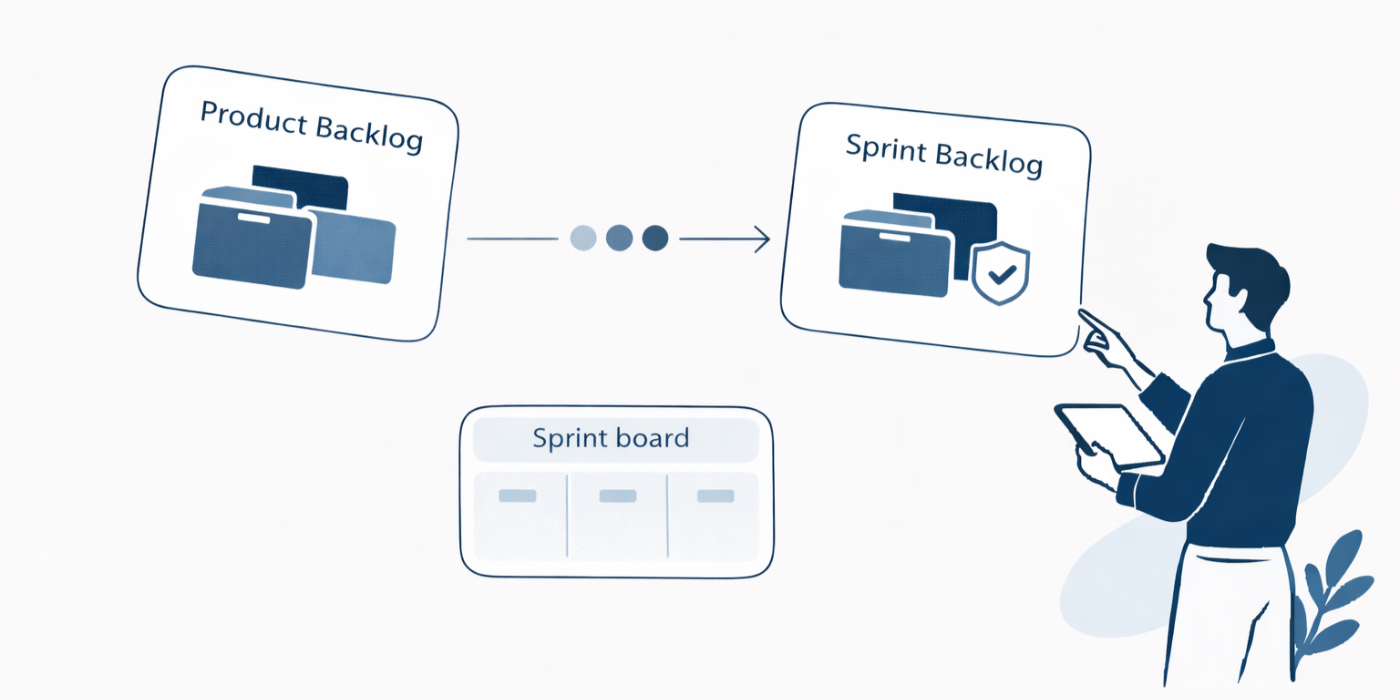
A backlog is not just a list. It is a decision system. The product backlog represents the full horizon of known product work, while the sprint backlog represents the work the team has chosen to execute now. When teams use those terms loosely, planning quality collapses. Stakeholders start assuming anything mentioned in conversation is “in backlog.” Developers begin sprint planning with items that are technically present but strategically weak. Leaders look at overloaded boards and mistake quantity for readiness. This is why disciplined teams anchor backlog work to project communication techniques, stakeholder alignment, risk management concepts, and quality management terms.
The product backlog is dynamic, strategic, and continuously reordered. It holds features, fixes, technical work, spikes, debt reduction, compliance items, and sometimes research. It should reflect product intent, business risk, delivery constraints, and dependency logic. When it turns into a dumping ground, the team loses trust in planning. Items age without decision, refinement sessions become rescue operations, and roadmap conversations drift into politics instead of evidence. PMs who understand backlog terminology are usually better at linking work to budget realities, resource allocation, issue tracking, and project reporting.
The sprint backlog is narrower and more fragile. It includes the selected backlog items plus the developers’ plan for delivering them in the sprint. That distinction matters. Many teams think the sprint backlog is only the list of stories carried into the sprint. In practice, it also includes task-level execution thinking, capacity trade-offs, daily adaptation, and the path to the sprint goal. Once that understanding is missing, teams overcommit, ignore dependencies, and treat carryover as normal instead of diagnostic. This is where strong PMs combine Scrum role clarity, project scheduling knowledge, critical path awareness, and Agile industry trend insight.
| Term | What It Means | Why It Matters | Signal / Artifact | Primary Owner or Influence |
|---|---|---|---|---|
| Product backlog | Ordered list of work needed to improve the product. | Creates one strategic source of demand. | Backlog board, ranked item list | Product Owner |
| Sprint backlog | Selected sprint items plus delivery plan for meeting the sprint goal. | Turns priority into near-term execution. | Sprint board, committed items | Developers |
| Backlog item | A unit of work in the backlog such as a feature, fix, or enabler. | Provides a manageable planning object. | PBI entry | Product Owner + Team |
| User story | Short statement of user-centered need and value. | Keeps work tied to outcome, not just activity. | Story card | Product Owner |
| Epic | Large body of work too broad for a single sprint. | Helps organize related value streams. | Epic hierarchy | Product + PM |
| Feature | Meaningful product capability delivering stakeholder value. | Bridges strategy and team-level work. | Roadmap item | Product leadership |
| Backlog refinement | Ongoing clarification, splitting, estimating, and reordering of items. | Reduces planning waste and sprint surprises. | Refinement session notes | Product Owner + Team |
| Ordering | Relative ranking of backlog items by value, risk, urgency, and dependency. | Prevents teams from working on loud instead of important items. | Ranked backlog | Product Owner |
| Priority | Degree of importance assigned to an item. | Guides attention under constraints. | Priority field | Product Owner |
| Acceptance criteria | Specific conditions that define item completion and acceptability. | Prevents rework and vague “done.” | Criteria checklist | Product Owner + Team |
| Definition of Ready | Shared standard for when an item is sufficiently understood to pull into sprint planning. | Stops teams from committing to fog. | Ready checklist | Team |
| Definition of Done | Quality and completion standard applied to finished work. | Protects integrity across increments. | Done policy | Team |
| Estimation | Relative assessment of effort, complexity, or uncertainty. | Supports capacity and forecasting. | Story points, t-shirt sizes | Developers |
| Story points | Relative unit used to estimate backlog items. | Enables team-specific forecasting patterns. | Point values | Developers |
| Capacity | Amount of work a team can realistically take into a sprint. | Prevents fantasy commitments. | Availability plan | Developers + Scrum Master |
| Velocity | Amount of estimated work completed per sprint over time. | Helps forecast with caution. | Velocity trend | Team / PM |
| Sprint goal | Single objective that gives the sprint coherence. | Keeps work from becoming a random bundle of tickets. | Sprint goal statement | Team + Product Owner |
| Task breakdown | Decomposition of selected sprint items into actionable work. | Improves execution visibility. | Subtasks | Developers |
| Carryover | Work not finished within the sprint and moved forward. | Signals planning or execution problems. | Rolled items | Team / PM |
| Spillover | Backlog items exceeding sprint boundaries due to underestimation or interruption. | Exposes commitment quality issues. | Sprint variance | Team |
| Technical debt | Accumulated engineering shortcuts that will require future correction. | Competes with feature delivery in the backlog. | Debt items, refactor tickets | Engineering + Product |
| Dependency | Work relationship where one item relies on another team, system, or decision. | Drives sequencing and risk. | Dependency log | PM + Team |
| Backlog grooming | Older term for backlog refinement activities. | Important for understanding legacy team language. | Legacy process docs | Product + Team |
| Investment theme | Strategic grouping used to guide backlog prioritization. | Aligns item-level work to bigger bets. | Roadmap themes | Leadership + Product |
| Backlog health | Quality of readiness, clarity, sequencing, and freshness across backlog items. | Shows whether future sprints are planned from strength or confusion. | Refinement scorecard | PM / Product Owner |
| Item aging | How long backlog items remain untouched or unresolved. | Reveals neglect, indecision, or poor prioritization. | Aging report | PM / Product Owner |
| Commitment | Planned sprint work the team believes it can finish to meet the goal. | Sets expectation and accountability. | Sprint commitment | Developers |
| Emergent work | Unplanned work that enters due to defects, incidents, or urgent needs. | Threatens sprint stability when unmanaged. | Interrupt tickets | Team + PM |
2. Essential Product Backlog Terms Every PM and Agile Leader Must Master
The product backlog is the ordered list of everything that might improve the product. “Ordered” matters more than “list.” Order reflects trade-offs. It tells the team what deserves attention first based on value, urgency, risk, dependency, compliance, and strategic timing. A product backlog without sharp ordering becomes a political artifact where stakeholders fight for visibility and teams work on whoever shouted last. Good ordering depends on disciplined use of stakeholder management, risk assessment terms, project communication, and project governance thinking.
A product backlog item, often shortened to PBI, is any unit of work inside that backlog. Teams may use stories, bugs, enablers, spikes, defects, or chores, but the point is the same: it is a planning object. Each item should carry enough context to be evaluated, refined, estimated, ordered, and eventually selected. Weak items produce weak planning. They are vague, oversized, detached from user value, or blind to dependency risk. PMs who can spot these weaknesses early typically perform better in project initiation, quality management, issue control, and documentation discipline.
A user story is one common type of backlog item. It expresses need from the user’s perspective. The real power of a story is not the template language. It is the forcing function toward value. Good stories reduce ambiguity about who benefits and why the work matters. Bad stories hide vague requests under Agile vocabulary. A story with no clear acceptance logic is an invitation to rework. That is why acceptance criteria sit so close to the heart of backlog quality. Acceptance criteria define the conditions under which the item can be considered satisfactory. Teams that skip this work pay for it later through review disputes, unfinished work, and sprint spillover. The discipline here aligns tightly with project quality terminology, budget and cost pressure management, reporting clarity, and productivity systems.
Epics and features matter because they provide scale. An epic is too large for a sprint and must be split. A feature represents meaningful capability. Teams that fail to distinguish them often bring giant, under-specified work into planning and then wonder why the sprint turns chaotic. Refinement exists to prevent that. Backlog refinement is the ongoing process of clarifying, splitting, estimating, and reordering items so future sprints are built from strong material instead of guesswork. Refinement is where Agile maturity becomes visible. Mature teams do not use refinement to rescue garbage; they use it to strengthen flow. That links directly to team-building discipline, human resource management in PM, knowledge management, and Agile certification paths.
3. Critical Sprint Backlog Terms That Drive Execution Reality
The sprint backlog begins during sprint planning, but it lives throughout the sprint. It includes selected product backlog items and the developers’ plan to deliver them. This means it is not a frozen shopping cart. It is an execution system that adapts while still protecting the sprint goal. That nuance matters. Teams often become brittle when they think any change to the sprint backlog is failure. The problem is not thoughtful adaptation. The problem is uncontrolled churn, weak commitment logic, and missing sprint purpose. Strong PMs and delivery leads connect sprint backlog control to project scheduling terms, critical path awareness, resource allocation tools, and dashboard visibility.
The sprint goal is the anchor. It gives coherence to the selected work. Without it, the sprint backlog becomes a pile of tickets that happen to fit inside a timebox. That kind of sprint can look busy and still fail strategically. The goal helps teams make intelligent trade-offs when interruption, complexity, or estimation error appears. It also helps product leaders see whether the sprint is producing a meaningful increment or merely completing unrelated tasks. This kind of goal-driven execution pairs well with project reporting and analytics, communication control, issue tracking software, and mobile collaboration apps.
Capacity is another critical term that teams misuse constantly. Capacity is not optimism. It is not team aspiration. It is the realistic amount of work the team can take given availability, meetings, leave, interruptions, and historical throughput. Velocity is related but different. Velocity reflects how much estimated work was completed over previous sprints. It can support forecasting, but only when interpreted carefully. Teams that weaponize velocity end up distorting estimates and hiding quality problems. Teams that understand it as a rough planning signal use it well. This is where backlog work intersects with project budget tracking, software tool selection, automation efficiency, and broader AI and automation changes in PM.
Definition of Ready and Definition of Done are two of the most abused terms in backlog practice. Definition of Ready helps the team avoid pulling half-formed work into sprint planning. Definition of Done protects quality and completion consistency. When these standards are weak, teams commit to ambiguity and then declare partial work finished. The result is false progress, high carryover, and fragile increments. Mature teams use these definitions to defend delivery integrity, not to create bureaucracy. That kind of discipline supports better quality management, project risk control, Agile coaching paths, and future-facing PM competencies.
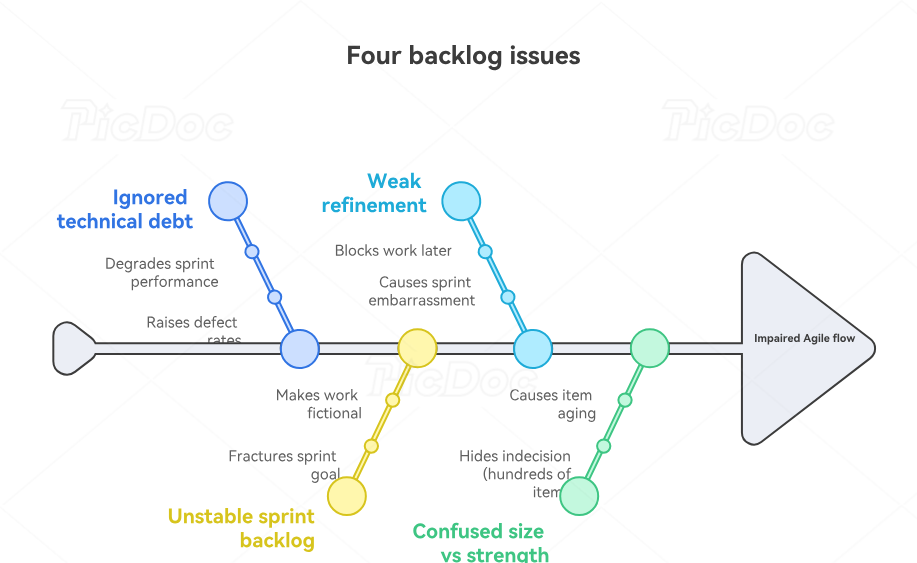
4. The Backlog Problems That Quietly Wreck Agile Teams
The first major problem is confusing backlog size with backlog strength. Some teams feel safe when hundreds of items are stored in the system. In reality, large backlogs often hide indecision, duplicate requests, stale priorities, and work that no longer deserves attention. Item aging becomes severe. Refinement time gets swallowed by archaeological cleanup. Stakeholders misread presence as commitment. A healthier backlog is smaller, fresher, and more deliberately ordered. PMs who want that outcome usually need sharper stakeholder management, communication techniques, dashboard reporting, and documented governance rules.
A second problem is weak refinement. Teams say an item is “ready enough” because they want to move planning along, but that shortcut lands later as blocked work, endless clarification, and sprint review embarrassment. Refinement should expose ambiguity before commitment, not during active execution. If work is large, split it. If value is unclear, challenge it. If dependencies are external, make them visible. If acceptance logic is missing, stop pretending the item is ready. This rigor supports not just Agile flow but the broader PM disciplines behind risk management, quality control, project issue tracking, and future PM leadership.
The third problem is sprint backlog instability caused by unmanaged emergent work. Some interruption is real. Production defects happen. Compliance requests appear. Executive pressure lands mid-sprint. The damage comes when teams have no policy for handling those interruptions. Then every urgent request bypasses backlog order, the sprint goal fractures, and committed work becomes fiction. Mature teams decide what level of interruption is tolerable, how trade-offs get made, and who can authorize entry. That is where issue tracking systems, project reporting tools, mobile PM apps, and Agile workforce insights become practical, not theoretical.
The fourth problem is treating technical debt as optional backlog filler. Teams under pressure often keep delivering features while refactoring, architecture cleanup, test hardening, and environment stabilization get pushed lower every cycle. Then sprint performance slowly degrades. Estimation becomes less reliable. Defects rise. Dependencies multiply. Delivery feels busy but increasingly brittle. Backlog language must be strong enough to defend debt reduction as real value protection. That connects directly to cost management, risk control, software tool effectiveness, and the future of AI-enabled PM work.
5. How to Build a Product Backlog and Sprint Backlog System That Actually Works
Start by making backlog ownership explicit. The Product Owner owns product backlog ordering, but backlog health is shared. Developers contribute technical reality. Scrum Masters protect process quality. Project managers often connect roadmap, dependency, reporting, risk, and cross-team coordination. That structure matters because backlogs decay fast when ownership is vague. Clear ownership becomes stronger when reinforced by project governance, stakeholder terms, communication controls, and project management software selection.
Use a backlog health standard. High-quality backlogs have visible ordering logic, current priorities, clear acceptance criteria, item sizes appropriate for planning, dependency notes where needed, and enough refined items to support upcoming sprints. This can be measured. Teams should review aging, carryover, blocked items, refinement depth, and ratio of planned versus emergent work. That kind of operational scrutiny becomes easier with reporting and analytics platforms, dashboard tools, document platforms, and automation tools.
Protect sprint planning from polluted inputs. Planning should not be the meeting where value gets invented, scope gets argued, and dependencies get discovered for the first time. That meeting should translate prepared backlog items into a coherent sprint goal and realistic sprint backlog. Teams improve quickly when they enforce a real Definition of Ready, calculate capacity honestly, and challenge commitments that feel inflated. This discipline aligns naturally with project scheduling practices, resource allocation thinking, productivity management, and Agile career growth paths.
Finally, treat carryover as a symptom, not a routine. When work repeatedly spills from one sprint to the next, something in the system is off. The item may be too large. Dependencies may be hidden. Capacity may be overstated. Urgent work may be bypassing backlog discipline. Acceptance criteria may be weak. Leaders who ignore repeated carryover end up normalizing unreliable delivery. Leaders who investigate it improve forecast quality, team trust, and backlog realism. That is exactly the kind of operational maturity that supports stronger results in PMP preparation, PMI-ACP preparation, Scrum Master development, and broader project leadership career roadmaps.
6. FAQs About Product Backlog and Sprint Backlog Terms
-
The product backlog contains the evolving universe of work that might improve the product. The sprint backlog contains the subset selected for the current sprint plus the team’s delivery plan for meeting the sprint goal. One is strategic and continuously reordered. The other is tactical and tied to short-term execution. Understanding the distinction improves Scrum role clarity, project scheduling, issue control, and project reporting.
-
The Product Owner owns the product backlog, especially its ordering and value direction. Developers own the sprint backlog because they decide how selected work will be executed during the sprint. That split helps preserve both strategic clarity and execution realism. It also works best when supported by strong stakeholder management, team-building practices, communication discipline, and Agile career frameworks.
-
Backlog refinement is the ongoing work of clarifying, splitting, estimating, and reordering backlog items. It matters because sprint planning quality depends on it. Without refinement, teams commit to work that is vague, oversized, dependent, or strategically weak. Good refinement reduces surprise and increases flow. It also reinforces risk management, quality control, project productivity, and knowledge management practices.
-
They overlap, but ordering is broader. Priority usually signals importance. Ordering reflects the actual rank of items after weighing value, timing, dependency, risk, capacity, and strategic logic. A high-priority item may still sit below another item due to sequencing or readiness constraints. PMs who understand this nuance usually make better choices in resource allocation, risk assessment, governance planning, and reporting clarity.
-
Carryover usually comes from oversized items, hidden dependencies, weak acceptance criteria, overstated capacity, unplanned interruption, or poor refinement. It is useful as a signal because it points to system weakness rather than bad luck. Teams that examine carryover honestly improve faster than teams that excuse it. That analysis becomes stronger when paired with issue tracking tools, dashboard visibility, automation support, and Agile tool effectiveness research.
-
Definition of Ready helps a team decide whether a backlog item is sufficiently clear to enter sprint planning or be selected for a sprint. It is a quality gate for commitment, not a bureaucratic ritual. It helps teams avoid spending sprint time discovering what should have been clarified earlier. Used well, it supports quality discipline, communication precision, project scheduling reliability, and future-ready PM capability.
-
Because technical debt consumes future delivery capacity whether it is acknowledged or not. If it never enters backlog conversations, teams create a false picture of progress while the product becomes harder to change safely. Putting debt into the backlog makes its cost visible and allows deliberate trade-offs. That visibility supports better cost management, risk reduction, software planning, and AI-era delivery forecasting.
-
The strongest signal is repeated mismatch between planned work and delivered reality. That may appear as stale items, chaotic refinement, high carryover, weak sprint goals, constant re-prioritization, or review sessions full of “almost done” work. Healthy backlogs produce clarity before execution starts. Unhealthy backlogs force the team to improvise under pressure. Fixing that improves delivery now and strengthens long-term growth in paths such as Agile project management consultant, project director, PMI-ACP certification, and the broader future of project leadership.
