
Ultimate Scrum Glossary: Terms Every PM Must Master
Scrum gets misread as a lightweight delivery framework because the guide itself is short. Real teams learn the hard way that weak terminology creates slow decisions, fuzzy ownership, bad planning, and sprint ceremonies that feel busy without producing useful increments. A project manager who cannot speak Scrum precisely will struggle to align delivery, forecast risk, manage stakeholders, and protect team flow.
This glossary is built for that exact gap. It does more than define words. It shows how each term affects execution, reporting, prioritization, estimation, governance, and cross-functional trust. Throughout the article, you will also find natural pathways into related APMIC resources on project management terms, Scrum roles and responsibilities, project risk management, stakeholder management, and project communication.
1. Why Scrum Vocabulary Separates Strong PMs From Struggling Ones
A project manager does not become Scrum-ready by memorizing a few ceremony names. The real advantage comes from understanding what each term protects inside a delivery system. When a PM confuses a sprint with a release, backlog grooming with backlog refinement, or velocity with productivity, the entire operating model starts bending in the wrong direction. That confusion spreads into project scheduling terms, critical path thinking, cost management, and issue tracking workflows.
Scrum language matters because every term encodes a management decision. A Product Goal keeps the backlog from becoming a random wish list. A Sprint Goal protects the team from fragmented effort. A Definition of Done prevents half-finished work from being reported as progress. An impediment tells leaders something structural is blocking flow, while a simple task delay may only need team-level adjustment. These are not academic distinctions. They shape reporting quality, resource allocation choices, dashboard interpretation, and knowledge management maturity.
PMs also need strong Scrum vocabulary because many organizations operate in hybrid environments. One team runs Scrum, another works in Kanban, leadership asks for waterfall milestones, procurement wants phase-based signoffs, and finance wants budget visibility. Without precise language, the PM becomes a translator who mistranslates everything. That is where delivery friction starts: bad handoffs, vague updates, false confidence, and retrospective conversations that identify pain but never isolate cause. A PM who understands Scrum terms deeply can connect them to project budgeting, quality management, procurement terms, and contract management language without diluting the framework.
| Term | Practical Meaning | Why It Matters | Common PM Mistake | What Good Looks Like |
|---|---|---|---|---|
| Scrum | Framework for managing complex product work through empiricism. | Creates fast feedback loops. | Treating it as a checklist of meetings. | Use it to inspect, adapt, and focus decisions. |
| Empiricism | Decisions based on observation, evidence, and learning. | Reduces fantasy planning. | Locking plans despite new evidence. | Adapt scope and priorities from real signals. |
| Transparency | Work and status are visible and understandable. | Enables sound inspection. | Hiding unfinished work behind percent-complete language. | Make backlog, blockers, and done criteria explicit. |
| Inspection | Frequent review of product and process. | Finds drift early. | Reviewing outputs without reviewing assumptions. | Check outcome, quality, and team health together. |
| Adaptation | Changing plan or approach based on inspection. | Prevents repeated errors. | Holding retrospectives with no behavior change. | Turn findings into concrete adjustments. |
| Product Owner | Person accountable for maximizing product value. | Creates decision clarity. | Turning the role into a ticket secretary. | Owns priorities and value tradeoffs. |
| Scrum Master | Leader who enables Scrum effectiveness. | Improves flow and system health. | Using the role as a meeting scheduler only. | Removes impediments and coaches the system. |
| Developers | People who build the increment. | Own execution quality. | Assuming only engineers count. | Include all contributors needed for delivery. |
| Scrum Team | Product Owner, Scrum Master, and Developers together. | Defines shared accountability. | Splitting ownership into silos. | Operate as one unit around value delivery. |
| Product Goal | Longer-term objective for the product. | Creates strategic direction. | Running a backlog with no destination. | Every major backlog choice supports it. |
| Sprint Goal | Single objective for the sprint. | Builds team focus. | Stuffing unrelated items into one sprint. | Work selection supports one coherent outcome. |
| Product Backlog | Ordered list of future product work. | Centralizes demand. | Keeping stale, duplicate, vague items. | Ordered, refined, value-led backlog. |
| Sprint Backlog | Selected work plus plan for the sprint. | Makes commitment visible. | Treating it as frozen regardless of new reality. | Updated as the team learns during the sprint. |
| Increment | Usable piece of value produced in the sprint. | Connects work to outcome. | Calling unfinished code an increment. | Potentially releasable and done. |
| Definition of Done | Shared quality standard for completeness. | Protects trust in delivery reporting. | Allowing “done” to mean “coding finished.” | Includes testing, review, documentation, and integration. |
| Definition of Ready | Optional readiness criteria before work enters a sprint. | Improves planning quality. | Using it as a bureaucratic gate. | Ensures enough clarity without blocking learning. |
| Backlog Refinement | Ongoing clarification and sizing of backlog items. | Improves sprint planning. | Waiting until planning to clarify everything. | Regular refinement keeps options healthy. |
| Sprint Planning | Event to decide why, what, and how for the sprint. | Aligns purpose and execution. | Turning it into a task download session. | Goal first, then item selection, then plan. |
| Daily Scrum | Short planning event for Developers. | Improves daily coordination. | Making it a status meeting for managers. | Used to inspect progress toward the Sprint Goal. |
| Sprint Review | Inspection of increment with stakeholders. | Tests value and direction. | Using slides instead of live product evidence. | Discussion centers on product reality and next decisions. |
| Sprint Retrospective | Event to improve team process and collaboration. | Compounds operating gains. | Collecting complaints without follow-through. | Ends with clear experiments and ownership. |
| Velocity | Historical measure of completed work. | Supports near-term forecasting. | Using it to compare teams. | Use as a local planning signal only. |
| Story Points | Relative estimate of effort, complexity, and uncertainty. | Helps compare work items. | Converting points directly into hours. | Use relatively, not literally. |
| Epic | Large body of work needing decomposition. | Helps organize bigger outcomes. | Bringing epics into a sprint unchanged. | Break into testable, deliverable slices. |
| User Story | Small unit of user-centered requirement. | Improves value framing. | Writing solution tasks as stories. | States who benefits and why. |
| Impediment | Obstacle slowing or blocking delivery. | Shows system friction. | Calling every inconvenience an impediment. | Escalate structural blockers that affect flow. |
| Burndown Chart | Visual of remaining work over time. | Supports trend inspection. | Using it as proof of health alone. | Read it with scope and quality context. |
| Release | Deployment or delivery of value to users. | Connects sprint work to market impact. | Assuming every sprint must release externally. | Release strategy matches risk and business need. |
2. Core Scrum Terms Every PM Must Understand at a Functional Level
Let’s start with the terms that define the framework itself. Scrum is a lightweight framework for complex work, but lightweight does not mean casual. It runs on empiricism, which means teams make decisions through transparency, inspection, and adaptation. If those three pillars are weak, the ceremonies become performative. PMs who already understand project failure patterns, drivers of project success, agile adoption data, and methodology adoption trends will immediately recognize why these pillars matter.
Transparency means the work is visible and understandable, not merely visible. A dashboard full of tasks with vague labels creates false transparency. A backlog with acceptance ambiguity creates false transparency. A sprint board that hides dependency risk creates false transparency. Strong PMs translate transparency into naming discipline, decision logs, visible blockers, and meaningful artifacts. That connects directly to document management, reporting software, communication methods, and stakeholder expectations.
Inspection is the regular act of checking reality. That includes checking whether the product solves the right problem, whether the sprint is still aligned to goal, whether estimates were distorted by hidden complexity, and whether quality is slipping beneath the noise of velocity. Adaptation is what happens after that inspection. Teams that inspect without adapting produce elegant meeting notes and repeat the same misses next sprint. Teams that adapt strengthen flow, reduce rework, and improve predictability. This is why Scrum terminology should be learned alongside risk identification, quality management terms, budget management language, and team building concepts.
Another foundational term is increment. Many PMs report progress based on work started, code written, tasks moved, or effort consumed. Scrum centers on the increment instead because value lives in usable output. That distinction matters when leadership asks whether the team is “on track.” A team may look busy while producing nothing releasable. Without that vocabulary discipline, status reporting becomes theater. A PM who understands increments can explain delivery maturity more credibly than one who reports only activity counts.
3. Role, Artifact, and Event Terms That Drive Real Delivery Quality
Scrum roles are simple on paper and often distorted in practice. The Product Owner is accountable for maximizing value. That means prioritization authority, backlog ordering judgment, and tradeoff ownership. It does not mean collecting requests from everyone and passing them to the team. PMs who work near Scrum teams must understand when a Product Owner is truly managing value and when they are drowning in stakeholder noise. That same skill improves work in stakeholder management, customer relationship workflows, project communication planning, and knowledge capture.
The Scrum Master is another role teams misunderstand. This person is not there to chase updates, enforce calendars, and host repetitive standups. The Scrum Master is accountable for Scrum effectiveness. That includes coaching the team, exposing impediments, improving flow, and helping the broader organization stop breaking the framework from the outside. PMs who understand this role stop asking the Scrum Master to be an admin layer and start partnering with them around systemic friction. That friction often connects to resource constraints, issue tracking breakdowns, automation gaps, and productivity challenges.
The Developers in Scrum include all professionals needed to create the increment. That may include engineers, testers, designers, analysts, or other contributors. PMs who restrict that term mentally to software developers often overlook quality ownership, design risk, and testing bottlenecks until late in the sprint.
Artifacts matter just as much. The Product Backlog is the evolving, ordered list of work for the product. It is not a dumping ground. It should reflect value, learning, risk, sequencing logic, and strategic intent. The Sprint Backlog contains selected work for the current sprint and the team’s plan to meet the Sprint Goal. The Definition of Done is the quality threshold that protects the team from fake progress. It must be strong enough to prevent partially tested, weakly documented, integration-risky work from slipping through. That is why smart PMs study Scrum alongside project quality management, contract terms, procurement management, and budget tracking discipline.
4. Estimation, Flow, and Planning Terms That PMs Commonly Misuse
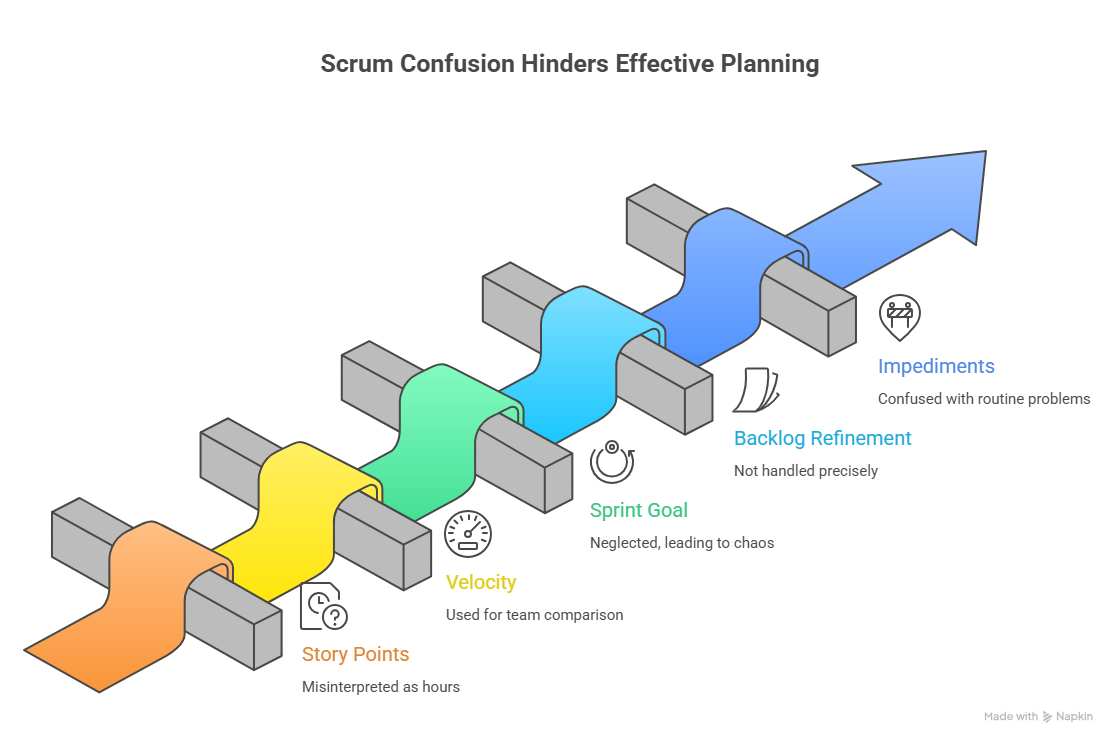
A large share of Scrum confusion sits in planning language. Story points are relative estimates, not disguised hours. They combine complexity, uncertainty, and effort into a comparative signal. PMs damage estimation quality when they force point-to-hour conversions for executive comfort. That pressure turns estimation into negotiation instead of learning. Teams then game numbers, inflate points, and lose trust in their own forecasting. Understanding this is essential if you also work with budget planning, cost management frameworks, project analytics, and dashboard interpretation.
Velocity is another term that gets abused. It is a local planning metric based on completed work over time. It helps a team forecast how much it may reasonably complete in future sprints. It does not measure talent, urgency, dedication, or business value. When leaders compare teams by velocity, teams immediately lose incentive to estimate honestly. Good PMs defend the correct use of velocity because they understand that distorted metrics create distorted behavior.
Then there is the Sprint Goal. This is one of the most powerful and most neglected concepts in Scrum. A sprint without a clear goal becomes a container of unrelated backlog items. That destroys focus, weakens tradeoff decisions, and makes the Daily Scrum less useful because the team cannot inspect progress toward a shared purpose. PMs who grasp Sprint Goal logic become much better at stakeholder communication, risk prioritization, resource sequencing, and Gantt-oriented coordination.
Backlog refinement also deserves precise handling. It is not a one-time ceremony where the team glances at future tickets. It is the ongoing discipline of making upcoming work small enough, clear enough, and valuable enough to be planned without chaos. Weak refinement creates bloated planning meetings, confused acceptance criteria, and last-minute dependency discovery. These are the exact hidden costs that later show up as “missed commitments” when the real problem was intake quality.
Finally, PMs should distinguish between an impediment and a routine problem. An impediment is something that blocks or significantly slows the team’s ability to deliver. That may be an approval bottleneck, unstable environment, decision vacuum, unresolved dependency, or conflicting executive demand. Labeling these accurately matters because real impediments need escalation paths, not motivational speeches.
5. Advanced Scrum Terms That Improve Stakeholder Handling, Governance, and Delivery Credibility
Once the basics are understood, the next layer of Scrum vocabulary gives PMs a sharper operating advantage. Product Goal is one of those terms. It keeps the backlog tethered to an outcome instead of drifting into feature accumulation. When a PM hears teams debating isolated tickets without a shared destination, that is usually a Product Goal weakness. The result is output without narrative, activity without strategic coherence. PMs with stronger strategic grounding connect Product Goal thinking to portfolio management trends, project success drivers, industry outlook data, and future PM skill shifts.
Another valuable term is Definition of Ready. Scrum does not formally require it, yet many teams use it to ensure work entering a sprint has enough clarity to be discussed intelligently. The danger is turning it into a bureaucratic gate that blocks learning. The benefit is using it to reduce ambiguity, expose hidden dependency risk, and improve planning quality. Strong PMs use readiness standards as a quality safeguard, not a paperwork ritual. This mindset overlaps with project initiation terms, procurement language, contract definition discipline, and quality management controls.
Epic and user story are also frequently blurred. An epic is a large body of work that must be broken down. A user story is a smaller, user-centered requirement that supports planning and conversation. When teams carry epics directly into sprint planning, they usually carry hidden scope, unclear acceptance, and impossible testing surfaces with them. That is where sprint confidence gets inflated on day one and punctured by day six.
PMs also benefit from understanding the difference between Sprint Review and Sprint Retrospective. The review inspects the product with stakeholders. The retrospective inspects the team’s way of working. Mixing them together creates bad outcomes on both sides. Stakeholder-facing reviews become process complaints, and retrospectives become political performances. Mature teams preserve the purpose of each event. That separation improves feedback quality, decision speed, and trust.
Finally, understanding release as distinct from increment is crucial. Every increment should be potentially releasable, yet not every sprint must trigger an external release. PMs who grasp that distinction communicate better with executives, compliance teams, customers, and operations. They can explain why the product is getting safer, more integrated, or more testable even before visible market release happens.
6. FAQs: High-Value Answers for PMs Trying to Master Scrum Terminology
-
Start with Product Owner, Scrum Master, Developers, Product Backlog, Sprint Backlog, Sprint Goal, Product Goal, Increment, Definition of Done, backlog refinement, Sprint Planning, Daily Scrum, Sprint Review, Sprint Retrospective, story points, velocity, impediment, and release. These terms give you the language to understand ownership, planning, execution, quality, forecasting, and stakeholder communication. Once these are clear, you can connect them more effectively to Agile trends, hybrid delivery models, career growth in project management, and future PM competencies.
-
Because training often explains the words without showing their operational consequences. PMs leave knowing the ceremony names but not how weak backlog refinement creates sprint chaos, how a weak Definition of Done destroys trust in status, or how misuse of velocity corrupts forecasting. Real mastery comes from using Scrum language to diagnose delivery patterns, not from memorizing a diagram. That is why learning should also include risk management, issue tracking, communication design, and resource planning.
-
It is a poor comparison metric because each team estimates differently, works in different contexts, and carries different complexity patterns. Velocity works best as a local forecasting signal. Once leadership turns it into a scoreboard, estimation quality erodes and behavior starts drifting toward number management instead of value delivery.
-
Many teams say work is “done” when coding is finished, even though testing, review, documentation, or integration is still incomplete. That single language problem can poison reporting, planning, and stakeholder trust for months. A strong Definition of Done fixes more delivery confusion than many expensive tooling changes.
-
Use the terms to communicate reality with precision. Explain the Product Goal to show direction. Explain the Sprint Goal to show near-term focus. Explain impediments to surface structural blockers. Explain the increment to show usable progress. Explain release separately so stakeholders understand what is already valuable internally versus what is externally deployed. Precision reduces false optimism and makes tradeoff conversations much easier.
-
The strongest next reads are Essential Scrum Roles & Responsibilities Explained Clearly, Top 100 Project Management Terms You Must Know, Comprehensive Project Risk Management Glossary, Comprehensive Guide to Project Scheduling Terms, Critical Project Stakeholder Terms Every PM Should Master, and Essential Project Communication Terms & Techniques. Together, these create a much stronger practical vocabulary for modern PM work.
