
Complete Guide to Becoming a Certified Scrum Master (CSM)
Becoming a Certified Scrum Master (CSM) in 2026–27 isn’t about collecting a badge — it’s about proving you can stabilize delivery when reality keeps changing. Teams don’t fail because they “don’t know Scrum.” They fail because priorities thrash, stakeholders bypass process, scope leaks quietly, and nobody protects flow. This guide shows how to earn the CSM the smart way, build evidence that hiring panels trust, and use the credential to level up into roles like Agile PM, Delivery Lead, or Agile Coach.
1) What the CSM Actually Signals in 2026–27 (and What It Doesn’t)
A CSM can open doors, but only if you understand what employers really buy when they see it.
What hiring managers want the CSM to mean
They hope it signals you can:
run clean ceremonies without wasting time
protect the team from chaos while keeping stakeholders aligned
turn blockers into decisions, not endless discussion
improve flow using real metrics, not vibes
That’s why CSM pairs naturally with career paths like Scrum Master → Agile Project Management Consultant and advanced lanes like Certified Agile Project Manager.
What the CSM does not prove by itself
It doesn’t prove you can:
deliver outcomes across complex dependencies (that’s program/portfolio muscle like a Project Portfolio Manager)
manage contracts, procurement, and vendor constraints (learn the language via contract management terminology and tooling like contract lifecycle management)
run hybrid environments where Scrum is only one layer (study the market shift in hybrid project management)
Here’s the pain point most candidates miss: lots of teams have “Scrum,” but very few have trust. They’ve been burned by performative Agile — ceremonies that look right but don’t change outcomes. If you want the CSM to pay off, you must prove you can make Scrum operationally real using disciplined communication systems like project communication terms & techniques and stakeholder clarity from critical stakeholder terms.
2) Step-by-Step: How to Get the CSM (and Make It Pay Off)
The fastest route isn’t “study more.” It’s train → test → prove → position. If you only do the first two, you’ll be one of thousands of candidates who “have CSM” but can’t show impact.
Step 1: Choose your goal role before you start
CSM can feed multiple paths:
Scrum Master → Agile PM/Consultant: start with the Scrum Master to consultant roadmap and pair with Certified Agile PM.
Scrum Master → Agile Coach: build toward the Agile Coach path.
Scrum Master → Product lane: understand PO alignment via the Product Owner guide.
Scrum Master → Leadership: long-term laddering fits the broader entry-level to executive PM path mindset.
If you don’t decide the destination, you’ll pick random study materials and your resume will look like a certification grocery list.
Step 2: Learn Scrum as a control system, not a framework
Most candidates memorize definitions. Strong candidates learn failure modes:
How work enters the system (intake discipline)
How work moves (WIP and flow)
How quality is enforced (DoD)
How decisions happen (review + decision logs)
This is where tooling and language matter. Build muscle with:
structured tracking via issue tracking software
executive-friendly visibility via dashboards & data visualization tools
clean updates via reporting & analytics software
stakeholder clarity via stakeholder terms
Step 3: Convert knowledge into “proof assets” immediately
If you want the CSM to actually convert into interviews, build a mini-portfolio:
Scrum Operating Rules (1 page): events, timing, outputs, ownership.
Definition of Done + Ready: explicit quality gates and entry criteria.
Retro action tracker: shows you implement change, not just discuss it.
Metrics one-pager: cycle time, throughput, WIP trends (not vanity velocity).
Store those artifacts in a clean structure, ideally mirroring how strong PMs build documentation using document management software and knowledge management tools.
Step 4: Position the CSM so it doesn’t look “junior”
The CSM gets discounted when your resume reads like “I facilitated standups.” Instead, phrase your Scrum Master work as risk and flow control:
“Reduced blocked time by creating an escalation path”
“Improved predictability by enforcing WIP discipline”
“Stabilized scope by implementing review decision logs”
That kind of language overlaps with what higher-level paths demand, like Project Management Director and VP of PM — because leadership ultimately pays for stability.
3) The CSM Exam Strategy That Doesn’t Waste Your Time
The most common exam failure isn’t intelligence — it’s reading Scrum like a textbook instead of a system.
What to prioritize
Roles and boundaries: what the Scrum Master owns vs enables.
Events and outcomes: the point of each event, not the agenda.
Artifacts and transparency: how DoD, backlog, and increments create trust.
Anti-pattern recognition: what breaks Scrum (and what to do instead).
If you’re also comparing pathways (CSM vs broader agile credentials), map your direction using PMI-ACP vs PRINCE2 comparison as a decision framework style, and then anchor your Agile depth via Certified Agile PM or eventually a leadership move like Chief Project Officer.
The “real” test: scenario thinking
A strong Scrum Master can answer:
What do you do when stakeholders inject scope mid-sprint?
What do you do when the team commits to too much every sprint?
What do you do when “urgent” work bypasses the backlog?
What do you do when quality breaks and defect rework spikes?
The answers are not “do more ceremonies.” They’re control moves: intake rules, WIP discipline, DoD enforcement, and escalation clarity. That mindset overlaps heavily with professional PM control systems in how to become a project manager and modern delivery realities in hybrid PM.
4) How to Use the CSM to Get Hired (Not Just Certified)
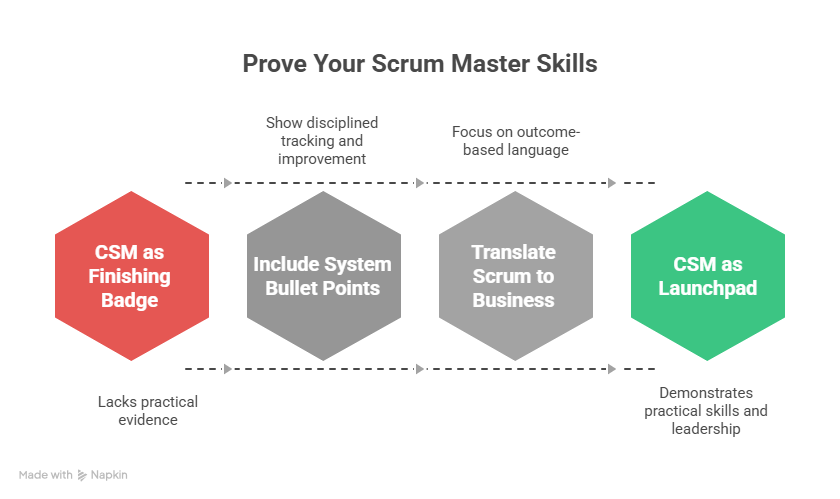
Here’s the uncomfortable truth: many applicants lose with CSM because they present it like a finishing badge. Employers read it like a starter credential unless you pair it with evidence.
Build a “Scrum Master proof pack” recruiters can visualize in 30 seconds
Include bullet points that imply systems:
Implemented WIP limits and improved flow metrics (cycle time / throughput) using disciplined tracking via issue tracking tools.
Created stakeholder decision logs and improved clarity using structured language from stakeholder terms and communication techniques.
Standardized reporting and delivery visibility through reporting & analytics software and dashboard visualization.
Built a documentation system so “Done” stayed done using document management and knowledge management tools.
Translate Scrum mastery into business language
Scrum language is internal. Hiring language is outcome-based:
“Reduced context switching” becomes “protected capacity and improved predictability.”
“Facilitated ceremonies” becomes “improved decision speed and reduced rework.”
“Removed impediments” becomes “created escalation paths that cut blocked time.”
This is why CSM is a launchpad, not an endpoint. The smart next step for many candidates is moving into Agile delivery leadership through Certified Agile Project Manager or expanding into a hybrid environment via hybrid PM trends.
5) Career Paths After CSM: Pick the Lane That Compounds Fastest
The best CSM outcomes happen when you use it to become “rare” in a specific way.
Lane A: Scrum Master → Agile PM / Consultant
If you can stabilize delivery across stakeholders and still keep teams healthy, you can grow into consulting. Follow the deliberate ladder in Scrum Master to Agile PM consultant. Then broaden capability with remote & virtual PM roles or an independent path like freelance PM careers.
Lane B: Scrum Master → Agile Coach
This path is about scale: you coach multiple teams, influence leadership, and change systems. Use the blueprint in the Agile Coach career path and strengthen leadership storytelling by studying how senior PMs climb via the entry-level to executive PM path.
Lane C: Scrum Master → Product-facing leadership
If you’re strong at alignment, backlog design, and value prioritization, build credibility through the Product Owner guide. This lane is powerful because it links delivery to value — something executives care about.
Lane D: Scrum Master → Portfolio + governance (later-stage)
If you want director/executive upside, you’ll eventually need governance and portfolio control. Study the ladders toward Project Management Director, VP of PM, and Chief Project Officer. This is also where hybrid delivery becomes unavoidable, so keep your strategy grounded in hybrid PM reality.
6) FAQs: Certified Scrum Master (CSM)
-
Yes — if you use it to prove you can stabilize flow and protect delivery. If you treat it like a badge, it becomes background noise. Pair it with proof assets (DoD/DoR, metrics one-pager, retro tracker) and show operational maturity using tools like issue tracking software and clear reporting via project reporting & analytics.
-
They memorize Scrum instead of learning failure modes: scope thrash, low-quality “Done,” stakeholder bypassing, and uncontrolled WIP. Great Scrum Masters build control systems and communicate using shared language from stakeholder terms and project communication techniques.
-
Create a sanitized “Scrum Master proof pack” from a real or simulated environment: operating rules, DoD/DoR, sample sprint goal library, retro tracker, and a flow metrics one-pager. Present it like a delivery system and store it cleanly using document management software plus knowledge management.
-
Pick a lane and compound: consulting via Scrum Master to Agile PM consultant, leadership via Agile Coach, or broader delivery scope via Certified Agile Project Manager.
-
Most organizations blend governance, fixed constraints, and Agile execution. Scrum is a layer — not the whole system. If you can bridge Scrum with planning constraints, you become far more valuable. Ground yourself in the market direction from hybrid project management’s future and stay aware of what’s changing in Scrum’s evolution by 2027.
-
Because hiring filters don’t reward certificates — they reward evidence. Rewrite your resume to show measurable outcomes (blocked time reduced, predictability improved, scope stabilized) and link your work to operational systems: tracking via issue tools, visibility via dashboards, and narrative via reporting & analytics.
