
Detailed Roadmap: How to Become a Chief Project Officer (CPO)
Becoming a Chief Project Officer (CPO) is not about “being the best PM.” It is about proving you can run enterprise delivery as a business system: portfolio bets, governance, capacity economics, risk, and outcomes. If you have been stuck at Senior PM, Program Manager, or PMO Director because leadership “isn’t sure you’re executive-ready,” this roadmap is built to fix that. You will leave with a clear progression path, the proof you need at each step, and the political and financial fluency that separates a delivery leader from a delivery worker.
Most people never reach CPO because they keep selling “execution.” Executives promote people who can protect strategy from chaos and turn delivery into predictable value.
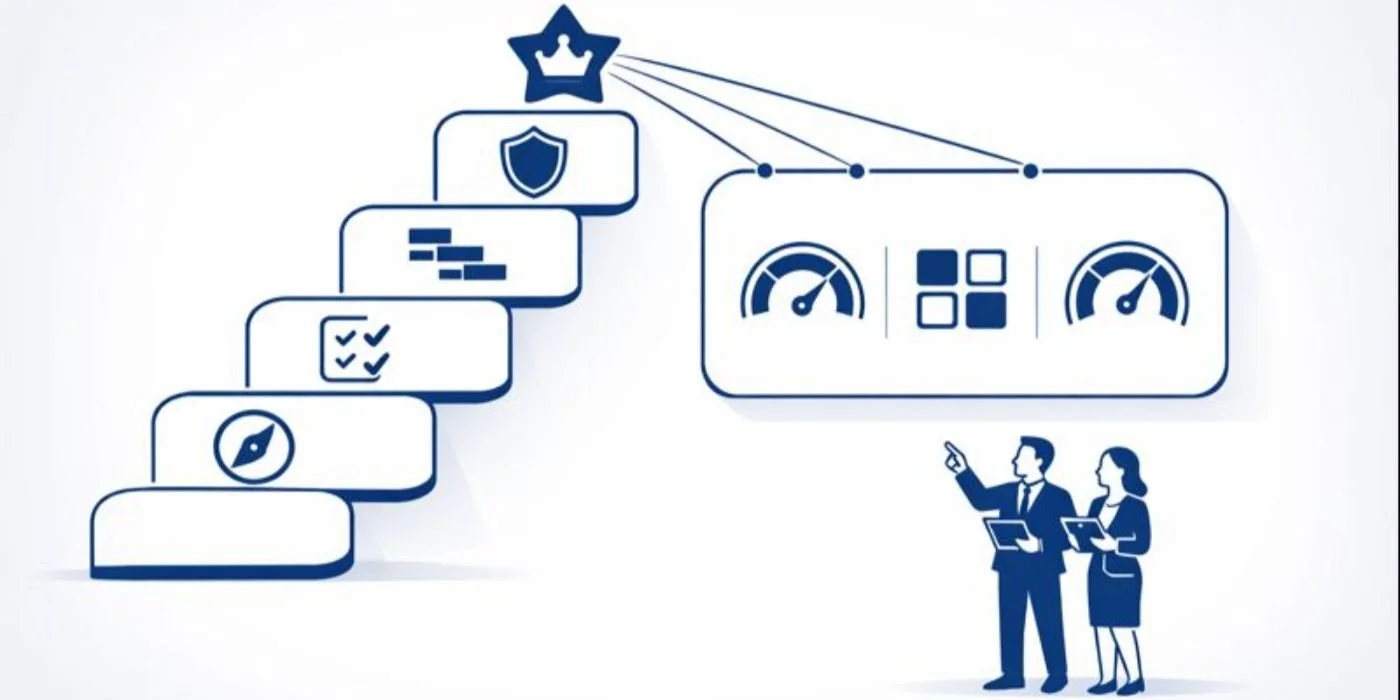
1) What a Chief Project Officer Really Owns (And Why Most PM Leaders Don’t Get Picked)
A CPO is the person leadership trusts to make delivery safe, profitable, and repeatable across the entire organization. That means you own the system that decides what gets funded, what gets killed, what gets delayed, and what gets accelerated. If you cannot talk in portfolio tradeoffs, you are not yet a CPO. If you cannot show how delivery choices change cash flow, risk exposure, or growth, you will get capped at “head of PMO” while another leader gets the seat.
At CPO level, your credibility comes from three things:
Enterprise throughput: you reduce stalled initiatives, dependencies, and rework by building a delivery operating system that scales (read: governance that speeds decisions, not committees). If your org is reorganizing or cutting roles, this becomes brutally visible, which is why executive teams lean on structured delivery frameworks during turbulence like major restructures and efficiency drives (see how orgs reshape delivery structures in moments like Microsoft cuts 6000 jobs and major internal resets such as Google implements new project management frameworks).
Portfolio governance: you ensure work is selected with discipline, resourced realistically, and measured with outcomes. If you have not mastered portfolio language, go deep on the future of PPM trends and what executives will demand from delivery leaders by 2030 in predicting the future role of the PMO.
Business impact conversion: you translate execution into economics. This is where many PM leaders lose the promotion. They track milestones, not value. If you cannot quantify forecast accuracy, burn, ROI confidence bands, and benefits realization, your “delivery success” is not executive-grade. Strengthen your strategic grounding with how modern leadership is evolving in future project management leadership styles and how governance itself is shifting in the future of project governance.
A CPO is also the person who can survive the politics without becoming political. You will routinely have to say “no” to powerful stakeholders, stop pet projects, and force clarity when teams want comfort. If your style is still “make everyone happy,” you will burn out or get sidelined.
Before you chase the title, calibrate your direction: CPO work increasingly blends methodologies and decision-speed, which is why understanding the next decade’s patterns matters, including project management 2030 dominant methodologies, the rise of hybrid project management, and what’s changing inside Scrum itself in predicting the evolution of Scrum.
| Stage | Target Scope | What “CPO-Ready” Looks Like | Proof / Metrics | Common Failure Pattern | Best APMIC Read |
|---|---|---|---|---|---|
| 1 | PM → Senior PM | Owns outcomes, not tasks. Runs stakeholders, decisions, and scope discipline. | Baseline vs actual variance; risk burn-down; rework reduction. | “Nice PM” who escalates too late. | Hybrid PM future |
| 2 | Senior PM → Program | Manages dependencies across teams; stabilizes delivery in ambiguity. | Dependency cycle time; delivery predictability; decision latency. | Planning theater with weak execution controls. | Estimation & scheduling |
| 3 | Program → Portfolio | Builds portfolio intake, prioritization logic, and kill-switch governance. | % projects stopped early; portfolio ROI confidence; capacity realism. | Funding everything, finishing nothing. | PPM trends |
| 4 | Portfolio → PMO Lead | Creates standards that accelerate delivery, not bureaucracy. | Time-to-decision; governance cycle time; template adoption outcomes. | PMO as “compliance police.” | Future PMO role |
| 5 | PMO → Director | Owns cross-functional delivery performance and executive reporting. | Portfolio throughput; critical path stability; escalation resolution time. | Reports activity instead of risk and value. | Governance trends |
| 6 | Director → VP Delivery | Runs delivery as an operating system: funding, capacity, risk, value. | Forecast accuracy; benefit realization; portfolio value protected. | Overpromising and under-resourcing. | Budget pressure |
| 7 | VP → Enterprise CPO | Owns enterprise change pipeline; aligns strategy to execution capacity. | Strategy-to-delivery alignment score; portfolio rebalancing speed. | Trying to “manage everything” personally. | Leadership evolution |
| 8 | Intake system | Defines what qualifies as a “project,” sets intake fields, and stops hidden work. | % work entering intake; shadow work reduced; triage SLA met. | Everything is “urgent,” nothing is prioritized. | PM software future |
| 9 | Prioritization | Uses scoring (risk, ROI, compliance, capacity) with transparent tradeoffs. | Reprioritization cycle time; stakeholder conflict reduction. | Ranking by politics. | AI impacts |
| 10 | Capacity economics | Builds capacity model: constraints, skills, utilization targets, buffers. | Utilization vs throughput; overtime trend; missed commitment rate. | High utilization, low output. | Career transformation |
| 11 | Benefits realization | Defines benefits owners, milestones, and value verification gates. | % benefits verified; value leakage reduced. | Benefits “assumed,” never measured. | Delivery at scale |
| 12 | Risk system | Runs enterprise risk register with escalation rules and leading indicators. | Risk detection lead time; avoided impact value. | Risks logged, not managed. | Future skills |
| 13 | Decision speed | Designs governance for fast decisions: thresholds, delegations, owners. | Decision latency; blocker aging. | Committee paralysis. | Governance best practices |
| 14 | Financial fluency | Understands CapEx/OpEx, NPV logic, and cost of delay. | Forecast variance; cost of delay tracked. | Business cases with fantasy numbers. | Finance + PM |
| 15 | Change enablement | Builds adoption plan tied to outcomes, not training attendance. | Adoption metrics; usage; retention; process compliance. | “We launched” ≠ “we changed.” | ESG delivery rise |
| 16 | Executive narrative | Reports in decisions: tradeoffs, risk exposure, value, and asks. | Exec escalations reduced; approvals faster. | Status updates with no point. | AI + exec reporting |
| 17 | Operating cadence | Runs a cadence (weekly/monthly/quarterly) that stabilizes delivery. | Cadence adherence; issue resolution cycle time. | Meetings that create noise. | Tooling evolution |
| 18 | Vendor control | Sets vendor governance, SOW clarity, and performance enforcement. | Vendor SLA; rework due to vendor; contract drift. | Vendors driving scope. | Traceability trends |
| 19 | Delivery talent | Builds PM career ladders, skill taxonomy, and coaching system. | Bench strength; promotion readiness; attrition reduction. | Hero culture. | Skills by 2030 |
| 20 | Portfolio rebalancing | Stops work early, reassigns capacity fast, resets priorities quarterly. | Stop/start velocity; sunk cost avoided. | Throwing good money after bad. | Market shifts |
| 21 | Complex programs | Runs multi-year transformation without losing control of dependencies. | Milestone reliability; scope churn; benefits preservation. | Transformation fatigue. | Mega-project lessons |
| 22 | Delivery during cuts | Rebuilds delivery structure when budgets and headcount shrink. | Throughput maintained; risk spikes controlled. | Cutting PMs, multiplying chaos. | Restructure playbook |
| 23 | Cross-industry lens | Understands sector-specific delivery pressures and compliance risk. | Fewer audit findings; faster approvals. | One-size-fits-all governance. | Renewables delivery |
| 24 | Regional credibility | Builds market awareness: salaries, employers, and opportunity mapping. | Pipeline strength; recruiter engagement; role-fit accuracy. | Applying blindly to titles. | NYC hub |
| 25 | Career positioning | Positions yourself as “enterprise outcomes leader,” not “PM leader.” | Exec interviews; internal sponsorship; board-level trust. | Resume reads like a task list. | Cert evolution |
| 26 | Methodology mastery | Chooses methods based on risk and constraints, not religion. | Reduced churn; fewer resets; higher predictability. | Agile theater vs real agility. | PM 2030 methods |
| 27 | Cert leverage | Uses certifications to fill gaps, not to “look qualified.” | Skill uplift; interview performance; system design credibility. | Collecting badges, lacking proof. | CAPM vs PMP |
| 28 | Strategic storytelling | Turns delivery history into executive-level “decisions and outcomes” stories. | Offer conversion; promotion committee confidence. | Too tactical in interviews. | Strategy fundamentals |
| 29 | Personal operating model | Runs your own system: learning, mentors, portfolio of wins. | Quarterly skills roadmap; measurable progress. | Random improvement. | Structured study |
| 30 | Promotion readiness | Secures sponsor, aligns to enterprise pain, and shows “why you now.” | Sponsor advocacy; clear mandate; measurable promise. | Waiting to be noticed. | PMO mandate |
2) The CPO Roadmap (The Exact Promotions You Need, And The Proof Each One Requires)
If you want the CPO seat, stop thinking in titles and start thinking in scope + proof. Most people fail because they chase “Director” but never build evidence that they can run a portfolio engine. Your mission is to stack wins that show you can manage (1) value selection, (2) value delivery, and (3) value verification.
Step 1: Move from “delivery execution” to “delivery outcomes”
At Senior PM and Program Manager level, you must become dangerous at controlling risk, dependencies, and decisions. Your best shortcut is to focus on the “invisible” constraints that kill delivery: delayed decisions, unclear owners, and unrealistic capacity. Build an operating cadence that measures decision latency and escalates it like a defect. If you cannot quantify this, executives won’t trust you with enterprise throughput.
To sharpen your methods, you need a practical view of what will dominate how work gets done over the next decade, especially hybrid execution patterns like the rise of hybrid project management and the model shifts in project management 2030 methodologies. CPO candidates don’t debate frameworks, they pick the method that reduces risk and increases throughput.
Step 2: Become a portfolio thinker before you become a portfolio owner
The most powerful career move is to volunteer for the painful work that nobody wants: prioritization fights, capacity constraints, and stopping projects. If you only run “approved” work, you are not yet trusted with the real CPO job, which is deciding what should never start. Master the logic of portfolio governance and trends through future of PPM and pair it with governance mechanics from future of project governance.
Here is how you build executive proof fast:
Build a lightweight intake system that catches “hidden work” and forces sponsors to define impact. This is critical in high-change environments and restructures (compare delivery stability pressures during major shifts like Google’s internal reorg framework changes).
Create a scoring model that forces tradeoffs: value, risk, compliance, and capacity.
Introduce a “kill gate” at 15–25% completion where benefits must be validated again. This is how you stop sunk-cost death marches.
Track benefit realization after launch, not just on launch day. CPO-level leaders protect value post-delivery.
Step 3: PMO leadership is not “more reporting,” it is system design
PMO leaders who get promoted to CPO are the ones who reduce noise and increase decision quality. They build governance that answers: who decides what, by when, and with what evidence. If your PMO’s output is dashboards nobody uses, you are not building the system that executives want. The seat goes to the person who makes the organization more predictable while moving faster.
Go deep on what the PMO mandate is becoming in future role of the PMO and the leadership patterns that will separate executive PM leaders from managers in future project management leadership.
3) Build a CPO-Level Delivery Operating System (PMO + PPM + Governance That Doesn’t Slow You Down)
A CPO’s real product is the operating system that runs delivery. That operating system has five components. If you cannot design these, you will always be “the PM leader,” not “the enterprise delivery executive.”
1) Portfolio intake that kills ambiguity
You need intake fields that force clarity: strategic objective, measurable outcome, benefit owner, constraints, risk exposure, and dependency map. Anything that cannot define value and ownership should not enter the portfolio. This is how you stop your org from spending months funding confusion.
2) A prioritization model people can’t argue with (because it’s transparent)
Executives hate black-box prioritization. They will argue less when the rules are visible: scoring, weightings, and thresholds. Your job is not to remove conflict. Your job is to make conflict productive and fast.
3) Capacity planning that matches reality, not fantasy
Most PMOs fail because they plan at 95–100% utilization and then act shocked when everything slips. CPO-level capacity models include buffers, skill constraints, and critical resource lock-in. If you want to get taken seriously at the executive level, your language must shift from “we need more people” to “here is the constraint, here is the throughput impact, and here is the cost of delay.”
If you want an edge here, study how estimation and scheduling will evolve through data-driven methods and automation in machine learning for estimation and scheduling and the broader tool direction in future of PM software. CPOs who can blend human judgment with evidence-based forecasting get trusted faster.
4) Governance that speeds decisions (delegations + thresholds)
Governance should not be “meetings.” Governance is decision design: who owns what decisions, what evidence they need, and what the timeline is. Use thresholds so teams don’t escalate everything. Make escalation rules strict so executives only see what matters.
This becomes essential in high-pressure environments where budgets tighten and layoffs hit delivery structures, like scenarios covered in Microsoft’s efficiency reshaping and leadership flattening moves such as Blue Origin workforce reduction targeting middle management. In those moments, decision speed is survival.
5) Benefits realization with ownership (no more “we launched” delusion)
Most portfolios “win” on delivery and “lose” in adoption. CPO readiness means you define benefit owners, track adoption leading indicators, and verify value. If value is not verified, your portfolio is just activity.
To build a modern edge, learn what organizations will demand from PM leaders as work becomes more automated in automation and AI transforming PM careers and how AI shifts executive expectations in AI and project management innovations by 2030.
4) Executive Influence That Gets You the Seat (Sponsors, Power Maps, And “Decision-Ready” Communication)
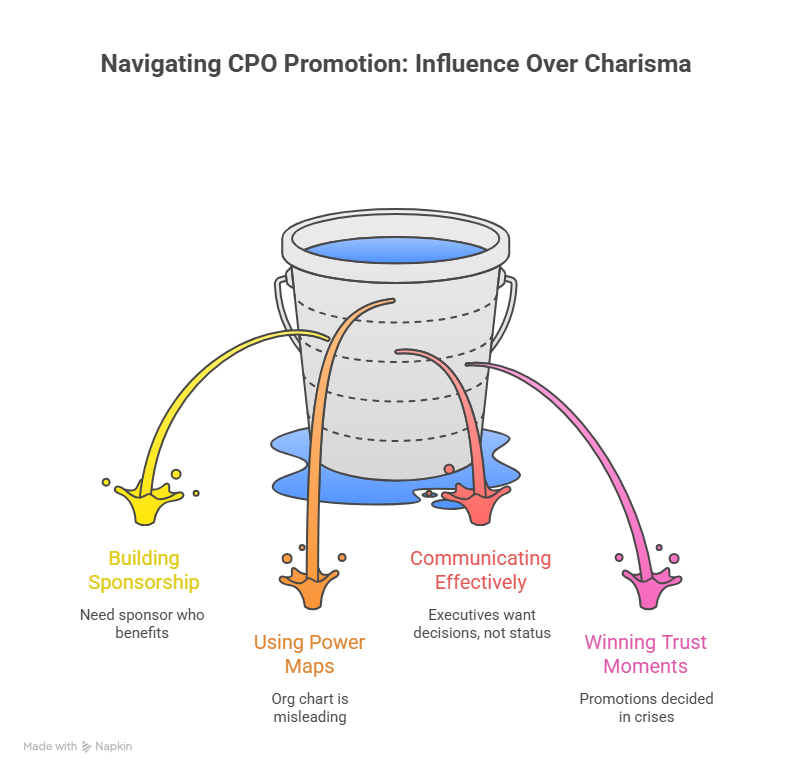
CPO promotion decisions are rarely “who is the best at delivery.” They are “who can be trusted to protect the enterprise from delivery risk while making the right bets.” That requires influence built on clarity, not charisma.
Build sponsorship like a portfolio, not a friendship
You need at least one executive sponsor who benefits from your delivery system working. The mistake is chasing a sponsor who “likes you.” You want a sponsor who needs what you can do: decision speed, portfolio clarity, and outcome verification.
A sponsor is earned through repeated moments where you:
Present a clear tradeoff and ask for a decision.
Reduce uncertainty with evidence, not optimism.
Kill weak work early to protect capacity for the real priorities.
If you want your communication to land at executive level, study how governance is changing in the future of project governance and how leadership itself must evolve for the next decade in future PM leadership styles.
Use a power map, not an org chart
CPO-level work crosses every boundary. The org chart lies. Your real map is:
Who controls funding?
Who controls the constraint resources?
Who can veto delivery?
Who owns benefits?
Who gets blamed when things fail?
When you know the real levers, you stop being “the PM leader who negotiates” and become “the delivery executive who structures decisions.”
Communicate in “decision packets”
Executives do not want status. They want:
What changed?
What risk is rising?
What decision is needed?
What happens if we delay?
What is the recommended path?
Tie this to economics. If you cannot express cost of delay, you will sound tactical. This is why reading about budgets under pressure matters, including inflation impact on project budgets. CPO candidates speak in constraints and consequences.
Win the “trust moments” that decide promotions
Promotions are decided in a handful of moments:
A crisis delivery situation.
A portfolio reset.
A major reorg.
A public failure that needs fixing.
If you can stabilize delivery in that moment, you become the default candidate. That is why real-world restructuring examples are valuable context, such as Blue Origin streamlining operations and large-scale delivery governance changes like Google’s framework shift.
5) The Fastest Accelerators: Skills, Certifications, And Strategic Career Moves (Without Wasting Years)
You do not become CPO by “waiting your turn.” You become CPO by building rare capability clusters that solve enterprise pain.
Skill cluster 1: Portfolio and governance architecture
This is the backbone. You must be able to design portfolio intake, prioritization, capacity planning, and governance thresholds. If you cannot do this, you are dependent on other leaders for “how the business runs delivery,” and you will not be trusted to own it.
Make your view modern by understanding where the field is going: future of PPM and future PMO role.
Skill cluster 2: Financial fluency and decision economics
CPOs get chosen because they can protect the business from bad bets. You need comfort with:
CapEx vs OpEx implications
NPV logic and assumptions
Benefits confidence bands
Cost of delay
Forecast accuracy
If you want a mental model for how finance-heavy delivery environments behave, study the domain pressures in financial services and project management.
Skill cluster 3: Modern tooling and automation leadership
Even if you do not “build AI,” executives increasingly expect delivery leaders to understand how automation changes planning, risk detection, estimation, and reporting. Learn the implications through AI and project management impacts by 2030, the tool direction in future PM software, and the career transformation shift in automation and AI transforming PM careers.
Certifications: use them to fill gaps, not to signal “ambition”
If you are early in the journey and need fundamentals, build structure with CAPM pathways like ultimate guide to passing the CAPM exam and sharpen your positioning by understanding CAPM vs PMP. If you want to anticipate what credentials will matter long-term, align to the market direction through evolution of PM certifications by 2030.
If your work environment is process-heavy and you need measurable improvement credibility, consider structured improvement frameworks like how to pass Six Sigma Green Belt. If you’re in agile-heavy environments and need stronger delivery leadership grounding, deepen methodology clarity through Scrum vs Agile certification comparison and the trajectory shifts in predicting the evolution of Scrum.
Strategic moves that shorten the timeline
If you want to accelerate to CPO readiness, aim for roles that give you:
Portfolio scope (not just projects)
Budget ownership (or influence)
Cross-functional dependency control
Benefits realization responsibility
Executive reporting exposure
If you are targeting markets with strong PM leadership demand, use location-based hub research to position yourself around employers and role clusters, such as project management careers in NYC, Chicago job market analysis, and Dallas Fort Worth PM market. CPO candidates don’t apply randomly. They choose environments where enterprise delivery leadership is valued and visible.
6) FAQs: Chief Project Officer (CPO) Roadmap Questions That Actually Matter
-
A Head of PMO often owns standards, reporting, and support. A CPO owns enterprise delivery outcomes, portfolio tradeoffs, and the system that decides what gets funded, stopped, and scaled. If your scope is “project execution quality,” you are closer to PMO leadership. If your scope includes portfolio value protection, capacity economics, governance thresholds, and benefits realization, you are moving into CPO territory. To build the right mental model, study how the PMO mandate is evolving in predicting the future role of the PMO and how governance is shifting in future project governance trends.
-
There is no clean average because the path depends on portfolio exposure. Someone who spends years managing single projects can stagnate, while someone who moves into program and portfolio scope earlier can accelerate. The fastest paths usually involve two jumps: (1) owning cross-functional dependencies at program level, then (2) owning prioritization, intake, and capacity decisions at portfolio/PMO leadership level. Your timeline shrinks when you collect proof of enterprise value decisions, not just delivery wins. Build future-facing capability by understanding future of PPM and PM 2030 methodologies.
-
Executives trust metrics that show predictability and value protection: forecast accuracy, decision latency reduction, dependency cycle time improvements, percent of projects stopped early to prevent waste, benefits verified post-launch, and capacity realism (utilization balanced against throughput). The biggest trust signal is when you can show how your governance improved speed and reduced risk without adding bureaucracy. Pair your reporting approach with frameworks from future project governance and the modern PMO mandate in future role of the PMO.
-
They stay trapped in execution identity. They talk about plans, timelines, and delivery methods, but cannot defend portfolio tradeoffs, economic assumptions, and benefits verification. Executives do not promote someone to run enterprise delivery if that person cannot speak the language of value protection. Fix this by building financial fluency and decision economics, then reinforcing it with portfolio systems thinking. Helpful context comes from budget pressure realities in inflation’s impact on project budgets and finance-heavy delivery environments in financial services and project management.
-
Certifications can help, but only when they fill a real gap. If you lack structured fundamentals, CAPM resources like passing the CAPM can build discipline. If you are choosing between paths, align based on your role trajectory using CAPM vs PMP. If you need stronger methodology decision-making, sharpen your framing through Scrum vs Agile certification and future changes in Scrum evolution. The CPO seat is won by proof and systems, not badges.
-
Enterprise proof is about complexity and value, not company size. You can build it by owning a cross-functional transformation that changes how work flows: a portfolio intake reset, governance redesign, benefits realization system, or capacity model rollout. The key is measurable outcomes: reduced decision latency, increased throughput, fewer stalled initiatives, and verified benefits. Also, smaller orgs can move faster, which gives you a clean before-and-after story. Modern tooling shifts make this easier, which is why understanding AI impacts on project management and future PM software helps you design smarter systems.
-
Stop listing “managed timelines” and start presenting executive-grade decision stories: the constraint, the risk exposure, the tradeoff options, the financial implications, the decision you drove, and the outcome verified later. Your resume should read like an operating model builder: portfolio governance, capacity economics, risk system, benefits realization, and executive reporting. Your interview stories should prove you can protect strategy from chaos. If you need structured credibility around how the field is evolving, anchor your narratives to trends like future PM leadership and evolution of PM certifications by 2030.
