
Waterfall Project Management Glossary: Clear Definitions & Examples
Waterfall project management still runs a huge share of serious delivery work, especially in environments where approvals, budgets, contracts, quality gates, compliance requirements, and sequencing discipline matter more than speed theater. The problem is that many project managers use Waterfall terminology loosely. They talk about scope, baselines, dependencies, milestones, and signoff as if those words are interchangeable. They are not. When the language gets sloppy, planning quality drops, reporting weakens, and overruns become easier to hide until they are expensive.
This glossary is built for professionals who need sharp command of Waterfall vocabulary in real settings, not just exam language. It explains the terms that shape scheduling, budgeting, procurement, quality, governance, communication, and stakeholder trust. It also connects Waterfall thinking to the wider APMIC library, including top 100 project management terms, project initiation terms, project scheduling terms, critical path method terms, and project risk management.
1. Why Waterfall Terminology Still Matters in High-Stakes Project Environments
Waterfall is often discussed as if it belongs to the past, yet the delivery realities of infrastructure, construction, regulated IT, public sector work, large procurement-heavy programs, enterprise transformation, vendor-managed implementations, and documentation-intensive initiatives keep it highly relevant. In these environments, sequence control is not a nice extra. It is the system that protects budget, quality, safety, contractual alignment, and executive accountability.
That makes terminology a control mechanism, not just vocabulary. A project manager who cannot clearly separate scope from requirements, milestone from deliverable, issue from risk, variance from change request, or assumption from dependency will create confusion at exactly the moments where clarity matters most. Teams suffer first, then stakeholders, then budgets.
Waterfall terminology also becomes critical when projects are judged through governance artifacts. Steering committees want milestone confidence. Sponsors want cost visibility. Procurement wants contractual compliance. Finance wants budget integrity. Quality teams want documented acceptance. Operations wants handover readiness. Each of those conversations depends on precise language tied to real project controls such as budgeting, cost management, procurement management, contract management, and project communication techniques.
This vocabulary also affects career growth. Hiring panels can tell quickly whether someone has managed delivery through stage gates, critical dependencies, formal approvals, vendor interfaces, and baseline control, or whether they only know modern project buzzwords. Professionals building toward PMP certification, CAPM certification, government PM roles, construction project management, or healthcare project management need stronger command of Waterfall language than many realize.
2. Foundational Waterfall Terms Every Project Manager Should Get Exactly Right
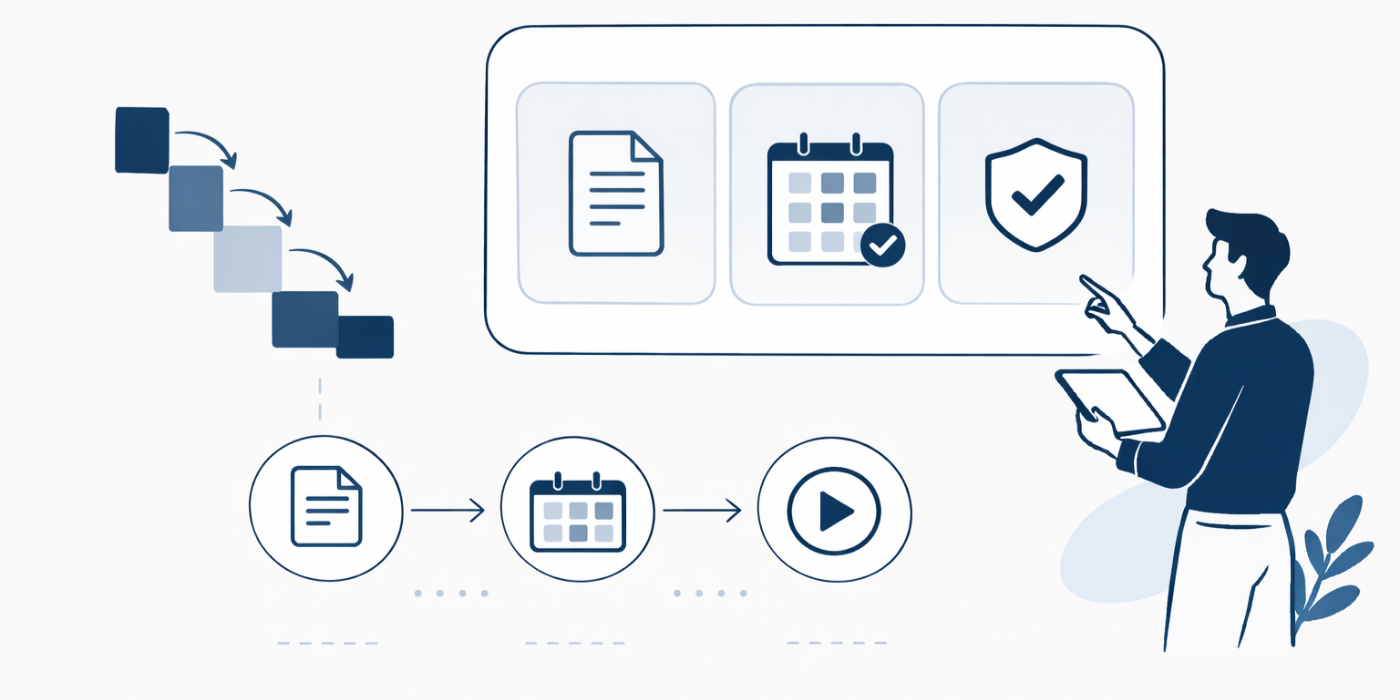
Waterfall is a project delivery approach built around defined phases that typically move in sequence: initiation, requirements, design, build, test, deployment, and closure. The value of Waterfall lies in structured planning, documented control, and phase-based discipline. It works especially well where deliverables need formal approval and where downstream work depends heavily on upstream clarity.
The project charter formally authorizes the project. It confirms the problem being solved, the sponsor, the initial authority structure, and the strategic reason the work exists. It is not the full execution blueprint. Project managers who overload the charter with too much planning detail create confusion about where true planning decisions live.
The scope statement defines what the project will deliver and what it will exclude. That second part matters. Many troubled projects drift through silent scope expansion because exclusions were never made explicit. Strong scope language helps protect requirements management, stakeholder expectations, change control discipline, and communication plans.
A requirement is a specific need that the project must satisfy. A deliverable is the actual output produced to satisfy those needs. A work breakdown structure, or WBS, decomposes the project into manageable components for planning, estimating, tracking, and ownership. This is one of the most important Waterfall artifacts because it connects scope to schedule, budget, resources, and accountability.
Phases and stage gates are also core Waterfall concepts. A phase organizes work logically. A stage gate determines whether the project is ready to move forward. Mature organizations do not treat stage gates as theater. They use them to stop weak design, incomplete approvals, missing documents, budget ambiguity, or unresolved risk from contaminating the next phase.
3. Scheduling, Dependency, and Baseline Terms That Control the Real Shape of a Project
Many project failures blamed on “execution” are actually schedule-architecture failures. The work looked reasonable on paper, but the sequencing logic was weak, the critical path was hidden, float was misunderstood, dependencies were not actively managed, and milestones were reported without enough diagnostic depth.
A milestone is a significant checkpoint, not just any completed task. Good milestone design gives executives visibility into decision points, phase transitions, or major output completions. Poor milestone design floods reports with noise and makes real slippage harder to spot.
A dependency exists when one task, team, decision, vendor, or deliverable relies on another. In Waterfall, dependencies often carry more risk than the individual tasks themselves, especially where design approval, procurement lead times, legal review, security signoff, or external vendor readiness shape the sequence. That is why strong Waterfall PMs care deeply about project procurement terms, contract management terminology, project scheduling concepts, and critical path method language.
The critical path is the longest sequence of dependent activities that determines the shortest possible project duration. Delay a task on the critical path, and the whole project end date may move. That makes critical path visibility one of the most important schedule-control concepts in Waterfall delivery.
Float is the amount of delay a task can absorb without moving the project finish date or another key milestone. Float is helpful, but it should never create false comfort. It can disappear quickly when multiple near-critical tasks slip at once.
A baseline is the approved reference point for time, scope, or cost. Without a real baseline, there is no honest variance analysis. There is only motion. Many weak projects appear calm because the baseline is casually revised every time reality goes off track. That behavior protects the report, not the project.
Strong Waterfall delivery usually improves when one weak control point gets fixed first: scope, schedule logic, change control, quality gates, or executive reporting.
4. Change, Risk, and Quality Terms That Protect Waterfall Projects From Slow Failure
A risk is a possible future event that could affect project objectives. An issue is a problem already happening. That distinction seems basic, but many teams blur it constantly. When they do, they weaken prioritization, ownership, and escalation. Risk conversations should remain forward-looking. Issue conversations should be action-driven and immediate.
An assumption is something accepted as true for planning. A constraint is a hard limitation, such as budget ceiling, regulatory deadline, or mandatory technology choice. Mixing assumptions and constraints leads to bad plans. An assumption may later prove wrong. A constraint shapes the plan from the start.
A change request is the formal mechanism used to alter an approved baseline. This is one of the most important Waterfall terms because it protects the project from invisible scope movement. Teams do not lose control all at once. They lose it in pieces, through “small asks,” rushed approvals, undocumented design shifts, and sponsor requests never translated into actual baseline impact. A serious Waterfall PM uses change requests to preserve traceability, budget honesty, and schedule realism.
The change control board, or CCB, reviews significant proposed changes. A healthy CCB asks: What is changing? Why? What are the impacts on cost, time, quality, risk, procurement, resources, and stakeholder commitments? A weak CCB just approves loudly requested items and leaves the PM to absorb the damage later.
Acceptance criteria, quality assurance, and quality control are often discussed as though they are one thing. They are not. Acceptance criteria define what good output must meet. Quality assurance focuses on the process used to prevent defects. Quality control checks the finished or in-progress output for conformance. Understanding the distinction strengthens project quality management, Six Sigma concepts, issue tracking, and document management practices.

5. Resource, Procurement, Reporting, and Closure Terms That Separate Controlled Projects From Messy Ones
A resource plan identifies the people, skills, equipment, and timing needed to execute the work. Waterfall projects often fail quietly when specialist capacity gets assumed rather than secured. Schedulers may build a clean-looking timeline that depends on subject-matter experts, external reviewers, testers, or procurement staff who were never realistically available. That is why resource planning must connect to team building terminology, human resource management terms, resource allocation tools, and project productivity systems.
A procurement plan defines how external goods or services will be acquired. In Waterfall settings, procurement timing can determine whether the entire schedule is realistic. Vendor selection, contract review, compliance checks, and lead times must be built into the schedule early rather than treated as administrative side work.
A status report should do more than summarize activity. Good reports tell decision-makers whether the project remains credible. They show milestone health, variance, major issues, emerging risks, forecast confidence, and decisions needed. They connect naturally to reporting software, dashboard tools, calendar tools, and knowledge management systems.
Signoff is formal approval that work meets its required standard. Weak signoff discipline creates future disputes, handover confusion, and blame loops when defects surface later. Formal signoff protects both the delivery team and the business.
Finally, lessons learned should not be treated as end-of-project paperwork. They are one of the few mechanisms organizations have for turning project pain into future capability. Captured well, they improve estimating, vendor strategy, governance design, dependency planning, and communication quality across the PMO.
6. FAQs About Waterfall Project Management Terms
-
Waterfall terminology is built around phase control, upfront planning, baselines, formal approvals, and sequencing discipline. Agile terminology focuses more on iteration, flow, incremental value, backlog management, and rapid adaptation. The language reflects different operating systems for delivery.
-
Yes, especially in environments that require formal approvals, controlled sequencing, strong documentation, procurement discipline, regulatory traceability, or milestone-driven governance. Waterfall remains highly relevant in many enterprise, construction, government, infrastructure, and compliance-heavy contexts.
-
Scope defines the boundaries of what the project will deliver and exclude. Requirements describe the specific needs, features, standards, or conditions that those deliverables must satisfy. Scope is broader. Requirements are more detailed and testable.
-
The baseline is the approved reference point used to measure variance. It protects reporting integrity. Without a stable baseline, schedule slips and budget drift become harder to quantify honestly, and project control weakens fast.
-
A milestone is a significant checkpoint or event in the schedule. A deliverable is an output the project produces. One marks progress. The other represents something concrete being delivered, reviewed, or accepted.
-
Formal change control protects the project from hidden scope growth, unrealistic expectations, and distorted reporting. It forces teams to evaluate the effect of a proposed change on cost, schedule, quality, risk, and stakeholder commitments before approval.
-
A risk is uncertain and may happen in the future. An issue is already happening and needs action now. Mixing the two creates poor escalation discipline and muddled ownership.
