
From Entry-Level to Executive: Ultimate Project Management Career Path (2026-27 Guide)
In 2026–27, “moving up in project management” isn’t about years served—it’s about the proof assets you can show on day one. Hiring panels (and promotion committees) reward PMs who can control scope, protect budgets, run governance, and communicate risk in a way that makes leadership feel safe. This guide maps the full ladder from entry-level to executive—and tells you exactly what to build at each stage so you’re not stuck doing “busy PM work” forever.
You’ll also get a competency matrix you can use as a checklist, plus a blocker-pain-point poll to diagnose what’s holding you back and what to fix next—fast.
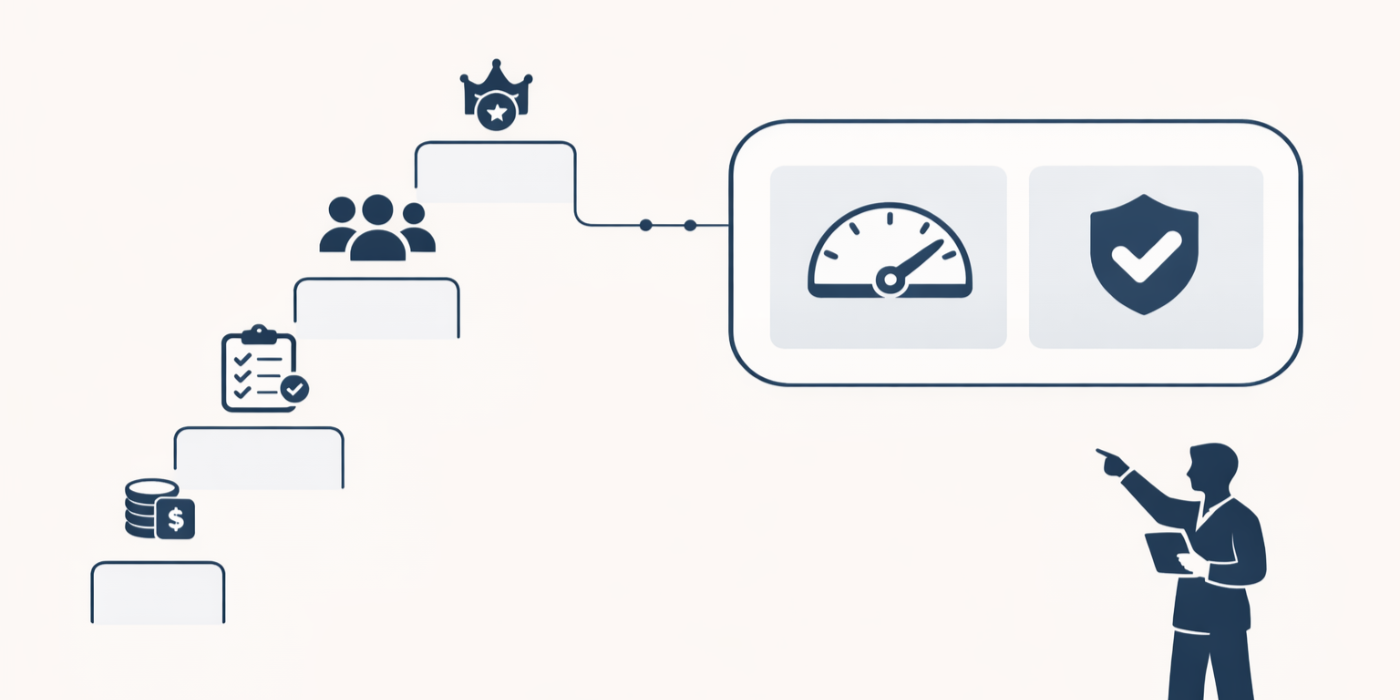
1. The 2026–27 PM ladder is really three ladders (and you must pick one early)
Most PM careers stall because people try to climb “the PM ladder” as if it’s one path. In reality, 2026–27 hiring splits into three tracks: delivery PM (ships outcomes), governance PM (controls risk, procurement, and approvals), and portfolio/executive PM (allocates capital and sets operating cadence). If you don’t choose a primary track, you’ll look “general” on paper—and general gets filtered out. Borrow clarity from specialized roadmaps like a government PM roadmap or a domain pivot guide like healthcare PM and then apply that structure to your industry. If your projects touch capital, vendors, or compliance, build your “control” story using procurement depth from procurement tools guidance and contracts perspective from CLM software reviews.
Here’s the uncomfortable truth: promotions are rarely about “being good at tasks.” They’re about reducing leadership anxiety. That means: no silent scope creep, no un-owned risks, no fuzzy reporting, no chaotic stakeholder comms. If you’re shaky here, fix it with “language + system” assets: learn stakeholder vocabulary via stakeholder terms, upgrade message discipline with communication terms + techniques, and standardize your cadence with a clean calendar layer using scheduling tools. Those aren’t “nice-to-haves.” They’re the foundation of credibility in panels that judge you in 30 seconds.
A strong career path is built like a portfolio: each level requires different proof. Entry-level proof is “I can run a clean system.” Mid-level proof is “I can ship outcomes and recover when things break.” Senior proof is “I can lead other PMs and build governance.” Executive proof is “I can allocate resources, set strategy, and manage enterprise risk.” If you want a concrete example of how specialization changes your story, compare your narrative to a vertical guide like construction PM and a market guide like California PM careers—you’ll notice the best candidates talk in outcomes, not duties.
2. Mid-level PM (2–6 years): become the person who ships and can prove it
Mid-level PMs get filtered out when they have experience but no measurable, defensible outcomes. “Delivered projects on time” is not proof. Proof is: what changed, how you measured it, what tradeoffs you drove, and what risks you prevented. Start building a “before/after” portfolio: 2–3 projects with a one-page case study each (problem → constraints → approach → decisions → metrics → lessons). If your portfolio is chaotic, tighten it with tool-backed evidence: use a lightweight issue tracking system and learn what panels expect from modern tooling with issue tracking software and structured planning via Gantt chart tools. Then make your execution visible with dashboards using data visualization tools and cleaner weekly packs using reporting & analytics.
At 2–6 years, you must master tradeoffs, not just coordination. Your interview stories should highlight moments where you chose between scope, time, cost, quality, and risk—then defended the decision. If you don’t have those stories, it usually means you were not in the room where decisions happened. Fix that by owning a governance cadence: pre-reads, decision memos, and escalation paths. The fastest way to sound senior is to speak in decision gates and stakeholder outcomes. Study how governance-heavy environments work through the lens of government PM skills and strengthen contract + vendor control using procurement tools plus CLM platforms.
You also need a specialization story, even if you’re “industry-flexible.” Pick one dominant context: healthcare, construction, software, infrastructure, public sector, or consulting. Specialization isn’t a cage—it’s a credibility shortcut. If you’re exploring healthcare, align your language to that space with healthcare PM. If you’re closer to capital projects, borrow positioning from construction PM. If you’re pursuing a flexible lifestyle narrative, shape your positioning with freelance PM or PM consultancy—but only if you can show proof assets and client-facing governance maturity.
3. Senior PM → Program Manager (6–12 years): scale complexity, govern risk, and lead other PMs
Senior roles are not “mid-level but bigger.” They’re fundamentally different: you’re now paid to manage organizational complexity. That means multi-workstream dependencies, executive-level reporting, and cross-functional conflict resolution without drama. Your proof assets shift from “I shipped” to “I kept the organization safe while shipping.” Build an exec-ready steering pack, clarify decision rights with RACI, and show that your risk management actually changes outcomes. If your reporting still looks like a wall of text, you’re not ready. Use modern tooling to communicate clearly: create a dashboard layer using visualization tools, support it with reliable metrics from reporting & analytics, and keep documentation audit-proof through document management and broader knowledge management software.
At this stage, you must be able to answer “How do you run governance?” with specifics: cadence, artifacts, escalation rules, and decision-making design. If you can’t explain how you prevent silent scope creep, leadership will assume you create it. Learn how strong PMOs operationalize systems by looking at “future-of-work” and “system-level PM” thinking found in trend pieces like future of PPM and method evolution like scrum changes by 2027. Even if you aren’t “Agile-only,” you must speak hybrid fluently; reference hybrid PM’s rise in how you choose governance based on risk, not ideology.
Senior progression often requires a location/market story too—especially if you’re aiming at a higher pay band or larger portfolios. If you’re targeting a specific market, study the employer and opportunity patterns via a state/city hub like New York PM careers or Texas PM careers. That kind of market awareness signals maturity because executives know talent and budgets vary massively by region—and they expect you to understand that reality.
4. Portfolio & enterprise impact (10–15+ years): move from “delivery” to “investment logic”
The jump to portfolio is where many strong PMs fail—because the job is no longer “manage projects,” it’s decide what not to do. Portfolio leaders get rewarded for capital allocation clarity: prioritization, sequencing, capacity tradeoffs, and kill/continue decisions with low emotion. If your experience is purely “we delivered what we were told,” you’ll look like a passenger, not a leader. Build a portfolio narrative: how initiatives were chosen, what got deprioritized, how value was measured, and how you handled benefit realization. For tooling and language, build your foundation with resource allocation software and portfolio trend literacy from future of PPM.
Executive audiences also expect clean visibility. That means less noise, more signal: top risks, top decisions, top constraints, and the “ask.” Upgrade how you present by adopting a dashboard-and-pack model using dashboard & visualization tools and high-quality storytelling through reporting & analytics. If you don’t have a strong documentation backbone, your portfolio claims will sound like opinions; fix that with document management and broader knowledge management. This is where executives decide whether you’re “credible” or “messy.”
2026–27 portfolio conversations also increasingly include: AI adoption, cybersecurity risk, economic uncertainty, and ESG constraints. You don’t need to be a technologist, but you must be able to govern these themes: how risk changes your stage gates, how AI changes operating cadence, and how compliance changes delivery sequencing. Build that literacy with trend context like AI adoption in project management and risk context like major cybersecurity concerns. Even if you’re not leading those programs, being able to discuss them calmly is a huge executive-signal advantage.

5. Director → VP → CPO (15+ years): the executive PM path is operating design + risk governance
At the executive tier, nobody cares that you can run Jira tickets or update schedules. They care whether you can design an operating system: governance rituals, decision rights, funding models, portfolio visibility, and talent standards. Your job becomes: reduce enterprise surprises, increase value delivery, and create repeatable performance. Use role-specific roadmaps to structure your narrative and proof: compare your trajectory to a PM Director roadmap, the step-up expectations in PM → VP of PM, and the enterprise delivery expectations in Chief Project Officer (CPO).
Executives are evaluated on portfolio outcomes, talent systems, and governance effectiveness. That means you need proof of: (1) operating cadence (quarterly planning, monthly steering, weekly exec review), (2) standards (templates, stage gates, definition of ready/done), (3) talent (career ladders, coaching systems, promotion readiness), and (4) risk (enterprise risk mapping, controls, auditability). If you’ve built a PMO, highlight the “system” you created—not the meetings you ran. If you’ve led transformation, quantify it: cycle time improved, risk realized reduced, quality improved, or cost avoided. Use thought-leadership context to frame why your system fits the next decade, referencing project management 2030 and why hybrid governance is becoming standard via hybrid PM’s rise.
If your path is more entrepreneurial (consulting, fractional PMO leadership, multi-client work), you must still show executive-grade governance. The difference is your proof assets need to demonstrate repeatability across contexts. Structure that narrative with guides like PM consultancy firm and freelance PM career, then add credibility through tools and systems: use automation tools for scalable reporting, productivity software for exec cadence, and mobile PM apps so your operating rhythm doesn’t collapse when you travel or context-switch.
Finally, executive interviews are won with three stories: (1) a turnaround (project in trouble → recovery → measurable outcome), (2) a system build (operating model created → adoption → results), and (3) a strategic tradeoff (what you stopped doing and why). If you can’t tell these with metrics and decision logic, you’ll be seen as a “strong PM” rather than an executive leader.
6. FAQs
-
Build a “trust system” portfolio: RAID log, change control, a weekly status template, and a decision log—then show how it reduced chaos. Pair that with sharper stakeholder language using stakeholder terms and cleaner messaging from communication techniques. If you can prove reliability and clarity, managers take the risk to promote you.
-
Your resume is likely duty-heavy and proof-light. Convert work into outcomes: baseline → change control → variance → resolution. Add a small “tooling credibility” layer with reporting & analytics tools and execution visibility through issue tracking software. Filters reward clarity and measurement.
-
Specialization is a credibility shortcut in 2026–27. Choose one anchor domain and speak its language. If you’re unsure, compare a domain roadmap like construction PM vs healthcare PM and notice how hiring expectations differ. You can still pivot later—but you need one strong identity first.
-
Senior PMs manage decision systems, not just delivery. They reduce decision latency, control escalation, and design governance that prevents surprises. If you want to build that executive signal, study governance-heavy environments like government PM and strengthen procurement/contracts understanding via procurement tools and CLM platforms.
-
Show tradeoffs and investment logic: prioritization criteria, capacity constraints, kill/continue decisions, and benefits tracking. Tools help make this credible—use resource allocation software and align your narrative with future PPM trends.
-
Demonstrate that you can scale standards and people: templates, playbooks, coaching, governance rituals, and measurable adoption. Then structure your narrative like the PM Director roadmap and support it with executive-grade visibility via dashboards & visualization tools.
-
VP-level interviews test enterprise risk, portfolio governance, and talent systems. Build your story around operating cadence + risk control, then align it to PM → VP of PM. You’ll be expected to talk about methodology choices in context—reference hybrid PM’s rise and the system-level future described in PM 2030.
