
Step-by-Step Career Guide to Becoming a Product Owner (Scrum Framework)
Becoming a strong Product Owner is not about “writing user stories” or “attending standups.” It is about turning business goals into a prioritized product direction the team can execute without confusion, churn, or constant rework. The best Product Owners reduce waste, sharpen decisions, and create momentum by aligning users, stakeholders, and delivery teams around what matters now.
This guide gives you a practical roadmap to become a Product Owner within the Scrum framework—covering skills, role progression, stakeholder management, backlog mastery, certifications, and career positioning. It is built for serious career growth, not surface-level theory.
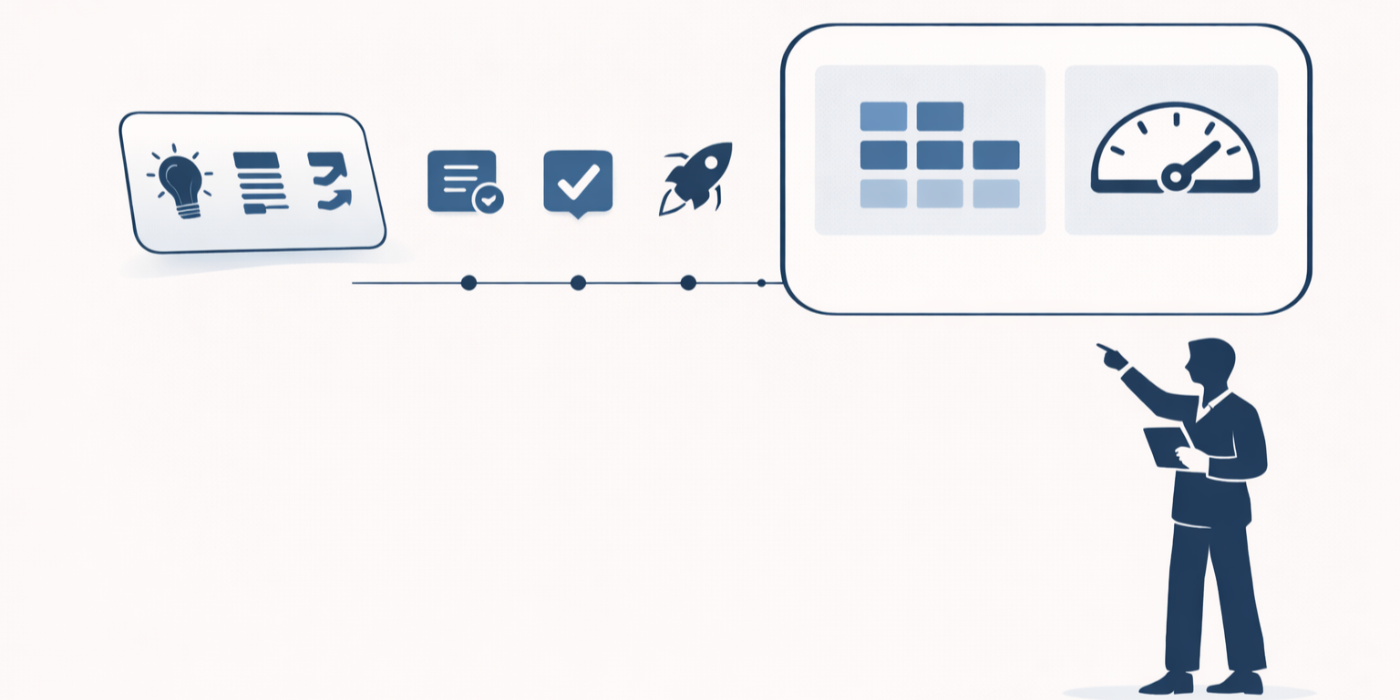
1) What a Product Owner Actually Does in Scrum (and Why Many People Misunderstand the Role)
A Product Owner (PO) is the person accountable for maximizing product value by managing priorities, clarifying outcomes, and shaping the product backlog so the team is always working on the highest-value work. In Scrum, the PO is not a “ticket admin” and not just a messenger between business and engineering. The PO is a decision-maker.
Many candidates misunderstand the role because they focus on tools and ceremonies instead of value decisions. They learn Scrum terms but struggle with the real work: sequencing, tradeoffs, stakeholder alignment, scope discipline, backlog quality, and release judgment. That is why some teams have “a Product Owner” but still ship late, overbuild, or build features no one uses.
If you are transitioning from project management, product support, business analysis, or Scrum Master work, this role can be a powerful move. Build context through how to become a project manager, complete guide to becoming a certified Scrum Master (CSM), detailed career path: how to become an agile coach, career roadmap from Scrum Master to agile project management consultant, and detailed career roadmap: becoming a certified agile project manager.
A great PO also benefits from understanding how product decisions affect delivery systems. Strengthen your systems view with rise of hybrid project management, future of project portfolio management (PPM), AI & project management innovations by 2030, and future of project management software.
2) Step-by-Step Career Roadmap to Become a Product Owner (Scrum Framework)
The strongest Product Owners do not “arrive” by title change alone. They build PO capability in stages: product thinking, backlog execution, stakeholder alignment, decision quality, and outcome ownership.
Stage 1: Build Scrum and product fundamentals
Start by understanding Scrum roles, events, artifacts, and why they exist. But do not stop at definitions. Learn how Scrum supports focus, feedback, and adaptation. Pair that with basic product thinking: users, problems, outcomes, and prioritization. Start with complete guide to becoming a certified Scrum Master (CSM), Scrum vs agile certification detailed comparison, PMI-ACP exam prep in 30 days, detailed career roadmap: certified agile PM, and predicting the evolution of Scrum by 2027.
Stage 2: Learn backlog mechanics that reduce team pain
This is where many aspiring POs fail interviews. They can describe Scrum, but cannot create a high-quality backlog. You need to practice:
writing clear stories,
defining acceptance criteria,
splitting large work into smaller increments,
sequencing dependencies,
removing vague requests,
clarifying value and urgency.
This skill gets stronger when you understand delivery tools and coordination patterns through top calendar & scheduling tools for project managers, best Gantt chart software solutions, top productivity software for busy PMs, best automation tools for project management efficiency, and top 15 project management mobile apps.
Stage 3: Build stakeholder and prioritization judgment
A PO’s real credibility comes from handling competing requests without losing team focus. You must become excellent at saying “not now” with logic instead of emotion. Learn prioritization frameworks, roadmap communication, and tradeoff narratives. This stage overlaps well with career path to a project management consultant, ultimate guide to starting a project management consultancy firm, detailed career guide to remote & virtual PM roles, future PM skills needed by 2030, and future of PPM trends.
Stage 4: Own outcomes, not just backlog updates
Once you can manage a backlog, the next leap is product ownership maturity: tying backlog decisions to outcomes. Track what shipped, why it shipped, what changed, and what improved (or failed). This makes your interviews stronger because you can show judgment, not just process participation. Improve your analytics and systems perspective with AI & PM innovation predictions, machine learning in estimation and scheduling, project knowledge management software guide, future PM software trends, and project management 2030 methodology forecast.
3) Skills Hiring Managers Look for in Product Owners (That Matter More Than Buzzwords)
Hiring managers do not just want “Scrum knowledge.” They want a Product Owner who reduces ambiguity and improves throughput without sacrificing product quality. The most painful teams to manage are not teams with low effort—they are teams with weak prioritization and unclear requirements. A strong PO fixes that.
The skill clusters that create real hiring leverage
1) Backlog quality and clarity
If engineering and QA constantly need re-explaining, your backlog is weak. Great POs create work items that are understandable, testable, and connected to user value.
2) Prioritization and tradeoff logic
Anyone can accept stakeholder requests. Strong POs rank them. You need a method: value, urgency, risk, dependency, confidence, and effort tradeoffs.
3) Stakeholder management without backlog chaos
Sales, support, leadership, compliance, operations, and engineering will all pull in different directions. Your job is not to please everyone; it is to maintain a credible prioritization system.
4) Communication and decision speed
Product teams slow down when POs go silent or stay indecisive. Timely answers, clear acceptance criteria, and focused sprint priorities are trust multipliers.
5) Outcome mindset
Hiring teams increasingly want POs who can connect backlog choices to outcomes and learning. This becomes even more important in growth, SaaS, platform, and transformation environments.
Build adjacent credibility through step-by-step guide to becoming a product owner (Scrum framework), detailed career path to agile coach, career roadmap from Scrum Master to agile PM consultant, complete guide to certified Scrum Master (CSM), and rise of hybrid PM.
4) Certifications, Training, and Professional Development for Aspiring Product Owners
Certifications can help you break into Product Owner roles, but they work best when paired with proof of backlog and prioritization skill. The mistake is collecting agile certificates while remaining weak at decision-making and backlog quality.
What helps most (and when)
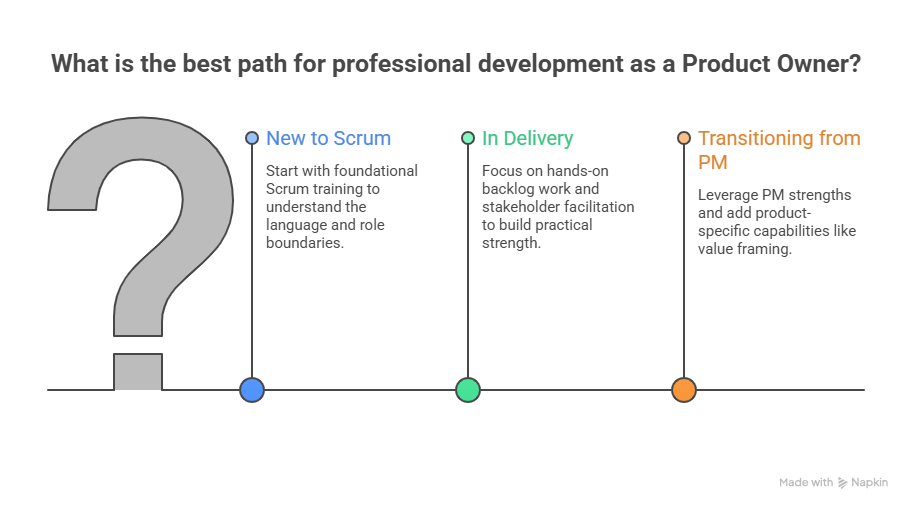
If you’re new to Scrum and product delivery:
Start with a recognized Scrum foundation path so you can speak the language correctly and understand role boundaries. Use complete guide to becoming a certified Scrum Master (CSM), Scrum vs agile certification comparison, PMI-ACP exam prep guide, and top 25 PMI-ACP exam questions.
If you’re already in delivery and want stronger PO readiness:
Your best development may be hands-on backlog work, stakeholder facilitation practice, and product decision case studies—not just more frameworks. Build practical strength using best software platforms for PM training, project knowledge management software, best mobile collaboration apps for project teams, top PM software for software development industry, and best customer relationship management (CRM) tools for PMs.
If you’re transitioning from project management into product ownership:
Lean on your PM strengths (stakeholder control, coordination, communication), but add product-specific capabilities: value framing, user problem discovery, prioritization logic, and iterative learning. Use how to become an IT project manager, project portfolio manager guide, future PM skills by 2030, AI innovations in PM, and future of PM software.
5) How to Get Hired as a Product Owner (Resume, Portfolio, and Interview Strategy)
Product Owner roles are often competitive because many candidates can talk about Agile, but fewer can prove decision quality. Your hiring strategy should make it obvious that you can prioritize, clarify, and align.
1) Rewrite your experience in Product Owner language
If you have been doing PO-like work under another title (business analyst, project manager, Scrum Master, implementation lead), translate it correctly:
“Prioritized backlog for X initiative across stakeholder requests”
“Defined acceptance criteria and release scope”
“Ran refinement sessions and aligned dependencies”
“Maintained roadmap communication with leadership”
“Used data/support feedback to re-sequence features”
Strengthen your career narrative with career path to a project management consultant, remote/virtual PM roles guide, project management director roadmap, PM to VP of PM path, and chief project officer roadmap.
2) Build a mini PO portfolio (this dramatically improves interviews)
Create sanitized examples of:
a prioritized backlog segment,
story before/after rewrite examples,
acceptance criteria examples,
roadmap slice with tradeoff notes,
stakeholder request log with prioritization rationale,
outcome review (what shipped, what changed, what you learned).
This portfolio proves you can do the role, even if your title has not caught up yet.
3) Prepare for the interview questions that actually matter
You will likely be tested on:
how you prioritize conflicting requests,
how you write/clarify requirements,
how you handle engineering pushback,
how you decide what goes into a sprint/release,
how you measure success,
how you communicate roadmap changes.
Use frameworks, but answer with real examples. Hiring managers trust specifics.
4) Target the right stepping-stone roles if needed
If direct PO roles are out of reach, aim for roles that build PO evidence:
Business Analyst (agile teams)
Associate Product Owner
Product Operations / Product Analyst
Scrum Master with backlog partnership exposure
Project Manager in software/digital delivery
Implementation/solutions roles with requirements ownership
You can also improve domain relevance via IT project manager roadmap, healthcare project manager guide, government project manager roadmap, international project manager guide, and freelance PM career roadmap.
6) FAQs About Becoming a Product Owner (Scrum Framework)
-
No. You do need enough technical fluency to understand constraints, dependencies, and delivery implications—but the PO role is primarily about value decisions, backlog quality, stakeholder alignment, and prioritization. Many excellent POs come from business analysis, operations, QA, support, and project management backgrounds.
-
The Product Owner is accountable for product value and backlog prioritization. The Scrum Master supports the team’s Scrum effectiveness, removes process impediments, and coaches the team and organization on Scrum practices. Both roles collaborate closely, but they solve different problems.
-
Yes—and it is a common path. Project managers often bring strong stakeholder management, coordination, and communication. The main gap to close is product thinking: problem framing, prioritization by value, and outcome ownership instead of only timeline/budget delivery.
-
Take ownership of backlog-related work in your current role: refine requirements, write clearer stories, define acceptance criteria, support prioritization decisions, and improve roadmap communication. Then document those contributions in PO language on your resume and portfolio.
-
Show evidence of prioritization and clarity: a backlog sample, story rewrite examples, acceptance criteria, roadmap tradeoffs, stakeholder request handling, and a short outcome review. Hiring managers want proof that you can make decisions and reduce ambiguity.
-
Scrum and agile certifications can help with credibility and screening, especially early on. But they are not enough on their own. Your strongest advantage comes from pairing training with real backlog artifacts, prioritization examples, and outcome-focused stories.
