
The Ultimate Guide to Getting Your Project Management Certification in Switzerland: All You Need to Know in 2026-2027
Switzerland rewards project managers who can handle precision, governance, multilingual stakeholders, regulated industries, and measurable delivery. A certificate helps, yet the real advantage comes from choosing the right credential for the Swiss market, then turning it into proof employers can trust. This guide shows how to plan your certification path, position your experience, avoid wasted study time, and build a profile that fits Zurich finance, Basel life sciences, Geneva international organizations, Swiss public projects, technology teams, construction programs, and consulting roles.
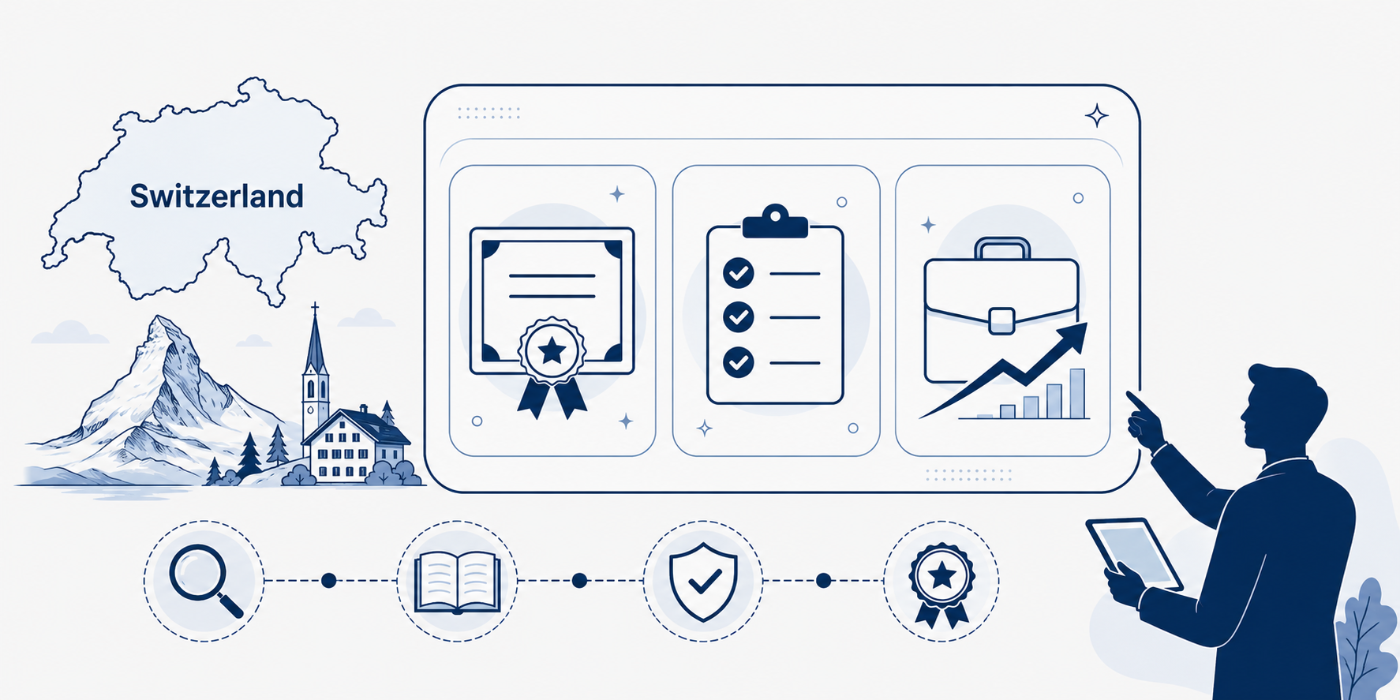
1. Why Switzerland Requires a Different Certification Strategy in 2026-2027
Getting certified for Switzerland should start with market fit. A general project management career roadmap helps you understand the baseline, while an entry-level to executive PM path shows how credentials support progression. Switzerland adds another layer: hiring managers expect disciplined planning, cost control, risk visibility, stakeholder documentation, vendor coordination, and clear governance. A credential can open the interview, yet your examples must prove you can operate in a country where regulated delivery, quality expectations, and cross-functional alignment matter.
Your certification choice should connect to sector demand. Zurich and Geneva often value governance, finance, risk, vendor control, and stakeholder reporting, so guides on project financial management terms, risk registers, and stakeholder engagement become practical preparation tools. Basel life sciences and healthcare delivery reward documentation strength, quality discipline, and change control, which makes a healthcare project manager roadmap and ISO standards glossary useful even when your official exam is PMP, CAPM, PRINCE2, Agile, or Scrum.
Switzerland also punishes vague career positioning. “Certified PM” alone sounds weak. “PMP-ready project manager with vendor governance, regulated documentation, budget tracking, and multilingual stakeholder coordination” sounds Swiss-market ready. Build that language through the project management consultant career path, the IT project manager roadmap, the construction PM guide, and the international project manager guide. Swiss employers want certification plus evidence, and that evidence must look organized before anyone meets you.
| Capability | What “Good” Looks Like | Swiss Business Impact | Certification / Proof Asset | APMIC Resource |
|---|---|---|---|---|
| Certification fit | Credential selected by role level, industry, delivery method, and Swiss employer expectations. | Prevents months of study going toward the wrong career signal. | PMP, CAPM, PRINCE2, Scrum, or Agile decision note. | Certification trends |
| Eligibility mapping | Experience months, training hours, project examples, and application evidence prepared before exam booking. | Reduces rejected applications, weak claims, and rushed rewrites. | Eligibility worksheet and project inventory. | PMP exam domains |
| Governance cadence | Steering rhythm, decision gates, escalation routes, and ownership rules are clear. | Builds trust in regulated, executive-facing, and multi-stakeholder projects. | Governance pack and RACI. | Project governance |
| Scope control | Baseline, acceptance criteria, change log, approvals, and trade-off decisions are documented. | Protects timelines and budgets in a high-cost Swiss delivery environment. | Change register and scope statement. | Execution terms |
| Risk discipline | Risks have probability, impact, owners, triggers, mitigation actions, and review dates. | Shows maturity before issues become expensive executive surprises. | Risk register sample. | Risk registers |
| Vendor control | RFP clarity, SOW discipline, SLA tracking, vendor escalation, and acceptance criteria are visible. | Critical for consulting, IT, construction, and outsourced delivery. | Vendor tracker and SOW checklist. | Vendor management |
| Procurement fluency | Bid timelines, evaluation matrices, contract constraints, and approval gates are understood. | Reduces friction with procurement, legal, finance, and external suppliers. | RFP calendar and bid scorecard. | RFP, RFQ, RFI terms |
| Budget control | Cost baseline, forecast, variance, earned value view, and change impact are tracked. | Supports finance-heavy Swiss hiring conversations. | Budget tracker and EVM snapshot. | EVM terms |
| Stakeholder mapping | Influence, decision rights, communication needs, resistance points, and cadence are mapped. | Essential for multilingual, multi-site, and cross-border project environments. | Stakeholder map. | Stakeholder engagement |
| Reporting clarity | Status updates show risks, decisions, dependencies, milestones, blockers, and owner actions. | Helps sponsors act quickly instead of asking for clarification later. | Weekly status report template. | Reporting terms |
| Hybrid delivery | Waterfall governance is blended with Agile execution where uncertainty is high. | Fits Swiss IT, transformation, banking, and regulated delivery teams. | Hybrid delivery model. | Hybrid PM |
| Agile fluency | Backlog health, sprint goals, capacity, reviews, metrics, and release plans are handled confidently. | Builds credibility in software, fintech, SaaS, and digital product roles. | Backlog and sprint review sample. | Agile glossary |
| Scrum credibility | Accountabilities, ceremonies, impediments, stakeholder reviews, and improvement loops are clear. | Helps candidates enter Swiss digital delivery and product teams. | Scrum operating model. | Certified Scrum Master |
| Product ownership | Backlogs are outcome-driven, prioritized, testable, and connected to release trade-offs. | Strong for fintech, SaaS, medtech, and internal platform teams. | Product backlog sample. | Product Owner guide |
| Resource planning | Capacity, allocation, dependencies, skill gaps, and escalation options are visible. | Prevents hidden overload across matrix teams and specialist departments. | Resource plan. | Resource allocation |
| Schedule control | Critical path, float, dependencies, milestones, and recovery options are maintained. | Supports predictable delivery in expensive talent and supplier markets. | Gantt and milestone plan. | Gantt charts |
| Recovery planning | Fast-tracking, crashing, descoping, resequencing, and approval logic are understood. | Shows calm control when timelines slip or sponsors demand options. | Schedule compression memo. | Schedule compression |
| Quality mindset | Acceptance criteria, defect flow, audit trail, checks, and sign-off logic are built into delivery. | Essential in pharma, healthcare, engineering, construction, and public projects. | Quality checklist. | TQM terms |
| PMO alignment | Templates, standards, dashboards, portfolio reporting, and governance compliance are followed. | Important for banks, insurers, pharma groups, and large multinationals. | PMO reporting pack. | Future PMO role |
| Portfolio thinking | Benefits, prioritization, dependencies, capacity, and value trade-offs are understood. | Moves a PM toward senior Swiss roles and strategic delivery work. | Portfolio prioritization matrix. | Portfolio manager guide |
| Leadership maturity | Decisions, conflict, trust, executive communication, and accountability are handled professionally. | Separates coordinators from accountable delivery leaders. | Leadership evidence log. | Leadership terms |
| Conflict handling | Issues are framed with options, decision owners, escalation routes, and documented agreements. | Protects momentum across vendors, sponsors, and cross-border teams. | Conflict resolution case note. | Conflict resolution |
| AI readiness | Automation supports reporting, risk signals, documentation, estimation, and schedule insight. | Relevant for 2026-2027 transformation and PMO modernization hiring. | AI-enabled reporting workflow. | AI and PM |
| Tool fluency | Tools are selected by workflow, stakeholder visibility, governance model, and reporting needs. | Prevents tool-heavy, process-light delivery. | Tool selection scorecard. | PM templates |
| Remote delivery | Async updates, decision logs, meeting hygiene, and digital documentation are consistent. | Supports Swiss multinational and distributed teams. | Remote delivery operating rhythm. | Remote PM roles |
| Consulting posture | Delivery gaps are diagnosed, governance is designed, improvement is sold, and outcomes are tracked. | Useful for Swiss consulting, contracting, and advisory opportunities. | Consulting case study. | PM consultancy firm |
| Credential upkeep | PDUs, learning plan, renewal calendar, and professional development are planned early. | Keeps certification useful after passing the exam. | PDU plan. | PMP renewal |
| Interview proof | Answers include context, decision, trade-off, measurable outcome, and learning. | Turns certification into credible hiring evidence. | STAR story bank. | PMP success stories |
2. Which Project Management Certification Makes the Most Sense in Switzerland?
PMP is usually the strongest general-purpose credential for experienced project managers who already lead projects, manage stakeholders, and handle delivery accountability. It pairs well with Swiss finance, pharma, IT transformation, consulting, engineering, and multinational roles because it signals broad delivery maturity. Use the PMP exam domains guide, PMP exam preparation resources, common PMP exam mistakes, and PMP renewal guide to build a path that covers application, study, exam performance, and long-term credential value.
CAPM makes sense for early-career candidates, coordinators, analysts, operations professionals, and career switchers who need a recognized foundation before applying for junior PM roles. Pair CAPM-level learning with the entry-level PM career guide, the complete project manager roadmap, the project execution glossary, and the monitoring and control terms guide. The pain point here is simple: many candidates study theory, then submit resumes that still sound administrative. Your resume must show ownership of schedules, risks, issues, suppliers, stakeholders, and documentation.
PRINCE2 is valuable for candidates targeting structured governance environments, European employers, public-sector-style delivery, or organizations that emphasize controlled stages, business justification, and defined roles. It can sit beside PMP rather than compete with it. PMP proves broad project leadership; PRINCE2 proves method discipline. To strengthen that positioning, study waterfall project management terms, project closure concepts, project reporting best practices, and project governance trends. This combination helps you speak the language of control, assurance, benefits, and decision gates.
Agile and Scrum certifications matter when your target roles involve software, product delivery, cloud migration, digital banking, medtech platforms, enterprise systems, or cross-functional transformation. A Swiss digital employer will care less about buzzwords and more about backlog quality, sprint predictability, stakeholder reviews, and release outcomes. Build the foundation with the Certified Scrum Master guide, the Agile project manager roadmap, the Agile coach career path, and essential Agile metrics.
For senior professionals, certification should support a bigger story: portfolio value, PMO influence, strategic alignment, executive governance, and measurable business outcomes. A PMP with strong delivery history can progress toward project portfolio manager, project management director, vice president of PM, or chief project officer positioning. Switzerland’s high-cost employment market makes senior hiring unforgiving; vague “team leadership” claims should become portfolio, budget, governance, benefits, and transformation evidence.
3. How to Prepare for Certification Without Burning Months on the Wrong Work
Start with a certification decision sheet. Write your target role, target industry, current experience, eligibility status, strongest project examples, weakest knowledge areas, and proof assets. Then choose one main credential and one support layer. For example, an IT transformation candidate may choose PMP plus Scrum; a public-sector delivery candidate may choose PRINCE2 plus stakeholder governance; a life sciences candidate may choose PMP plus quality and risk documentation. Use the IT PM roadmap, healthcare PM guide, government PM roadmap, and construction PM career guide to map credentials to sector expectations.
Build a project inventory before you apply or study deeply. For each project, record objective, budget range, timeline, team size, stakeholders, delivery approach, risks, issues, vendor dependencies, governance, outcomes, and lessons learned. This inventory becomes exam application material, interview fuel, resume proof, and LinkedIn content. It also exposes weak spots. Many candidates think they lack experience; they actually lack documentation. Study project reporting terms, risk mitigation terms, earned value terms, and resource allocation concepts while converting your own history into evidence.
Create a 10-week study plan with weekly output, not just reading targets. Week one should define the exam blueprint and baseline score. Weeks two to six should cover domains, terminology, scenario thinking, and practice questions. Weeks seven to eight should focus on full mocks and error logs. Weeks nine to ten should sharpen weak areas, review formulas, and rehearse timing. Use PMP prep resources, PMP exam mistakes, Agile estimation techniques, and Scrum glossary terms to avoid shallow memorization.
Your pain points deserve direct handling. If English exam wording slows you down, practice scenario questions daily and build a glossary. If your background is coordination-heavy, rewrite responsibilities into decisions, risks, dependencies, and outcomes. If your Swiss resume gets ignored, add quantified delivery results, tool fluency, and industry proof. If your experience is outside Switzerland, position it through international stakeholder management, regulated delivery, vendor control, remote coordination, and governance. The international project manager guide, remote PM roles guide, freelance PM roadmap, and PM consultancy firm guide help turn non-local experience into portable credibility.
4. How to Turn Certification into Swiss Hiring Proof
A certificate should create interview confidence, salary leverage, and recruiter clarity. That requires proof assets. Build a one-page project case study that shows the business problem, constraints, stakeholders, delivery method, risks, decisions, tools, and measurable result. Then create a small portfolio with a risk register, change log, stakeholder map, status report, and project plan. The best project management templates guide, Gantt chart terms guide, project reporting guide, and stakeholder engagement glossary give you the language to package those assets cleanly.
Swiss hiring conversations often test your judgment before your technical knowledge. A recruiter may ask about a delayed vendor, a sponsor conflict, a budget risk, or a team working across locations and languages. Your answer should include the decision you made, the trade-offs you considered, the evidence you used, the stakeholder route, and the outcome. Strengthen these stories with vendor management terms, conflict resolution terms, schedule compression terms, and monitoring and control concepts.
For Zurich finance, emphasize governance, data, controls, stakeholder reporting, risk, compliance, and delivery assurance. For Basel pharma, emphasize quality, documentation, regulatory sensitivity, change control, and cross-functional coordination. For Geneva organizations, emphasize international stakeholders, procurement, donor or institutional reporting, vendors, and multicultural communication. For Swiss construction and infrastructure, emphasize schedules, contractors, permits, safety coordination, change control, and cost visibility. Use financial services and PM predictions, healthcare PM career guidance, government PM career guidance, and construction software tools to tune your examples.
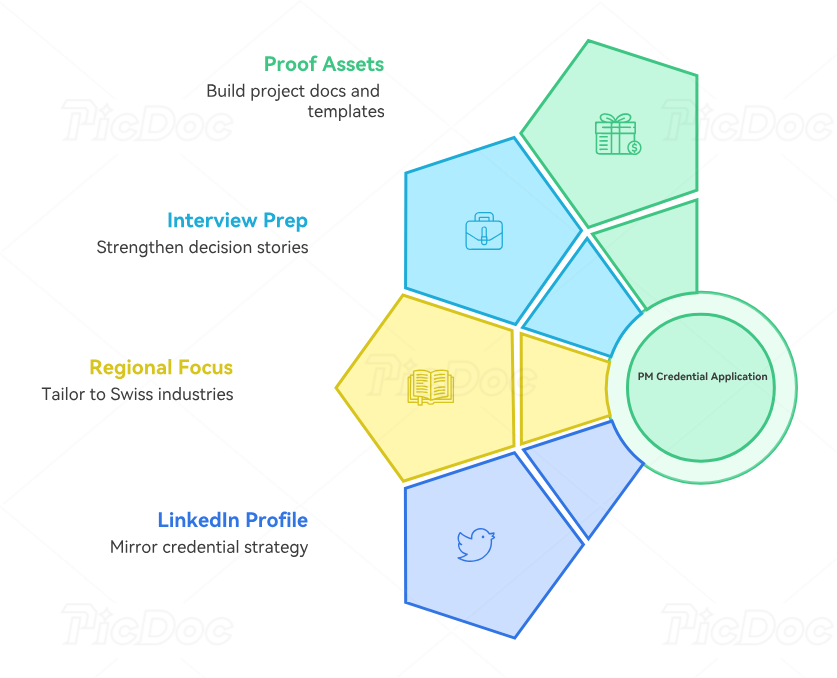
Your LinkedIn profile should mirror the same strategy. The headline should show credential path plus domain, such as “PMP Candidate | IT Transformation | Risk, Vendor, and Stakeholder Governance.” The About section should include project scale, industry context, delivery approach, and measurable outcomes. Featured content can include a sanitized project case study, a certification milestone, a lesson from your mock exams, or a short post on hybrid delivery. Support this with future PM skills, AI adoption in project management, digital transformation PMO trends, and automation in PM careers.
5. A 90-Day Roadmap to Get Certified and Become More Hireable in Switzerland
Days 1 to 10 should be about diagnosis. Pick your target Swiss role, target industry, certification route, study timeline, and proof portfolio. Audit your experience against requirements, then create a gap list. Read the complete PM career roadmap, compare it with the international PM guide, review future certification trends, and use PMP exam domain guidance if PMP is your main route. The goal is clarity before commitment.
Days 11 to 35 should produce your study system. Set a weekly schedule, choose resources, build flashcards, and begin scenario practice. Create an error log that classifies mistakes by concept, wording, timing, and confidence. Candidates fail when they read passively and avoid feedback. Use PMP preparation resources, PMP mistake guidance, Agile estimation techniques, and Kanban PM terms to combine exam knowledge with practical fluency.
Days 36 to 60 should add portfolio proof. Build five sanitized assets: a project charter, risk register, stakeholder map, status report, and change log. Add one case study that shows a real delivery problem and measurable improvement. This is where certification becomes career capital. Use the PM templates guide, risk register glossary, stakeholder engagement guide, and project financial management glossary to make each asset sharp.
Days 61 to 75 should focus on mock exams, interview stories, and resume revision. Run timed practice, review every wrong answer, and rewrite your CV bullets around outcome, scale, constraint, and leadership. Add Swiss-market keywords only where you can prove them: governance, vendor management, risk, budget, quality, stakeholder reporting, multilingual teams, regulated delivery, Agile, hybrid, PMO, portfolio. For role-specific positioning, use the IT PM roadmap, project management consultant guide, portfolio manager guide, and PM director roadmap.
Days 76 to 90 should move from preparation to market action. Schedule the exam when mock results are stable, update LinkedIn, send targeted applications, contact recruiters, join relevant PM communities, and prepare a short explanation of why your certification path fits Swiss delivery needs. Keep learning visible through PDUs, events, templates, case studies, and practical posts. Use the PMP renewal guide, remote PM career guide, freelance PM roadmap, and PM consultancy firm guide to keep your next step active after certification.
6. FAQs About Getting Project Management Certification in Switzerland
-
PMP is the strongest broad option for experienced project managers because it supports finance, IT, pharma, consulting, engineering, and multinational delivery roles. CAPM fits early-career candidates. PRINCE2 fits governance-heavy and European-style environments. Scrum or Agile certifications fit software, product, and digital transformation roles. The best choice depends on your target job, so compare the project manager roadmap, Agile PM roadmap, Certified Scrum Master guide, and certification trends guide before choosing.
-
PMP can strengthen your profile, yet Swiss hiring teams still expect proof of delivery maturity. You need a CV and interview story that show risk control, stakeholder management, vendor coordination, budget awareness, reporting discipline, and measurable outcomes. Add proof assets using the risk register guide, vendor management guide, project reporting guide, and earned value management terms.
-
Choose PMP when your goal is broad project leadership across industries, especially when you already manage teams, budgets, schedules, risks, and stakeholders. Choose PRINCE2 when your target environment values structured governance, controlled stages, defined roles, and business justification. Many candidates benefit from PMP plus PRINCE2 awareness. Strengthen the decision by reviewing waterfall PM terms, project governance guidance, project execution terms, and project closure concepts.
-
English can support many multinational roles, especially in Zurich, Geneva, Basel, Lausanne, and global companies. Local language ability can still improve trust, stakeholder access, and hiring competitiveness, especially in client-facing, public, construction, healthcare, or regional roles. Position language honestly and emphasize cross-cultural delivery. Use the international PM guide, remote PM guide, stakeholder engagement guide, and leadership communication terms to sharpen your profile.
-
A disciplined candidate can often prepare in 8 to 12 weeks, depending on experience, exam choice, study hours, and baseline knowledge. The real mistake is studying without an error log, mock exam rhythm, or application strategy. Use PMP preparation resources, PMP exam mistake guidance, Agile estimation guidance, and Scrum glossary terms to make preparation active.
-
Build a small evidence portfolio: project case study, risk register, stakeholder map, status report, change log, budget tracker, vendor tracker, and governance summary. These assets help you answer interview questions with structure and confidence. They also make your certification feel applied rather than academic. Use PM templates, resource allocation terms, schedule compression terms, and project monitoring and control terms.
