
Understanding Sprint Planning: Essential Terms & Definitions
Sprint planning is where a Scrum team either creates controlled momentum or quietly plants the seeds of the next sprint’s confusion. When this event is weak, teams leave with bloated commitments, half-understood work, invisible dependencies, and a goal so vague that daily coordination turns into scattered status sharing. The damage rarely announces itself on day one. It shows up later as churn, missed commitments, rushed work, and stakeholders asking why the sprint looked full but delivered so little.
This guide explains the essential sprint planning terms and definitions every serious PM should know, but it does more than define them. It shows how those terms shape commitment quality, backlog readiness, estimation clarity, capacity realism, and team focus. Along the way, it connects sprint planning language to APMIC resources on Scrum roles, project communication, risk management, project scheduling, and issue tracking.

1. Why Sprint Planning Vocabulary Matters More Than Most PMs Think
Sprint planning is often treated as a routine calendar event where the team pulls work from the backlog and gets moving. That shallow view is exactly why so many sprints begin with false confidence. Sprint planning is where intent, capacity, clarity, and delivery logic have to align at the same time. A PM who does not understand the core terms of this event will misread readiness, overestimate feasibility, and confuse a busy sprint with a well-planned one. That confusion spills into project management terms, project initiation logic, project scheduling language, and critical path thinking.
The language of sprint planning matters because each term carries a control function. Sprint Goal protects focus. Capacity protects realism. Backlog refinement protects planning quality. Definition of Done protects the integrity of commitment. Acceptance criteria protect shared understanding. Story points protect relative estimation without forcing false precision. Once those terms are misunderstood, sprint planning becomes a crowded negotiation instead of a disciplined planning event.
A strong PM also knows that sprint planning sits at the intersection of delivery pressure and decision quality. Stakeholders want more included. Teams want less ambiguity. Product wants value moved quickly. Leadership wants predictability. Sprint planning terms help the PM translate those competing pressures into a coherent decision structure. Without them, the team starts using dangerous phrases like “we’ll figure it out during the sprint,” “it should be fine,” “let’s just add it,” or “we can probably squeeze this in.” Those phrases are not flexibility. They are warning signs. Mastering sprint planning vocabulary improves execution across stakeholder management, project reporting, resource allocation, and project quality management.
| Term | Practical Meaning | Why It Matters | Common PM Mistake | What Good Looks Like |
|---|---|---|---|---|
| Sprint Planning | The event where the team decides why, what, and how for the sprint. | Sets the sprint foundation. | Treating it as ticket allocation only. | Goal, scope, and plan align clearly. |
| Sprint Goal | The single objective the sprint should achieve. | Creates focus and tradeoff clarity. | Planning without one coherent objective. | All selected work supports the goal. |
| Product Backlog | Ordered list of future product work. | Feeds sprint selection. | Pulling work from a stale backlog. | Backlog is refined and value-ordered. |
| Sprint Backlog | Selected work plus the delivery plan for the sprint. | Makes commitment visible. | Thinking it is only a task list. | Includes items and the path to delivery. |
| Product Owner | Role accountable for maximizing value. | Drives prioritization quality. | Letting others dilute backlog order. | Value decisions are clear and owned. |
| Developers | People who do the work needed to create the increment. | Own sprint feasibility. | Excluding delivery voices from planning. | Execution contributors shape the plan. |
| Scrum Master | Role that supports Scrum effectiveness. | Protects the planning process. | Using the role as a meeting host only. | Improves planning quality and clarity. |
| Capacity | The team’s realistic available effort for the sprint. | Prevents overcommitment. | Ignoring leave, support load, or meetings. | Capacity reflects actual availability. |
| Velocity | Historical measure of completed work. | Supports forecasting. | Using it as a guarantee. | Used as an input, not a promise. |
| Story Points | Relative estimate of effort, complexity, and uncertainty. | Helps compare items. | Converting points directly into hours. | Used relatively, not literally. |
| Backlog Refinement | Ongoing clarification of upcoming work. | Improves planning quality. | Waiting until planning to clarify everything. | Ready items enter planning with useful detail. |
| Definition of Done | Shared standard for what complete means. | Protects delivery credibility. | Planning work the team cannot finish properly. | Selected items can reach true completion. |
| Definition of Ready | Optional criteria showing an item is ready for planning. | Reduces avoidable ambiguity. | Using it as bureaucracy instead of clarity. | Enough detail exists to make a sound decision. |
| User Story | Small user-centered requirement. | Improves value framing. | Bringing vague or oversized stories into planning. | Stories are clear, testable, and small enough. |
| Epic | Large body of work needing decomposition. | Helps organize bigger outcomes. | Dragging epics into a sprint unchanged. | Epics are broken into workable slices. |
| Acceptance Criteria | Conditions required for item approval. | Defines completion expectations. | Planning without clarity on done conditions. | Criteria are visible and testable. |
| Dependency | A reliance on another item, team, or decision. | Exposes execution risk. | Ignoring dependencies in commitment decisions. | Dependencies are surfaced before commitment. |
| Impediment | A blocker or drag on delivery progress. | Reveals flow threats. | Planning around known blockers without ownership. | Impediments have response paths. |
| Increment | Usable piece of product value produced in the sprint. | Connects planning to outcomes. | Planning activity instead of increment logic. | Sprint selection supports a coherent increment. |
| Forecast | The team’s best current expectation of what can be done. | Keeps commitment realistic. | Presenting a forecast as certainty. | Forecast is evidence-based and revisited honestly. |
| Commitment | What the team intends to achieve in the sprint. | Shapes accountability. | Committing to volume instead of goal. | Commitment reflects focus and feasibility. |
| Task Breakdown | Conversion of backlog items into actionable work steps. | Improves delivery visibility. | Leaving complex work unbroken until mid-sprint panic. | Enough breakdown exists to expose effort shape. |
| Planning Horizon | The time scope considered during planning. | Prevents long-range noise in sprint decisions. | Dragging future uncertainty into current commitment. | Focus stays on the sprint window. |
| Spillover | Work not finished in the prior sprint. | Signals planning or execution weakness. | Normalizing repeated spillover. | Spillover is investigated, not shrugged off. |
| Stretch Goal | Additional work attempted if capacity remains. | Allows optional upside. | Stuffing stretch work into core commitment. | Clearly separated from must-do items. |
| Risk Flag | Indicator that an item carries execution uncertainty. | Improves commitment quality. | Planning risky work as routine work. | High-risk items are called out openly. |
| Team Availability | Actual time contributors can spend this sprint. | Protects against fantasy plans. | Ignoring support work and parallel obligations. | Availability is calculated before commitments. |
| Ready Queue | Backlog items refined enough for sprint consideration. | Makes planning cleaner. | Entering planning with thin options. | A healthy queue of ready work exists. |
2. Core Sprint Planning Terms Every PM Should Be Able to Use Correctly
The first term to understand properly is Sprint Planning itself. This event is not a backlog download session and not a calendar ritual where the team agrees to be busy for two weeks. Sprint planning answers three essential questions: why is this sprint valuable, what can be done this sprint, and how will the selected work get done. When those questions are handled well, the sprint begins with usable alignment. When they are handled badly, the team walks into execution carrying hidden contradictions. That is why sprint planning should be studied alongside project communication techniques, risk terminology, stakeholder terms, and issue tracking discipline.
The Sprint Goal is the anchor of the event. A team can complete many items and still have a weak sprint if the work never forms a coherent outcome. The Sprint Goal creates focus and helps the team make better tradeoff decisions once the sprint is underway. If unplanned work appears, if a dependency slips, or if one story becomes larger than expected, the team can still ask whether the Sprint Goal is being protected. Without that anchor, planning becomes volume-driven instead of purpose-driven.
The Product Backlog and Sprint Backlog are also frequently misunderstood. The Product Backlog is the ordered list of future work. The Sprint Backlog is the work selected for the sprint plus the team’s plan for delivering it. A PM who treats the sprint backlog as just a copied slice of the product backlog is missing the operational core of sprint planning. The sprint backlog should reflect not only selection but delivery logic, coordination, and a path toward a usable increment.
Then there are the planning participants. The Product Owner brings value prioritization. The Developers bring execution realism. The Scrum Master supports Scrum effectiveness and helps the event stay healthy. If any of these roles is weak in planning, the sprint starts with distorted commitments. That is why strong PMs also sharpen their understanding through Scrum roles and responsibilities, team building terminology, project reporting practices, and knowledge management tools.
3. Readiness, Estimation, and Scope Terms That Shape Sprint Commitment Quality
A large share of sprint planning problems begin before the event even starts. That is where backlog refinement becomes critical. Refinement is the ongoing effort to clarify, split, size, and prepare upcoming work. Teams that skip this discipline usually waste sprint planning time on confusion that should have been removed earlier. Items enter planning oversized, vague, dependent on unknowns, or missing acceptance logic. The team then either commits recklessly or spends the meeting trying to do emergency analysis live. Good PMs know that strong sprint planning depends on strong preparation. That same habit strengthens project scheduling, quality planning, document control, and project automation.
Definition of Ready can help with this when used carefully. It is not a mandatory Scrum artifact, but many teams use it as a practical filter for whether backlog items are ready to be considered in sprint planning. The danger is turning it into bureaucracy. The benefit is making sure the team is not forced to commit to items that still lack enough clarity for a smart decision. A PM should view readiness as a planning quality tool, not as a ritual.
Story points and velocity also shape commitment quality, but only when used correctly. Story points estimate relative effort, complexity, and uncertainty. Velocity reflects historical completion patterns. Neither should be treated as a mechanical guarantee. Teams get into trouble when velocity becomes a quota or story points become disguised time estimates. That pressure leads to false confidence, gaming, and poor planning conversations. PMs who understand this protect the team from metric misuse and make better use of project analytics tools, dashboard platforms, resource allocation tools, and project productivity software.
Acceptance criteria deserve special attention too. Teams often plan around titles rather than true content. A story sounds manageable until the team unpacks what has to be true for it to be accepted. If acceptance criteria are weak, the sprint gets loaded with work that looks small but is actually wide, politically sensitive, or test-heavy. Good PMs insist on clarity before commitment. That protects delivery and reduces the rework that often appears later disguised as “final adjustments.”
4. Capacity, Dependency, and Commitment Terms That Prevent Overloaded Sprints
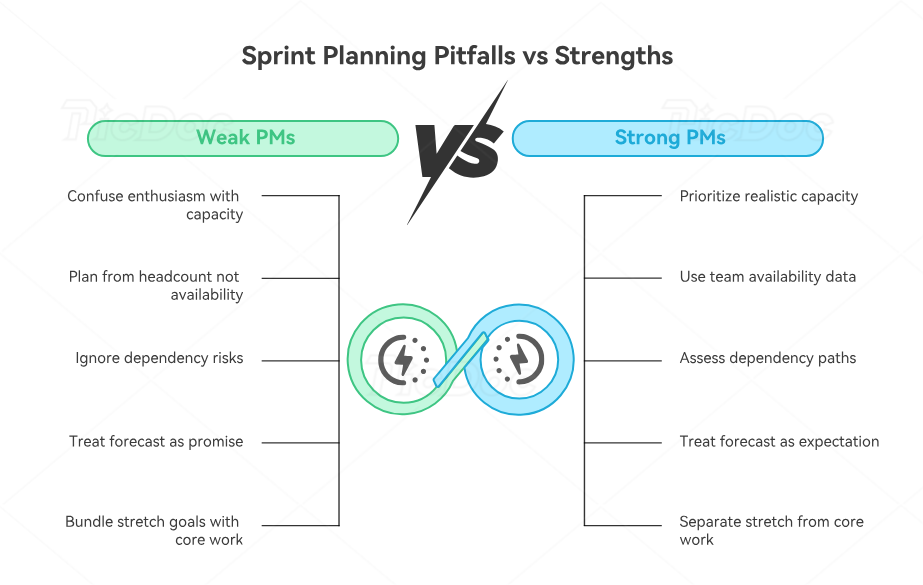
One of the most dangerous sprint planning mistakes is confusing enthusiasm with capacity. Capacity means the team’s realistic available effort for the sprint. It should account for leave, support obligations, operational work, meetings, handoffs, and other interruptions. Teams that ignore those factors create “paper capacity” that looks strong and fails immediately once real life starts pressing on the sprint. PMs who understand capacity thinking usually perform better in resource planning, calendar and scheduling management, mobile coordination tools, and collaboration apps.
Team availability is the raw input behind capacity. Availability is not the same as headcount. A five-person team with fragmented availability may plan worse than a three-person team with protected focus. PMs who plan from headcount instead of availability repeatedly create overloaded sprints and then act surprised when spillover becomes routine.
Dependency is another planning term that gets ignored until it causes disruption. Dependencies can sit inside the team, across teams, with vendors, with decision-makers, or with technical environments. A backlog item that looks small in isolation may become a bad sprint candidate if its dependency path is fragile. Strong PMs do not just ask whether a story is estimated. They ask whether it is actually runnable inside this sprint. That is where planning maturity becomes visible. It also connects to procurement management, contract management, issue tracking software, and project software selection.
Then there is the term forecast. In Scrum, the sprint backlog is a forecast of what the team believes it can complete. That word matters. Forecast is evidence-based expectation, not certainty. PMs damage planning culture when they transform a forecast into an inflexible promise. That pressure pushes teams toward defensive estimation and shallow commitments. A better approach is to maintain honesty: this is what the team expects to achieve based on current information, current capacity, and current understanding of the work.
Finally, stretch goal is useful only when it is clearly separated from core commitment. Teams get into trouble when optional work gets quietly bundled into expected work. That turns ambition into hidden overload. Strong PMs create clarity around what is central to the sprint and what is merely possible if conditions stay favorable.
5. Advanced Sprint Planning Terms That Improve Delivery Focus and Reduce Chaos
The most overlooked sprint planning term may be increment. Planning is not just about filling the sprint with items. It is about moving the product toward a usable outcome. If the selected stories do not combine into a coherent increment, the sprint may still be active but strategically weak. PMs who understand increment logic ask sharper questions during planning. They look for connected value, not only estimated volume. That mindset improves the use of quality management terms, project reporting systems, PM software features, and Agile tool effectiveness data.
Task breakdown is another important planning term. Teams do not always need a perfect micro-plan before the sprint starts, but they do need enough breakdown to expose whether the work shape is realistic. If a story remains a black box after selection, the sprint has already inherited uncertainty it may not be able to absorb. Good task breakdown reveals whether the work is front-loaded with analysis, heavy in testing, dependent on external review, or vulnerable to specialist bottlenecks.
Spillover is a term teams often normalize when they should be investigating it. Carryover work from one sprint to the next is not always catastrophic, but repeated spillover is a structural signal. It may indicate weak refinement, inflated commitments, undercounted support load, unstable priorities, or quality debt that keeps expanding the true size of planned items. Mature PMs treat spillover as a planning diagnostic, not as routine background noise.
Planning horizon also matters. Sprint planning should focus on the sprint window, not get hijacked by every future uncertainty. Teams sometimes clutter the event with debates that belong in roadmap, release, or portfolio conversations. Keeping the planning horizon clean helps the team make stronger near-term decisions while still staying aligned to broader product direction.
Finally, strong PMs understand that sprint planning quality is cumulative. One bad session may create a messy sprint. A repeated pattern of weak sessions creates declining trust, rising fatigue, constant recovery work, and a team that feels perpetually behind. That is why learning sprint planning terms deeply pays off far beyond the ceremony itself.
6. FAQs: High-Value Questions About Sprint Planning Terms and Definitions
-
The most important sprint planning terms are Sprint Goal, Product Backlog, Sprint Backlog, capacity, velocity, story points, backlog refinement, acceptance criteria, Definition of Done, dependency, forecast, commitment, increment, spillover, and task breakdown. These terms control whether the sprint begins with clarity or confusion. They also connect directly to Scrum roles, project communication, risk management, stakeholder handling, and quality management.
-
The forecast is the team’s evidence-based expectation of what it can complete during the sprint. Commitment is the seriousness with which the team intends to pursue the Sprint Goal and selected work. Trouble begins when leaders interpret the forecast as absolute certainty rather than informed expectation.
-
Experience does not fix weak intake quality. Teams still struggle when backlog refinement is thin, acceptance criteria are vague, dependencies are hidden, or capacity is overstated. Many planning failures happen before the meeting begins, then become visible only after execution starts.
-
Velocity should be treated as one planning input, not a target to force and not a performance ranking. It helps teams forecast based on prior completion patterns. Once velocity becomes a management score, teams stop estimating honestly and planning quality drops.
-
Planning too much work around weakly defined items is one of the worst mistakes. It creates the illusion of ambition while quietly guaranteeing churn, confusion, and spillover. Weak planning usually looks energetic at the start and expensive by the end.
-
The strongest follow-up reads are Essential Scrum Roles & Responsibilities Explained Clearly, Top 100 Project Management Terms You Must Know, Comprehensive Project Risk Management Glossary, Essential Project Communication Terms & Techniques, Comprehensive Guide to Project Scheduling Terms, and Definitive Guide to Project Issue Tracking Software. Together they sharpen the exact execution muscles that make sprint planning effective under pressure.
