
Career Roadmap for a Government Project Manager: Skills, Certifications & Salaries
Freelance is one thing. Government is a different game.
Public-sector delivery runs on compliance, traceability, and decision gates, not vibes. If you want a stable career with serious project scale, long program horizons, and impact you can point to, government PM is a strong lane. But you only win if you understand how hiring works, what skills matter, which certifications actually signal competence, and how pay bands and budgets shape your options.
This roadmap shows the real path from entry to senior government PM, without fluff.
1) What a Government Project Manager Really Does (And Why It’s Harder Than Private Sector)
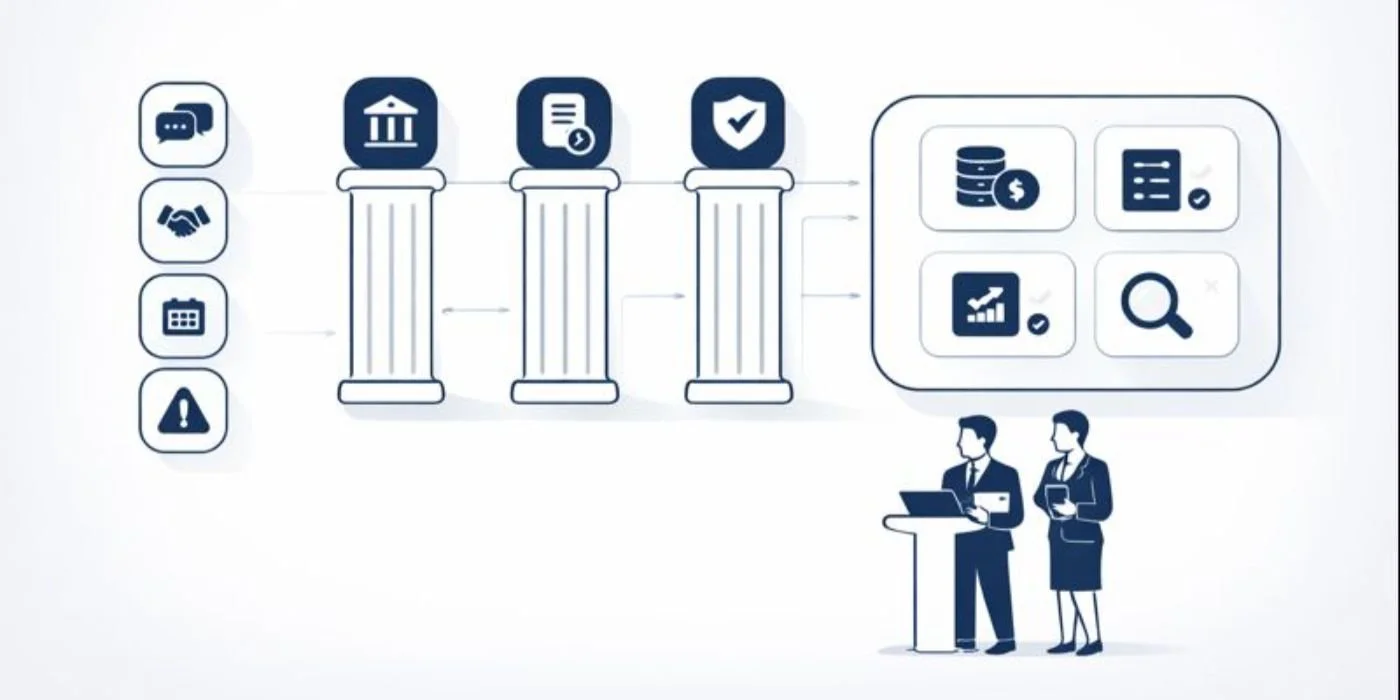
A government project manager is a delivery leader operating inside constraints most private companies never face. You are accountable to procurement rules, public transparency, formal governance, and audits. That changes how you plan, how you communicate, and how you choose tools. The “win condition” is not only shipping, it is shipping with evidence, approvals, and defensible decisions aligned with governance expectations similar to the future of project governance and the evolving role of the PMO.
Most candidates underestimate the real difficulty. It is not writing a plan. It is protecting the plan from slow approvals, vendor constraints, and shifting political priorities while still maintaining delivery momentum using modern practices like hybrid project delivery models and the strategic skill profile described in future PM skills for 2030.
Government PM roles vary by domain. You might manage technology modernization, infrastructure programs, healthcare systems, public safety initiatives, education rollouts, or climate and sustainability programs. Those sectors map directly to market shifts like the future of project management in construction, the growth of renewable energy delivery programs, and budget pressure patterns described in inflation’s impact on project budgets.
If you want to break in faster, anchor yourself in high-demand regions and hiring ecosystems by studying local market dynamics from APMIC’s career hubs like New York City opportunities, Los Angeles demand signals, Chicago salary and job market patterns, and Dallas Fort Worth employer trends.
| Capability | What “Good” Looks Like | Business Impact | Signals / Tools | Who You Align With |
|---|---|---|---|---|
| Requirements control | Clear baseline, traceable changes, signed approvals, no “silent scope.” | Fewer overruns | Requirements log, change register | Business owner, legal |
| Governance cadence | Decision gates, escalation rules, meeting design built for approvals. | Faster decisions | Steering pack, RACI | Exec sponsor, PMO |
| Procurement fluency | Understands bid timelines, evaluation, contract constraints, vendor levers. | Fewer delays | RFP calendar, SOW checklist | Procurement, contracts |
| Budget discipline | Tracks burn, obligations, variance, and funding gates without drama. | Spend control | Forecast model, variance report | Finance, grants |
| Risk management | Leading indicators, mitigation owners, weekly updates, escalations early. | Lower exposure | RAID log, trend alerts | Security, compliance |
| Schedule realism | Critical path visible, buffers justified, dependencies owned. | Predictability | Milestone map, CPM view | Delivery leads |
| Stakeholder mapping | Knows who can block, who must approve, who must be reassured. | Less resistance | Stakeholder heatmap | Public affairs, HR |
| Public accountability | Documentation is audit-ready and decisions are explainable. | Lower audit risk | Decision log, evidence pack | Audit, governance |
| Vendor management | SLAs, deliverable acceptance criteria, change control enforced. | Better outcomes | SLA dashboard, acceptance check | Vendor, contracts |
| Compliance delivery | Knows controls, privacy, records retention, and approval constraints. | Fewer findings | Control checklist | Security, legal |
| Change management | Training plans, adoption KPIs, readiness gates, measurable usage. | Real adoption | Readiness rubric | Ops, training |
| Communication clarity | Exec updates are decision-first, not activity dumps. | Trust increases | 1-page weekly brief | Sponsors |
| Data traceability | Metrics have definitions, sources, and owners. | Fewer disputes | Metric dictionary | Analytics |
| Scope triage | Can cut scope without breaking mission outcomes. | Delivery survival | Must/should/could map | Sponsor |
| Meeting design | Meetings exist to decide, unblock, or approve. | Time saved | Decision agenda | All leads |
| Security coordination | Builds security reviews into timeline, not at the end. | Fewer reworks | Security gate plan | Infosec |
| Interagency alignment | Understands shared ownership and competing incentives. | Lower conflict | MOUs, joint charters | Partner agencies |
| Grant/funding logic | Knows reporting requirements, eligible spend, milestones. | Funding protected | Grant calendar | Grants office |
| Quality assurance | Defines acceptance, testing gates, defect thresholds. | Less failure | QA plan | QA, delivery |
| Documentation rigor | Every approval leaves a trail. Nothing depends on memory. | Audit-ready | Evidence index | Audit |
| Political sensitivity | Communicates outcomes carefully and avoids unnecessary risk. | Safer delivery | Messaging review | Leadership |
| Contract change control | CRs are priced, scheduled, approved, then executed. | Scope controlled | Change request form | Contracts |
| Portfolio awareness | Understands tradeoffs and capacity across initiatives. | Better priorities | Capacity view | PMO |
| Hybrid execution | Uses Agile where it fits, governance where it is required. | Less chaos | Hybrid playbook | Leads, PMO |
| Crisis recovery | Rapid replan, escalation, stakeholder reset, realistic forecast. | Rescue possible | Recovery timeline | Sponsor |
| Ethics + transparency | Decisions and vendor choices can survive scrutiny. | Reputation protected | Decision criteria sheet | Leadership |
| Reporting credibility | Status aligns with evidence. No “green theater.” | Trust rises | Risk heatmap | Execs |
2) The Skills Government PM Hiring Panels Actually Screen For
Government PM hiring is less impressed by buzzwords and more impressed by proof that you can run controlled delivery. Many panels quietly look for one thing: can you protect public money and public outcomes while navigating structured approvals? That is why governance capability, budget discipline, and documentation rigor matter more than sounding “agile.”
Start by building foundational delivery competence aligned with the evolving expectations in project management leadership trends, and the system-level thinking in project portfolio management trends. Then add government specific depth.
Procurement and contract fluency is a career accelerator. Many private-sector PMs lose credibility in government interviews because they cannot explain how vendor selection, evaluation windows, and statement-of-work constraints affect timeline reality. Combine contract understanding with delivery discipline so you can run hybrid execution under governance rules similar to the patterns described in the rise of hybrid PM, and maintain decision speed using practices aligned with the future of project governance.
Budget discipline is not optional. Government programs often operate on annual cycles, earmarked funding, grant rules, and obligation timelines. You must track forecasts, explain variance, and build cost of delay arguments that survive scrutiny, especially in environments shaped by inflation pressure on budgets and organizational efficiency pushes that reshape delivery structures like the patterns discussed in major restructuring impacts on PM.
Stakeholder and political navigation is where careers are made. Government delivery includes public stakeholders, oversight committees, partner agencies, and sometimes shifting leadership priorities. If you do not proactively map decision makers and blockers, you will get stuck in endless “alignment meetings” that produce no approvals. Build a governance cadence that is decision-first, similar to the operating model implied in future PMO evolution, and communicate with the clarity demanded in future PM leadership styles.
Schedule realism and dependency control are essential because government programs have more external constraints. Your schedules must reflect approvals, reviews, security checks, procurement windows, and agency dependencies. Strengthen this skill by adopting forecasting concepts from modern estimation and scheduling evolution, and align your execution style with the blended methods described in project management 2030 methodology shifts.
Tool literacy is valuable only when it improves traceability. Government teams care less about fancy dashboards and more about whether your reporting can be audited. If you use AI or automation, you must implement guardrails and evidence trails aligned with the direction described in AI and project management impacts and the trend toward integrated systems in the future of PM software.
3) Certifications That Help You Break In (And Which Ones Signal Seniority)
Certifications matter in government because they function as risk signals. Hiring panels want confidence you understand structured delivery, governance, and documentation. The right certification does not replace experience, but it can shorten trust-building time.
If you are entering project management, CAPM is a strong baseline because it signals fundamentals and structured thinking. Use APMIC resources like the CAPM exam strategy guide, the 30 day CAPM study plan, and the comparison logic in CAPM vs PMP. If you want to anticipate where credentials are going, track the market direction in the future of PM certifications.
For government environments that use Agile but still require formal governance, pairing an agile credential with hybrid execution competence is powerful. Build that competency through frameworks described in the future of hybrid PM and method evolution insights in Scrum changes coming by 2027. Then select credentials based on your target role. If you want deeper Agile exam preparation, use APMIC’s PMI-ACP support like PMI-ACP 30 day prep and the question-focused guide in PMI-ACP exam questions.
If you want to demonstrate delivery improvement capability, Six Sigma is a strong credibility layer in government because public programs often measure success through throughput, quality, and reduced waste. Use APMIC’s Six Sigma Green Belt exam guide to build that signal.
If you want a broadly recognized credential outside the PMI ecosystem, Project+ can be useful, especially for entry and mid-level roles in IT-heavy government programs. Use the CompTIA Project+ guide to align your study with what hiring panels recognize. For leadership signaling in structured environments, senior credentials like the Certified Project Director guide and advanced structured delivery signals like IAPM exam insights can support progression.
The mistake is collecting badges without building execution capability. Certifications should map to the competency themes government rewards: governance strength, predictable delivery, and traceable reporting, all aligned with the direction described in future PMO expectations and future governance requirements.
4) Government PM Salaries (What You Can Earn And What Actually Drives Pay)
Government PM pay is structured, but it is not low by default. The pay you can reach depends on agency, location, project complexity, pay band, clearance requirements, and how close your work is to high-impact delivery domains like IT modernization, infrastructure, public safety, healthcare systems, and energy.
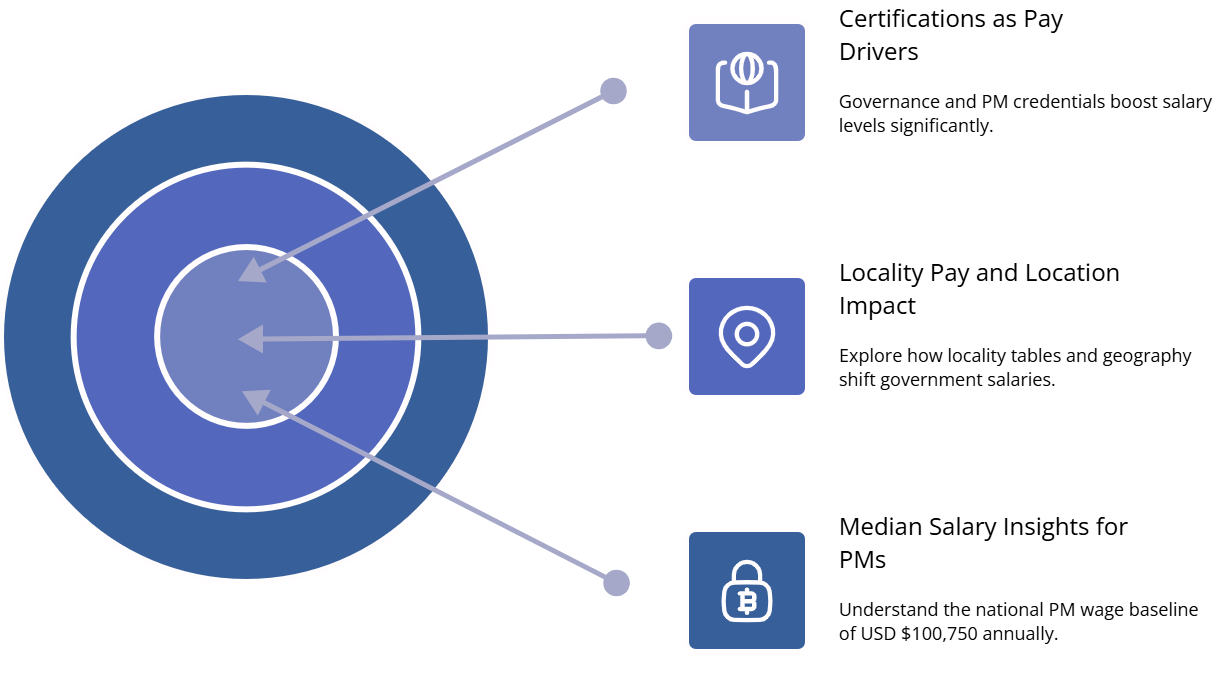
For a national baseline, the US Bureau of Labor Statistics reports a median annual wage of $100,750 for project management specialists as of May 2024, with the top 10 percent earning above $165,790. This is not “government only,” but it anchors what the market pays for structured delivery skills.
For government-specific benchmarks, salary aggregators show ranges typically around the high five figures to low six figures, depending on role and seniority. For example, Salary.com reports a median government project manager salary around $99,038 in 2025. Other datasets show higher averages for federal-adjacent roles and contractors, including ZipRecruiter’s reported average for federal government project manager roles around $102,682 as of early 2026. Glassdoor’s employer-specific estimate for a “United States Federal Government” project manager role lands around $104,559 with a reported range.
Where does salary jump fastest?
Location and locality pay can shift your effective earnings. For US federal roles, the General Schedule structure and locality pay tables are publicly defined, which means geography and grade level can materially impact salary bands. This is why studying regional job markets is useful. Use APMIC’s local market intelligence like NYC salaries and employers, Chicago compensation patterns, and Massachusetts PM career trends to understand how local demand shifts your leverage.
Domain complexity drives pay. Government PMs working in highly regulated, high-stakes environments often command stronger pay bands and faster advancement because risk and scrutiny are higher. Consider domains aligned with macro-trends like renewable energy delivery, infrastructure acceleration tied to construction PM evolution, and high-security IT programs influenced by AI impacts on project management.
Certifications and evidence of governance competence improve offers. If your resume shows you can run decision gates, manage risk registers, and produce audit-ready reporting aligned with the future of project governance, you get treated as lower risk. Combine that with a strong credential base via CAPM preparation and leadership signals like CPD certification, and your pay ceiling rises.
5) Step-by-Step Career Roadmap (Entry Level to Senior Government PM)
If you follow a deliberate path, you can move into government PM roles without waiting years. The key is building proof that you can operate inside government constraints: procurement, governance, documentation, and stakeholder complexity.
Step 1: Choose your government PM lane
Pick a lane based on what government hires heavily for:
Infrastructure and construction programs aligned with construction PM trends
IT modernization programs influenced by future PM software and automation
Energy and sustainability programs aligned with renewable opportunities and the broader rise of sustainability and ESG in PM
Public finance-heavy programs tied to budgeting realities like inflation impacts
Portfolio and PMO work aligned with future PMO role expectations
This matters because your resume should tell one consistent story. “General PM” is weak positioning. “IT modernization PM with governance and compliance strength” is a clear hire.
Step 2: Build your foundational PM credential
If you are early career, start with CAPM and create a proof trail. Use the CAPM study plan, validate your understanding through CAPM exam questions, and decide long-term credential direction via CAPM vs PMP logic. Then map how credentials are evolving with the future of certifications.
If your lane includes process improvement, add credibility with Six Sigma Green Belt. If your lane is IT-heavy and you need broad recognition, add Project+.
Step 3: Create government-ready proof assets (this is what changes everything)
Most applicants fail because their resumes look like task lists. Government hiring wants evidence that you can run controlled delivery.
Build these proof assets:
A one-page governance framework aligned with the future of governance
A RAID log sample and a decision log sample aligned with PMO operating models
A sample weekly executive brief written in the decision-first style described in future PM leadership
A hybrid execution approach grounded in the hybrid PM forecast and method evolution in Scrum evolution
These are not “nice to have.” They make you interviewable.
Step 4: Target the right job markets and build your pipeline
Government hiring is local and structured. Target regions with heavy public programs and large employer ecosystems using market guides like Washington State opportunities, Illinois employer trends, Pennsylvania training demand, Georgia opportunities, and Arizona job hubs.
Then use sector trend posts to shape your narrative. If you are aiming for infrastructure, connect your positioning to construction PM trends. If you are aiming for modernization programs, show you understand the tooling and AI shift in future PM software and AI impacts on PM.
Step 5: Your first 90 days as a government PM (what top performers do)
If you want rapid progression, your first 90 days must build trust.
Weeks 1–2: stabilize clarity
Confirm scope, decision rights, and constraints
Build a milestone plan that reflects governance timing aligned with future governance trends
Build a risk register and escalation cadence aligned with future PMO discipline
Weeks 3–6: enforce control
Implement change control, acceptance criteria, and vendor cadence
Improve forecasting using principles aligned with estimation and scheduling evolution
Align execution style to hybrid delivery reality
Weeks 7–12: prove outcomes
Report in decisions and risks, not activities
Track benefits and adoption where relevant using portfolio logic from PPM trends
Demonstrate leadership behaviors aligned with future PM leadership expectations
That is how you become the PM leadership trusts.
6) FAQs: Government Project Management Career Questions
-
Not always. You need evidence that you can operate inside structured constraints: governance, documentation, vendor control, and budget discipline. Build proof assets and align your story with structured delivery expectations in the future of project governance and the evolving PMO operating model.
-
CAPM is a strong foundation for structured delivery. Use the CAPM exam guide and the 30 day CAPM plan to build baseline credibility fast, then refine direction through CAPM vs PMP.
-
Yes, if you understand hybrid execution. Many agencies need Agile delivery inside formal governance. Pair method knowledge from Scrum evolution by 2027 with execution patterns from the hybrid PM forecast. Then build credential support through PMI-ACP preparation.
-
They can be competitive, especially for complex programs and federal-adjacent roles. Use the broader market baseline from the BLS median for project management specialists and compare government-specific datasets and pay band structures like the federal GS tables. The biggest drivers are domain complexity, location, and evidence of governance capability.
-
Procurement fluency, governance cadence design, budget discipline, and audit-ready reporting. Tie your answers to modern delivery expectations like future governance practices, PMO evolution, and forecasting improvements from estimation and scheduling evolution.
-
Infrastructure, renewable energy, and technology modernization remain strong. Align your narrative with the growth forces in construction PM trends, renewable energy opportunities, and modernization shifts driven by future PM software.
-
Win trust through predictability. Build a decision-first cadence, enforce change control, track risk trends weekly, and report honestly without “green theater.” That behavior maps to leadership expectations in future PM leadership trends and structured execution models in the future PMO role.
