
Guide to Vendor & Supplier Management Terms for PMs
Vendor and supplier management looks harmless on paper. A contract is signed, a timeline is agreed, a few checkpoints are scheduled, and everyone assumes delivery will take care of itself. Then the real project begins. Lead times stretch, ownership blurs, change requests multiply, approval loops slow down, and a dependency outside your direct control starts dragging the whole schedule behind it.
That is why PMs need stronger vendor and supplier language. The right terms help you define accountability, spot risk earlier, negotiate from a position of clarity, and manage outside partners without letting the project get quietly owned by someone else’s delays.
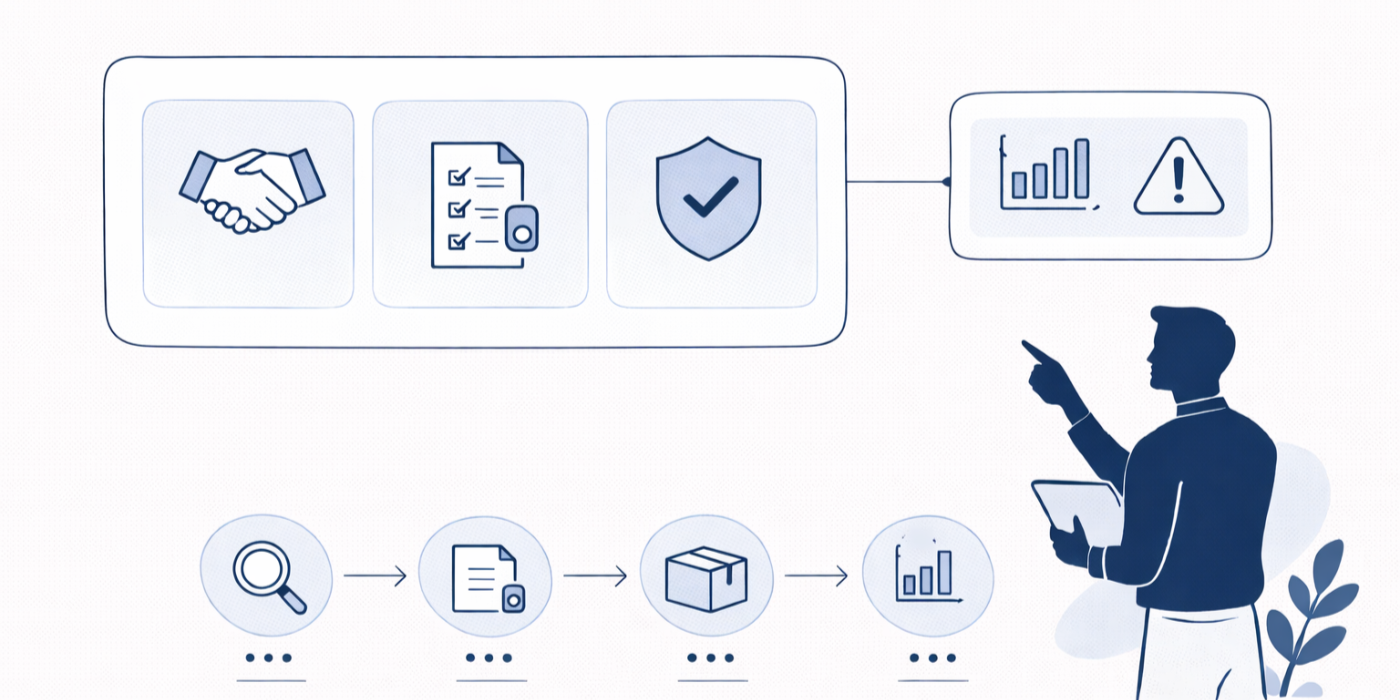
1. Why vendor and supplier terminology matters so much in project management
PMs often lose control of a project in the exact place they assume control already exists: third-party delivery. Internal teams can be chased, meetings can be called, and priorities can be escalated. Vendors and suppliers sit outside that circle. They are governed through contracts, commercial structure, relationship management, service expectations, and timing discipline. When a PM uses weak language in this area, the result is predictable. Scope gets interpreted loosely, lead times get guessed, invoices move faster than deliverables, and the project starts paying for uncertainty twice.
That is why vendor and supplier terms are tightly linked to project procurement, contract management, risk management, project communication, and stakeholder management. The PM has to translate commercial language into delivery control. That means knowing when a document defines scope, when it only describes intent, when a service level is measurable, when it is decorative, and when a delay is merely frustrating versus when it is genuinely threatening the critical path.
It also matters for credibility. In interviews, governance reviews, and steering meetings, PMs who understand vendor language sound different. They do not just say “the supplier is delayed.” They explain the lead-time risk, contractual obligation, acceptance gap, escalation route, and corrective action path. That level of detail makes a PM far more convincing than someone who only knows how to chase updates and forward emails.
2. The core vendor and supplier management terms every PM should know
Start with the difference between a vendor and a supplier. In many organizations the terms are used interchangeably, but they can signal different roles. A vendor often provides services, systems, or contracted expertise. A supplier may provide physical materials, components, or upstream inputs. A PM who understands that distinction can map dependencies more accurately across project scheduling, critical path planning, budget control, and issue tracking.
A statement of work, or SOW, is one of the most important documents in vendor management. It defines what is being delivered, the boundaries of the work, the timeline, roles, assumptions, and often the acceptance conditions. A vague SOW is a future argument in document form. Good PMs read it line by line and test every soft phrase before execution starts.
A service level agreement, or SLA, defines measurable service commitments. This might include uptime, response times, resolution times, delivery windows, or support availability. The danger appears when SLA metrics sound official but do not actually protect what the business needs. A PM has to check whether those measures connect to real project outcomes, not just the vendor’s favorite reporting dashboard.
A deliverable is the output the vendor owes, while acceptance criteria define the conditions under which that output counts as complete. This pair matters enormously. Projects get damaged when teams approve “nearly there” work because the criteria were not nailed down in advance. That affects quality management, project reporting, knowledge management, and even future project failure analysis.
A lead time is the elapsed time between request and delivery readiness. PMs who ignore real lead times build fantasy schedules. This becomes especially painful in equipment procurement, environment provisioning, integration dependencies, and external reviews. The most dangerous lead times are the ones assumed rather than confirmed.
A procurement cycle captures the full path from sourcing through purchase, approval, contract, order, and fulfillment. Too many teams treat procurement as an event when it is actually a schedule chain. By the time someone says, “we placed the order,” the project may already be late.
3. Commercial and control terms that protect PMs from quiet scope, cost, and delivery damage
Once a vendor is selected, the next layer of terms becomes more commercial and more dangerous.
A purchase order, or PO, is the formal authorization to buy. PMs get burned when operational work begins before the PO or internal approvals are properly in place. The work may move, but the payment path, invoicing sequence, or legal protection may not. That gap creates nasty friction later between finance, procurement, the project team, and the vendor.
A change order is the formal mechanism for modifying agreed scope, pricing, timing, or terms. This term matters because suppliers are often very happy to continue discussing new requests informally while cost and delay grow in the background. A PM who does not force changes into a documented route ends up with scope expansion disguised as cooperation. That directly affects cost management, project budgeting, resource planning, and project dashboards.
A payment milestone ties invoicing to defined delivery events. It prevents the project from paying too far ahead of verified progress. Retention strengthens that control by holding back part of the payment until closeout or final acceptance conditions are satisfied. PMs do not always design these terms, but they must understand how they influence leverage.
Invoice reconciliation is the discipline of matching billed amounts against approved scope, completion evidence, and commercial terms. Teams that rush invoice approval under schedule pressure often create a second problem after the first one. Now the project is late and has already surrendered financial leverage.
A performance review is a formal assessment of how the vendor is delivering against expectations. This should not be saved for the post-mortem. Recurring performance review points allow the PM to surface pattern issues before they harden into normal behavior. Pair that with the right KPIs, and the vendor conversation becomes evidence-based instead of emotional.
4. Risk, escalation, and recovery terms PMs need when supplier performance starts wobbling
The most painful vendor problems rarely begin as total failure. They begin as small inconsistencies: one missed update, one soft answer on lead times, one unowned action, one delivery that technically arrived but did not actually meet operational need. That is why recovery language matters.
An escalation clause defines the formal path for unresolved issues. Good PMs do not wait until the relationship is melting down before using it. Escalation works best when it is early, specific, and tied to evidence. This connects strongly with project communication techniques, stakeholder reporting, PM leadership terms, and future PM leadership capability.
A non-conformance occurs when the supplied product, service, or process fails to meet agreed specifications. This term matters because some teams accept partial compliance just to keep the project moving. That usually creates downstream damage, especially in regulated, technical, or client-facing environments.
A corrective action plan, or CAP, is the vendor’s structured response to fix a problem. Good CAPs include root cause, action owner, deadline, evidence, and follow-up review points. Weak CAPs are full of vague verbs like review, revisit, improve, and align. Those plans do not recover anything.
A supplier risk is any threat connected to third-party stability, quality, capacity, delivery consistency, or external exposure. This includes financial weakness, geopolitical issues, staffing churn, backorders, poor subcontractor control, and unrealistic lead-time assumptions. PMs who do not put supplier risk into RAID discussions end up treating third-party exposure like bad luck instead of managed risk.
Then there is the subcontractor problem. A vendor may look solid on paper while quietly relying on a secondary provider the project team has barely assessed. That adds hidden complexity, hidden delays, and hidden accountability gaps. Strong PMs ask who is actually doing the work, not just who signed the paper.

5. How PMs should apply vendor and supplier terms in real execution, not just documentation
These terms matter only if they influence behavior. In real projects, that means integrating vendor milestones directly into the project plan, tying acceptance criteria to visible review gates, matching invoice flow to verified progress, and creating a rhythm of status, risk, performance, and escalation reviews that treats third-party work as controlled execution rather than hopeful waiting.
For example, if a vendor-owned deliverable sits on the critical path, the PM should not only track its due date. The PM should track upstream readiness, internal approvals, lead-time exposure, escalation thresholds, and the conditions required for acceptance. That is where terms like SOW, SLA, change order, non-conformance, and corrective action stop being contract vocabulary and start becoming schedule defense.
These terms also improve interview answers. A candidate sounds stronger when they say they renegotiated acceptance criteria, implemented milestone-based vendor reviews, tightened invoice reconciliation, escalated through formal clauses, and reduced dependency risk from a single-source provider. That lands harder than generic claims about “managing suppliers effectively.” It becomes even more valuable for PMs moving into consulting roles, portfolio roles, freelance PM work, director paths, and CPO-level leadership.
The deeper truth is simple. Vendor control is rarely won through aggression. It is won through clarity. The PM who defines the work, measures the right things, escalates early, preserves evidence, and protects commercial leverage usually controls the relationship even without formal authority over the supplier team.
6. FAQs: Vendor and supplier management terms for PMs
-
The statement of work is usually the most important because it defines scope, deliverables, assumptions, timeline, and often acceptance expectations. Weak SOWs create downstream disputes.
-
An SLA measures ongoing service performance, such as uptime or response time. Acceptance criteria define whether a specific deliverable or work package counts as complete and acceptable.
-
Because teams often let work evolve informally while assuming the paperwork can catch up later. By then, cost, timing, and accountability have already drifted.
-
Corrective action plan is often the key term. It forces the vendor to move from vague reassurance into structured recovery with owners, deadlines, and evidence.
-
Because many project delays begin long before the scheduled handoff date. If lead time assumptions are wrong, the plan is already weaker than it looks.
-
It is the possibility that an outside provider creates delivery, quality, cost, compliance, or timing damage to the project through instability, delay, or poor performance.
-
As a material dependency layer. If the prime vendor relies on subcontractors, the PM should understand who they are, what they control, and how accountability flows through them.
