
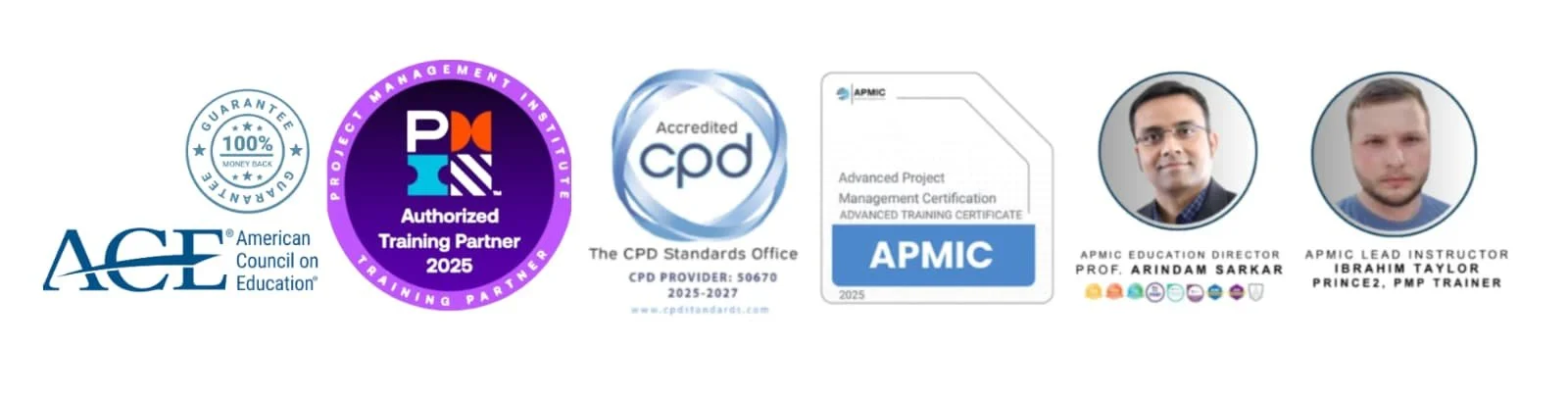
Accreditations and Standards
How APMIC makes project management credibility reviewable, not assumed
APMIC was built around a simple reality of modern delivery work. Project management credibility is not decided at enrollment. It is decided later, inside real execution environments, when scope changes, risks surface, stakeholders disagree, and delivery pressure exposes what you actually know.
APMIC's accreditations and standards translate directly to career credibility. Graduates report these credentials accelerate hiring decisions, support promotion justifications, and satisfy employer reimbursement requirements across Fortune 500 companies, government agencies, healthcare systems, and technology firms. Whether you're advancing from project coordinator to project manager, moving into senior PM or PMO Director roles, or pursuing specialized positions in IT, healthcare, or construction project management, APMIC's third-party validated credentials reduce legitimacy friction in competitive job markets.
Read verified testimonials from graduates whose APMIC credentials supported role transitions and salary increases. Review complete career outcome data showing how CPD accreditation and PMI ATP recognition translate to employment opportunities. Compare APMIC's credential structure to other project management certification programs and understand why employers value multi-layered validation.
Employers do not ultimately care whether a course “felt comprehensive.” They care whether you can plan, coordinate, control, and deliver in a way that holds up under review.
That is the purpose of accreditations and standards at APMIC. Not logos. Not marketing. A set of external and internal accountability mechanisms that make training structure legible to employers, PMOs, auditors, and career reviewers who want proof of depth, hours, rigor, and alignment to current standards.
APMIC treats accreditation, standards alignment, governance, assessment integrity, and credential verification as one integrated system. It exists for career changers, new project managers, senior PMs moving into program and portfolio roles, and organizations that need consistent capability across teams.
Institutional Identity
Postsecondary professional training built for workforce credibility
APMIC operates under Advanced Education Group LLC, a non degree granting postsecondary educational institution headquartered in Orem, Utah. APMIC provides vocational and professional education designed for adult learners, continuing education, and workforce aligned certification.
Learn more about APMIC's mission, instructional philosophy, and institutional approach to project management education. Review our complete faculty credentials and curriculum governance structure. Explore detailed program information including structure, syllabus, learning methodology, and assessment approach.
For prospective students evaluating institutional legitimacy, APMIC provides full transparency through publicly accessible documentation covering accreditation status, faculty backgrounds, curriculum structure, assessment methodology, and credential verification processes. Contact our enrollment advisors for institutional documentation needed for employer reimbursement or professional development approval.
APMIC issues a professional certificate supported by third party accreditation signals and standards alignment, alongside a URL verifiable credential designed to make employer validation fast and objective.
APMIC does not position its program as an academic degree, a license, or a replacement for employer specific governance. It positions the certification as structured training designed to build applied competency across PMBOK aligned knowledge areas, modern delivery methods, stakeholder leadership, and portfolio level thinking.
This clarity matters because project management is full of misleading shortcuts. People collect badges without building judgment. APMIC is structured so the training is reviewable, auditable in practice, and defensible in a PMO setting.
Why accreditation and standards matter in project management
The gap is not knowledge, it is execution credibility
Most learners discover the value of standards only after they enter real delivery.
They can “explain Agile” but struggle to run a sprint with conflicting stakeholders.
They can “name risk responses” but cannot build a risk posture that survives executive review.
They can “make a plan” but cannot control scope, schedule, and dependencies when things break.
Accreditations and standards do not magically create competence. What they do is create shared reference points so employers can evaluate whether your education was:
Structured, not improvised
Aligned to recognized frameworks, not personal opinions
Built with documented learning hours
Supported by governance and curriculum maintenance
Designed to produce repeatable capability, not surface familiarity
APMIC uses accreditations and standards as accountability layers. They reduce legitimacy friction. They do not replace performance.
CPD Accreditation
500 plus hours that are documented and professionally legible
APMIC is CPD accredited for 500 plus hours. CPD accreditation is widely used in professional development contexts to verify that education is structured, outcome driven, and supported by documented hours.
CPD accreditation helps make APMIC training intelligible across many workforce settings because it gives stakeholders a consistent framework for evaluating:
Verified learning hours
Curriculum structure and outcomes
Instructional design quality
Assessment methodology
Relevance to professional practice
Oversight and governance
This matters because project management titles vary across industries, but the need for verifiable capability does not. CPD hours are a portable way to show that the training was substantive, not a weekend overview.
CPD accreditation does not guarantee employment, salary outcomes, or promotion. It confirms that the program is structured professional education with documented hours, not a casual content product.
PMI ATP Recognition and PMI Standard Alignment
Training that maps to what PMI expects, not what social media rewards
APMIC is aligned to PMI standards through PMI Authorized Training Partner recognition. For learners and employers, this matters because PMI alignment signals that the program is built to support professional expectations commonly used in corporate PM functions.
APMIC is also designed to satisfy the 35 contact hour education requirement for PMP eligibility. That is a practical standards anchor for learners who want to pursue PMI credentials after building deeper capability.
APMIC does not frame PMI alignment as a shortcut. It frames it as structure. You are training against recognized expectations that employers already understand, while developing the applied skills that make those expectations real.
PMBOK Alignment and Modern Delivery Standards
PMBOK aligned, updated for real 2026 delivery environments
Many project management programs overfit to exam style memorization or overfit to one methodology. APMIC is built to be legible to traditional PMOs while still preparing you for how delivery works now.
APMIC is PMBOK aligned across knowledge areas and execution realities, while also covering modern delivery approaches including Agile, hybrid models, and portfolio governance concepts required in many organizations.
This alignment exists so you can:
Speak PMBOK language when you need to
Execute Agile delivery when the work demands it
Operate hybrid when the environment forces it
Communicate in governance terms when leadership reviews outcomes
Transition into program and PMO roles without retraining your entire foundation
Standards alignment is not treated as compliance theater. It is treated as career mobility infrastructure.
ACE College Credit Recognition
A workforce signal that supports formal recognition pathways
APMIC includes ACE recognition for 12 semester credit hours. This matters for learners who need a more formal credential signal for employer reimbursement, training records, career development documentation, or credit aligned professional progression.
ACE recognition does not make the program a university degree. It provides an external recognition structure that some employers and institutions use to validate learning value and documented scope.
For many adult learners, this reduces friction when requesting reimbursement or explaining the program to HR and leadership.
What APMIC standards are designed to produce
Competence that survives scrutiny inside delivery work
APMIC’s accreditation and standards system exists to support one outcome: training that produces project managers whose work holds up under review.
That means graduates are trained to demonstrate capability across areas employers actually evaluate:
Planning that is actionable, not theoretical
Scope control and change handling that prevents silent project drift
Risk management that is operational, not just a spreadsheet
Stakeholder management that reduces conflict and ambiguity
Delivery execution that aligns teams and maintains momentum
Governance awareness that supports leadership visibility
Portfolio thinking that connects projects to strategic outcomes
Credentials become meaningful when behavior changes. APMIC is structured around that definition of legitimacy.
Curriculum Governance and Continuous Updates
Standards do not matter if they are not maintained
APMIC treats curriculum quality as a living system.
The program is updated and maintained through structured governance that includes:
Quarterly curriculum review to reflect evolving delivery expectations
Continuous refinement of lessons, simulations, and templates based on learner performance signals
Reinforcement of standards based execution, not content consumption
Assessment integrity review to ensure evaluations test applied judgment, not memorization
APMIC does not rely on a static “version” of project management. Delivery environments change. Standards evolve. Tools shift. The program is maintained accordingly without diluting the depth that makes it defensible.
Instructor Authority and Instructional Oversight
Standards stay real when leadership is visible
APMIC’s standards system is reinforced by defined instructional leadership.
Lead Instructor: Neal Rowland
Over 15 years instructing, designing, managing, and transforming projects across technology, enterprise software, product development, and large scale organizational change. Listed contributor to the PMBOK. Global Product Manager for AI and Data Privacy at Stellantis. Agile consultant at The Crowd Training. Among the first 500 professionals worldwide to earn PMI ACP certification. Deep expertise in Agile, SAFe, instructional design, and interactive learning systems. APMIC curriculum architect.
Mentor Instructors: Arindam Sarkar and Ibrahim Taylor
Arindam Sarkar: 20 plus years delivering multi million dollar initiatives across IT consulting, public sector programs, enterprise systems, and large scale digital transformations. Certified Scrum Master, Certified Scrum Product Owner, Certified Agile Leader, PMI Authorized Training Partner Instructor. Adjunct and visiting instructor at multiple universities and colleges.
Ibrahim Taylor: Project and Program Manager with hands on experience managing technical, infrastructure, and client driven projects across operational and consulting environments. Background in networking, infrastructure, and enterprise technology initiatives for diverse clients.
This structure matters because standards drift when leadership is hidden. APMIC keeps instructional responsibility visible so employers and learners can understand who is accountable for curriculum design and quality.
What APMIC does not claim
Credibility is protected by conservative language
To protect learners and preserve trust, APMIC does not claim that accreditation guarantees outcomes outside the training environment.
APMIC does not:
Guarantee employment, promotions, or salary outcomes
Promise PMP certification outcomes or exam results
Claim licensure or legal authority in any jurisdiction
Replace employer specific governance or PMO processes
Suggest that tools and templates substitute for judgment
APMIC is designed to increase capability and make training legible. Outcomes depend on execution, market conditions, and role alignment.
Verification and Employer Legibility
Credentials that can be checked, not just displayed
APMIC issues a certificate and credential structure designed to reduce employer verification friction. The intent is that an employer can validate completion without relying on screenshots or self reported claims.
Programs provide non-degree professional education and certification training. Completion does not confer government licensure or guarantee eligibility for any particular position. Employers and independent credentialing organizations establish their own education, experience, certification, and hiring requirements.
If you need documentation for employer reimbursement, HR records, or professional development tracking, APMIC can support those requests through advising.
Advising: advising@apmic.org
Phone: +1 801 919 8741
FAQ: Accreditations and Standards at APMIC
1) What does CPD accreditation verify and what does it not verify?
CPD accreditation verifies that APMIC is structured as professional education with documented learning hours, defined outcomes, and reviewable instructional design and assessment methodology. It makes the program legible to employers because the hours are not vague and the curriculum is not improvised. CPD does not guarantee job placement, promotions, income outcomes, or personal competence by itself. Competence is demonstrated through applied delivery work, decision quality, stakeholder handling, and execution consistency. CPD functions as an accountability layer that supports credibility, not a substitute for performance.
2) What does PMI ATP recognition mean for a learner?
PMI Authorized Training Partner recognition signals that APMIC is aligned to PMI expectations and is built in a way that employers and PMI aware organizations can recognize. It helps learners who want standards aligned training that maps to PMI language and professional practice realities. It does not guarantee PMP approval, exam results, or credential outcomes. It means the training structure and alignment are designed to support serious project management competence and recognized pathways, including the education requirement for PMP eligibility.
3) Does APMIC satisfy the 35 contact hour requirement for PMP eligibility?
Yes. APMIC is structured to satisfy the 35 contact hour education requirement for PMP eligibility. This is one of the practical reasons employers and learners view the program as professionally aligned training rather than informal coursework. Eligibility for the PMP also depends on PMI requirements beyond education hours, including experience requirements and PMI review processes, which remain under PMI authority.
4) What does PMBOK aligned actually mean in practical terms?
PMBOK aligned means the program covers the knowledge areas and execution expectations that traditional PMOs, enterprise organizations, and many hiring managers use as a baseline for evaluating project managers. In practical terms, it means you can plan, execute, monitor, and close projects using language and structures employers recognize. APMIC goes beyond naming concepts by teaching application through structured lessons, tools, and practice frameworks, so the alignment translates into execution capability rather than memorization.
5) How should employers interpret APMIC accreditation and standards signals?
Employers typically interpret accreditation and standards as risk reduction signals. They want training that is structured, assessed, governed, and documented. APMIC’s CPD hours, PMI ATP recognition, and PMBOK alignment make the program easier to evaluate because it is legible and reviewable. Employers still evaluate you on performance. The value is that APMIC reduces credibility friction by making your training easier to validate and easier to explain inside HR and PMO review systems.
6) What does ACE recognition for 12 semester credit hours mean?
ACE recognition indicates that the program has an external credit recommendation structure that some employers and institutions use for professional development documentation and learning recognition. It can support reimbursement discussions and training record legitimacy. It does not make APMIC a university degree and does not force any institution to accept credit. It is a recognition mechanism that strengthens professional legibility for learners who need formal documentation signals.
7) Why does APMIC emphasize governance and curriculum updates?
Because standards are only useful if they are maintained. Delivery environments change, tools evolve, and organizational expectations shift. APMIC uses structured governance including quarterly curriculum review to prevent the program from becoming outdated or superficial. This approach protects learners by ensuring they are training against current execution realities, not a frozen version of project management that no longer matches how modern teams deliver.
8) Who should I contact if I need employer documentation or standards clarification?
For program standards questions, employer reimbursement documentation, credential verification details, or pathway guidance, contact advising@apmic.org or call +1 801 919 8741. If your question relates to internal employer approval, it helps to share your role target, whether you are pursuing PMP, and what your employer needs to see so advising can provide the most relevant documentation and framing.