
How to Become an IT Project Manager: Detailed Career Guide & Roadmap
IT Project Management is where “project skills” meet technical reality: ambiguous requirements, fast-changing systems, security constraints, vendor dependencies, and stakeholders who want certainty without giving clarity. If your projects keep slipping, it’s usually not because you “need better Agile”—it’s because you’re missing the operating system that IT delivery demands: intake discipline, technical fluency, risk visibility, and tooling that tells the truth. This guide shows the exact skill stack, proof assets, and career roadmap that hiring managers reward—so you stop getting filtered out and start getting hired as someone who can ship reliably.
1) What an IT Project Manager actually owns in the real world
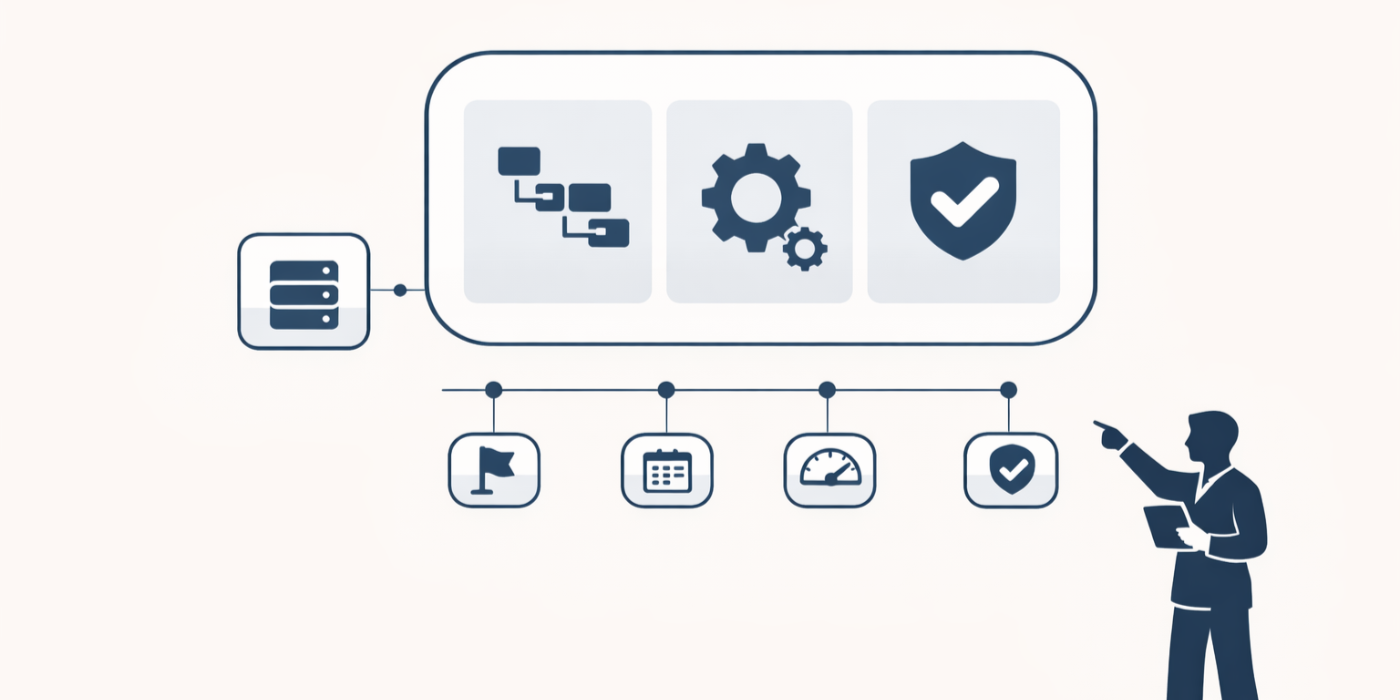
IT PMs aren’t “meeting schedulers.” You’re the person who makes technical delivery predictable under constraints: legacy systems, change windows, compliance, vendor timelines, and cross-team dependencies. Hiring panels look for one thing: can you turn “technical uncertainty” into structured decisions?
Here’s what the role truly owns—regardless of industry:
Scope control that engineers trust. Your requirements must be traceable, testable, and resistant to “silent scope.” If you can’t define what “done” means, you’ll never control delivery drift. Pair your approach with stakeholder clarity using critical project stakeholder terms so decisions are anchored to ownership, not opinions.
Delivery truth, not status theater. IT PMs win by building systems where progress is visible without chasing people. That’s why strong reporting stacks matter—use practices aligned with project reporting & analytics software and clean execution visibility using dashboards & data visualization tools.
Risk work that happens early. Most IT failures were predictable: unclear integrations, underestimated security reviews, missing environments, or vendor delays. Your job is to surface them while there’s still time to act, using disciplined workflows supported by issue tracking systems.
Tooling and workflow design. If your team spends hours on admin, your process is leaking money. Strong IT PMs choose tooling that reduces friction—especially around document management software, durable knowledge capture via project knowledge management software, and time coordination using calendar & scheduling tools.
Hybrid delivery competence. Most IT organizations blend Agile, Waterfall, ITIL-ish change control, and vendor governance. If you can’t run hybrid reality, you’ll get replaced by someone who can. Build credibility through principles explained in hybrid project management.
Hard truth: if your resume reads like “ran standups, updated Jira,” you’ll be seen as operational support. If it reads like “designed controls that reduced delivery risk and improved predictability,” you’ll be hired as an IT PM.
2) The core skills IT PMs must master (and how to prove each one)
Hiring managers don’t want a list of “skills.” They want signals: how you think, what artifacts you produce, and how you prevent predictable failure modes.
A) Technical fluency (not coding) that prevents estimation lies
You don’t need to be an engineer, but you must understand:
how environments work (dev/test/stage/prod)
why integrations cause hidden work
why security reviews create lead time
why data migration is a project inside the project
The proof isn’t a certificate. It’s how you plan: dependency maps, cutover checklists, and honest assumptions. For planning tools that support this, know the landscape of Gantt chart software and time coordination via calendar tools.
B) Requirements + change control that eliminates “silent scope”
Most IT projects fail because stakeholders keep changing requirements without accepting tradeoffs. Strong IT PMs build:
a baseline scope
a change log with approvals
acceptance criteria with definition of done
You also must speak stakeholder language precisely—use the vocabulary and ownership models from stakeholder terms every PM should master.
C) Risk + issue systems that stop firefighting
A real IT PM can tell you:
what the top risks are
what triggers would make them real
what mitigation is already in motion
who owns each mitigation
That’s why issue discipline matters. Build your operating model around practices in project issue tracking software and use strong reporting from project reporting & analytics so leadership sees risk early.
D) Tooling that reduces admin and increases truth
Tool choice is not about features—it’s about workflow integrity. A credible IT PM knows:
how documentation stays current using document management tools
how knowledge compounds using knowledge management software
how dashboards communicate outcomes using data visualization tools
how time management stays realistic via calendar & scheduling tools
E) Communication that produces decisions, not noise
Your updates should never be “here’s what we did.” They should be:
decisions needed
risks and options
tradeoffs and impacts
next commitments and owners
Build that capability using project communication terms & techniques.
3) The step-by-step career roadmap to become an IT Project Manager
There are three reliable entry paths: support roles → coordinator, technical roles → PM, and general PM → IT PM. Your roadmap depends on what you’re missing today.
Stage 1: Build delivery mechanics (0–3 months)
Goal: stop being “the person who follows up” and become “the person who controls flow.”
Do this:
learn issue/RAID discipline using issue tracking software
learn how reporting works with project reporting & analytics
learn how dashboards become decision tools using dashboard & visualization tools
learn stakeholder ownership terms using stakeholder terms
Proof asset to build now: one-page status template that includes decisions, risks, and next actions.
Stage 2: Get IT exposure with real constraints (3–9 months)
Goal: build experience where technical constraints are unavoidable:
infrastructure upgrades
software rollout
integrations
data migration
security improvements
Your edge comes from hybrid competence—use the mindset in hybrid project management and show you can operate under change control and dependencies.
Proof asset: a dependency map + release readiness checklist.
Stage 3: Move into IT PM ownership (9–18 months)
Goal: own scope, timeline, risk, and delivery truth for an IT initiative.
Here’s what makes you “hireable” at this stage:
you can plan dependency-based schedules using Gantt chart tools
you can coordinate time across teams using calendar tools
you can keep documentation sane using document management + knowledge management
Proof asset: a project kickoff pack (scope baseline, RAID, comms plan, RACI, release plan).
Stage 4: Become a senior IT PM (18+ months)
Goal: run portfolios, vendors, and executive trust.
Senior IT PMs are hired for:
predictable delivery under constraints
stakeholder alignment and governance
vendor control and procurement fluency
leadership-ready reporting
If you can speak modern methodology direction, you’re seen as strategic. Build that credibility through project management 2030 and the evolving direction of delivery frameworks.
4) Certifications, tools, and proof assets that make hiring easy
Certifications help only when they match what employers need. Proof assets help because they show you can operate.
A) Certifications that map to real IT PM signals
A strong approach is: one methodology credential + one technical-adjacent credential + real artifacts.
Examples of signals hiring managers respect:
Planning + scheduling competence (you can defend dates with dependencies)
Reporting competence (you can tell the truth with data)
Risk and issue discipline (you prevent “surprise failures”)
Tie your learning to tools and workflows:
planning via Gantt chart solutions
reporting via project reporting & analytics
visibility via dashboards & visualization
B) The 7 proof assets that instantly upgrade your profile
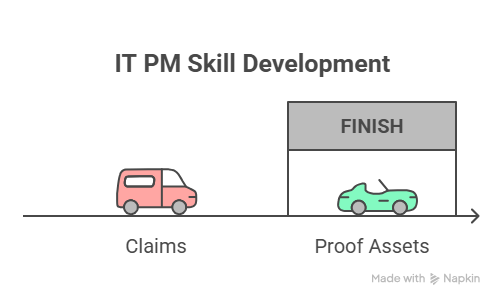
If you build these, your resume stops being “claims” and becomes “evidence”:
Scope baseline + change log (shows control, not chaos)
RAID log with triggers and owners (shows you prevent pain)
Dependency map (shows you can plan reality)
Release readiness checklist (shows you reduce outage risk)
Executive weekly brief (decisions, risks, options) using communication techniques
Dashboard spec (what leadership sees, why it matters) powered by dashboard tools
Knowledge base structure (how-to, decisions, runbooks) using knowledge management and document management
C) Tools you should be fluent in (categories, not brands)
You should understand what these tools do for control:
Issue tracking to keep work honest: issue tracking guide
Scheduling to manage dependencies: calendar tools
Planning for critical paths: Gantt chart tools
Reporting to build trust: project reporting & analytics
Documentation & knowledge to prevent hero culture: document management + knowledge management
5) How to land an IT Project Manager job: resume, interview, and 30-60-90 plan
Resume: turn responsibilities into control signals
Stop writing:
“managed stakeholders”
“tracked timelines”
“led meetings”
Start writing:
“controlled scope through baseline + change approvals”
“reduced delivery risk using RAID discipline and weekly decision briefs”
“improved predictability by mapping dependencies and building a release readiness checklist”
“replaced status chasing with dashboards and analytics reporting”
Back up your bullets with your asset stack (even if anonymized). Hiring teams love candidates who already work like a professional PMO—even in chaotic environments. Use concepts anchored in project reporting & analytics and stakeholder ownership from stakeholder terms.
Interviews: the questions behind the questions
“How do you estimate timelines?”
They’re asking if you can defend dates. Talk about dependencies, assumptions, and buffers—and show you use planning tools like Gantt chart software plus stakeholder alignment rituals.
“How do you handle scope changes?”
They’re asking if you can say no professionally. Use baseline scope, change control, and tradeoffs—then communicate clearly using project communication techniques.
“How do you report progress?”
They’re asking if leadership can trust you. Explain your metrics, dashboards, and decision framing using dashboard tools and reporting & analytics systems.
“Our environment is hybrid.”
They’re asking if you can operate under governance and still deliver fast. Anchor your approach in hybrid project management.
30-60-90 day plan (what strong IT PMs do immediately)
First 30 days: map reality and remove ambiguity
stakeholder map + RACI
risk/issue system (owners, triggers, escalation) using issue tracking
documentation structure using knowledge management
Days 31–60: build delivery truth
dependency map + baseline plan
dashboard + reporting cadence using analytics reporting and dashboards
Days 61–90: lock in predictability
change control policy
release readiness + cutover runbook
stakeholder decision cadence using communication techniques
6) FAQs
-
No—but you need technical fluency: environments, dependencies, integrations, testing, security reviews, and release constraints. You prove this through artifacts (dependency maps, risk triggers, release readiness) plus solid delivery tooling like issue tracking and Gantt planning tools.
-
Volunteer for IT-adjacent projects: software rollout, integrations, infrastructure upgrades, data migration, security improvements. Then build proof assets: RAID, dependency map, executive brief, and dashboard plan using project reporting & analytics and dashboard tools.
-
You implement change control with explicit tradeoffs: what changes, what slips, what increases in cost/risk. Then you document decisions and owners using stakeholder clarity from stakeholder terms and structured comms from communication techniques.
-
Think in categories: planning (Gantt chart software), scheduling (calendar tools), issue tracking (issue tracking guide), reporting (analytics reporting), dashboards (data visualization tools), documentation (document management), and knowledge reuse (knowledge management).
-
They treat IT like generic project management. IT delivery has hidden work: security reviews, environment readiness, integration testing, cutover planning, rollback, monitoring, and support handoffs. Strong IT PMs build systems that expose this early using disciplined reporting via project reporting & analytics.
-
Replace responsibility bullets with control signals and proof assets: scope baseline + change log, RAID, dependency map, release readiness checklist, executive decision brief, and dashboard spec. Anchor your story in hybrid realism with hybrid PM and delivery truth tools like issue tracking.
