
Detailed Career Roadmap: Becoming a Certified Agile Project Manager
Agile hiring panels don’t reward “I know Scrum.” They reward predictable delivery under uncertainty, stakeholder control, and proof that you can run a mixed-method environment without chaos. This roadmap shows how to become a Certified Agile Project Manager in a way that converts into interviews: the right certification sequence, the proof assets to build alongside it, and the delivery signals recruiters actually screen for—especially in hybrid orgs where agile is real work, not ceremonies. Along the way, you’ll build a portfolio that demonstrates leadership, reporting, risk control, and communication maturity—using the same signals covered in APMIC’s guidance on hybrid delivery, Scrum’s evolution, stakeholder language, and communication execution.
1. What “Certified Agile Project Manager” really means in hiring terms
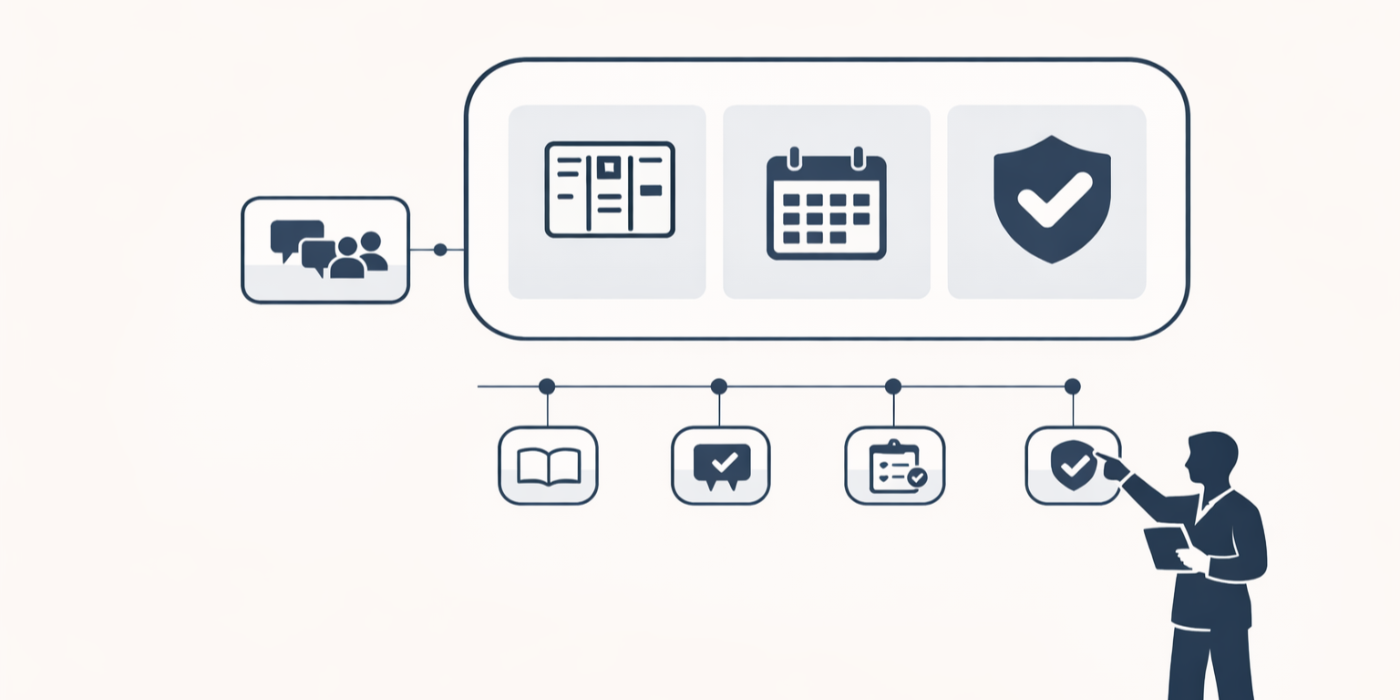
“Certified Agile PM” isn’t a single universal title—it’s a signal bundle: (1) you understand agile systems, (2) you can lead delivery in ambiguity, and (3) you can prove it in artifacts and outcomes. If your certification sits alone without evidence, it reads like theory. If your evidence exists without a recognized credential, you often get filtered out early—especially when applicants are stacked with badges.
Hiring teams usually judge you on four measurable dimensions:
Delivery control: Can you plan realistically, manage risk, and still move fast? That’s why teams care about your ability to use strong execution tooling—like issue tracking systems and consistent reporting practices supported by reporting and analytics tools.
Stakeholder influence: Agile PMs live in the real world: dependencies, politics, procurement, approvals, and budget constraints. Your credibility rises when you speak stakeholder language the way APMIC frames it in stakeholder terms and operationalize it through clear communication techniques.
Method fit (not religion): Most orgs run hybrid—some Agile, some predictive, many blended. Your “agile” value increases when you can run a blended delivery system confidently, which is why understanding hybrid PM’s rise matters as much as pure Scrum knowledge.
Leadership trajectory: Agile PM is often a stepping stone to higher leadership paths. Knowing how the role ladders into senior leadership helps you build the right story (and proof), including what APMIC outlines in paths to PM Director, VP of PM, and Chief Project Officer.
If you want the certification to convert, your roadmap must be: credential + proof assets + delivery signals + narrative. That’s exactly how high-signal candidates position themselves in markets that are increasingly shaped by tech change (see APMIC’s view on PM evolution to 2030 and the accelerating role of AI in PM).
2. Choose the right certification path and sequence for your background
The fastest path depends on what you already have: experience, PMI-style hours, Scrum exposure, or scaled-agile environment familiarity. The mistake is picking a credential because it’s popular, instead of because it maps to the job you’re targeting.
Use this sequencing logic:
Path A: You have PM experience, need agile credibility quickly
Goal: Convert your existing delivery experience into agile-language proof.
Start with a Scrum fundamentals credential (entry-to-mid). Your focus isn’t the badge; it’s building clean agile vocabulary and artifacts.
Build 2–3 portfolio assets immediately: backlog sample, sprint report snapshot, stakeholder memo (structured like APMIC’s best practices in project communication).
Upgrade into a broader agile credential that signals cross-method competence, especially if your org is hybrid (anchored to APMIC’s hybrid future forecast).
This path works extremely well if you’re coming from industries where documentation and controls still matter (construction, healthcare, government). If that’s you, borrow positioning techniques from APMIC’s roadmaps like healthcare PM or construction PM to show domain seriousness while upgrading your method toolkit.
Path B: You’re early-career or switching into PM and need a structured ladder
Goal: Build foundations + proof assets in parallel with the credential.
Learn delivery tooling first (it’s what makes you operational on day 1): start with the systems described in issue tracking, then layer reporting via reporting & analytics.
Build your “mini delivery case study” portfolio: one problem, one backlog, one sprint plan, one risk log, one retrospective improvement.
Then get the credential that matches your target environment: pure Scrum team vs enterprise portfolio vs hybrid.
This path is also ideal if you want flexibility later—like building a location-independent career. APMIC’s guidance on remote and virtual PM roles pairs well with agile certification because remote teams rely heavily on process clarity.
Path C: You’re entering an enterprise/large organization context
Goal: Show you can operate in scaled environments with governance, dependencies, and cross-team planning.
Scaled orgs care less about your ceremonies and more about your ability to manage dependencies, approvals, and reporting without slowing delivery. Build credibility by mastering:
Cross-team visibility (dashboards, dependency maps) supported by dashboard tools
Budget and forecast discipline using budget tracking tools
Clear stakeholder alignment using stakeholder terms
If you want to keep the door open to leadership, align your roadmap with the behaviors APMIC outlines for PM Director and VP of PM: decision framing, executive updates, governance rhythm, and measurement maturity.
3. Turn Agile theory into delivery evidence that recruiters can’t ignore
This is the section most candidates skip—and it’s why they stay invisible. Your certification syllabus won’t automatically produce employability. Employability comes from evidence that you can run delivery.
Here’s a proof-first build plan you can execute even if you’re not currently “the PM” on a team.
Step 1: Build a credible delivery system (tooling + rhythm)
A hiring manager wants to feel you can walk in and create order fast. That means you must demonstrate competence in three areas:
Work visibility: You can organize work into a backlog and track it cleanly (backed by APMIC’s deep tooling breakdown on issue tracking).
Reporting clarity: You can translate delivery reality into leadership language using practices supported by reporting & analytics tools and dashboard tools.
Time control: You can run a predictable cadence using scheduling systems like APMIC’s recommended calendar and scheduling tools.
This is also where modern PMs get leverage: automate the boring parts so you can lead. If you want to stand out quickly, build simple workflow improvements aligned to APMIC’s view of automation tools for PM efficiency and high-output habits in productivity software.
Step 2: Build two case studies that show “agile under constraints”
Agile PM roles are rarely “greenfield perfect Scrum.” You’ll be evaluated on how you handle constraints:
Stakeholders who interrupt constantly
Dependencies across teams
Delivery dates that don’t move
Budget pressure
Compliance or documentation requirements
To look credible, write two case studies with constraints baked in:
Case study #1: Hybrid reality. Show how you planned agile execution while still reporting milestones the business needed (tie it to hybrid PM’s future).
Case study #2: Forecast and risk control. Show how you protected schedule and budget using real tracking and reporting signals (supported by budget tracking tools and consistent dashboards via reporting & analytics).
Make sure each case study includes the stakeholder layer—use the terminology patterns from stakeholder terms and the execution style from project communication techniques.
Step 3: Convert your proof into an interview-ready narrative
Most resumes fail because they list responsibilities instead of decisions + outcomes. Rewrite your bullets as:
Situation (constraint)
Decision you drove
Tradeoff you managed
Outcome you produced
Signal you tracked
This is exactly how you position for senior tracks. If you want a long runway, align your story to progression roadmaps like PM Director and CPO, because they teach you what leadership expects to see: decision quality, stakeholder control, and measurable impact.
4. Positioning, resume strategy, and the “Certified Agile PM” interview playbook
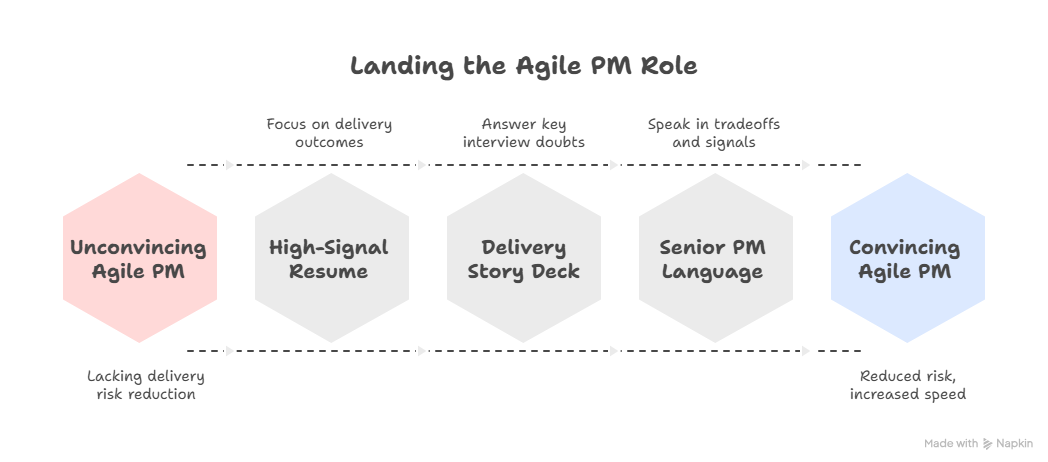
If you want to land the role, you must match how hiring teams evaluate agile PMs. Your job isn’t to convince them you “know agile.” Your job is to convince them you can reduce delivery risk and increase delivery speed without losing stakeholder trust.
What to put on your resume (and what to remove)
Remove low-signal filler like “facilitated daily standups.” Keep high-signal outcomes like:
Reduced cycle time / improved predictability
Reduced escaped defects
Reduced churn from stakeholder interruptions
Improved dependency clarity and escalation speed
Delivered outcomes under fixed constraints
Then support each claim with a signal: dashboards, logs, and cadence artifacts. Your tooling credibility improves fast when you reference a clean stack: issue tracking + reporting + scheduling + automation. That’s why APMIC’s tool guides are powerful supporting signals, including issue tracking, reporting & analytics, and calendar/scheduling tools.
The interview questions you should “pre-answer” in your portfolio
Agile PM interviews often revolve around the same doubts:
“Can you forecast delivery without lying?”
“Can you handle scope and stakeholder chaos?”
“Can you run hybrid delivery without creating process waste?”
“Can you communicate risk early without panicking leadership?”
“Can you manage dependencies and still move fast?”
Build a 6–10 slide “delivery story deck” that answers these doubts. Use stakeholder language from stakeholder mastery, align delivery method to hybrid reality, and show tool-backed execution using APMIC’s coverage on dashboards and budget tracking.
How to sound senior without pretending
Senior agile PMs don’t speak in dogma. They speak in:
Tradeoffs
Constraints
Decision rights
Stakeholder alignment
Measurable delivery signals
This is also why senior-path content matters: learning how executives think improves your interview performance. If you want to position above the “mid-level scrum executor” tier, study leadership trajectories like PM Director and VP of PM and mirror those behaviors now in smaller scope.
5. Long-term growth: how a Certified Agile PM becomes a leader, consultant, or specialist
Once you’re certified and employable, the next trap is stagnation—being the person who runs ceremonies but never gets promoted. The growth path comes from owning larger systems: portfolios, strategy, governance, and cross-org execution.
Here are three high-upside routes:
Route 1: Delivery leader → PM Director track
If you want management progression, you must expand from sprint execution into:
Multi-team dependency management
Governance and decision design
Budget forecasting and prioritization
Executive comms
That map is covered clearly in APMIC’s roadmap to Project Management Director. Your “agile” edge becomes stronger here because you can increase speed while still maintaining control—especially when you operate confidently in hybrid orgs.
Route 2: Agile PM → consulting/freelance independence
If you want freedom, you need proof assets, repeatable frameworks, and a tight positioning niche. APMIC’s guides on building a freelance PM career and launching a PM consultancy firm are highly aligned with agile because companies pay for outcomes, not ceremonies.
Route 3: Remote/hybrid agile PM roles
Remote delivery demands stronger written communication, stronger tooling discipline, and stronger stakeholder alignment. Build toward it intentionally using APMIC’s guidance on remote & virtual PM roles and reinforce your toolkit with mobile PM apps so you can maintain cadence and visibility without being “always online.”
No matter which route you choose, the long-term advantage comes from anticipating where the profession is going—APMIC’s outlook on PM methodologies through 2030 and enterprise shifts like digital transformation acceleration can help you choose skills that stay valuable.
6. FAQs
-
Build proof assets while studying: a backlog sample, risk/issue log, dashboard snapshot, and a stakeholder memo. Hiring panels trust evidence, especially when it aligns to strong communication practice and real tooling signals like issue tracking systems.
-
Yes—hybrid is now a dominant environment. Your certification becomes more valuable when you can prove you operate in blended delivery models, aligned with APMIC’s analysis of the rise of hybrid project management.
-
Create redacted or simulated versions: a sanitized status update, a template-based risk log, and a demo dashboard using placeholder data. What matters is your thinking structure, which should match the clarity emphasized in stakeholder terms and project reporting disciplines.
-
Stop describing ceremonies and start describing tradeoffs, constraints, decisions, and measurable signals. Tie your delivery approach to outcomes and leadership expectations by aligning your narrative to senior paths like PM Director and VP of PM.
-
At minimum: issue tracking, reporting/analytics, dashboarding, and scheduling. APMIC’s tool guides give you the language and evaluation criteria: issue tracking, reporting & analytics, dashboard tools, and calendar tools.
-
Package your proof assets into a repeatable “delivery improvement offer” (visibility + cadence + stakeholder reporting). Then position yourself using APMIC’s playbooks for freelance PM careers and launching a PM consultancy firm.
-
Don’t stop at team-level execution—expand into cross-team governance, forecasting, and executive communication. That’s how you climb toward Project Portfolio Manager or leadership tracks like Chief Project Officer, where agile becomes a strategic advantage instead of a delivery label.
