
Total Quality Management (TQM) Terms: Your Essential Glossary
Quality problems rarely begin on the inspection line. They usually begin much earlier, in weak definitions, soft standards, inconsistent process language, and leadership teams that talk about excellence while tolerating variation, rework, handoff friction, and preventable defects. Once that happens, the project starts paying twice: first in execution waste, then again in lost trust, delayed delivery, and stakeholder fatigue.
This glossary is built to prevent that slide. It explains the Total Quality Management terms project managers need to understand if they want quality to function as a real operating discipline rather than a decorative promise buried in status reports.
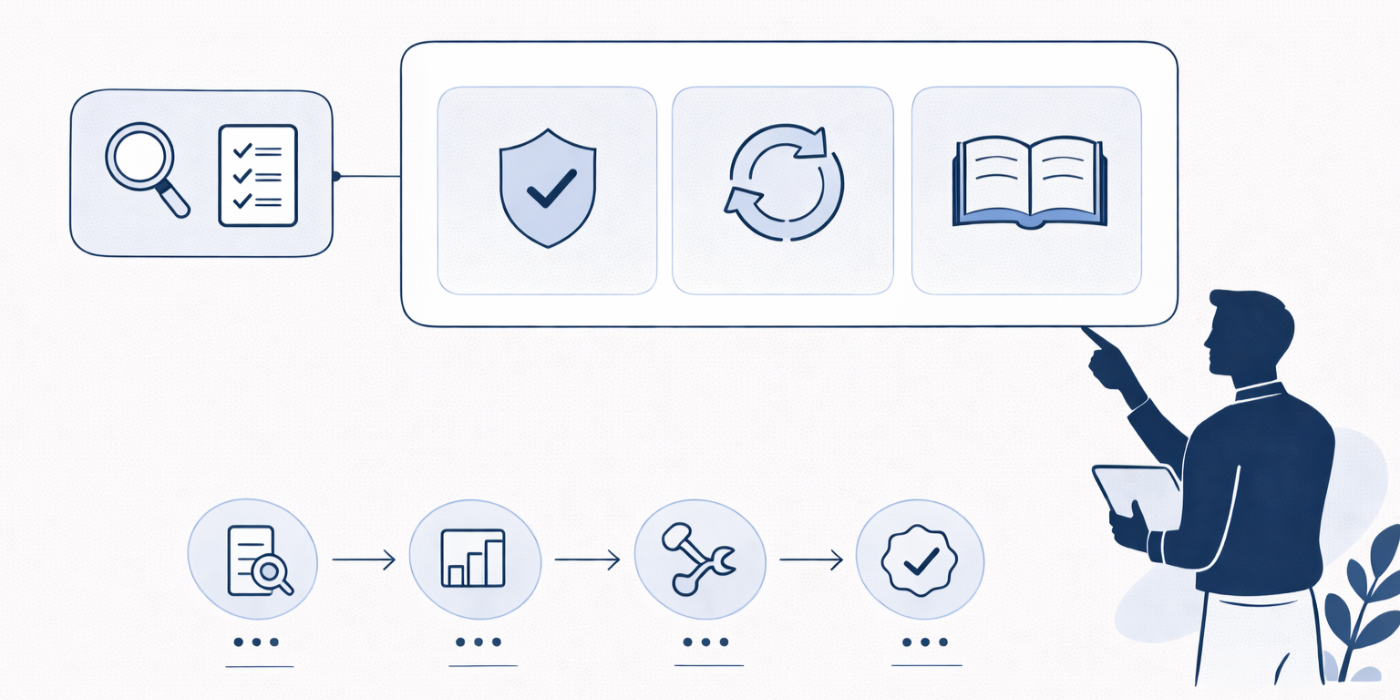
1. Why TQM Language Matters More Than Teams Realize
A project team can survive temporary schedule pressure. It can recover from a budget shock. It can even fight through a vendor problem. Quality decay is harder. It spreads quietly. A rushed approval here, a vague acceptance criterion there, a repeated defect blamed on “communication,” and suddenly the project is spending energy correcting work it already paid to complete. That is why TQM terminology matters. It gives teams a precise language for preventing sloppiness before it becomes normalized.
Total Quality Management is not a narrow quality assurance concept. It is a management philosophy that pushes quality into design, process control, leadership behavior, supplier expectations, customer feedback, measurement, and continuous improvement. When teams misunderstand that, they reduce TQM to inspection, forms, and end-stage corrections. That is the exact mindset that creates expensive rework. Real TQM lives much closer to essential project quality management terms defined, complete guide to six sigma terms for project managers, essential project communication terms & techniques, and critical project stakeholder terms every PM should master than many teams realize.
This matters for project managers because quality failure is rarely just a quality department problem. It hits scope credibility, schedule reliability, vendor confidence, customer satisfaction, and executive patience at the same time. Teams that already understand top 100 project management terms you must know, project initiation terms every project manager needs to understand, project risk management glossary, and project failure rates & root causes usually spot quality drift earlier because they understand the structural cost of vague standards.
This glossary focuses on the terms that turn quality from an abstract aspiration into something measurable, governable, repeatable, and defendable.
| Term | Meaning in Practice | Why It Matters | Typical PM Use |
|---|---|---|---|
| Total Quality Management (TQM) | Organization-wide approach to continuous quality improvement | Builds quality into the system | Used for culture and governance alignment |
| Customer focus | Prioritizing user needs and expectations | Prevents internally convenient but externally weak outcomes | Shapes requirements and acceptance standards |
| Continuous improvement | Ongoing effort to improve products and processes | Stops quality stagnation | Embedded in retrospectives and reviews |
| Kaizen | Small, continuous improvements over time | Builds sustainable gains | Used in process tuning |
| Quality policy | Formal statement of quality direction and intent | Aligns leadership expectations | Referenced in governance and audits |
| Quality objective | Specific measurable quality goal | Turns ambition into target | Used in planning and reporting |
| Quality planning | Defining standards, methods, and acceptance rules before work begins | Prevents ambiguity and rework | Builds criteria into delivery plans |
| Quality assurance (QA) | Process-focused activities that build confidence in quality | Prevents system-level weakness | Audits, standards checks, process review |
| Quality control (QC) | Product-focused checks on outputs | Catches defects before release | Testing, inspection, validation |
| Defect | Failure to meet a requirement or standard | Signals quality breakdown | Logged and analyzed for correction |
| Nonconformance | Deviation from a specified requirement | Supports formal corrective action | Audit and compliance workflows |
| Root cause analysis | Method for finding the underlying source of a problem | Prevents repeat failure | Used after recurring defects or escapes |
| Corrective action | Action taken to remove the cause of an existing problem | Stops recurrence | Assigned in issue resolution |
| Preventive action | Action taken to stop a potential problem before it occurs | Reduces future defect exposure | Used in risk and process reviews |
| Standard operating procedure (SOP) | Documented standard way of performing work | Improves consistency | Supports onboarding and audits |
| Process capability | Ability of a process to meet required output consistently | Reveals whether the system can deliver stable quality | Used in process evaluation |
| Variation | Differences in process or output performance | Exposes inconsistency | Tracked through metrics and control charts |
| Common cause variation | Normal built-in variation within a process | Indicates systemic improvement need | Used in process redesign discussions |
| Special cause variation | Unexpected variation caused by a specific factor | Supports fast targeted intervention | Used in anomaly analysis |
| Benchmarking | Comparing performance against best practices or peers | Reveals improvement gaps | Used in maturity reviews |
| Voice of the customer (VOC) | Captured customer needs, expectations, and pain points | Anchors quality to real user value | Used in requirements and improvement work |
| Acceptance criteria | Conditions that define acceptable output | Stops subjective approval | Embedded in scope and QA planning |
| Audit | Formal review of compliance with standards or procedures | Improves accountability | Used in governance and supplier review |
| Control chart | Visual tool for monitoring process stability over time | Shows whether variation is normal or alarming | Used in process monitoring |
| Pareto analysis | Technique for identifying the few causes driving most problems | Focuses effort where it matters most | Used in defect trend review |
| PDCA cycle | Plan-Do-Check-Act improvement loop | Structures continuous improvement | Used in pilots and process upgrades |
| Quality culture | Shared behaviors and beliefs that reinforce quality | Determines whether standards survive pressure | Influenced by leadership and daily habits |
| Supplier quality management | Managing vendor quality performance and compliance | Prevents external defects from entering delivery | Used in procurement and contract oversight |
2. Core TQM Terms That Build the Foundation of Quality Discipline
The starting point is Total Quality Management itself. TQM is an organization-wide approach to quality that insists quality is everybody’s responsibility, not just the job of reviewers or inspectors. That shift matters. Once quality is treated as a final checkpoint instead of a system property, the project starts discovering problems after the cost of fixing them has already gone up.
Customer focus sits at the center of TQM. Teams can meet their internal checklist and still fail the customer badly. That happens when quality gets defined around convenience for the producer instead of usefulness for the user. Strong project managers therefore connect TQM with project communication techniques, project stakeholder terms, project management careers in healthcare, and future of project governance, because quality expectations shift across industries, stakeholders, and governance environments.
Then comes continuous improvement, often expressed through Kaizen. This is the discipline of improving processes in ongoing, practical ways rather than waiting for dramatic rescue plans after quality collapses. Teams that ignore small corrections usually end up needing expensive ones later. A small recurring approval bottleneck, a confusing handoff template, or a loosely defined review criterion may look harmless in one cycle. Across a full project, those weaknesses compound into delay, rework, and morale drag.
A quality policy states the organization’s direction and intent around quality. A quality objective turns that intent into something measurable. Together, they help teams move from slogans to standards. This is especially important on projects where leadership wants “high quality” but never defines what that means in terms of defect rates, response times, first-pass acceptance, or supplier performance.
Finally, understand quality planning, quality assurance, and quality control as distinct but connected concepts. Quality planning defines standards and methods before work starts. QA focuses on whether the process is strong enough to produce quality consistently. QC checks the output itself. A PM who blurs those three will chase defects forever instead of fixing the system that generates them.
3. Defect, Variation, and Process Terms That Expose Hidden Quality Failure
A defect is a failure to meet a requirement. Simple. Brutal. Costly. Every defect is not equally severe, but repeated defects always tell a story about process weakness, vague requirements, poor training, weak supplier discipline, or rushed execution. A nonconformance is a deviation from a specified requirement, often used in more formal audit or compliance settings. Knowing the difference helps teams document quality problems accurately and choose the right response path.
This is where root cause analysis becomes essential. Weak teams fix the symptom and move on. Strong teams ask why the failure happened, why it was not prevented earlier, why it was not detected sooner, and what system weakness allowed it to recur. That mindset connects directly with project risk management glossary, top 25 risk identification & assessment terms, project issue tracking software, and best document management software for project teams, because quality failures become much easier to correct when the evidence trail is clean.
A corrective action removes the cause of an existing problem. A preventive action stops a possible future problem before it occurs. Teams often over-celebrate corrective action because it feels concrete and urgent. Preventive action is more valuable long term. It reduces the need for firefighting and helps quality survive periods of pressure.
Then there is variation. TQM treats variation seriously because inconsistency is the breeding ground for defect escape. Common cause variation comes from the process itself. It is built into the system. Special cause variation comes from specific abnormal factors, such as a tool failure, a one-off staffing issue, or an unusual supplier batch. If a project manager cannot distinguish between the two, the response gets distorted. Systemic problems get treated as isolated exceptions, while isolated disruptions get overengineered into unnecessary process change.
That is why terms like process capability, control chart, and standard operating procedure matter. They tell you whether quality is stable, whether variation is normal or alarming, and whether work is being performed consistently enough to deserve trust.
Quality collapses fastest when teams are forced to move quickly without clear standards, stable processes, or the courage to reject weak output.
4. Improvement and Measurement Terms That Make TQM Operational
TQM becomes real when improvement is structured. One of the most useful terms here is the PDCA cycle: Plan, Do, Check, Act. It gives teams a disciplined loop for testing changes instead of launching quality fixes based on frustration alone. A process gets planned carefully, implemented at a manageable scale, evaluated honestly, and then standardized or adjusted based on evidence.
Another key term is Pareto analysis. This helps identify the small number of causes driving the majority of problems. Teams waste massive energy treating every quality issue as equally important. Usually they are not. A few recurring weaknesses often create most of the pain. That is why TQM is powerful. It pushes attention toward the areas with the greatest corrective value.
Benchmarking matters because teams are often too impressed by their own internal standards. A process can look disciplined inside one department and still lag badly against stronger teams, stronger industries, or stronger competitors. Benchmarking helps break that complacency. It also supports better tool and process choices, especially when paired with project reporting & analytics software, dashboard & data visualization tools, knowledge management software, and automation tools for project management efficiency.
Do not overlook voice of the customer (VOC) either. Quality becomes dangerously inward-looking when teams define success only through internal compliance. VOC pulls the definition of quality back toward what users actually experience: responsiveness, clarity, reliability, ease, trust, fit-for-purpose output, and low-friction support. Projects that ignore VOC often deliver technically correct outcomes that still feel disappointing.

5. Leadership and Culture Terms That Determine Whether TQM Survives Pressure
The hardest part of TQM is not terminology. It is behavior. That is why quality culture matters. Quality culture is the shared belief that standards matter even when deadlines tighten, stakeholders push for shortcuts, and defects are politically inconvenient to surface. Without that culture, quality systems become decorative. The templates exist. The reviews exist. The leadership language exists. The standards still collapse under pressure.
A project manager influences quality culture more than many realize. The PM decides whether weak output is challenged, whether rework causes are documented, whether suppliers are held to standard, whether acceptance criteria are enforced, and whether schedule recovery comes at the cost of future defects. Those choices shape the team’s quality reflexes. This is where TQM links closely with team building terminology for PMs, human resource management terms in PM, future role of the PMO, and future project manager skills needed by 2030.
Another critical term is supplier quality management. Many projects fail quality targets through external partners long before internal teams realize the depth of the problem. If vendor reviews are soft, specifications are vague, acceptance conditions are weak, or contract language does not protect quality expectations, defects enter the project from outside and then spread inward. That is why quality management cannot be separated from procurement discipline.
The final practical anchor is acceptance criteria. If quality standards are not translated into specific, testable acceptance conditions, then approval becomes subjective and politics starts replacing discipline. That is where projects lose the argument. Clear acceptance criteria let a PM defend quality decisions without sounding personal or obstructive. The work either meets the standard or it does not.
6. FAQs About Total Quality Management Terms
-
The core idea is that quality should be built into the entire system, not inspected into the final output. TQM treats quality as a shared management responsibility tied to process design, leadership, customer expectations, and continuous improvement.
-
Quality assurance focuses on the processes used to create the work. Quality control focuses on the output produced. QA asks whether the system is strong enough. QC asks whether the result meets the standard.
-
Variation signals inconsistency. Inconsistent processes produce unpredictable output, which leads to defects, rework, and weak customer confidence. TQM aims to understand, reduce, and manage variation before it turns into visible failure.
-
It prevents teams from treating symptoms as solutions. Without root cause analysis, the same defect often returns in a new form because the underlying process weakness was never addressed.
-
It helps PMs create clearer standards, stronger acceptance logic, better defect prevention, more reliable supplier oversight, and stronger stakeholder confidence. It also reduces costly rework and quality-related schedule drift.
-
Corrective action responds to a problem that already happened. Preventive action addresses a weakness that could create a future problem. The first stops recurrence. The second reduces the chance of failure appearing at all.
-
Because speed often gets rewarded more visibly than consistency. If leadership praises rapid delivery while quietly tolerating rework and defect escape, the team learns that quality is negotiable when pressure rises.
