
Essential Project Closure Terms and Concepts
Projects rarely fail at the finish line because teams stop caring. They fail there because closure gets treated like admin work instead of value protection. Deliverables may be live, invoices may be sent, and the sponsor may already be focused on the next priority, yet unresolved scope items, weak acceptance records, open risks, poor handoffs, and missing lessons can quietly damage trust long after “done” is announced.
Strong project managers know closure is where execution becomes proof. It is where benefits get protected, disputes get reduced, vendors get finalized, knowledge gets retained, and teams leave a clean record behind. Mastering project closure terminology helps you close faster, defend decisions better, and prevent the kind of loose ends that create expensive rework, audit pain, and stakeholder frustration months later.
1. Why Project Closure Terminology Matters More Than Most Teams Realize
Many project managers build strong habits around initiation, planning, risk management, stakeholder management, and project scheduling, then treat closure as a short final meeting plus a few archived files. That mistake is expensive. Closure terms define the last layer of control over scope, money, obligations, accountability, and knowledge. When a PM cannot clearly explain the difference between final acceptance, administrative closure, contract closure, residual risk, and post-implementation review, the closeout process becomes loose, slow, and vulnerable to conflict.
Closure terminology also improves stakeholder communication. A sponsor may think “we’re done” means benefits are now owned by the business. Procurement may think “we’re done” means the vendor can invoice the balance. Operations may think “we’re done” means support documentation is complete. Finance may think “we’re done” means committed costs are fully reconciled. These meanings collide when language is weak. That is why strong PMs use precise closure language just as carefully as they use budgeting terms, cost management terms, quality management terms, and communication techniques.
There is another reason this matters. Closure is where future credibility is won or lost. A PM who finishes delivery but leaves unclear warranties, undocumented lessons, unresolved defects, or messy handoffs often gets blamed later for failures that surfaced after the team moved on. Hiring panels and senior leaders notice this. They want project managers who can finish cleanly, defend the record, and protect organizational memory. That skill sits beside issue tracking discipline, contract management terminology, procurement fluency, and knowledge management.
| Closure Term | What It Means in Practice | Why It Matters | Common Artifact / Signal | Main Stakeholders |
|---|---|---|---|---|
| Administrative closure | Formal completion of records, approvals, documentation, and reporting. | Creates an auditable finish instead of a vague verbal ending. | Closure checklist, signed records | Sponsor, PMO, governance |
| Contract closure | Completion of all vendor obligations, payments, claims, and acceptance steps. | Prevents legal, payment, and warranty disputes. | Final invoice approval, contract closeout file | Procurement, legal, vendor |
| Final acceptance | Formal confirmation that deliverables meet agreed requirements. | Stops endless “one more fix” arguments. | Acceptance certificate, sign-off email | Client, sponsor, business owner |
| Transition to operations | Handoff of ownership from project team to BAU or support teams. | Reduces post-launch chaos and orphaned work. | Handover plan, support model | Operations, service owner, PM |
| Operational readiness | Evidence that users, systems, support, and controls are ready to run live. | Protects adoption and service continuity. | Readiness checklist, go-live checklist | Ops, IT, business leads |
| Benefit transition | Movement of benefit tracking from project to business ownership. | Keeps value measurement alive after delivery. | Benefits register, owner assignment | Sponsor, finance, business owner |
| Lessons learned | Structured capture of what helped, hurt, and should change next time. | Turns cost into institutional knowledge. | Retrospective summary, lessons log | Team, PMO, leadership |
| Post-implementation review | Assessment after launch to compare planned versus actual outcomes. | Finds performance gaps that closure meetings miss. | PIR report | Sponsor, PMO, business owner |
| Closeout report | Summary of objectives, results, issues, finances, and recommendations. | Becomes the official historical record. | Final project report | Sponsor, PMO, auditors |
| Residual risk | Risk remaining after project actions are complete. | Prevents hidden exposure from being forgotten at handoff. | Residual risk log | Risk owner, ops, sponsor |
| Open issue transfer | Movement of unresolved issues into support or business ownership. | Keeps unfinished problems visible and owned. | Issue transfer log | Service desk, ops, business lead |
| Warranty period | Defined period in which defects are corrected after delivery. | Clarifies post-delivery accountability. | Warranty clause, support window | Vendor, client, PM |
| Defect liability | Responsibility for correcting faults discovered after completion. | Protects the buyer from rushed or weak delivery. | Defect log, liability clause | Legal, vendor, procurement |
| Knowledge transfer | Passing critical know-how, procedures, and context to the receiving team. | Prevents dependency on departing project staff. | Runbook, SOP, training deck | Ops, trainers, SMEs |
| Release of resources | Formal reassignment of people, tools, budget, and facilities. | Improves portfolio efficiency and staffing visibility. | Resource release note | PMO, line managers, finance |
| Final financial reconciliation | Comparison of actual cost, committed cost, and remaining obligations. | Stops budget leakage and late surprises. | Final budget statement | Finance, sponsor, PM |
| Cost variance at completion | Difference between final approved budget and actual spend. | Feeds forecasting accuracy for future work. | Variance analysis | Finance, PMO |
| Schedule variance at closure | Gap between baseline finish date and actual finish date. | Shows planning and execution realism. | Baseline vs actual timeline | PMO, sponsor |
| Scope verification | Check that delivered work matches approved scope and change history. | Prevents silent omissions and disputed extras. | Requirements traceability, scope checklist | Client, PM, QA |
| Configuration closure | Final confirmation of released versions, assets, and baselined items. | Protects technical integrity and traceability. | CMDB update, release record | IT, engineering, ops |
| Document archiving | Storage of contracts, plans, approvals, and evidence in a controlled repository. | Makes audits, disputes, and future reuse easier. | Archive index, folder structure | PMO, compliance, legal |
| Stakeholder sign-off | Recorded approval from required decision-makers at closure. | Reduces later claims of misalignment. | Signature page, approval workflow | Sponsor, client, steering group |
| Customer satisfaction review | Evaluation of delivery quality, responsiveness, and overall experience. | Improves repeat business and reputation. | Survey, feedback interview | Client, account lead |
| Compliance closeout | Confirmation that regulatory, policy, and audit requirements are satisfied. | Prevents late compliance exposure. | Compliance checklist, audit evidence | Compliance, legal, sponsor |
| Claim waiver | Agreement that no further claims will be raised after settlement. | Protects against lingering vendor disputes. | Waiver, settlement document | Procurement, legal, vendor |
| Closure criteria | Defined conditions that must be true before the project can close. | Stops arbitrary declarations of completion. | Gate criteria, closeout checklist | Sponsor, PMO, PM |
| Success criteria validation | Check of whether intended business outcomes were actually achieved. | Separates activity completion from real success. | KPI review, outcome report | Sponsor, business owner, finance |
| Formal closure approval | Official authorization that the project is complete and governance is satisfied. | Provides the final decision record. | Closure memo, board approval | Sponsor, PMO, steering committee |
2. Core Project Closure Terms Every PM Must Understand
A good closeout starts with administrative closure. This term refers to the formal completion of project records, approvals, documentation, and governance requirements. It sounds simple, yet this is where many teams struggle. Files sit in personal drives, approvals live in chat threads, action items remain unassigned, and the project exists in a gray zone where nobody is certain whether it is truly complete. PMs who understand administrative closure create structured evidence and remove ambiguity.
Contract closure is narrower and equally important. It focuses on vendor obligations, deliverable acceptance under the contract, final payments, claims, penalties, warranties, and legal release conditions. Teams that confuse project closure with contract closure often discover too late that a supplier still has unresolved obligations or that final settlement was processed without proper acceptance evidence. Anyone working across external vendors should pair this concept with strong knowledge of procurement terms, contract lifecycle tools, procurement management tools, and project reporting.
Final acceptance is the formal acknowledgment that the deliverable meets agreed requirements. This is not the same as “the team seems happy” or “the sponsor saw the demo.” Final acceptance must be tied to requirements, scope changes, quality thresholds, and agreed acceptance criteria. That makes requirements control, quality management, risk identification, and issue tracking critical inputs even at the very end.
Then comes transition to operations. This is the movement of ownership from the project team to the business, support, or service function that will run the result. If this handoff is weak, users face confusion, support queues spike, and the project team gets dragged back into emergency firefighting. Operational readiness, knowledge transfer, support model definition, training completion, and document availability all sit under this area. PMs who want stronger handoffs benefit from mastering team building terminology, human resource management terms, document management software, and calendar and scheduling tools.
Residual risk is another term many teams underplay. It refers to the exposure that remains after project actions are complete. Some risks cannot be eliminated; they must be owned. A mature closeout makes that ownership visible. Otherwise, risks quietly disappear from discussion until they reappear as incidents. Residual risk belongs in the closure pack beside open issue transfer, benefit ownership, and post-implementation review scheduling. This is where fluency in risk management glossaries, critical path thinking, dashboard tools, and reporting software pays off.
Lessons learned and post-implementation review are often mentioned together, but they are not identical. Lessons learned capture insight during and at the end of delivery. A post-implementation review looks at what happened after launch and compares expected results to actual results. One improves future execution. The other tests whether the business case held up in the real world. Strong PMs use both. That discipline connects naturally to project success research, project failure analysis, methodology adoption data, and the wider project management career roadmap.
3. The Most Important Closure Deliverables and What Good Looks Like
A closeout report is one of the most valuable deliverables in project closure. Weak versions are generic summaries that say the project delivered its objectives and thank everyone for the effort. Strong versions explain what was delivered, what changed from baseline, which major risks materialized, where cost and schedule landed, what business outcomes are already visible, what still needs monitoring, and what the next team should never repeat. That level of specificity turns a report into a reusable asset. It works even better when supported by reporting tools, analytics software, knowledge management platforms, and disciplined communication techniques.
The acceptance package is another critical deliverable. Good PMs do not wait until the final week to assemble sign-off evidence. They build it progressively. That package may include requirements traceability, testing outcomes, change approvals, defect summaries, exceptions, and the named approver’s formal decision. When final acceptance is rushed, scope disputes often surface later from missing evidence rather than missing work. This is where familiarity with quality terms, project initiation discipline, Scrum roles and responsibilities, and Agile versus traditional methods helps the PM translate delivery evidence across different environments.
Financial reconciliation deserves more attention than it usually gets. Final cost should show actual spend, outstanding liabilities, released contingencies, unused budget, and any settlement decisions. A PM who cannot explain where the final numbers came from weakens trust with sponsors and finance teams. Accurate closure here depends on mastery of budget tracking tools, budgeting terms, cost management terms, and broader salary and market trend awareness when resource costs and staffing decisions are under review.
A handover pack should also be treated as a core deliverable, not an attachment dumped into a folder. A strong handover pack includes operating instructions, support contacts, escalation paths, known limitations, unresolved issues, maintenance needs, warranty terms, training artifacts, and key decision history. That kind of pack reduces panic in the first weeks after launch. It also protects the project manager from being dragged into “ownership confusion” long after closure. Teams often improve this area with document management software, mobile collaboration apps, automation tools, and productivity software.
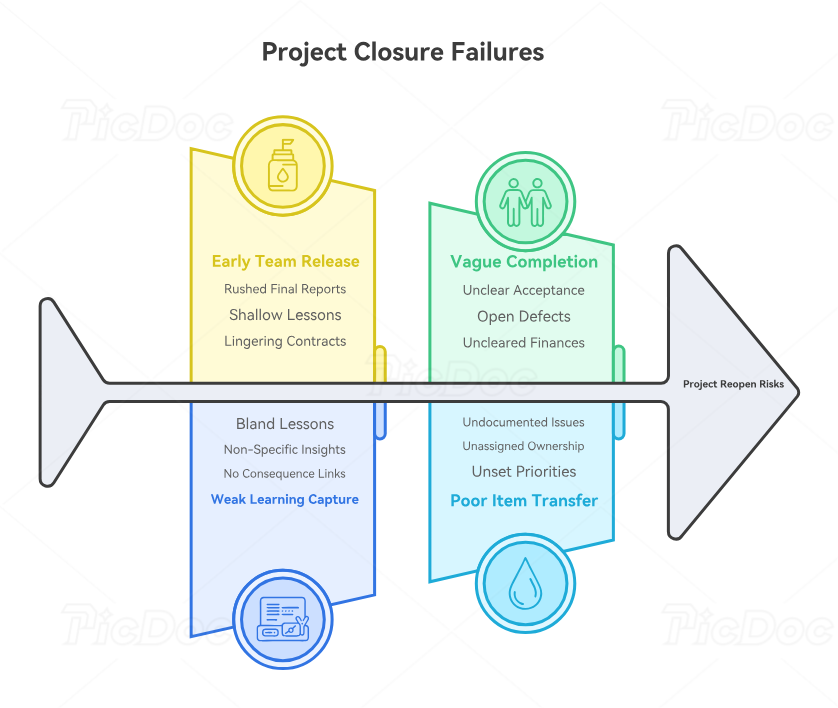
4. Common Project Closure Failures That Keep Creating Rework
One of the biggest closure failures is vague completion language. Teams say the project is “complete enough,” “basically done,” or “ready to hand over,” yet none of those phrases identify whether acceptance has been granted, whether defects remain open, whether financial obligations are cleared, or whether support ownership has actually transferred. Projects then reopen through side channels. A business lead escalates missing behavior. A vendor disputes withheld payment. An operations team rejects ownership. Strong PMs reduce this by linking scope evidence to requirements and initiation discipline, quality management, communication controls, and stakeholder alignment.
Another common failure is closing without transferring unresolved items properly. Not every issue will be solved before closure. That is normal. What damages projects is failing to document what remains, who owns it, what priority it carries, and what response time is expected. Unassigned loose ends become organizational ghosts. Months later, nobody can explain whether the project failed, support failed, or the business simply accepted the risk. That is why mature teams combine issue tracking software, document repositories, knowledge management tools, and dashboard visibility to make ownership explicit.
A third failure appears when the project team gets released too early. Leadership wants scarce resources back. The next initiative is already understaffed. The sponsor assumes the remaining admin work is small. Then closeout quality drops sharply. Final reports become rushed, lessons are shallow, contract paperwork lingers, and important context leaves with the team. PMs need the confidence to defend closure effort as real delivery work. This is easier when they can connect closeout discipline to resource allocation thinking, team management, productivity systems, and the broader career expectations for project leaders.
The last major failure is weak learning capture. Teams often write bland lessons like “communicate earlier” or “engage stakeholders more.” That language sounds respectable and teaches nothing. Useful lessons are specific, situational, and tied to consequences. For example: procurement lead time for a specialized vendor was underestimated by four weeks, causing schedule compression and rushed testing; next project should include legal review trigger at draft SOW stage and baseline supplier lead times during planning. That level of detail supports better procurement management, contract practices, schedule realism, and future PM capability development.
5. How to Build a Closure Process That Leaves Nothing Important Behind
Start closure planning early. The best time to define closeout evidence is not the last week of the project. It is during planning, when acceptance criteria, sign-off roles, reporting expectations, contract conditions, and operational handoff needs can still be designed into the work. Experienced PMs know closure is easier when the team has already built good habits around project initiation, risk assessment, budget control, and stakeholder governance.
Next, separate closure into workstreams. Treat acceptance, finance, vendor closeout, documentation, lessons learned, handover, and governance approval as distinct lines of work with owners and deadlines. That prevents the classic problem where one finished area masks another neglected one. Some PMs manage this with Gantt tools, calendar tools, mobile apps, and automation platforms so closeout tasks stay visible rather than disappearing under “miscellaneous.”
Use a formal closure checklist tied to evidence, not vague statements. “Training complete” should point to attendance, materials, and operational sign-off. “Vendor complete” should point to obligations met, claims reviewed, and final payment status. “Benefits transferred” should point to named owners and review dates. “Lessons learned captured” should point to actions that can change future practice. Checklists work best when stored in strong document systems, connected to knowledge bases, and reported through analytics tools.
Finally, insist on a real closing conversation with stakeholders. This is not a thank-you call. It is a decision forum. Confirm what was delivered, what changed, what remains open, what is being accepted, who owns residual items, when the post-implementation review will occur, and when the project record becomes final. That is the kind of professional closure that strengthens careers. It signals readiness for bigger roles such as government project manager, project portfolio manager, project management director, or even chief project officer.
6. FAQs About Project Closure Terms and Concepts
-
Project completion usually means the work or deliverables have been produced. Project closure is broader. It includes formal acceptance, documentation, financial reconciliation, contract closeout, handover, lessons learned, and governance approval. A project can be technically complete while still being poorly closed. PMs who understand this distinction usually perform better in project reporting, stakeholder communication, quality management, and career advancement paths.
-
Final acceptance is the point where the customer or sponsor formally confirms that deliverables meet agreed requirements. Without it, closure rests on assumptions. That creates a dangerous opening for later disputes over scope gaps, defects, payment release, and accountability. Strong acceptance discipline depends on earlier rigor in initiation, risk management, issue tracking, and procurement control.
-
A useful closeout report includes objectives achieved, scope changes, major risks and issues, final budget and schedule performance, acceptance status, unresolved items, residual risks, lessons learned, handover details, and recommendations for future projects. Generic reports waste the opportunity. Specific reports build organizational memory. They are even more powerful when combined with knowledge management systems, document management tools, data visualization tools, and project failure insights.
-
Residual risk is the exposure that remains after all planned project responses have been applied. It matters because closure does not erase risk. It changes ownership. If residual risk is not documented and transferred clearly, the receiving team inherits uncertainty without context. Mature PMs track this carefully and align it with risk identification practices, stakeholder accountability, governance discipline, and future leadership capability.
-
Start early, define receiving owners, document support procedures, transfer unresolved issues clearly, train users, confirm readiness, and record escalation paths. Handover improves when PMs treat it as a managed workstream rather than a final-day package drop. Helpful enablers include mobile collaboration apps, productivity tools, document platforms, and project management software.
-
They serve different purposes. Lessons learned focus on execution insight that can improve future delivery. A post-implementation review checks whether the delivered solution produced the expected operational and business outcomes after launch. One sharpens how projects are run. The other tests whether success actually happened. Teams that use both become stronger over time, especially when they connect those reviews to success-rate research, failure-rate analysis, methodology insights, and career development frameworks.
-
They confuse delivery with closure. The deliverable may be live, yet acceptance may be unclear, financials unreconciled, documents scattered, ownership unresolved, and lessons undocumented. That gap causes rework and erodes credibility. PMs who want to avoid it should strengthen communication controls, quality assurance habits, issue discipline, and governance capability.
