
Career Roadmap: From Scrum Master to Agile Project Management Consultant
Career Roadmap: From Scrum Master to Agile Project Management Consultant is less about “being good at Scrum” and more about becoming a trusted operator who can diagnose delivery systems, fix constraints, and prove outcomes in writing. Most Scrum Masters get stuck because they can facilitate—but can’t scope, price, sell, contract, or measure consulting work. This guide is built to close that gap with a step-by-step roadmap, proof assets, and a skill stack that hiring panels and clients actually reward—especially in regulated or enterprise environments.
1) The Real Gap Between “Scrum Master” and “Consultant”
A Scrum Master is often evaluated on team-level flow: ceremonies, blockers, and coaching habits. A consultant is evaluated on business-level change: governance, portfolio alignment, risk, procurement, stakeholder conflict, and measurable results. That shift is why many transitions fail: the market doesn’t pay for “Agile enthusiasm”—it pays for reduced cycle time, fewer escalations, predictable delivery, and leadership trust.
Here’s the uncomfortable truth: you can be an excellent facilitator and still be a weak consultant if you can’t do four things:
Diagnose why delivery is failing (work intake, dependencies, decision latency, funding model, incentives, tooling, compliance).
Design an intervention that fits the org’s reality (not “textbook Scrum”). For modern orgs, this is often hybrid—and you must be fluent in it. Use this as your baseline: Rise of Hybrid Project Management: Why Agile & Waterfall Blend Is the Future.
Prove value with evidence (before/after metrics, risk reduction, audit-ready documentation). Tighten your language with stakeholder clarity from Critical Project Stakeholder Terms Every PM Should Master and message design from Essential Project Communication Terms & Techniques.
Operate commercially (scope boundaries, SOW, pricing, change control, renewals). If you don’t know how consulting businesses are actually built, start here: Ultimate Guide to Starting a Project Management Consultancy Firm and then layer the independence mindset from Career Roadmap: How to Build a Successful Freelance Project Management Career.
If you want to be paid like a consultant, your positioning must shift from “I run standups” to “I improve delivery economics.” That means you need proof assets (case studies, dashboards, charters, playbooks), better strategic vocabulary (portfolio + governance), and tooling fluency that makes implementation easy. The moment you can explain Agile change in the language of leadership, you become valuable—especially as orgs chase productivity and AI-driven changes described in Project Management 2030: Predicting the Next Decade’s Dominant Methodologies.
| Capability | What “Good” Looks Like | Business Impact | Signals / Tools | Who You Align With |
|---|---|---|---|---|
| Discovery | Runs structured interviews, maps symptoms to root causes, clarifies constraints, success metrics, and decision owners. | Fast clarity | Interview guide, problem statement | Sponsors |
| Engagement design | Defines phases, gates, deliverables, and meeting architecture that produces approvals (not endless alignment loops). | Less churn | Milestone plan, gate checklist | PMO |
| Scope control | Baseline scope + traceable change control; no “silent scope”; explicit tradeoffs for time/cost/quality. | Fewer overruns | Change log, scope baseline | Owners |
| Governance cadence | Decision rights, escalation rules, and steering cadence that removes decision latency. | Faster decisions | RACI, steering pack | Sponsor |
| Portfolio alignment | Connects work to outcomes/funding; prevents local optimization; ensures priorities don’t shift weekly without rationale. | Higher ROI | OKRs, portfolio map | Finance |
| Work intake | Single intake path + triage rules so “urgent” doesn’t destroy WIP limits and predictability. | Less thrash | Intake workflow, triage board | Ops |
| Flow metrics | Uses cycle time, throughput, WIP, aging work, blocked time—then targets interventions where data shows constraint. | Predictability | CFD, aging chart | Delivery |
| Dependency mgmt | Surfaces dependencies early; defines handshake agreements; schedules integration checkpoints before deadlines. | Fewer delays | Dependency board | Architects |
| Risk mgmt | Quantifies delivery risks, assigns owners/dates, and tracks mitigation effectiveness—not “hope.” | Less firefighting | RAID log | Leads |
| Stakeholder mgmt | Aligns expectations, documents decisions, resolves conflict, and prevents priority flips that trigger rework. | Lower churn | Comms plan, decision log | Business |
| Backlog quality | Hard standards for readiness and acceptance criteria; slices work to reduce batching and hidden work. | Less waste | DoR/DoD | Team |
| Forecasting | Forecasts with throughput + variability; communicates ranges; maintains credibility under uncertainty. | Trust | Forecast model | Execs |
| Hybrid delivery | Blends governance + Agile execution; keeps compliance/approvals without killing flow. | Adoption success | Hybrid playbook | PMO |
| Compliance literacy | Builds audit-ready documentation, control evidence, and traceability without adding bureaucracy. | Lower exposure | Control matrix | Risk |
| Procurement fluency | Understands bid timelines, SOW structures, contract constraints, and vendor onboarding realities. | Fewer delays | RFP calendar, SOW checklist | Procurement |
| Vendor mgmt | Defines acceptance criteria + review cadence; manages SLAs, escalation, and deliverable leakage. | Less leakage | Vendor scorecard | Partners |
| Tooling strategy | Aligns tools to workflow; removes reporting theater; standardizes data definitions for reliable dashboards. | Less overhead | Tool map | Ops |
| Reporting | Exec-ready signals: risks, decisions, outcomes, flow—written for action, not “project vibes.” | Faster action | Weekly exec brief | Execs |
| Change adoption | Enablement plan + guardrails; designs rituals that survive after you leave. | Durable change | Enablement plan | Managers |
| Leadership coaching | Teaches leaders how to run system-level Agile, remove constraints, and stop micro-management patterns. | Culture shift | Leader workshops | C-suite |
| Facilitation | Runs high-stakes sessions: prioritization, tradeoffs, conflict, decision-making under uncertainty. | Momentum | Workshop plan | Cross-func |
| Value mgmt | Turns features into outcomes; tracks benefits; prevents “delivery = success” illusions. | ROI clarity | Benefits map | Finance |
| Pricing & packaging | Productizes offers; tiered scope; clear boundaries that protect profitability and simplify buying. | Higher close rate | Offer sheet | Buyers |
| Proposal writing | Converts diagnosis → plan → deliverables → metrics → terms; makes “yes” easy for stakeholders. | More wins | Proposal template | Decision group |
| Contract hygiene | Acceptance criteria, change clauses, payment milestones, and escalation—so scope doesn’t explode. | Less dispute | SOW + MSA | Legal |
| Measurement | Baseline + targets + weekly progress reporting; ties work to outcomes executives can defend. | Proof | KPI sheet | Sponsor |
| Executive narrative | Tells a clean story: problem → constraint → intervention → results; builds trust and renewals. | Trust | Exec narrative | Execs |
| Exit strategy | Leaves playbooks, training, ownership, and a sustainment plan—so success doesn’t depend on you. | Referrals | Handover pack | Client leads |
This is built to match the APMIC blue theme: navy title bar + light cyan-blue header row + soft blue borders + pill outline.
2) Build a Consultant-Grade Skill Stack
To move up-market, you must become bilingual: Agile execution + project governance. Clients don’t hire you to “increase Agile maturity” in the abstract—they hire you to stop delivery pain: missed dates, surprise dependencies, stakeholder fights, audit risk, bloated backlogs, status chaos, tool sprawl, and teams drowning in meetings.
Core domains you must master (and how to prove them)
A) Governance that doesn’t kill speed
Most orgs aren’t anti-Agile—they’re anti-surprise. Learn decision gates, change control, and executive reporting. Strengthen your leadership path with Career Roadmap: How to Become a Project Management Director and the executive lens in Step-by-Step Guide: From Project Manager to Vice President of PM. When you can walk a sponsor through tradeoffs with clean documentation, you become the adult in the room.
B) Portfolio thinking (not just team rituals)
Consultants get pulled into prioritization fights. Expand beyond a single team by learning portfolio mechanics and benefits tracking. Use Ultimate Guide to Becoming a Project Portfolio Manager to build your language for funding, prioritization, and value. Then align your “Agile change” narrative with where the industry is going via Future of Project Portfolio Management (PPM): Top Trends for 2025–2030.
C) Tooling literacy that enables evidence
If you can’t measure flow and show executive-ready signals, your advice sounds like opinion. Know what modern PM stacks look like and why they fail. Learn reporting depth from Best Project Reporting & Analytics Software for PMs and dashboard clarity from Top Dashboard & Data Visualization Tools for Projects. If your proof assets live in chaos, tighten documentation with Best Document Management Software for Project Teams and workflow structure with Definitive Guide to Project Issue Tracking Software (2025).
D) Procurement and contracting (where many Agile consultants lose money)
Enterprise clients will judge you on procurement readiness—SOW structure, acceptance criteria, and change clauses. Build this muscle with Best Procurement Management Tools for Project Managers and contract workflow fluency with Top Contract Lifecycle Management (CLM) Software Reviewed (2025). You don’t need to be a lawyer—you need to avoid scope traps.
E) Scrum evolution literacy
Clients don’t want 2015 Scrum; they want results under 2026 constraints: distributed teams, security reviews, AI tooling, governance pressure. Keep your Scrum narrative modern via Predicting the Evolution of Scrum: Changes & Innovations Coming by 2027.
3) The Step-by-Step Roadmap to Your First Consulting Engagement
Most people try to “become a consultant” by updating a title on LinkedIn. That’s why they get ignored. This roadmap builds credibility in proof-first order: assets → positioning → offers → pipeline → delivery.
Step 1: Choose a consulting lane (so buyers can place you)
“Agile consultant” is too vague. Pick a lane where pain is obvious and outcomes are measurable:
Delivery recovery (projects slipping, dependency chaos, exec distrust)
Hybrid transformation (PMO governance + Agile delivery integration)
Agile program setup (multi-team cadence, metrics, operating model)
Portfolio + prioritization (intake, triage, benefits, governance)
Tooling + reporting overhaul (dashboards, data quality, decision signals)
To sharpen your positioning and future-proof it, anchor it against macro-trends in Project Management Named Key Driver of Economic Growth (WEF 2025) and how modern environments reward adaptable approaches described in Economic Uncertainty Leads to Increased Demand for Agile PM (2025).
Step 2: Build 3 “proof assets” before you sell anything
Consulting buyers don’t trust adjectives; they trust artifacts.
Create these three assets (even if based on internal work you anonymize):
Agile Delivery Diagnostic (2–4 pages)
Symptoms, root causes, constraints, recommended interventions, and metrics.
Use stakeholder language from Critical Project Stakeholder Terms Every PM Should Master so executives read it quickly.
30-60-90 Day Intervention Plan
Week-by-week actions, decision points, deliverables, and expected deltas (cycle time, WIP, predictability).
Format the reporting as dashboard-ready using Top Dashboard & Data Visualization Tools for Projects.
Before/After KPI Snapshot (one page)
Baseline metrics + targets + how you’ll measure.
Support measurement decisions with Best Project Reporting & Analytics Software for PMs.
Step 3: Productize your offer (so scope doesn’t eat you alive)
Avoid “monthly Agile coaching” as your first offer—it’s vague and invites scope creep. Productize:
Diagnostic Sprint (2 weeks) → fixed price
Recovery Plan + Governance Setup (4–6 weeks) → fixed scope
Execution Support (8–12 weeks) → retainer with explicit deliverables
If you need the business mechanics, follow Ultimate Guide to Starting a Project Management Consultancy Firm and use independence tactics from Career Roadmap: How to Build a Successful Freelance Project Management Career.
Step 4: Build a tight pipeline (without begging for work)
Your first 3 clients come from proximity, not virality:
Ex-colleagues who trust you
PMO leaders who need a “fixer”
Product/engineering leaders with slipping initiatives
Vendors who need delivery leadership
Use one message framework: “I help X reduce Y by doing Z, measured by Q.”
Then attach one proof asset—never a resume.
Step 5: Deliver like a consultant (documentation + outcomes + handover)
Clients remember three things:
How quickly you created clarity
Whether you reduced chaos
Whether you left behind a system, not dependence
Document like a pro with Best Document Management Software for Project Teams, track execution discipline with Definitive Guide to Project Issue Tracking Software (2025), and run planning with scheduling fluency from Top Calendar & Scheduling Tools for Project Managers.
4) Certifications, Credibility Signals, and What Actually Moves the Needle
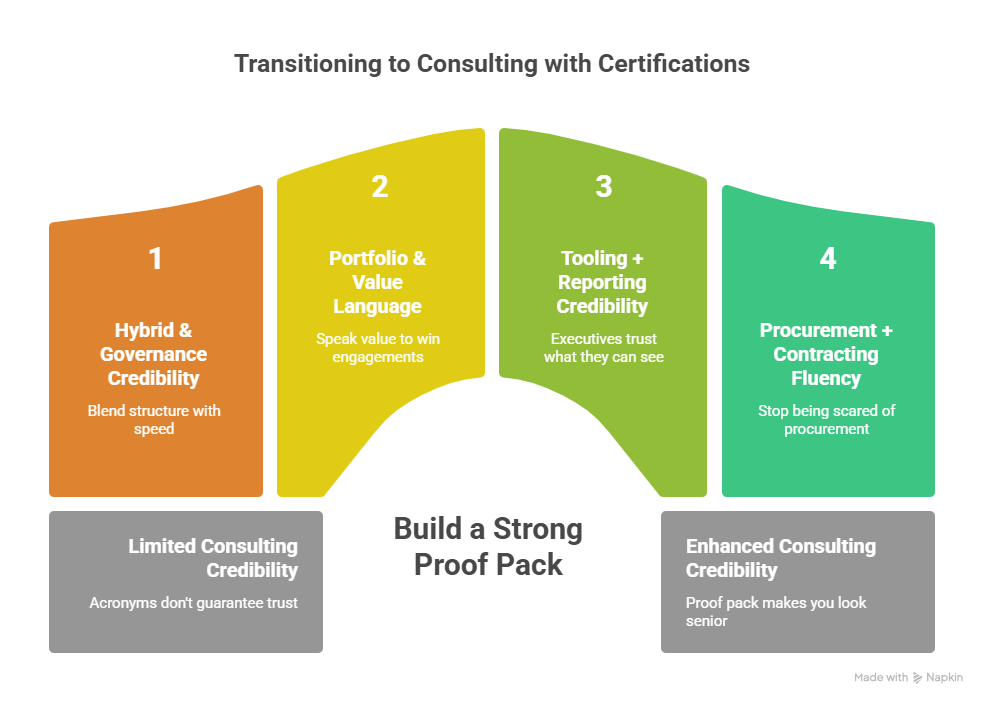
Certifications can help—but only when they support a clear consulting narrative. Buyers don’t pay for acronyms; they pay for reduced risk. Certifications are most powerful when they do one of these:
Signal credibility to enterprise buyers
Fill an obvious knowledge gap (governance, portfolio, domain)
Support your pricing (higher trust = higher fee)
The best “stack” for a Scrum Master → Consultant transition
1) Hybrid & governance credibility
If you’re aiming at enterprise transformation or PMO-facing work, your edge is the ability to blend structure + speed. Anchor your approach to modern reality with Rise of Hybrid Project Management and leadership-level pathways like Career Roadmap: How to Become a Project Management Director.
2) Portfolio and value language
Consultants who can speak value win bigger engagements. Use Ultimate Guide to Becoming a Project Portfolio Manager to strengthen prioritization, benefits, and governance—then future-proof with Future of PPM: Top Trends for 2025–2030.
3) Tooling + reporting credibility
Executives trust what they can see weekly. Learn what “good reporting” looks like with Best Project Reporting & Analytics Software for PMs, and build crisp dashboards using Top Dashboard & Data Visualization Tools for Projects. Then support your operational maturity with Best Document Management Software for Project Teams.
4) Procurement + contracting fluency
If you want bigger clients, you must stop being scared of procurement. Learn the tools and the language with Best Procurement Management Tools for Project Managers and reduce contract pain through Top Contract Lifecycle Management (CLM) Software Reviewed.
What matters more than certifications: your “proof pack”
A proof pack makes you look senior instantly:
1-page case study (problem → intervention → metrics)
Example governance pack (RACI, decision log, RAID)
Example dashboard (cycle time/WIP + risks + decisions)
Example SOW outline (deliverables + acceptance criteria + change clause summary)
If you’re unsure how to shape exec-friendly language, tighten your vocabulary with Essential Project Communication Terms & Techniques and stakeholder clarity via Critical Project Stakeholder Terms Every PM Should Master.
5) How to Price, Package, and Sell Your Consulting Without Getting Burned
The #1 pain point new consultants face is brutal: you do great work, but you underprice, allow scope creep, and end up resenting the client. Professional consulting is commercial design as much as delivery design.
Packaging that protects you and helps clients buy fast
Offer 1: Agile Delivery Diagnostic (Fixed Fee)
Deliverables:
Interviews + workflow review
Bottleneck map + dependency map
Baseline metrics + target metrics
30-60-90 plan + governance recommendations
Support deliverables using structured reporting guidance from Best Project Reporting & Analytics Software for PMs and document rigor from Best Document Management Software for Project Teams.
Offer 2: Recovery Implementation (Fixed Scope)
Deliverables:
Intake + prioritization improvements
Hybrid cadence + decision gates
Dependency management approach
Dashboard + executive narrative
Handover playbook
If your client environment is complex, ground your approach in modern blended delivery from Rise of Hybrid Project Management and long-term methodological evolution from Project Management 2030.
Offer 3: Executive Enablement Retainer (Monthly)
Deliverables:
Monthly governance + risk review
Leadership coaching sessions
Portfolio alignment support
Quarterly “operating model” improvements
This offer closes because it reduces leadership anxiety—not because it sounds “Agile.”
Pricing principles (the ones that stop you being underpaid)
Price against risk and outcome, not hours.
Your price increases when you reduce: delivery uncertainty, executive time waste, audit exposure, vendor leakage.
Protect yourself with acceptance criteria and change control—learn the mechanics via Top Contract Lifecycle Management (CLM) Software Reviewed and procurement workflows from Best Procurement Management Tools for Project Managers.
The sales conversation that wins
Stop “pitching Agile.” Run a diagnostic conversation:
What is slipping? What is costing money?
What decisions are delayed—and why?
What risks are hidden until late?
What does leadership need weekly to trust the plan?
What constraints cannot change? (compliance, vendors, release windows)
Then show your proof asset: a one-page sample diagnostic with outcomes and metrics. If you can explain the intervention and the measurement plan clearly, you’re already ahead of most candidates.
If you need help building pipeline and positioning, follow Career Roadmap: How to Build a Successful Freelance PM Career and the operating mechanics in Ultimate Guide to Starting a PM Consultancy Firm.
6) FAQs
-
If you already have enterprise exposure, you can be “consulting-ready” in 8–16 weeks—not by waiting for a title, but by building proof assets and productized offers. Your fastest path is: learn hybrid reality from Rise of Hybrid Project Management, build a diagnostic pack, and start selling a fixed-fee discovery engagement.
-
They sell “Agile coaching” instead of selling measurable outcomes. Buyers don’t want ceremonies; they want predictability, risk reduction, and executive clarity. Build dashboards and reporting discipline using Best Project Reporting & Analytics Software for PMs and Top Dashboard & Data Visualization Tools for Projects.
-
Not always—but you do need governance credibility. In many orgs, “Agile-only” roles get capped because leadership still needs decision gates, change control, and audit-ready documentation. Build your leadership lens with Career Roadmap: How to Become a Project Management Director and strengthen portfolio fluency via Ultimate Guide to Becoming a Project Portfolio Manager.
-
Anonymize. Show the structure, not the company: a sample diagnostic, a sample 30-60-90 plan, a sample governance pack, and a before/after metric snapshot without client identifiers. Store and present artifacts cleanly using Best Document Management Software for Project Teams.
-
You don’t need every tool—you need the categories that create proof and reduce chaos: issue tracking, reporting/dashboards, documentation, scheduling. Start with Definitive Guide to Project Issue Tracking Software (2025), then level up reporting via Best Project Reporting & Analytics Software for PMs and dashboards via Top Dashboard & Data Visualization Tools for Projects. If your clients are enterprise, add contract and procurement visibility through Top Contract Lifecycle Management (CLM) Software Reviewed and Best Procurement Management Tools for Project Managers.
-
Scope creep happens when you sell a feeling (“make us Agile”) instead of a deliverable set. Productize your work, define acceptance criteria, and enforce change control. Use contract workflow guidance from Top Contract Lifecycle Management (CLM) Software Reviewed and build your consulting business mechanics from Ultimate Guide to Starting a PM Consultancy Firm.
