
Freelance Project Management Future Trends
Freelance project management is no longer a fallback career path. Between 2025 and 2030, it will become a core delivery model for organizations navigating cost pressure, digital acceleration, and constant restructuring. As companies downsize permanent layers while scaling execution capacity on demand, they are turning to independent project leaders who can deliver outcomes without long-term overhead. Signals from workforce reductions, restructuring, and PMO redesigns discussed across APMIC coverage such as corporate PM structure changes and economic uncertainty driving agile demand point to a clear shift.
This article breaks down how the freelance PM market will evolve by 2030, where the real opportunities will sit, and why independent project managers who fail to adapt to ESG, AI, and portfolio-level thinking will be priced out. If you rely on generic scheduling skills alone, the next five years will be brutal. If you position yourself correctly, they will be career-defining.

1. Why Freelance Project Management Is Expanding Faster Than Traditional Roles
The expansion of freelance project management is not driven by preference. It is driven by structural necessity. Organizations are reducing permanent management layers while increasing the volume and complexity of change initiatives. This contradiction forces leaders to source execution capability externally. Trends highlighted in investment in project management software and digital transformation across PMOs show that companies want flexible execution without fixed headcount risk.
Freelance PMs offer three advantages internal teams often cannot. First, they bring rapid deployment. Second, they deliver outcome-focused accountability rather than career-driven politics. Third, they allow organizations to scale delivery capacity up or down without restructuring cycles like those described in workforce streamlining cases. This is especially attractive in volatile sectors such as construction, infrastructure, and technology, where articles like UK construction sector downturns show how quickly priorities can shift.
By 2030, freelance PMs will no longer be hired only for “overflow work.” They will be embedded into portfolio delivery models, running high-risk initiatives, transformation programs, and ESG-critical projects. Organizations will treat freelance PMs as modular leadership units, not temporary admins.
Before exploring capability shifts, the table below outlines how the freelance PM role itself is evolving.
2. Market Trends Shaping Freelance PM Demand Through 2030
Several macro trends will reshape the freelance PM market. The first is continuous transformation. Organizations are no longer running one major change every few years. They are executing overlapping initiatives across digital, regulatory, ESG, and operational domains. Coverage such as AI adoption in project management and blockchain applications in PM shows how frequently delivery models must adapt. This favors independent PMs who can move quickly between contexts.
The second trend is portfolio fragmentation. Many organizations lack mature enterprise PMOs, especially after restructuring waves like those described in corporate operational streamlining. Freelancers increasingly fill governance and coordination gaps at the portfolio level, not just project execution. Those who understand concepts from project initiation terms and risk identification frameworks can operate effectively without heavy internal support.
The third trend is outcome-based procurement. Clients will increasingly reject time-based billing for anything other than staff augmentation. Instead, they will contract freelance PMs for defined outcomes, milestones, or benefits realization. This mirrors the pressure described in project management as a driver of economic growth. Freelancers who cannot articulate value will compete on price alone.
3. Skills and Capabilities Freelance PMs Must Master
The freelance PM of 2030 must operate across delivery, strategy, and governance. Scheduling competence is assumed. What differentiates professionals is their ability to manage trade-offs across cost, risk, ESG, and stakeholder expectations. Knowledge drawn from cost management terms, budgeting concepts, and human resource management terminology becomes table stakes.
Digital fluency is equally critical. Freelancers must be comfortable operating within client toolchains, interpreting AI-generated insights, and protecting data integrity. Lessons from cybersecurity-driven PM software overhauls and advanced persistent threat mechanisms highlight why security awareness is no longer optional.
Finally, ESG literacy will be non-negotiable. As discussed in sustainability and ESG adaptation, freelance PMs will increasingly be asked to manage environmental and social risk alongside traditional constraints. Those who cannot interpret ESG requirements will be excluded from regulated sectors and large capital programs.
Before continuing, reflect on the primary obstacle limiting your freelance PM growth.
4. High-Growth Opportunities for Freelance PMs by Sector
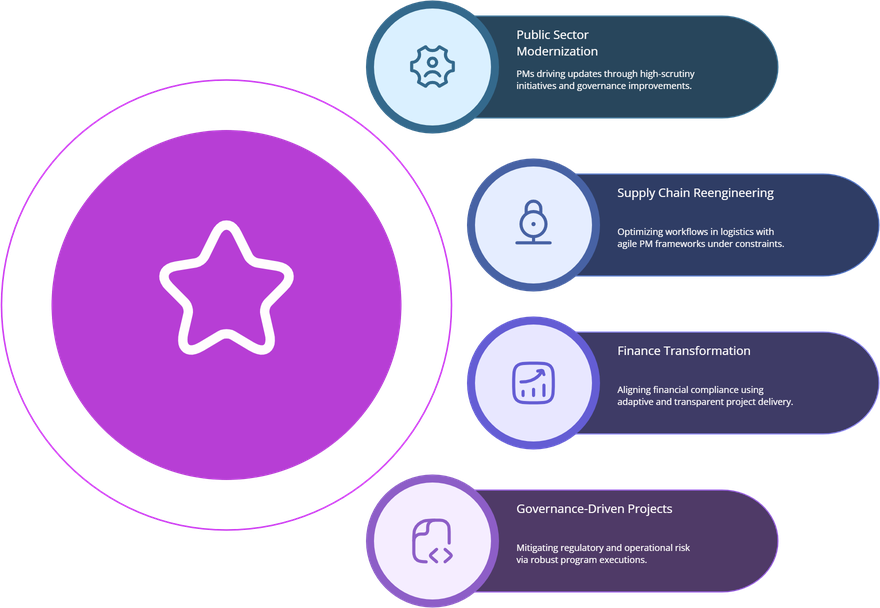
High-growth demand will also spike in public sector modernization, supply-chain and logistics reengineering, and finance and compliance-heavy transformations, because these programs combine high scrutiny with high operational stakes. When budgets tighten or restructures hit, organizations still need projects delivered, they just need them delivered with sharper governance and faster reprioritization, which is exactly what you see reflected in APMIC’s coverage of organizational restructuring pressures and workforce efficiency moves like major operating model changes.
The real compounding advantage comes when you specialize and pair it with modern capability signals like agile delivery fluency and digital-first execution, supported by market trends such as rising demand for agile project management and the push toward project management software investment under economic pressure. If you can walk into a regulated, capital-heavy environment and immediately stabilize scope, risk, and governance using disciplined frameworks like the project risk management glossary, you stop being “a freelancer” and become a mission-critical delivery asset.
5. Certifications, Positioning, and Income Stability
Certifications remain critical trust signals for freelancers without corporate brands behind them. Foundational pathways such as CAPM, PMP, and PRINCE2 provide credibility. Comparisons like CAPM vs PMP help freelancers choose efficient progression paths.
However, certification alone is insufficient. Freelancers must position themselves as solution providers, not labor. This means publishing insights, contributing to portfolio discussions, and aligning with client outcomes. Those who combine credentials with sector experience and ESG fluency will command premium rates and longer engagements.
6. FAQs: Freelance Project Management Trends & Opportunities (2025–2030)
-
Freelance project management will remain stable only for professionals who evolve beyond task execution. Organizations increasingly rely on independent PMs to plug governance and delivery gaps created by restructuring and lean PMOs, as seen in trends like economic uncertainty increasing demand for agile project management. Freelancers who understand portfolio dynamics, risk trade-offs, and value delivery will see consistent demand, while generic schedulers will face volatility. Stability will come from positioning yourself as an outcome owner, not a temporary resource.
-
Yes, certifications remain critical trust signals, especially when freelancers lack an internal brand or long tenure with a client. Credentials such as PMP, PRINCE2, and CAPM signal governance maturity and shared language, which becomes essential in complex environments described in the PMP vs PRINCE2 comparison. Clients use certifications to de-risk hiring decisions, particularly for high-value or regulated projects. However, certifications must be paired with real delivery outcomes to justify premium rates.
-
AI will reduce demand for low-value coordination work but significantly increase demand for strategic freelance PMs. As highlighted in AI adoption in project management, automation handles reporting and forecasting faster than humans. This shifts freelance PM value toward interpretation, decision support, and stakeholder alignment. Freelancers who can work alongside AI tools and translate insights into executive actions will gain leverage, not lose relevance.
-
The strongest demand will come from sectors facing regulatory pressure, capital intensity, or continuous transformation. Infrastructure, energy transition, cybersecurity, and enterprise technology mirror patterns seen in initiatives like large-scale infrastructure programs and global factory build-outs. These environments favor independent PMs who can operate quickly without heavy internal support. Sector specialization will matter more than general PM experience.
-
Hourly billing will increasingly be viewed as a commodity model suitable only for staff augmentation. Clients will prefer milestone-based or value-based pricing that aligns with outcomes, a shift consistent with themes in project management as a driver of economic growth. Freelancers who can define benefits, risks, and success criteria upfront will justify higher fees. Pricing power will correlate directly with clarity of value, not years of experience.
-
Yes, ESG literacy will become a gatekeeper skill for accessing regulated, publicly funded, or capital-intensive projects. As discussed in sustainability and ESG adaptation in project management, organizations expect project leaders to manage environmental and social risks alongside cost and schedule. Freelancers without ESG fluency will be excluded from high-impact portfolios. Those who can integrate ESG into delivery plans will access longer and higher-value engagements.
-
The greatest risk is remaining positioned as an execution-only resource rather than a value-driven leader. Market signals from restructuring, digital transformation, and PMO redesign show that clients want decision support, not status reporting, as seen in digital transformation across PMOs. Freelancers who fail to upgrade their strategic, financial, and governance capabilities will compete purely on price. Those who evolve into portfolio-aware advisors will thrive through 2030.
