
Future of Project Governance & Best Practices
The future of project governance is being decided right now in boardrooms, PMOs, and steering committees that are under pressure from inflation, ESG scrutiny, cyber risk, and AI-driven disruption. Executives no longer want governance that “signs off documents”; they want governance that protects capital, accelerates delivery, and keeps regulators away from their door. Between 2025 and 2030, the organisations that win will be the ones that treat governance as a strategic product, not a compliance ritual, and that is exactly the lens we will use throughout this guide.

1. The New Reality Of Project Governance For 2025–2030
Traditional governance models were built for stable portfolios and predictable funding cycles. That world has already vanished. Layoffs like those in the Microsoft PM restructuring, workforce optimisation at Blue Origin, and re-wiring of operating models at Google show how violently portfolios can be reshaped. Governance must now cope with:
Economic volatility. Boards expect PMOs to adjust guardrails quickly when inflation hits project budgets, as explored in global inflation’s impact on project budgets. Governance that cannot re-prioritise within weeks becomes a liability.
Agile and product-centric ways of working. As economic uncertainty drives demand for agile project management, portfolio governance must align Kanban boards, product roadmaps, and traditional stage-gates into a single decision architecture.
Digital, ESG and cyber risk. Boards are now accountable for ESG disclosures and cyber resilience. The trends described in sustainability & ESG project management and major cybersecurity concerns in PM software are reshaping what projects are approved in the first place.
Smart PMOs are responding by building governance “products”: clearly defined decision flows, minimum data sets, and role definitions that can be reused across capital projects like Carpentaria Highway Stage 3, complex rail programmes such as London’s Crossrail 2, and commercial redevelopments like Centennial Yards in Atlanta.
Before we go into trends and practices, it helps to see what a future-fit governance capability matrix actually looks like.
2. Key Project Governance Trends Shaping 2025–2030
From 2025 onwards, governance will be shaped by five converging forces. First, economic volatility means boards want governance that reallocates funding with the same agility described in economic-uncertainty agile demand. Static annual investment committees will be replaced with rolling, data-driven councils. Second, technology risk is exploding; trends in cybersecurity-driven software overhauls and APT threats show that security decisions can no longer be delegated entirely to IT.
Third, AI-infused PM tools are changing the information the board sees. As AI adoption in project management accelerates, steering committees will interrogate algorithmic forecasts, not spreadsheets, and they will demand transparency on model assumptions. Fourth, ESG expectations will turn many projects into reputation risks by default, reinforcing themes in sustainability and ESG project management. Finally, global talent and certification gaps are widening. The demand patterns highlighted in CAPM salary insights and PM as a driver of economic growth will push PMOs to professionalise governance skills, not just tools.
These forces will reward PMOs that frame governance as a value story: “Here is how governance protects cash, speeds decisions, and keeps us compliant,” supported by metrics borrowed from agile surveys and digital transformation case studies.
3. Best-Practice Governance Models For Complex Portfolios
Modern governance models are converging into a few patterns. One is portfolio-centric governance, where a single investment committee allocates funding across both traditional and agile initiatives. This model links value streams, epics, and projects into one prioritisation sequence, echoing the integrated thinking seen in investment surges in PM software and large-scale rail programmes. Another pattern is product-based governance, where cross-functional product lines own outcome metrics, while portfolio governance ensures strategic balance. This reduces the hand-offs that often cripple classic steering committees.
A third pattern, visible in many mega-infrastructure programmes, is tiered governance. Critical, high-risk projects receive intensive oversight through control towers; low-risk initiatives move through streamlined gates. This allows scarce executives to focus on existential risks such as those exemplified by Roberts Co’s administration. Across all patterns, the best practice is to separate assurance from delivery. Independent assurance functions, informed by frameworks from PMP exam guidance and PRINCE2 principles, test whether processes are followed while delivery teams focus on outcomes.
Finally, mature organisations treat governance artefacts as living products. They maintain curated glossaries, such as the top 100 PM terms and risk identification term guides, and they embed these into templates so that terminology is consistent from idea intake through to benefits tracking.
4. Practical Governance Design Playbook For PMOs
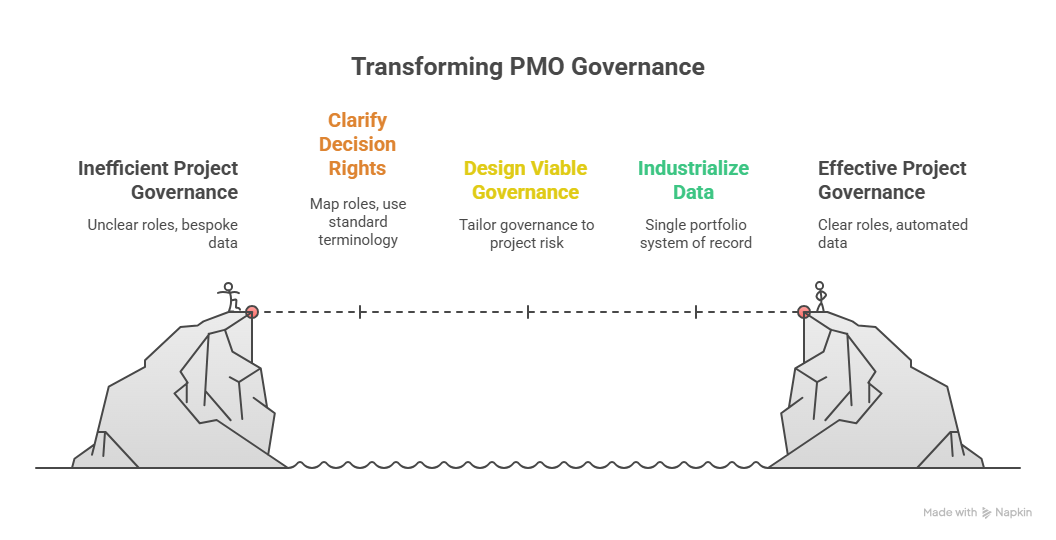
To turn trends into action, PMOs need a pragmatic playbook. Start with clarity of decision rights. Map who decides, who advises, and who is accountable at each step from ideation to closure. Use the terms and patterns from project initiation glossaries and team-building terminology to make sure roles are unambiguous. Then, design minimum viable governance for different project archetypes. Low-risk automation initiatives inspired by AI-enabled PM tools should not carry the same paperwork burden as multi-billion-dollar plants modelled on Tesla-style expansion programmes.
Next, industrialise data. Governance collapses when each project presents bespoke slides. Use lessons from PM software investment trends to configure a single portfolio system of record. Every steering pack should be generated automatically from that data, with risk classifications aligned to the risk management glossary and financial terms drawn from the essential budgeting guide.
Finally, embed escalation and kill criteria. Governance that never closes projects is as harmful as governance that never approves them. Define clear thresholds for terminating initiatives, referencing economic scenarios like those in global inflation impact analyses and sector-specific stress, such as the patterns discussed in the UK construction downturn. When these thresholds are hit, boards must act decisively rather than endlessly commissioning more reviews.
5. Using Certifications To Lift Governance Quality
Many governance failures can be traced back to skill gaps. Organisations that invest in structured certification paths create a common language and toolkit for governance. PMP-certified leaders bring rigorous planning, earned value and stakeholder management practices that fit naturally into audit-ready governance, as outlined in PMP vs PRINCE2 comparisons and the PMP exam survival guide. PRINCE2 practitioners add strength in business-case stewardship, product-based planning, and exception-based control, which align closely with benefits-driven governance models explained in the comprehensive PRINCE2 guide and PRINCE2 Foundation vs Practitioner breakdown.
At portfolio level, CAPM-level professionals provide standardised terminology and process literacy, reinforced by the ultimate CAPM exam guide, CAPM exam question sets, and 30-day CAPM study plans. These create a baseline understanding of scope, cost, schedule, and risk which governance boards can rely on. For change portfolios dominated by agile delivery, PMI-ACP skills matter; techniques from the top 25 PMI-ACP exam questions help teams design lightweight, feedback-rich governance layers.
Smart organisations treat this as a structured capability roadmap. For example, they might require that PMO analysts hold CAPM, project leads hold PMP or PRINCE2 Practitioner, and transformation leaders supplement these with agile credentials. They then codify these expectations into governance charters, alongside vocabulary from the top 100 PM terms reference and HR terminology guides, ensuring everyone speaks the same governance language.
6. FAQs: Project Governance 2025–2030
-
Boards should treat governance as an investment and measure it accordingly. Start by quantifying the percentage of portfolio spend aligned with strategic themes, using techniques from portfolio cost-management guides. Track how rapidly funding can be reallocated when conditions change, referencing the agility expectations highlighted in economic-uncertainty agile articles. Monitor benefits realisation for at least three years after delivery, rather than stopping at go-live. Finally, measure non-financial indicators: risk exposure reduction based on the risk management glossary, ESG improvements linked to sustainability-focused projects, and stakeholder satisfaction across project sponsors, delivery teams, and customers.
-
Most governance frameworks fail because they are designed as document workflows, not decision systems. PMOs spend months perfecting templates, yet executives still make decisions based on corridor conversations, escalating issues outside the formal structure. To avoid this, governance must be anchored around clear decision rights, transparent criteria, and reliable data flows, echoing the principles in project initiation term guides and team-building references. When governance meetings consistently surface conflicting numbers, as described in software overhaul cases like major cybersecurity-driven changes, executives quickly bypass the process. Ensuring a single portfolio data source, coupled with clear escalation routes and kill criteria, turns governance into the fastest way to obtain a high-quality decision, rather than an administrative chore.
-
The key is to replace heavy gates with guardrails that articulate boundaries rather than prescribe detailed steps. PMOs can define mandatory constraints around risk, spend limits, architectural standards, and ESG requirements, drawing on patterns from agile PM demand surveys and Scrum role definitions. Within those boundaries, product teams are free to adapt backlogs and technical solutions. Governance then shifts toward monitoring leading indicators, such as cycle time and defect trends, supported by insights from AI-enabled PM tools and digital PMO transformations. This approach prevents the two classic failures: agile teams being suffocated by legacy stage-gates, or executives being deprived of the risk visibility they require to protect the organisation.
-
By 2030, ESG will be inseparable from mainstream project governance. Many regulators are already holding boards personally accountable for non-financial disclosures, and investors analyse emissions, diversity, and community impact when allocating capital. The ESG-focused patterns explored in sustainability project-management articles show that organisations are beginning to treat carbon and social impact like any other cost or risk. Practically, that means business cases must quantify ESG implications, risk registers must include climate and social dimensions, and benefits maps must capture long-term environmental outcomes. Portfolios will be screened using ESG thresholds, similar to the financial criteria detailed in budgeting guides and cost-management term lists. Projects that cannot meet ESG expectations will either be redesigned or rejected, fundamentally reshaping what enters the portfolio.
-
AI will change both the inputs and the dynamics of steering committees. Instead of static slide decks, executives will receive scenario simulations produced by portfolio tools described in PM software investment analyses and AI-adoption trend pieces. These systems can forecast schedule slippage, cost overruns and benefits erosion based on patterns from historical portfolios. Governance must adapt by establishing standards for model transparency, bias testing, and data lineage, informed by security discussions in the APT mechanisms guide and digital-risk narratives in cybersecurity overhaul articles. Committees will spend less time debating which numbers are correct and more time exploring trade-offs between different portfolio scenarios, which will significantly increase the strategic value of governance meetings.
-
Governance leaders benefit from a layered certification mix. PMP provides a deep grounding in integration, cost, schedule, and stakeholder management, supported by resources like the PMP vs PRINCE2 comparison and the PMP exam survival guide. PRINCE2 Practitioner adds structured control through themes and principles explored in the comprehensive PRINCE2 guide and success-story case studies. For pipeline and portfolio design, CAPM ensures consistent terminology across teams, using foundations from the ultimate CAPM guide and CAPM vs PMP comparisons. Finally, PMI-ACP is valuable wherever agile governance is required, backed by exam-question insights in the PMI-ACP Q&A article.
-
The safest approach is to run a governance pilot around a strategically important slice of the portfolio. Choose a cluster of initiatives, such as a digital product line similar to those in AI-enabled PM case studies or a capital programme like Centennial Yards. Apply modern practices: a single enterprise backlog, clear decision rights, standardised data, and scenario-based funding reviews informed by economic-uncertainty analyses. Track measurable improvements in decision speed, benefit realisation, and risk reduction. Once the pilot proves its value, codify the new practices into templates using terminology from the top 100 PM terms reference and HR and team-building glossaries, then roll it out incrementally across the rest of the portfolio. This phased, evidence-based approach builds credibility and minimises resistance.
