
Detailed Guide to Understanding PMP Exam Domains (2026)
The PMP exam domains tell you what PMI is really testing: leadership judgment, delivery discipline, and business awareness under pressure. For 2026, this matters even more because PMI says the revised PMP exam launches on 9 July 2026, with People weighted at 33%, Process at 41%, and Business Environment at 26%. PMI also states that predictive, adaptive/agile, and hybrid approaches appear across all three domains, so candidates must study by decision logic rather than memorizing separate “agile” and “waterfall” buckets.
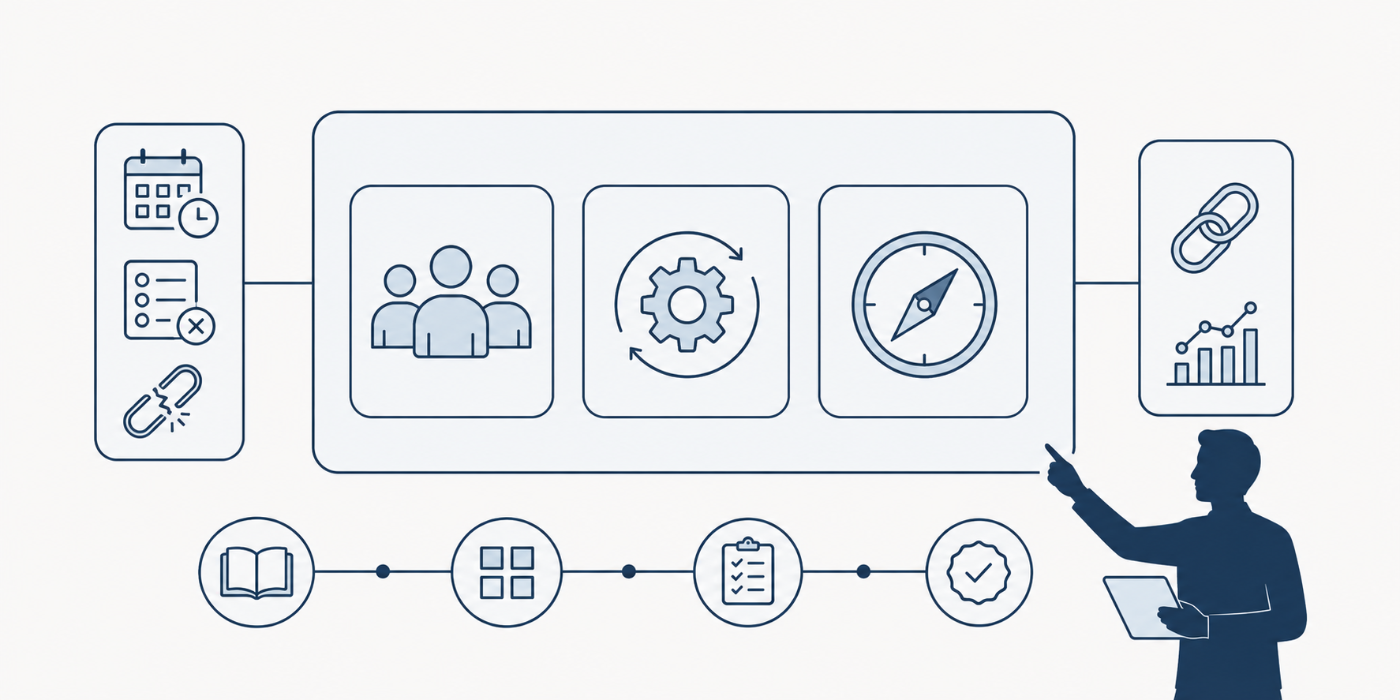
1. Why PMP Exam Domains Matter More Than Most Candidates Realize
The PMP exam domains are the blueprint behind every question. A candidate who studies through random chapters, loose flashcards, or scattered mock tests often feels busy without knowing whether the work is moving them toward the actual exam. The smarter approach is to treat the domains as a diagnostic map. People shows whether you can lead teams and stakeholders. Process shows whether you can plan, deliver, measure, and close work. Business Environment shows whether you can connect projects to governance, compliance, strategic value, and external change. That is why candidates should pair the official domain structure with a complete project management career roadmap, project execution terms, project monitoring and control terms, and stakeholder engagement terms.
The big mistake is studying each domain as a list of definitions. PMP questions rarely ask, “What is this term?” They usually ask what the project manager should do when the sponsor disagrees, the team is blocked, the vendor misses a commitment, the backlog changes, a risk becomes an issue, or business value is unclear. That means the domains must be translated into action. A candidate reviewing risk registers, earned value management terms, resource allocation concepts, and project reporting best practices should constantly ask: “What decision would a professional project manager make here?”
The 2026 domain change also sends a strong signal about modern project work. PMI’s official update says the exam adds focus areas such as AI, sustainability, and stakeholder engagement while shifting more toward outcomes and value. It also highlights real-world impact, adaptive project dynamics, and strategic alignment. This means candidates cannot prepare by treating the PMP as a fixed-process exam. A strong study plan must connect AI and project management, sustainability and ESG project management, hybrid project management, and future PM skills.
| Domain Area | What It Tests | Common Candidate Mistake | What to Practice | Best APMIC Resource |
|---|---|---|---|---|
| People | Shared vision and team alignment. | Jumping into tasks before clarifying direction. | Vision, expectations, communication, and stakeholder purpose. | Leadership communication terms |
| People | Conflict diagnosis and resolution. | Treating every conflict as a personality problem. | Source, stage, impact, ground rules, and resolution strategy. | Conflict resolution terms |
| People | Team leadership and empowerment. | Choosing command-and-control answers when coaching fits better. | Leadership style, role clarity, problem solving, and empowerment. | Future PM skills |
| People | Stakeholder identification and engagement. | Communicating the same way to every stakeholder. | Stakeholder analysis, influence, trust, and tailored messaging. | Stakeholder engagement terms |
| People | Stakeholder expectations. | Waiting for dissatisfaction before realignment. | Expectation mapping, mentoring opportunities, and alignment discussions. | Project reporting terms |
| People | Customer satisfaction and outcome alignment. | Thinking delivery completion equals stakeholder satisfaction. | Feedback loops, customer expectations, and outcome review. | Project success factors |
| People | Knowledge transfer. | Saving lessons learned until the end only. | Critical knowledge capture, sharing, and continuity planning. | Project closure terms |
| People | Communication strategy. | Overusing meetings when a better channel is needed. | Transparency, reporting requirements, feedback, and governance support. | Reporting best practices |
| Process | Integrated project planning. | Choosing a delivery method before analyzing project needs. | Complexity, magnitude, dependencies, and development approach. | Hybrid project management |
| Process | Scope management. | Accepting informal scope changes. | Scope definition, stakeholder agreement, and decomposition. | Waterfall glossary |
| Process | Value-based delivery. | Measuring progress only by task completion. | Benefits, incremental value, feedback, and outcome metrics. | PM workforce trends |
| Process | Resource planning. | Ignoring capacity until the schedule fails. | Resource needs, availability, skills, and optimization. | Resource allocation terms |
| Process | Procurement management. | Confusing procurement control with internal task management. | Contract types, supplier performance, negotiation, and delivery solutions. | Vendor management terms |
| Process | Financial planning. | Memorizing formulas without understanding reserves and variance. | Budget needs, contingency, reserves, tracking, and reporting. | Financial management terms |
| Process | Quality planning. | Fixing defects late instead of preventing them early. | Quality requirements, regulatory compliance, CoQ, and continuous improvement. | TQM terms |
| Process | Schedule management. | Using crashing or fast tracking without tradeoff analysis. | Dependencies, story points, baselines, benchmarks, and variance. | Schedule compression terms |
| Process | Project status evaluation. | Reporting status without analyzing what the data means. | Metrics, artifacts, progress review, and status communication. | Monitoring and control terms |
| Process | Closure readiness. | Closing before acceptance, transition, and lessons learned are complete. | Acceptance, transition, retrospectives, procurement closure, and financial closure. | Project closure concepts |
| Business | Governance. | Escalating without understanding thresholds and authority. | Rules, procedures, success metrics, and escalation paths. | Project governance trends |
| Business | Compliance. | Treating compliance as paperwork instead of project risk. | Regulatory, safety, security, sustainability, and consequences. | ISO standards terms |
| Business | Change control. | Implementing changes before impact analysis and approval. | Change process, communication, implementation, and documentation updates. | Waterfall PM terms |
| Business | Impediments and issues. | Failing to recognize when a risk has become an active issue. | Impact evaluation, prioritization, intervention, and stakeholder collaboration. | Risk register examples |
| Business | Risk management. | Listing risks without response ownership and monitoring. | Identification, analysis, register maintenance, response, and communication. | Risk mitigation terms |
| Business | Continuous improvement. | Treating lessons learned as archival paperwork. | Lessons learned, OPA updates, process improvement, and feedback loops. | Project success analysis |
| Business | Organizational change. | Ignoring culture when implementation resistance appears. | Culture, change impact, adoption barriers, and required actions. | Future PM leadership |
| Business | External environment changes. | Missing regulation, technology, market, or geopolitical impacts. | External scanning, impact assessment, backlog adjustment, and scope review. | Digital transformation in PMOs |
| Cross-Domain | Predictive, agile, and hybrid judgment. | Studying methods separately instead of applying them together. | Approach selection, adaptation, value flow, and governance fit. | Methodology adoption trends |
| Cross-Domain | Scenario-based exam decisions. | Looking for keywords instead of diagnosing the situation. | Role, timing, authority, stakeholder pressure, and next best action. | Common PMP exam mistakes |
2. Domain I: People — Leadership, Conflict, Stakeholders, and Communication
People is the domain that exposes whether a candidate understands project leadership beyond job titles. In the 2026 ECO, PMI lists People at 33% and includes tasks such as developing a common vision, managing conflicts, leading the project team, engaging stakeholders, aligning expectations, managing customer expectations, supporting knowledge transfer, and planning communication. A weak candidate reads this as soft-skills content. A strong candidate sees it as high-pressure decision-making where trust, influence, transparency, and accountability shape delivery outcomes. This domain should be studied alongside PM leadership communication terms, conflict resolution terms, stakeholder engagement terms, and project reporting terms.
The most painful People-domain mistake is choosing an answer that sounds decisive while damaging trust. For example, a project manager may be tempted to escalate every conflict, replace a low-performing team member too quickly, or send a formal warning before understanding the issue. PMP scenarios often reward earlier, more professional actions: analyze the context, speak with people directly, clarify expectations, coach the team, use agreed ground rules, and tailor communication. Candidates coming from IT project management, healthcare project management, government project management, or construction project management should watch for workplace habits that may conflict with exam-preferred leadership behavior.
Stakeholder questions are especially dangerous because they look simple. The exam may show a sponsor who changes expectations, a customer who feels ignored, a functional manager who blocks resources, or a product owner who disagrees with priority. The correct answer usually depends on influence, timing, authority, and communication need. A candidate should know how to identify stakeholders, analyze their needs, tailor the engagement plan, build trust, and keep expectations aligned. This links directly to project management career growth, project manager salary by certification, certification impact on project success, and future project management leadership.
A practical way to prepare for People is to create a “human situation log.” Every time you miss a People question, label it as conflict, stakeholder resistance, communication failure, team empowerment, customer expectation, or knowledge transfer. Then write the better action in plain language. Over time, you will see the pattern: the exam wants project managers who listen before acting, coach before punishing, align before executing, and communicate with intent. That habit also strengthens real workplace performance in remote project management roles, international project management, project management consulting, and PM director pathways.
3. Domain II: Process — Planning, Delivery, Metrics, Quality, Finance, and Closure
Process is the largest 2026 PMP domain at 41%, and it tests whether you can turn project intent into disciplined delivery. PMI’s 2026 ECO places integrated planning, delivery approach selection, scope, value-based delivery, resources, procurement, finance, quality, schedule, status evaluation, and closure under this domain. This is where many candidates over-study terminology and under-practice decisions. Knowing what a baseline is matters. Knowing what to do when the baseline is threatened matters more. Study this domain with project execution terms, EVM terms, schedule compression terms, and resource allocation terms.
The Process domain punishes candidates who think in single-step answers. A project manager rarely “fixes the schedule” in isolation. A schedule delay may affect cost, risk, procurement, resources, quality, stakeholder expectations, and business value. A scope change may require impact analysis, change control, communication, documentation updates, and re-baselining. A vendor problem may require contract review, supplier performance analysis, negotiation, and governance escalation. That is why candidates should connect vendor management terms, RFP, RFQ, and RFI terms, financial management terms, and quality management terms while practicing scenarios.
Value-based delivery is one of the most important signals in the 2026 outline. PMI’s ECO specifically includes identifying value components, prioritizing work based on value and stakeholder feedback, assessing incremental value delivery, examining business value throughout the project, and tracking benefits. This pushes candidates beyond “finish the project” thinking. The exam wants to know whether you can protect the reason the project exists. That means connecting Process study to project success root causes, factors driving project success, project portfolio management trends, and project portfolio manager careers.
The best Process-domain study method is a decision chain. Pick a common scenario, then trace what happens across planning, execution, monitoring, and closure. For example: a supplier delay appears. First, check the procurement agreement. Then assess schedule and cost impact. Then review risks and contingency. Then communicate status. Then apply governance or change control if thresholds are crossed. This is more powerful than memorizing a process list. It also prepares candidates for agile project management tools, Kanban software tools, Scrum platforms, and waterfall software reviews, where process discipline turns tool features into project outcomes.
4. Domain III: Business Environment — Governance, Compliance, Risk, and Strategic Value
Business Environment is the domain many candidates underestimate, yet the 2026 weighting makes it much more important at 26%. PMI’s revised outline includes governance, compliance, change control, impediment and issue management, risk, continuous improvement, organizational change, and external business environment changes. This domain tests whether you understand why projects exist inside organizations. A project manager must deliver work while respecting rules, strategy, ethics, policies, market shifts, security requirements, sustainability pressures, and business value. Study this domain with project governance trends, ISO standards terms, risk mitigation terms, and sustainability project management.
The main pain point in Business Environment questions is that the correct answer often feels slower than the shortcut. A candidate may want to approve a change quickly, ignore a minor compliance concern, delay risk communication, or treat an external regulation as someone else’s responsibility. The PMP mindset is different. It asks the project manager to protect the organization and the project. That means understanding escalation paths, governance thresholds, compliance categories, documentation updates, change control, and risk communication. These skills connect naturally to project failure root causes, agile project failure lessons, AI adoption in project management, and digital transformation across PMOs.
The governance portion is especially important for candidates targeting senior roles. A project manager who understands governance knows who can approve, when escalation is appropriate, what evidence must be prepared, and how to avoid informal decision chaos. This is useful for exam questions and career growth. Candidates aiming for project management director roles, VP of project management paths, chief project officer roles, or project portfolio management should treat Business Environment as leadership preparation, not a minor exam section.
Risk and issue management also sit strongly inside this domain. The exam may ask what to do when a known risk occurs, when an impediment blocks the team, when a compliance threat appears, or when market conditions change the project’s value. The best preparation is to separate risk, issue, change, and impediment. A risk may happen. An issue is happening. A change request modifies an approved baseline or direction. An impediment blocks progress and needs removal or minimization. Candidates can strengthen this thinking with risk register examples, risk response planning terms, project reporting best practices, and project monitoring and control terms.

5. How to Study PMP Domains Without Wasting Weeks on the Wrong Material
Start by building a domain-based baseline. Take a mixed mock set and tag every missed question as People, Process, or Business Environment. Then add a second tag: concept gap, wording trap, wrong priority, wrong escalation, wrong method, or pacing issue. This creates a study map that is far more useful than a raw score. A candidate preparing through PMP exam mistake prevention, PMP certification maintenance, project management certification trends, and certification impact research should treat this as the first serious prep step.
Next, study by scenario pattern. For People, practice conflict, stakeholder resistance, team performance, communication breakdown, and expectation misalignment. For Process, practice scope change, schedule variance, cost pressure, procurement delay, quality issue, and closure readiness. For Business Environment, practice governance escalation, compliance risk, organizational change, external regulation, and strategic value shifts. This method works better than passive reading because the PMP exam includes scenario and case-style questions; PMI’s 2026 ECO describes 180 total questions, 170 scored and 10 pretest, with 240 minutes, and new question types including case or scenario items and graphic-based questions. Strong candidates support this with agile estimation techniques, agile metrics, Scrum glossary terms, and Kanban terms.
Then build a “next best action” habit. For every question, ask: What is the project environment? What has already happened? Who owns the decision? Is this a risk, issue, change, conflict, compliance matter, or value concern? What should the project manager do before escalating, approving, rejecting, or implementing? This habit is especially useful across predictive, agile, and hybrid work because PMI states that these approaches are spread across all domains. Candidates can reinforce that flexibility through methodology adoption research, state of agile project management, future of remote project management, and project management software feature trends.
Finally, connect domain study to your career story. The PMP exam is easier to remember when every domain maps to real work. People becomes your ability to lead stakeholders and teams. Process becomes your ability to deliver predictably and adapt intelligently. Business Environment becomes your ability to protect value and guide projects through organizational complexity. That makes your preparation useful for roles in California project management careers, New York project management careers, Texas project management careers, and Florida project management careers, where employers want evidence of judgment, not exam language alone.
6. FAQs
-
For the revised PMP exam launching 9 July 2026, PMI lists three domains: People at 33%, Process at 41%, and Business Environment at 26%. The current version before the 2026 launch uses different weights, so candidates should match their study plan to the exam date they will actually take. The revised outline also spreads predictive, adaptive/agile, and hybrid approaches across all domains. To prepare properly, use PMP exam mistake guidance, agile glossary terms, waterfall glossary terms, and hybrid project management trends.
-
The hardest PMP domain depends on the candidate’s background. Experienced technical PMs may struggle with People because conflict and stakeholder questions require judgment. Agile candidates may struggle with Process because procurement, finance, and governance feel formal. Delivery-focused candidates may struggle with Business Environment because compliance, organizational change, and external forces require strategic thinking. A smart study plan compares weak areas across stakeholder engagement, project financial management, project governance, and risk response planning.
-
Study People through situations rather than definitions. Practice conflict sources, stakeholder expectations, team empowerment, communication strategy, customer satisfaction, and knowledge transfer. For each wrong answer, write why your chosen action failed: premature escalation, weak listening, poor communication channel, missing stakeholder analysis, or unclear team expectations. Then reinforce the concepts with leadership communication terms, conflict resolution terms, stakeholder engagement terms, and project reporting terms.
-
Study Process as a delivery chain. Connect scope, schedule, cost, resources, procurement, quality, status, and closure. When you miss a question, identify which part of the delivery chain you skipped. Did you forget impact analysis? Did you ignore the baseline? Did you miss supplier obligations? Did you close before acceptance? The best reinforcement resources include EVM terms, schedule compression terms, resource allocation terms, and project closure concepts.
-
Study Business Environment like a senior project leader. Focus on governance, compliance, change control, risk, issues, organizational change, external business changes, and continuous improvement. The exam wants candidates who protect business value while managing delivery pressure. Build a small checklist for each scenario: governance authority, compliance exposure, risk/issue status, change impact, stakeholder impact, and value impact. Use project governance trends, ISO standards terms, risk registers, and sustainability project management.
-
PMI states that predictive, adaptive/agile, and hybrid approaches are found throughout the three domain areas rather than isolated in one domain. That means candidates should prepare for agile, predictive, and hybrid logic inside People, Process, and Business Environment questions. A stakeholder conflict may occur in Scrum. A procurement issue may occur in a hybrid project. A governance issue may affect an adaptive backlog. Strengthen this range with Scrum glossary terms, agile estimation, methodology adoption data, and future methodology trends.
