
Understanding RFP, RFQ, and RFI: Essential Terms Explained
Understanding procurement language late is one of the fastest ways to lose leverage in project delivery. Teams misread the request type, suppliers answer the wrong question, timelines slip, and decision-makers start doubting whether the PM actually understands how buying works inside real organizations.
RFP, RFQ, and RFI look simple on paper. They are not simple in practice. Each one changes vendor behavior, pricing quality, negotiation room, evaluation effort, documentation burden, and the kind of risk that lands back on the project team. That is why this guide goes deep, connects the terms to live project pressure, and shows where PMs win or get exposed.
1. Why RFP, RFQ, and RFI Matter More Than Most Project Managers Realize
Procurement terms often get treated like administrative vocabulary, yet they shape budget control, schedule realism, stakeholder confidence, and contract quality long before a supplier is selected. A PM who understands intake, scope clarity, evaluation logic, and supplier signaling will usually make better downstream decisions than one who only learns procurement after a buying process has already gone sideways. That is why strong PMs pair procurement literacy with broader grounding in project initiation terms, project scheduling terms, project budgeting terms, and project risk management glossary.
At a practical level, RFI, RFQ, and RFP are not interchangeable documents. An RFI helps a buyer understand the market, available approaches, capability ranges, and supplier maturity before serious commercial evaluation begins. An RFQ is used when the requirement is already clear enough that pricing comparison matters most. An RFP is used when the buyer needs vendors to propose a solution, method, staffing model, governance approach, or delivery strategy, not just a number. PMs who confuse those purposes create preventable friction that later shows up in contract management terminology, project procurement terms, stakeholder terms, and project communication terms.
The deeper issue is that every request type attracts a different supplier response pattern. Suppliers answer RFIs broadly, RFQs tightly, and RFPs strategically. That means the wrong document distorts the market feedback you receive. Use an RFQ too early and you get inaccurate prices built on shaky assumptions. Use an RFI when leadership needs decision-ready proposals and you lose momentum. Use an RFP when the requirement is already standardized and you waste weeks scoring narrative responses instead of locking cost, lead time, and commercial terms. Those mistakes connect directly to issues covered in cost management terms, issue tracking software, project reporting and analytics software, and dashboard and data visualization tools.
Another reason this topic matters is career credibility. Hiring panels for procurement-heavy PM roles notice very quickly whether a candidate understands bid packaging, evaluation governance, commercial sequencing, and supplier ambiguity. A PM who can explain when to start with an RFI, when to convert to an RFQ, and when to run a full RFP sounds operationally mature. A PM who says “they are basically all vendor request documents” sounds untested. That career distinction becomes even more important for readers exploring how to become a project manager, government project manager careers, construction project management, and healthcare project management.
2. RFI, RFQ, and RFP Defined Clearly Without Procurement Fog
An RFI, or Request for Information, is used when the organization needs structured market insight before it is ready to buy in a fully committed way. The purpose is not to force suppliers into exact pricing. The purpose is to gather intelligence: what solutions exist, what implementation models are common, what commercial structures show up repeatedly, what capability differences matter, and where your internal assumptions are still weak. That makes an RFI especially useful when teams are still shaping scope through project initiation, refining stakeholder requirements, assessing quality management terms, and pressure-testing knowledge management software.
A strong RFI asks targeted questions instead of vague prompts. It asks vendors how they approach delivery, how they structure support, what assumptions usually break projects, what dependencies buyers ignore, what implementation timelines are realistic, and what data or governance inputs are required from the client side. This is where many PMs miss the point. They ask generic questions, receive generic answers, and conclude that vendors all sound the same. In reality, their document failed. Clean RFI design should reflect the same discipline used in team building terminology, human resource management in PM, project communication techniques, and project reporting software.
An RFQ, or Request for Quotation, belongs in a different universe. It works best when the buyer already knows what must be purchased and can describe it in a way that suppliers can price consistently. That may be units, quantities, service hours, deliverables, or defined technical specifications. The point is comparability. You want quotes that line up. You want lead times exposed. You want commercial terms visible. You want fast evaluation. RFQs pair naturally with mature cost management, tighter project budgeting, detailed project scheduling, and operational tools like budget tracking software and calendar and scheduling tools.
The trap with RFQs is seductive simplicity. Teams believe they are getting apples-to-apples pricing when they are actually comparing apples to invisible assumptions. One vendor prices implementation. Another excludes it. One includes training. Another prices only the base package. One assumes client-side data readiness. Another assumes paid migration support. The quote looks clean while the scope is dirty. That is why PMs must force specification discipline, assumption logging, and clarification rounds using habits that also strengthen issue tracking, document management software, dashboard tools, and procurement management tools.
An RFP, or Request for Proposal, is used when the buyer wants suppliers to propose the solution itself, not merely confirm a price against a fixed spec. This is common in consulting engagements, complex software implementations, transformation programs, outsourced PMO setups, and multi-workstream service arrangements. The buyer wants to evaluate understanding, method, governance, delivery model, team quality, risk controls, change management approach, and commercial structure together. That is why RFPs overlap heavily with contract lifecycle management software, procurement terms, contract management terminology, and project management software for small businesses.
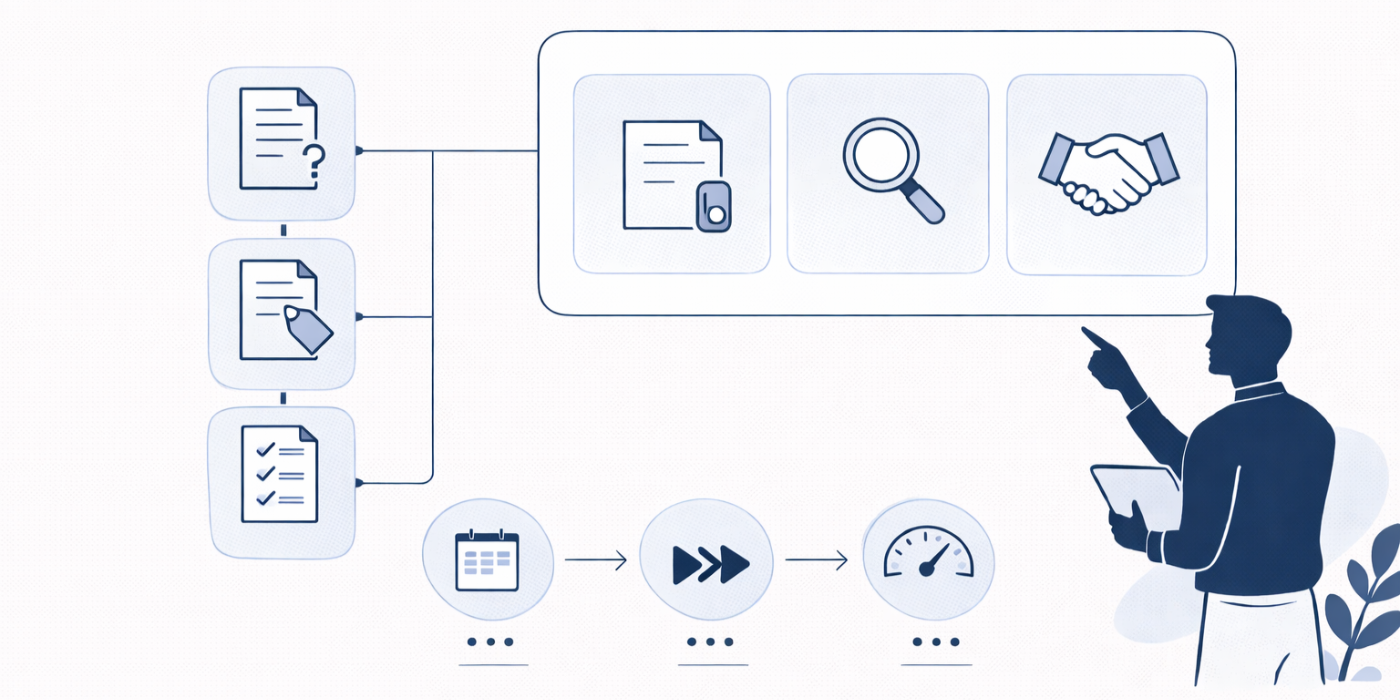
The difference that matters most is this: RFI learns, RFQ compares, RFP decides. Once a PM sees those three verbs clearly, document choice gets much easier.
3. When to Use Each Document and How PMs Get Burned by the Wrong Choice
Use an RFI when internal stakeholders are pretending they know the market but clearly do not. That happens often in digital transformation, PMO tooling, workflow automation, reporting architecture, or new service models. Leadership wants timelines and cost confidence, but the team has not even mapped the available solution categories. In that situation, an RFI saves money by exposing missing knowledge early. It is especially useful before buying project management software, resource allocation software, automation tools, or mobile collaboration apps.
Use an RFQ when the requirement is narrow, stable, and measurable enough that vendor differentiation should happen mostly on price, availability, service levels, and basic compliance. Hardware purchases, commodity licenses, standardized training bundles, fixed-volume support work, or well-defined implementation tasks often fit that model. If your team can produce a good specification pack, an RFQ can move fast and preserve decision clarity. It aligns well with operational control practices found in critical path method terms, Gantt chart software, top project productivity software, and project knowledge tools.
Use an RFP when failure would be expensive, visible, and hard to reverse. That includes selecting consulting partners, enterprise platforms, managed service providers, transformation vendors, PMO design specialists, or delivery partners whose method matters as much as their price. In those cases, the cheapest answer can be the most expensive one three months later. A polished budget line hides weak governance, shallow staffing, and unrealistic change control. This is where PM judgment must extend beyond numbers and into evaluation architecture, a skill connected to project failure rate analysis, factors driving project success, top challenges facing project managers today, and future trends in PPM tools.
Where do PMs get burned? First, they launch procurement before the requirement is mature enough for the document type chosen. Second, they treat supplier writing quality as proof of delivery strength. Third, they under-design scoring criteria, then let subjective preferences drive selection. Fourth, they fail to log assumptions, so negotiation begins after selection instead of before it. Fifth, they underestimate approval timelines involving procurement, finance, legal, sponsors, and technical reviewers. Those pain points show up everywhere from future project governance trends to project management methodology adoption to remote project management roles.
The practical rule is brutally simple. If you need market understanding, issue an RFI. If you need directly comparable prices against clear specifications, issue an RFQ. If you need vendors to solve the problem with you and defend their method, issue an RFP. Confuse those lanes and you create rework, supplier frustration, thin proposals, false savings, and very public internal embarrassment.
The fastest procurement gains usually come from fixing request-type selection before trying to negotiate harder later.
4. Essential Terms Every PM Should Know Around RFPs, RFQs, and RFIs
Statement of Work (SOW). This defines the work to be done, deliverables, responsibilities, timelines, acceptance criteria, and boundaries. In an RFQ, the SOW must be tight. In an RFP, the SOW may define the problem and outcomes while leaving room for vendor method. Weak SOWs destroy procurement quality and later feed disputes in contract management, project quality management, issue tracking, and project reporting.
Scope. Scope is the agreed boundary of what is included and excluded. Procurement collapses fast when stakeholders keep hidden expectations outside the written scope. PMs who do not lock scope before pricing usually end up defending budget overruns later. Strong scope control also strengthens work in project initiation, project scheduling, budget tracking, and project communication.
Bidder conference. This is a pre-bid meeting where vendors can ask questions, clarify expectations, and expose requirement ambiguity. Good bidder conferences reduce avoidable misunderstanding. Bad ones create more confusion because the buying organization answers vaguely or inconsistently. They matter heavily in complex RFPs and tie directly to stakeholder management, team communication, project leadership and communication terms, and future PM leadership skills.
Evaluation criteria. These are the weighted standards used to assess vendor responses. Common categories include cost, technical fit, implementation approach, staffing, risk controls, references, compliance, and support model. When these are vague, the selection becomes political. When these are sharp, the recommendation becomes defensible. This discipline also matters in project governance, project success factors, AI and automation adoption, and project management software feature analysis.
Compliance matrix. This is a structured response grid showing whether vendors meet each requirement, partially meet it, or propose an alternative. It is one of the cleanest tools for reducing narrative fog in RFPs. A compliance matrix makes vendor gaps visible early and supports comparison logic in document management, dashboard reporting, knowledge management, and project reporting analytics.
Lead time. In RFQs especially, lead time matters almost as much as price. The lowest quote may be commercially useless if delivery misses the required project window. PMs who ignore lead time are really ignoring schedule risk. This ties directly into critical path method terms, Gantt chart software, calendar tools, and project scheduling glossary.
Best and final offer (BAFO). This is the final pricing or proposal revision requested from shortlisted vendors after evaluation and clarifications. BAFO rounds can sharpen commercial value, but only when the team already knows what tradeoffs matter. Otherwise they become theater. Good BAFO use depends on strong procurement management tools, contract lifecycle management, cost management terms, and project issue tracking.

5. How to Evaluate Responses Without Getting Seduced by Price, Polish, or Procurement Theater
The first rule in evaluation is that cheap does not mean low cost. Cheap often means incomplete. A thin quote becomes expensive through change orders, delays, extra internal labor, training gaps, data cleanup, weak onboarding, or poor support. PMs who have lived through vendor disappointment know the pattern: the proposal looked neat, the pricing looked efficient, leadership felt relieved, and then the real work started. To avoid that trap, compare total delivery reality, not just headline commercial figures. That evaluation mindset belongs beside project budgeting, cost management, project quality management, and project failure root-cause analysis.
Second, score what actually matters to the project’s pain profile. If implementation risk is high, weight method and governance harder. If schedule is brutal, weight mobilization readiness and lead time harder. If stakeholder adoption is fragile, weight training and change support harder. If long-term support matters, weight service model and escalation design harder. The scoring model should mirror where the project is most likely to bleed. This is where good PMs separate themselves from box-checkers, and it connects naturally with project stakeholder terms, team building terminology, PM leadership and communication, and future PM leadership trends.
Third, stress-test assumptions out loud. Ask every vendor what they are assuming the client will provide, own, approve, or finish before delivery starts. Ask what happens if data quality is poor, decisions are delayed, key SMEs are unavailable, integrations are more complex than expected, or adoption resistance emerges. Ask how they handle variance. A vendor that becomes slippery under assumption pressure is giving you useful information. This style of procurement discipline pairs well with risk identification and assessment terms, project risk glossary, project issue tracking software, and analytics software for PMs.
Fourth, check whether the vendor has answered your question or rewritten it. Some proposals look excellent because the vendor quietly responds to an easier version of the problem. They frame their strength area, avoid the messy constraints, and hope the buyer is too rushed to notice. PMs who catch this early save their organizations from elegant disappointment. That same reading discipline helps when assessing PM software for healthcare projects, PM software for software development, automation tools, and mobile PM apps.
Finally, document the recommendation in plain business language. Leadership does not need a decorative procurement memo. Leadership needs to know why this vendor is the best fit, what tradeoffs were accepted, what risks remain, how pricing compares after assumption normalization, and what contract controls must be negotiated before award. Clear recommendation writing builds trust far faster than long procurement jargon.
6. FAQs About RFP, RFQ, and RFI
-
Remember the buyer’s goal. An RFI is for learning, an RFQ is for price comparison on a defined need, and an RFP is for selecting the best overall solution when approach and delivery quality matter. Those three goals should guide the document choice before anyone starts drafting.
-
Yes, and that is often the smartest path. Teams use an RFI to understand the market, reduce uncertainty, sharpen requirements, and identify serious suppliers. After that, they may move into an RFQ if the requirement becomes standardized or into an RFP if they still need suppliers to propose the best delivery model. This staged approach works especially well in complex programs.
-
An RFQ is the wrong choice when scope is still fuzzy, assumptions vary widely, implementation complexity is high, or vendor method matters as much as price. In those situations, the quotes may look comparable while hiding major differences in exclusions, support, staffing, and delivery effort. That false precision is dangerous.
-
RFPs take longer because they demand more from both sides. The buyer must define objectives, constraints, scoring criteria, response instructions, commercial terms, and evaluation governance. Vendors must propose a solution, team, methodology, risk controls, pricing model, and delivery plan. Reviewers then need time to score narrative content responsibly instead of rushing toward the cheapest line item.
-
Only when the quotes are genuinely comparable and the lowest-priced vendor still meets quality, timing, compliance, support, and commercial requirements. If one quote leaves out onboarding, training, warranty coverage, or critical service levels, it is not truly lower cost. Good PMs normalize assumptions before comparing prices.
-
Look first at whether the vendor truly understood the problem. After that, examine assumptions, delivery method, staffing strength, governance approach, risk handling, and commercial structure. A beautiful proposal that avoids the hardest part of the project is a warning sign, not a comfort signal.
-
Not always. In unfamiliar markets, emerging technology categories, or cross-functional buys where stakeholders disagree on what they even need, an RFI can save massive downstream time. It prevents teams from forcing an early pricing exercise before the requirement is mature enough to price accurately.
