
Ultimate Guide to Project Management APIs & Integrations
Project management APIs and integrations decide how fast work moves after planning ends. A team can have strong schedules, skilled managers, and polished dashboards, yet still lose hours to copied updates, stale status reports, duplicate tools, disconnected approvals, and hidden dependency risks. The real advantage comes from connecting project data across schedules, budgets, procurement, reporting, risk, resources, and stakeholder systems so decisions happen from live evidence instead of manual chasing.
1. Why PM APIs and Integrations Now Decide Operational Maturity
A project management API gives teams a controlled way to move project data between tools. That data can include tasks, milestones, budgets, risks, issues, approvals, documents, time logs, vendor records, change requests, sprint metrics, and executive reporting fields. The value becomes obvious when a team compares a manually updated PMO with one connected through well-designed integrations, especially after reading about AI and automation adoption in project management, project management software features, future PM software trends, and digital transformation across PMOs.
The pain is rarely the lack of a tool. The pain is fragmented truth. Finance has one cost view, the PM has another, procurement has contract dates in a separate system, executives see a deck from last Friday, and delivery teams update a sprint board that never reaches the portfolio dashboard. That gap creates the root causes described in project failure rates and root causes, factors driving project success, project reporting best practices, and stakeholder engagement terms.
APIs turn project management from a meeting-heavy discipline into a signal-driven operating system. A risk raised in a delivery tool can trigger a governance review. A late vendor document can update a procurement tracker. A budget threshold can alert finance before overruns become political. A sprint burn-down trend can update portfolio forecasting without forcing a Scrum Master to rewrite the same information twice. This is why API literacy now belongs beside risk registers, earned value management, resource allocation, and PM leadership communication as a practical PM capability.
The strongest project managers understand one rule: integration should remove judgment delays, duplicate entry, and blind spots. It should never create a fragile maze that only one administrator understands. That is why API decisions must be tied to governance, workflow design, security, ownership, and business impact. Teams studying project governance trends, hybrid project management, PPM trends, and project portfolio management careers should treat APIs as a core execution topic.
2. The Integration Stack: What Should Connect, What Should Govern, and What Should Stay Manual
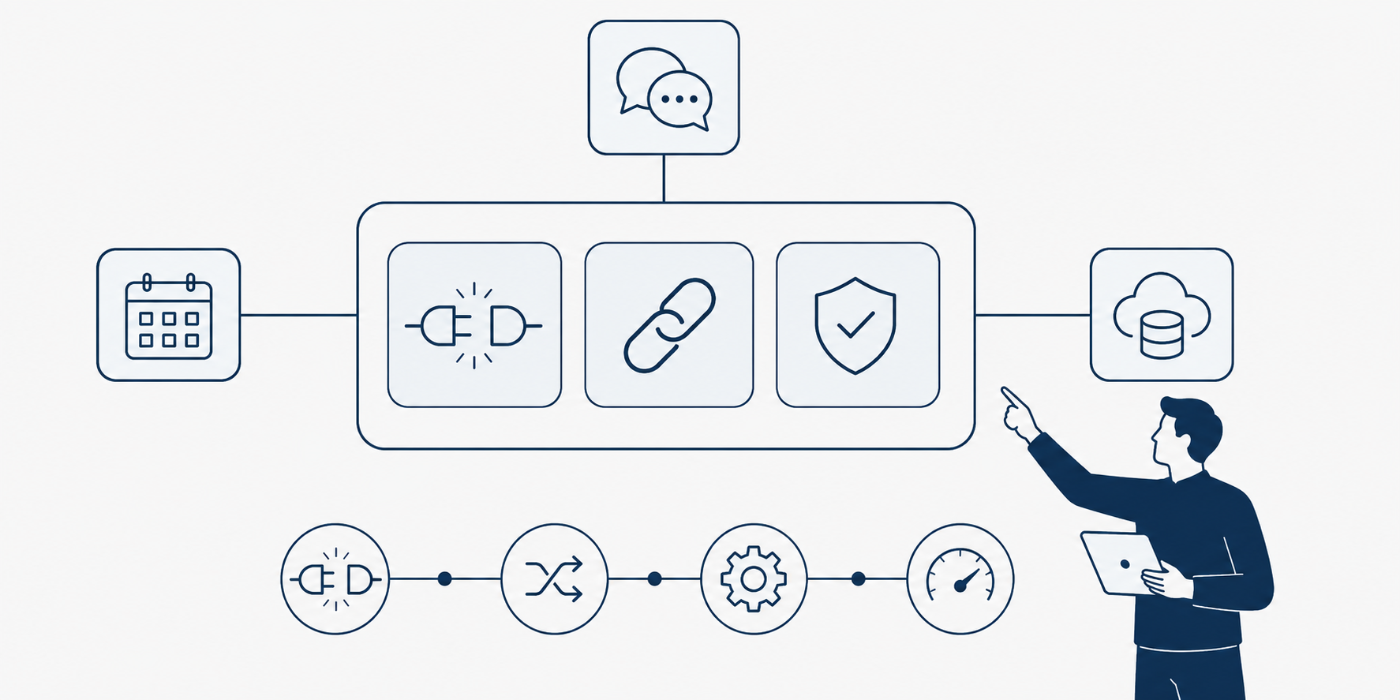
A mature PM integration stack has five layers: source systems, integration logic, data governance, workflow triggers, and reporting outputs. Source systems hold the original records, such as a task board, ERP, CRM, HR system, procurement platform, document repository, or ticketing tool. Integration logic moves data through APIs, connectors, middleware, webhooks, iPaaS platforms, or custom scripts. Data governance defines field ownership, naming rules, access rights, audit trails, and approval authority. Workflow triggers convert events into action. Reporting outputs convert raw signals into leadership-ready decisions. This architecture connects directly with project initiation terms, monitoring and control terms, project financial management, and PMO success predictions.
The first mistake is connecting everything because it can be connected. Strong PMs start with friction. Which update gets copied into three systems? Which report requires manual reconciliation every week? Which approval repeatedly delays delivery? Which risk arrives too late for mitigation? Which vendor document creates contract confusion? These questions matter more than a shiny integration catalog, especially for teams already comparing agile project management tools, Kanban software tools, Scrum project management platforms, and waterfall project management software.
Every integration needs a source-of-truth decision. Task status may belong in Jira, sprint planning in an agile tool, cost actuals in finance, contracts in procurement, and executive health in the portfolio platform. Once ownership is clear, integrations can move approved fields rather than compete over which system is “correct.” This avoids the ugly situation where a PM spends Monday morning defending numbers instead of managing delivery. The same discipline appears in risk identification, resource allocation terminology, team building terminology, and conflict resolution terms.
Manual work still has a place. Judgment-heavy decisions, sensitive stakeholder conversations, complex tradeoff approvals, vendor negotiations, and escalation framing should remain human-led. APIs should prepare the evidence, route the work, expose the pattern, and reduce delay. The PM still owns interpretation, leadership, and judgment. This distinction is vital for professionals building careers through the project manager career roadmap, the executive PM career path, IT project management, and project management consultancy.
3. How to Design API-Driven PM Workflows Without Creating Data Chaos
Start with a workflow map, then decide the API design. Many teams reverse the order. They buy a tool, enable connectors, sync fields, and then wonder why reports get noisier. A better sequence is: define the business event, identify the source record, choose the system owner, decide the trigger, map the fields, set validation rules, test exceptions, assign support ownership, and measure cycle-time improvement. That method supports stronger outcomes in project success analysis, certification impact on project success, project management industry outlook, and project management market reporting.
Field mapping is where many integrations become dangerous. A “due date” may mean planned finish in one system, committed finish in another, requested finish in another, and contractual finish in procurement. A “complete” status may mean development complete, QA accepted, client approved, invoice ready, or closed. A “priority” label may reflect executive pressure instead of business value. Before an API moves data, the team must define terms with the same seriousness used in top project management terms, agile terminology, Scrum terms, and project procurement terms.
Exception handling separates useful integrations from brittle automation. What happens when a required field is missing? What happens when a vendor changes a date after approval? What happens when a sprint item has no epic? What happens when finance rejects a cost code? What happens when an API fails during a reporting window? Strong teams design error queues, fallback owners, retry rules, audit logs, and escalation paths. This is the same operational discipline that protects construction project management, healthcare project management, government project management, and international project management.
Security must be designed before adoption expands. API keys, OAuth scopes, service accounts, admin roles, webhook endpoints, data retention, audit logs, and vendor permissions all create risk. Project data can include budgets, layoffs, procurement negotiations, customer details, unreleased products, legal issues, and strategic investments. A careless integration can expose sensitive information faster than a careless meeting note. Teams should connect API governance with ISO standards, cybersecurity-related PM software changes, project governance best practices, and risk mitigation planning.
4. The High-Value Integrations Every PM Team Should Prioritize First
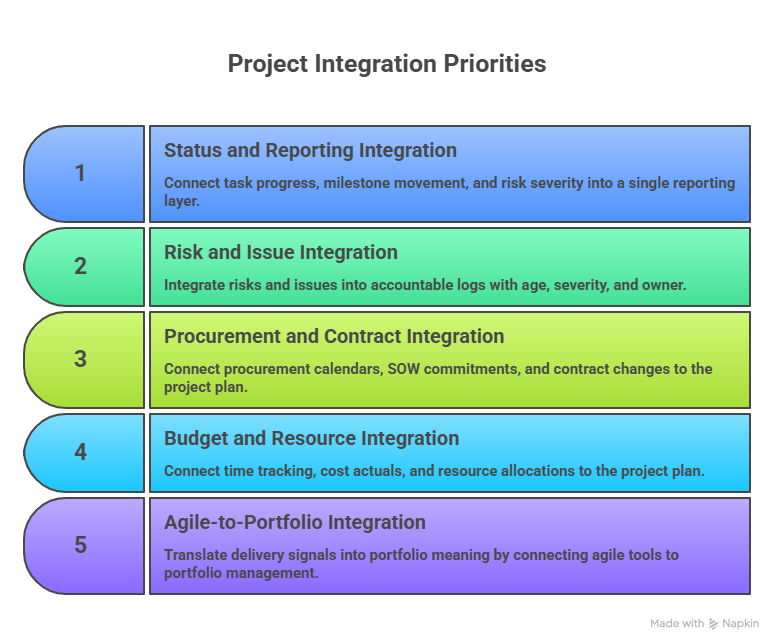
The first priority is status and reporting integration. If project status relies on manual updates, leaders are always reacting to old information. Connect task progress, milestone movement, risk severity, issue aging, budget variance, and decision blockers into a single reporting layer. The goal is a trusted executive view that shows where intervention is needed. This aligns with project reporting, monitoring and control, Gantt chart terminology, and schedule compression terms.
The second priority is risk and issue integration. A risk register that sits outside daily execution becomes ceremonial. Risks should create mitigation tasks, owner reminders, review triggers, and escalation prompts. Issues should move from team channels into accountable logs with age, severity, owner, due date, and decision dependency. This is where integrations make leadership feel real because unresolved risk becomes visible before it becomes failure. Teams can strengthen this through project risk management, risk assessment terms, risk mitigation planning, and project failure analysis.
The third priority is procurement and contract integration. Many projects fail quietly in the gap between delivery planning and vendor reality. A contract date slips, a vendor deliverable arrives incomplete, an RFP milestone gets missed, or a change order sits unapproved while the project continues spending. APIs should connect procurement calendars, SOW commitments, vendor records, contract changes, and payment milestones to the project plan. This gives PMs a sharper operating view, especially when combined with procurement tools, RFP terminology, vendor management, and contract management terminology.
The fourth priority is budget and resource integration. Schedule optimism becomes expensive when finance and capacity data are disconnected. A project can look on track while overtime climbs, contractors burn budget, role gaps widen, and specialists are overbooked across several projects. Connect time tracking, cost actuals, forecasts, capacity plans, leave calendars, and resource allocations. This produces stronger staffing decisions and earlier cost conversations through cost management terms, project budgeting, resource allocation software, and human resource management in PM.
The fifth priority is agile-to-portfolio integration. Agile teams often work in sprint-level tools while executives think in outcomes, budgets, risks, and roadmap commitments. The API job is to translate delivery signals into portfolio meaning. Backlog growth, carryover, velocity movement, blocked work, dependency strain, and sprint goal misses should inform roadmap confidence. This is especially valuable for teams studying agile tool effectiveness, agile estimation, product backlog and sprint backlog, and future Scrum evolution.
5. How to Evaluate PM APIs Before You Commit to a Platform
Evaluate APIs with delivery scenarios, not vendor promises. Ask whether the platform can create, read, update, and delete the records that matter to your workflows. Check whether webhooks exist for real-time triggers. Review rate limits, authentication methods, permission scopes, audit logs, documentation quality, sandbox access, versioning policy, export controls, and integration monitoring. Then test a real workflow: create a risk, assign an owner, trigger a mitigation task, update a dashboard, notify a stakeholder, and capture the audit trail. This gives a practical view that supports PM software rankings, project management software for small businesses, future PM software, and software investment trends.
Documentation quality is a hiring signal for tools. Clear API documentation should explain authentication, endpoints, data models, pagination, error codes, rate limits, webhook payloads, permission boundaries, examples, and version changes. Weak documentation creates dependency on expensive consultants or one internal expert. That fragility becomes a delivery risk when the integration owner leaves, the vendor updates a field, or the reporting workflow breaks before a steering committee. PMs who want deeper platform judgment can connect this skill to PM consultancy careers, freelance project management, remote project management roles, and PM director career growth.
Integration ownership should be named before launch. Business owners define workflow rules. System owners protect platform configuration. Data owners approve field meaning. Security reviews permissions. PMO leaders decide reporting standards. Support owners monitor failures. Without this ownership map, integrations become invisible infrastructure until something breaks. Strong teams place APIs under governance, change control, release management, and benefits tracking. That approach pairs naturally with project governance, quality management, TQM terms, and project closure concepts.
The final evaluation question is business impact. A useful integration should reduce cycle time, increase data trust, speed escalation, improve forecast quality, reduce rework, strengthen compliance, or improve stakeholder confidence. A connector that merely moves noise faster gives the team a faster way to stay confused. The best integrations produce cleaner decisions, fewer surprise meetings, and stronger proof of control. That is why API capability now matters for project managers in California, New York project management careers, Texas PM careers, and Chicago project management careers.
6. FAQs About Project Management APIs & Integrations
-
A project management API is a structured way for other software systems to access or update project data. It may allow tools to create tasks, read milestone dates, update status fields, pull budget records, sync risks, or trigger notifications. For PMs, the practical value is visibility and control. A good API reduces manual copying, supports better reporting, and connects delivery activity to business decisions. It becomes even more useful when paired with project execution terms, project monitoring terms, project reporting practices, and PM software feature analysis.
-
Start with the integration that removes the most repeated pain. For many teams, that means reporting, risk, issue tracking, resource planning, budget tracking, procurement, or agile-to-portfolio visibility. The best first integration has high frequency, clear ownership, measurable business impact, and low ambiguity in field definitions. A weekly status dashboard fed by live milestone, risk, issue, and budget data often produces faster trust than a complex all-system architecture. Useful starting points include issue tracking software, risk registers, resource allocation, and project budgeting terms.
-
APIs reduce duplicate work by moving approved data between systems automatically. For example, a task update can feed a dashboard, a risk entry can create a mitigation task, a vendor milestone can update procurement reporting, and a budget variance can trigger review. The PM spends less time copying updates and more time resolving blockers. The team also avoids conflicting information across tools. This supports better execution across agile project tools, Kanban platforms, Scrum platforms, and waterfall software.
-
The biggest risk is spreading ungoverned data across systems. If field meanings are unclear, permissions are too broad, source-of-truth ownership is weak, or errors are ignored, integrations can make poor decisions look official. A dashboard powered by bad mappings can create false confidence. Teams should define data owners, validation rules, audit trails, access controls, and escalation paths before scaling integrations. That governance mindset connects directly to ISO standards for PM, project governance trends, cybersecurity concerns, and risk mitigation planning.
-
Most project managers do not need to write production code, but they should understand API concepts well enough to ask the right questions. They should know what endpoints, fields, authentication, webhooks, rate limits, audit logs, and error handling mean in workflow terms. This helps them challenge vague vendor claims, protect reporting quality, and work effectively with technical teams. API fluency is especially valuable for IT project managers, project management consultants, portfolio managers, and future PM leaders.
-
Integrations improve executive reporting by pulling live, governed data from delivery, finance, risk, procurement, and resource systems. This reduces manual slide preparation and gives leaders fresher evidence on project health. The strongest reports show trend movement, risk exposure, decision needs, budget pressure, dependency issues, and owner accountability. They give executives a reason to act. Teams can strengthen this capability through project reporting terms, earned value management, portfolio management trends, and PMO success predictions.
-
Measure integration success through business outcomes, not connector count. Track report preparation time, duplicate entry reduction, issue escalation speed, risk mitigation completion, data discrepancy count, budget forecast accuracy, approval cycle time, and stakeholder response time. A useful integration makes the team faster, clearer, and more accountable. A weak integration adds technical activity without operational improvement. The best measurement approach draws from project success factors, project failure root causes, Agile metrics, and project financial management.
