
Complete Guide to Becoming a Certified Scrum Master (CSM)
Becoming a Certified Scrum Master (CSM) isn’t about collecting a badge—it’s about proving you can run real Scrum events, protect focus, and turn messy work into predictable delivery. Hiring panels and delivery leads don’t reward “I know Scrum.” They reward evidence: cleaner backlogs, fewer stalled sprints, faster decisions, better stakeholder alignment, and teams that ship without burnout. This guide is built to help you earn the credential and build the proof assets that make your CSM immediately credible in interviews, internal transfers, and consulting gigs.
1) What CSM Actually Proves and What It Doesn’t
CSM proves you completed a recognized Scrum education path and can speak the language of Scrum confidently. It doesn’t automatically prove you can rescue a failing sprint, resolve cross-team dependencies, or prevent stakeholders from hijacking priorities. The gap between “certified” and “trusted” is filled by delivery evidence and governance maturity—especially if you plan to work in organizations that are trending toward hybrid delivery models (Agile + Waterfall) rather than pure Scrum. If you want that hybrid fluency packaged for hiring panels, read Rise of Hybrid Project Management: Why Agile & Waterfall Blend is the Future (2025 Forecast) and use it to articulate when Scrum is ideal vs when a blended approach is safer.
A professional CSM also understands why Scrum exists: to reduce the cost of wrong assumptions by shipping increments early and adapting fast. That ties directly to portfolio-level prioritization and governance, which is why it helps to connect your Scrum work to bigger PM thinking like Future of Project Portfolio Management (PPM): Top Trends for 2025–2030 and industry shifts such as Economic Uncertainty Leads to Increased Demand for Agile Project Management (2025).
To position your CSM as more than a credential, build your narrative around outcomes: reduced cycle time, fewer defects, cleaner scope boundaries, better predictability, stronger stakeholder trust. Pair that with tooling and reporting literacy—because leadership often experiences “Agile” through dashboards, not ceremonies. Use references like Best Project Reporting & Analytics Software for PMs and Top Dashboard & Data Visualization Tools for Projects to level up how you communicate delivery health.
| Capability | What “Good” Looks Like | Business Impact | Signals / Tools | Who You Align With |
|---|---|---|---|---|
| Scrum fundamentals | Explains Scrum roles/events/artifacts using team-specific examples—no jargon dumping. | Fewer “process fights” | Scrum Guide mapping, onboarding deck | Team leads, new hires |
| Sprint Goal clarity | One goal per sprint; measurable outcome; scope flexes but goal holds. | More completed sprints | Goal template, outcome metrics | Product Owner, delivery lead |
| Backlog refinement | Stories sliced to “testable increments,” acceptance criteria tight, dependencies visible early. | Less mid-sprint churn | DoR checklist, story slicing guide | PO, engineers |
| Estimation & forecasting | Estimates used for tradeoffs, not punishment; forecasting is probabilistic. | Fewer missed dates | Velocity bands, throughput chart | Stakeholders, PMO |
| Facilitation | Meetings end with decisions, owners, next steps—no “status theater.” | Faster decisions | Agenda scripts, decision log | Cross-functional teams |
| Impediment removal | Blocks categorized (process/tech/org); cleared with escalation discipline. | Reduced cycle time | Impediment board, escalation ladder | Managers, platform teams |
| Dependency management | Dependencies made explicit with dates/owners; integration points scheduled. | Fewer surprises | Dependency map, RAID log | Other teams, vendors |
| Risk handling | Risks turned into experiments/spikes; “unknowns” shrink weekly. | Lower rework | Risk register, spike outcomes | Leads, architecture |
| Sprint Planning | Capacity reality-check; scope selected to meet goal; tasks not over-planned. | Better predictability | Capacity sheet, planning script | Team, PO |
| Daily Scrum | Focus on progress to goal, blockers, and plan—no manager report-outs. | Less wasted time | 3-question variant, board walk | Team members |
| Sprint Review | Shows working increments; ties demo to outcomes and next bets. | Higher stakeholder trust | Demo narrative, feedback log | Stakeholders |
| Retrospectives | 1–2 actions max; owners set; action outcome reviewed next retro. | Continuous improvement | Retro formats, action tracker | Team, manager |
| Definition of Done | DoD includes quality gates (tests, review, docs) tied to your context. | Less escaped defects | DoD checklist, quality metrics | QA, security |
| Metrics hygiene | Metrics inform decisions; avoids vanity charts; explains tradeoffs. | Better governance | Flow metrics, OKR links | Leadership, PMO |
| Stakeholder comms | Sets expectation boundaries; reduces “drive-by priority changes.” | Less scope thrash | Update templates, decision memos | Business owners |
| Tooling setup | Boards reflect reality; WIP visible; policies documented. | Fewer blind spots | Jira policies, automation rules | PMO, team |
| Hybrid fluency | Knows when to blend Agile/Waterfall without breaking governance. | More viable delivery | Hybrid playbook, phase gates | PMO, compliance |
| Career packaging | Portfolio + stories prove impact; resume shows outcomes, not ceremonies. | More interviews | Case studies, STAR bank | Recruiters, panels |
2) The Step-by-Step CSM Path: Training, Exam, and the Fastest Way to Real Competence
The CSM pathway is intentionally straightforward: (1) take an approved course, (2) pass the assessment, (3) maintain the credential as required. The mistake most candidates make is treating this as a memorization task. The fastest professional path is: learn → apply → document proof → test. Your goal isn’t “pass.” Your goal is “pass + produce artifacts that make you employable.”
Step A: Choose training with the right learning outcomes (not just a date)
Pick a course that emphasizes facilitation, conflict patterns, and real backlog slicing—not just definitions. A CSM who can run strong events is instantly valuable in roles beyond software, including healthcare, government, and enterprise transformation. If you want cross-domain perspective, compare how structured environments operate using Step-by-Step Guide to Becoming a Healthcare Project Manager (2026–27) and governance-heavy hiring expectations like Career Roadmap for a Government Project Manager: Skills, Certifications & Salaries.
Step B: Build a “Scrum Master Operating System” while you study
While learning, start creating reusable templates you can bring to interviews:
Sprint Goal template + decision rules
Refinement checklist (DoR-style)
Impediment log + escalation ladder
Retro action tracker that forces follow-through
Stakeholder update template that prevents scope thrash
This is also where your tool literacy matters. If you can’t make your board reflect reality, teams won’t trust the process. Study tooling ecosystems and governance with Top Calendar & Scheduling Tools for Project Managers and Best Document Management Software for Project Teams so your “process” is operational, not theoretical.
Step C: Pass the exam by understanding patterns, not phrases
Exam questions often test:
Role boundaries (what the Scrum Master does vs PO vs Developers)
How to handle interruptions, scope changes, and unrealistic expectations
How to run events so they produce decisions
How to use transparency without weaponizing metrics
To strengthen your “why,” ground your answers in macro trends like Predicting the Evolution of Scrum: Changes & Innovations Coming by 2027 and modern delivery contexts such as AI Adoption in Project Management Reaches Record Levels (2025).
Step D: Turn certification into career leverage immediately
Within 14 days of passing, publish (or privately compile) two short case studies:
“How I improved sprint predictability”
“How I reduced blockers and improved flow”
If you want a larger leadership arc later, map your pathway using Career Roadmap: How to Become a Project Management Director and Detailed Roadmap: How to Become a Chief Project Officer (CPO).
3) What Great Scrum Masters Do Differently in the First 30–60–90 Days
A professional Scrum Master doesn’t start by “enforcing Scrum.” They start by diagnosing why delivery is failing: unclear priorities, invisible dependencies, weak slicing, lack of quality gates, stakeholder hijacks, or tool chaos. Your first 90 days should look like a deliberate stabilization plan.
Days 1–30: Stabilize signals and trust (stop the bleeding)
Clarify sprint goals and reduce work-in-progress so the team can finish.
Make blockers visible and categorize them (team / platform / org).
Fix meeting design: each event must end with decisions, not discussion.
Add a lightweight Definition of Done that matches your environment (tests, reviews, documentation, compliance).
Use reporting discipline without drowning the team. Borrow practical approaches from Best Project Reporting & Analytics Software for PMs and keep metrics decision-focused. If the org is finance-pressured, read Global Inflation’s Impact on Project Budgets: How Project Managers Are Adapting to speak stakeholder language: cost, speed, risk.
Days 31–60: Improve flow (reduce churn and rework)
Install a refinement rhythm so stories are ready before planning.
Create a dependency map and lock integration points.
Replace “big stories” with sliced increments (thin vertical slices).
Add one improvement action per retro and track it like a deliverable.
If your environment requires structured oversight, build hybrid competency with Project Management 2030: Predicting the Next Decade’s Dominant Methodologies so you can explain tradeoffs: when to stay agile, when to add gates.
Days 61–90: Scale impact (make your work visible and portable)
Create a team playbook: DoD, decision rules, escalation ladder, and event scripts.
Establish a stakeholder feedback loop in Sprint Reviews that produces decisions.
Package outcomes into a portfolio: before/after metrics, examples, and templates.
If you want to sell your skills as a consultant or freelancer, align your packaging with Career Roadmap: How to Build a Successful Freelance Project Management Career and consider tool leverage from Best Automation Tools for Project Management Efficiency.
What’s Your Biggest Blocker to Passing CSM *and* Getting Hired as a Scrum Master?
4) Scrum Events That Hiring Panels Test You On (and the Mistakes That Fail You)
Interviewers rarely ask “What is Scrum?” They ask scenario questions that expose whether you can keep delivery stable under pressure.
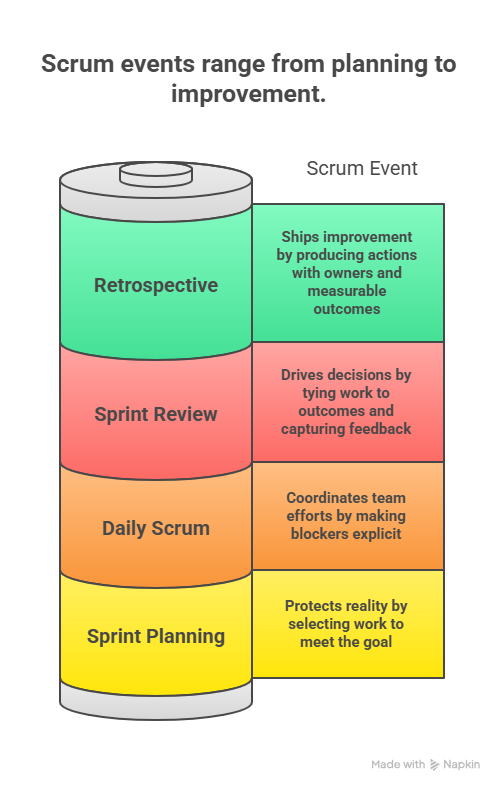
Sprint Planning: Your job is to protect reality
High performers:
Start with Sprint Goal and capacity reality-check.
Select work to meet the goal, not to “fill the sprint.”
Surface dependencies and risks before committing.
Common failure pattern: planning becomes task micromanagement and false certainty. Use schedule discipline from Top Calendar & Scheduling Tools for Project Managers to keep planning lean but accountable.
Daily Scrum: It’s coordination, not reporting
Great Daily Scrums:
Are about the goal, not “what I did yesterday.”
Make blockers explicit and assign actions immediately.
Keep chatter off the critical path.
If you need a clean system for capturing blockers and decisions, pair meeting discipline with stronger documentation habits using Best Document Management Software for Project Teams.
Sprint Review: It’s a decision-making event
A Review that “shows a demo” but doesn’t change decisions is wasted. High-value Reviews:
Tie work to outcomes and next options.
Capture feedback as decisions or experiments.
Create stakeholder alignment on what not to do.
If leadership expects dashboards, connect review outputs to reporting clarity using Top Dashboard & Data Visualization Tools for Projects.
Retrospective: Improvement must ship, not just be discussed
Your retro should produce 1–2 actions with owners and measurable outcomes. Hiring panels love candidates who can show a retro action tracker and explain what changed as a result. For bigger-picture improvement messaging, connect continuous improvement to evolving methodologies using Project Management 2030: Predicting the Next Decade’s Dominant Methodologies.
5) Build a “CSM Career Package” That Gets Interviews (Even With Limited Experience)
If your background is light on Scrum titles, your packaging must be heavy on evidence. Build a portfolio that proves you can stabilize delivery.
The 5 proof assets that change hiring outcomes
Scrum Master Playbook (5–8 pages): DoD, event scripts, escalation ladder, metrics rules.
2 case studies: before/after, what you changed, what improved.
Metrics snapshot: throughput/cycle time trends with interpretation (not vanity charts).
Conflict pattern library: how you handled scope thrash, broken refinements, dependency stalls.
Tooling screenshots: boards/policies that reflect reality.
For roles that blend Scrum with enterprise governance, show you understand hybrid constraints using Rise of Hybrid Project Management: Why Agile & Waterfall Blend is the Future and portfolio-level prioritization using Future of Project Portfolio Management (PPM) Trends.
How to write your resume bullets (CSM-style)
Instead of “Facilitated Daily Scrums,” write outcome bullets:
Reduced cycle time by X% by enforcing WIP policies and removing top 3 recurring blockers.
Increased sprint goal completion from X to Y by installing refinement rhythm and story slicing rules.
Improved stakeholder trust by redesigning Sprint Reviews into decision-based demos with feedback logs.
If your longer-term aim is leadership, align your narrative with career progression frameworks like Career Path from Project Manager to Vice President of PM and Ultimate Guide to Becoming a Project Portfolio Manager.
Where CSM fits in modern market demand
Scrum roles are increasingly evaluated by results, not ideology—especially as organizations experiment with AI assistance, automation, and new reporting expectations. Read AI Adoption in Project Management Reaches Record Levels (2025) to prepare for interview questions like “How do you use AI without harming quality?” and “How do you prevent automation from hiding delivery risk?”
6) FAQs: Certified Scrum Master (CSM)
-
CSM helps you get past early filters, but hiring decisions come from evidence: how you handle scope changes, dependencies, and stakeholder pressure. Build proof assets (playbook + case studies) and speak in outcomes. Use frameworks from Best Project Reporting & Analytics Software for PMs to make your impact measurable.
-
Turn informal experience into documented evidence: event scripts you used, a blocker log with outcomes, a refinement checklist, and one “before/after” metric story. Tie your approach to modern practice by referencing Predicting the Evolution of Scrum by 2027.
-
They describe ceremonies instead of decisions. Interviewers want: “Here’s the exact conflict, the decision rule I used, the artifact I updated, and what improved.” Use stakeholder-friendly framing learned from Top Dashboard & Data Visualization Tools for Projects.
-
Protect the Sprint Goal with explicit decision rules: what qualifies as an emergency, who can approve swaps, and how tradeoffs are documented. Escalate with evidence: impact on goal and delivery risk. Hybrid environments make this more common—prepare with Rise of Hybrid Project Management.
-
Use flow metrics that support team decisions: cycle time trends, throughput, WIP, and blockers cleared. Avoid ranking individuals. Present metrics as “system health,” not performance surveillance. Pair your approach with tools and reporting ideas from Best Project Reporting & Analytics Software.
-
Yes—Scrum is a delivery system for uncertainty, not a coding religion. But you must adapt it to governance, compliance, and procurement realities. Learn cross-domain expectations via Healthcare Project Manager Roadmap (2026–27) and Government PM Roadmap.
-
Ship your career package: playbook + two case studies + a metrics snapshot. Then practice scenario answers (scope thrash, broken refinement, dependency stalls). Anchor your long-term growth using leadership pathways like Project Management Director Roadmap.
-
Show you can keep Scrum teams effective while respecting gates, reporting needs, and portfolio priorities. Build a hybrid playbook and reference macro methodology shifts using Project Management 2030 and Future of PPM Trends.
