
Complete Guide to Starting a Career in Construction Project Management
Construction project management is one of the few careers where you can start with zero industry “status” and still earn trust fast, if you learn the right systems. The hard part is not the title. It is surviving real world chaos: shifting scopes, subcontractor bottlenecks, change orders, safety pressure, and clients who want speed plus perfection. This guide breaks the path down into concrete steps you can execute, from your first role to your first project, and the skills that make you profitable, promotable, and respected on site.
1) What Construction Project Management Really Is and Why Most Beginners Fail
Construction PM is delivery under constraints. You are paid to turn drawings and promises into built reality, while controlling time, cost, risk, quality, and people. Unlike many office PM roles, construction adds physical dependencies that do not forgive mistakes. If a slab is poured wrong, you do not “iterate.” You demolish. That single difference changes everything about how you plan, communicate, and control work.
Most beginners fail for three reasons:
First, they confuse activity with control. They send emails, attend meetings, and “track” tasks, but cannot answer the only questions that matter: What is on the critical path today, what could block it next, and what decision is needed to keep the schedule alive. If you want a non negotiable foundation, study how modern PMOs measure delivery health in demanding environments, then translate it to site work. Use the discipline from articles like digital transformation in PMOs and apply it to field reporting, issue management, and escalation.
Second, they underestimate procurement and subcontractor management. A project is only as reliable as its supply chain. Material lead times, shop drawing approvals, and vendor fabrication capacity can quietly destroy your schedule. If you are serious about building this as a career, also learn how procurement tools and contract workflows reduce risk, similar to what is discussed in project management software investment surges and major cybersecurity concerns prompt software overhaul, because construction teams increasingly depend on digital workflows.
Third, they ignore the financial engine. In construction, you are managing cash flow through billing cycles, pay apps, retainage, and change orders. If you cannot forecast cost, you cannot lead. The pressure is amplified during inflation and price volatility, so understand how PMs adapt budgets under uncertainty by learning from global inflation’s impact on project budgets.
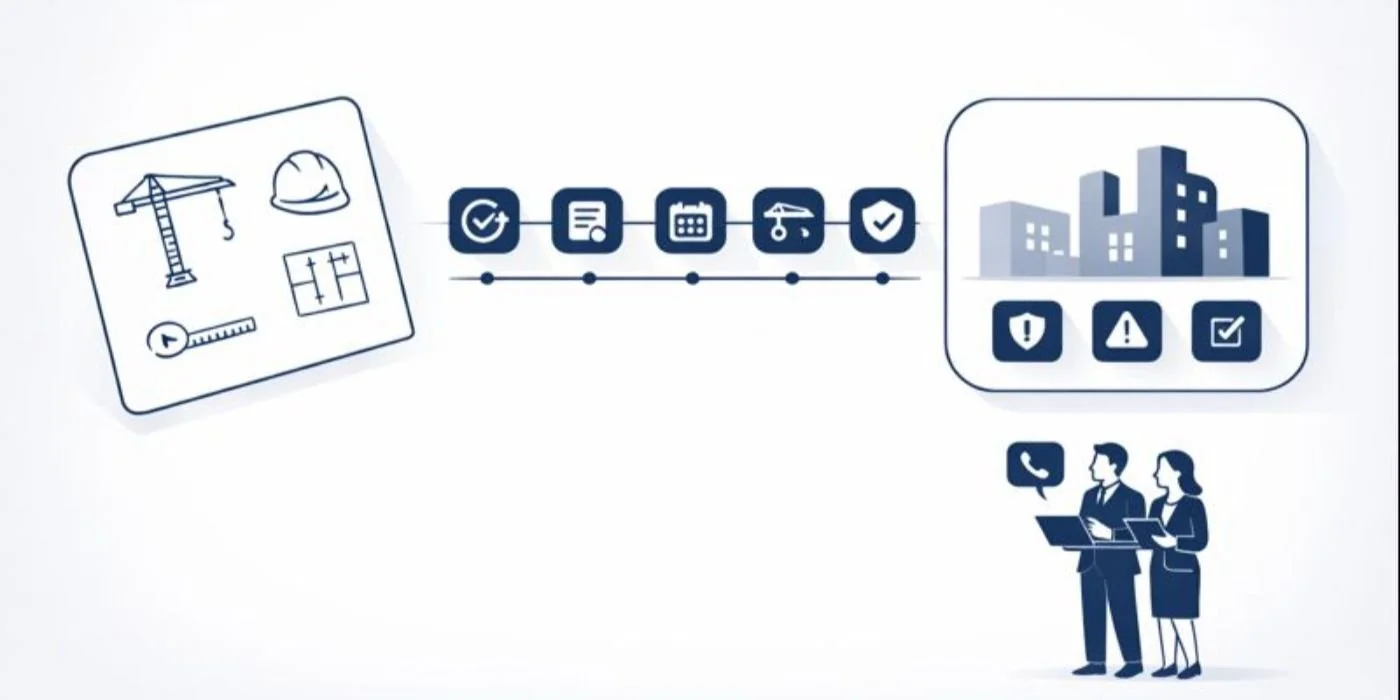
If you want the simplest career framing, think of construction PM as a system of five loops: planning, procurement, production, payment, and protection. Your job is to keep all five moving, while protecting the schedule, the margin, and the client relationship.
2) The Fastest Entry Paths and How to Choose the Right One
There are multiple entry doors into construction PM. The right one depends on your starting assets: experience, education, and tolerance for field intensity.
Path A: Project Coordinator to Assistant PM
This is the most accessible path for career switchers. You learn the control system first: RFIs, submittals, meeting notes, trackers, and reporting. Your goal is to become the person who always knows the latest truth. That reputation turns into promotion.
To accelerate this path, build your fundamentals like a professional PM first. Use structured learning from PM career roadmaps such as how to become a Chief Project Officer and becoming a project portfolio manager. You are not applying to be a CPO. You are borrowing the operating system: governance, metrics, stakeholder clarity, and decision discipline.
Path B: Field Engineer to Project Engineer
If you can handle site pressure, this path teaches reality faster. You learn sequencing, trade coordination, inspections, safety, and daily production. You become dangerous in a good way because you understand what “installable” means, not just what “planned” means.
This path is also where remote work myths get crushed. Construction is physical. Some roles are hybrid, but field presence is still a competitive advantage. If you want a modern career angle, read remote and virtual project management roles so you understand which parts of PM can be done remotely and which parts cannot.
Path C: Internships and Graduate Programs
If you have formal education in construction management or civil engineering, internships can fast track you into project engineer roles. The advantage is exposure. The trap is becoming book smart without field credibility. You must turn education into proof by owning measurable deliverables: a submittal register, a lookahead plan, a punch list closeout sprint.
How to choose correctly
Pick the path that gives you the best “learning leverage” in the next 12 months:
If you need a stable desk based start, go coordinator.
If you want rapid competence and can handle pressure, go field engineer.
If you have education and access, stack internships plus certifications.
Also decide your long term lane early: general contractor, subcontractor, or owner side. Owner side PM can be attractive, but many owner side roles expect you to already understand site reality. Build your foundation first, then move.
3) The Core Skill Stack That Makes You Hireable and Promotable
Construction PM rewards competence that reduces risk. If you want to stand out, build a stack that makes you useful in the first week, not the first year.
Scheduling that actually works
You do not need to be a scheduling wizard on day one. You need to protect the work front. Learn two levels:
Two week lookahead planning with constraints
Daily plan with trade commitments
This is where “agile” becomes practical. It is not about buzzwords. It is about short cycle planning, fast feedback, and removing blockers. Study how economic pressure increases agile adoption in PM at increased demand for agile project management and global survey highlights rising demand for agile. Then apply it on site through daily coordination and constraint management.
Cost and change order control
If you want to be trusted, you must protect the budget. The biggest pain point in construction is scope ambiguity turning into financial bleeding. Learn to do three things:
Document potential change the day you see it
Quantify impact in time and money
Get written direction before work continues
In inflationary periods, this becomes existential. Use insights from inflation’s impact on project budgets to build stronger forecasting habits and tighter procurement timing.
Procurement and vendor intelligence
Long lead items destroy schedules quietly. Build procurement fluency:
Identify long lead items during preconstruction
Build a procurement log tied to the schedule
Confirm lead times with vendors and update weekly
This is also where modern tooling matters. Learn the reality of tool adoption from investment in project management software and the impact of tech trends from AI adoption in project management. You are not chasing hype. You are reducing latency in decisions.
Communication that prevents rework
High performing construction PMs do not talk more. They remove ambiguity. Your communication should produce decisions, not conversations. Use structured updates: what changed, what is blocked, what decision is needed, by when, and what happens if it is late.
If you want a broader leadership arc and how PM is framed as an economic lever, read project management named a key driver of economic growth. Then use that narrative in interviews: you reduce waste, shorten cycle time, and increase reliability.
4) A 90 Day Plan That Gets You Job Ready Without Wasting Time
If you want momentum, you need a structured sprint. This 90 day plan is built to create proof, not just knowledge.
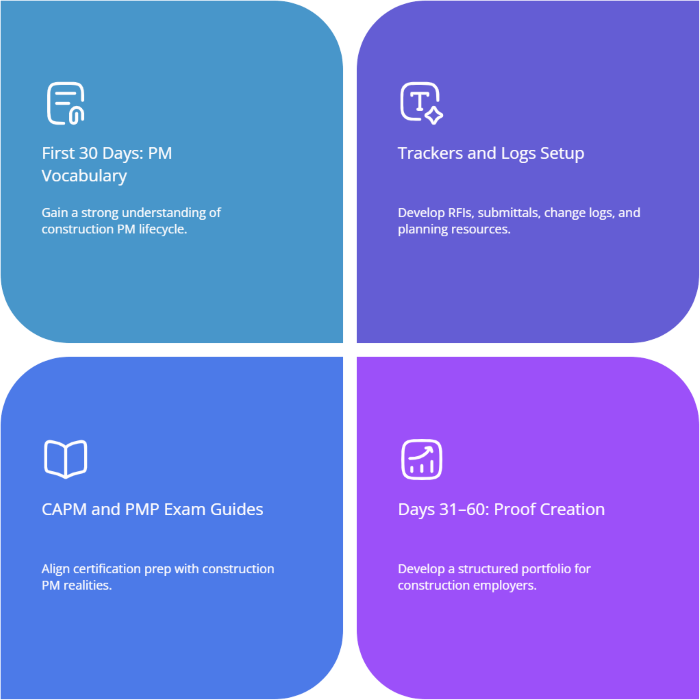
Days 1 to 30: Build your baseline and vocabulary
Your objective is to become conversational in construction PM mechanics.
Learn the life cycle: preconstruction, mobilization, rough in, closeout
Learn the document flow: drawings, specs, RFIs, submittals, change orders
Build a simple tracker set: RFI log, submittal log, change log, lookahead plan
Then connect your learning to formal PM credibility. If you are early career, CAPM can support your narrative. Use ultimate guide to passing the CAPM exam and align the concepts with construction realities. If you are more experienced, consider PMP positioning with ultimate PMP certification exam guide and reinforce your interview confidence using top 50 PMP exam questions.
Days 31 to 60: Build proof projects and interview assets
Employers hire evidence. Build a small portfolio that demonstrates you understand construction flow.
Create three one page artifacts:
Two week lookahead plan for a sample interior build
RFI and submittal tracker with realistic statuses
Change order log with scope change narrative and cost impact
Also build scenario answers. Interviewers will ask: what do you do when a delivery is late, when a subcontractor is behind, when an inspector fails work, when the client changes scope. Your answers must show structured thinking, not panic.
If you want an edge, learn how PM consulting frameworks create clarity. Even if you do not plan to consult, the frameworks help you speak executive language. Read starting a project management consultancy firm and apply its positioning and discovery discipline to construction interviews.
Days 61 to 90: Get field exposure and close gaps fast
If you do not have construction experience, you need controlled exposure:
Shadow site meetings if possible
Volunteer for documentation work
Find entry roles that touch real workflows
This is where location based career guides help you align your job search with actual demand. If you are targeting specific markets, use resources like project management careers in California, project management careers in Texas, and Florida project management job market to identify industries and employer patterns. If you want big market options, review New York project management career guide and project management careers in New York City. The point is not geography trivia. The point is targeting where construction pipelines and infrastructure spending create opportunity.
5) How to Stand Out in Hiring and Build a Long Term Construction PM Career
Competition is not about who wants the job most. It is about who reduces the employer’s risk fastest.
Make your resume speak construction
Even if you are coming from another industry, translate your experience into construction outcomes:
Planning and sequencing
Vendor coordination
Budget tracking and change control
Compliance and documentation
Use language that matches how construction teams think: constraints, lead times, inspections, punch lists, closeout.
Learn the technology direction without becoming tool obsessed
Construction PM is going digital quickly, but tools do not replace thinking. Your edge is knowing what to track and why. Keep up with trends that affect how projects are run, like blockchain momentum in project management and AI adoption trends. Then translate them into practical benefits: fewer document losses, faster approvals, better forecasting, stronger audit trails.
Add sustainability awareness because clients are demanding it
Construction is increasingly shaped by sustainability expectations, reporting, and supply chain scrutiny. If you can speak ESG fluently, you become more valuable on public and corporate projects. Use sustainability and ESG project management to understand how governance and reporting expectations are evolving, then connect that back to construction topics like materials, waste, and vendor compliance.
Build a growth path instead of chasing titles
A reliable career path often looks like:
Project Coordinator → Project Engineer → Assistant PM → PM → Senior PM → Project Executive
If you want to aim higher long term, build leadership maturity early. Use strategic roadmaps like how to become a Chief Project Officer as a leadership map. Then focus on the skills that actually get you there: decision quality, stakeholder trust, risk control, and team performance.
Also consider expanding your professional range. Construction projects are often global in stakeholders, standards, and supply chains. If that appeals to you, learn career positioning through international project manager guide. If you prefer autonomy, you can move into independent work later using the mindset from freelance project management career roadmap.
6) FAQs
-
Target roles that give you exposure to construction documents and coordination without requiring deep field history. Project Coordinator and Junior Project Engineer are often the fastest entry points because they touch RFIs, submittals, meeting actions, and trackers. In interviews, do not claim site mastery. Show that you understand the workflow and can execute reliably. Bring a simple RFI log, a submittal register, and a two week lookahead example. Hiring managers trust candidates who bring proof and speak in real deliverables, not generic enthusiasm.
-
A degree helps, but it is not mandatory in many markets if you can demonstrate competence. Construction PM is proof driven. If you can show you understand sequencing, change control, and documentation discipline, you can earn entry roles and grow. Certifications can strengthen credibility, especially when paired with real artifacts. Consider building foundational PM knowledge through CAPM preparation or stronger positioning through PMP guidance, then translate those concepts into construction examples.
-
Master constraint thinking, documentation discipline, and change control. Constraint thinking means you always know what could block progress next and you remove it early. Documentation discipline means decisions, approvals, and issues are recorded the same day. Change control means scope shifts are captured before they become free work. These three skills protect schedule, margin, and trust. Many beginners fail because they try to learn everything at once. Learn the few skills that keep projects from bleeding, then expand.
-
They treat scope change as a process, not a surprise. When change appears, they document it, quantify impact, and secure direction before proceeding. They maintain a change log tied to schedule and budget, and they communicate trade offs clearly to stakeholders. The goal is not to stop change. The goal is to prevent silent change that destroys margin. Budget volatility makes this more important, so learning from project budget adaptation under inflation helps you build stronger forecasting and tighter reporting.
-
Answer scenario questions with structure. When asked about a delay, do not give emotions or vague confidence. Walk through: impact, root cause, options, recommended action, owner, and timeline. Bring a one page tracker set that shows you understand RFIs, submittals, and lookahead planning. Also speak to modern delivery pressure by referencing how teams adapt under uncertainty through agile demand growth. Interviewers want calm thinking under chaos. Show it.
-
It can be, because it scales with responsibility and project size. The financial upside is tied to your ability to deliver reliably, manage risk, and protect margin. The fastest growth happens when you can run complex projects with fewer surprises. If you build skills in cost control, procurement planning, and stakeholder management, your value rises quickly. Long term, you can move into senior leadership or independent pathways using frameworks similar to consultancy building, especially once you have real project wins.
-
For early career professionals, CAPM can help you signal PM fundamentals, especially when paired with construction specific proof. For experienced professionals, PMP is often the strongest general credential. PRINCE2 can be useful in some regions and organizations that prefer it, especially for governance heavy environments. If you choose a certification, do not treat it as the goal. Treat it as a credibility layer that supports your real capability. If you are considering which path fits, use PMP vs PRINCE2 comparison to pick strategically.
