
Key Project Monitoring and Control Terms Explained
Projects rarely fail in one dramatic moment.
They fail in small, ignored signals: a slipped milestone nobody escalated, a budget variance explained away for three weeks, a dependency that looked minor until it blocked delivery, a status deck that sounded healthy while the schedule was already bleeding. Strong project managers learn to catch those signals early, translate them into decisions, and move teams before drift becomes damage. That is where monitoring and control stops being theory and starts becoming career protection.
This guide breaks down the monitoring and control terms that actually matter when deadlines tighten, sponsors lose patience, and delivery pressure exposes weak systems. Along the way, strong project managers should also deepen their command of core project management terms, sharpen their grasp of project risk management, strengthen project scheduling terms, and refine their command of project communication techniques, since monitoring only works when signals connect to action.
1. Why Monitoring and Control Terms Matter More Than Most PMs Realize
A surprising number of project managers can run meetings, update plans, and chase stakeholders, yet still struggle to explain the difference between a variance, an issue, a forecast, a corrective action, and a change request. That gap becomes expensive fast. When a sponsor asks why the budget is trending above baseline, weak PMs talk in generalities. Strong PMs point to cost management terms, tie them to earned value signals, map the exposure against project budgeting terms, and recommend a decision path the leadership team can act on immediately.
Monitoring and control is where project leadership becomes visible. It sits at the center of schedule discipline, risk response, dependency management, scope protection, escalation design, and performance reporting. A PM who understands critical path method terms, stakeholder terms, quality management terms, and issue tracking workflows can spot deterioration earlier and frame recovery faster.
This matters even more in complex delivery environments. In government, healthcare, infrastructure, technology, and enterprise transformation work, teams often drown in updates while starving for interpretation. Dashboards multiply. Meetings expand. Documents get longer. Yet decision quality gets worse. Monitoring and control vocabulary fixes that by giving teams shared language for what is happening, how serious it is, who owns it, and what action comes next. PMs building toward larger roles should treat this language the same way they treat career roadmaps for project managers, government PM career paths, project management director roles, and the long-term future project manager skill set: it is operational power, not glossary trivia.
| Term | What It Means | Why It Matters | Typical PM Action | Best Tool / Signal |
|---|---|---|---|---|
| Baseline | The approved version of scope, schedule, or cost used for comparison. | Shows whether performance is drifting from plan. | Lock approval history and compare actuals weekly. | Schedule baseline, cost baseline |
| Actual Cost (AC) | The real spend incurred for completed work. | Exposes budget truth instead of assumptions. | Reconcile invoices, labor, and vendor burn. | Budget tracker, finance reports |
| Planned Value (PV) | The budgeted value of work scheduled by a point in time. | Creates a target for time-phased budget analysis. | Map planned spend to milestones and periods. | EVM sheet, baseline plan |
| Earned Value (EV) | The budgeted value of work actually completed. | Shows delivery progress in monetary terms. | Validate percent complete before reporting. | EVM dashboard |
| Schedule Variance (SV) | Difference between earned value and planned value. | Shows whether work is ahead or behind schedule. | Investigate slippage drivers and recovery options. | Variance report |
| Cost Variance (CV) | Difference between earned value and actual cost. | Shows whether the project is over or under budget. | Review labor efficiency and vendor costs. | Cost control dashboard |
| SPI | Schedule Performance Index measuring schedule efficiency. | Gives a quick health ratio for time performance. | Track trend line, not one isolated week. | EVM metrics |
| CPI | Cost Performance Index measuring cost efficiency. | Helps forecast likely budget overrun patterns. | Trigger reforecast when CPI weakens persistently. | EVM metrics |
| Estimate at Completion | Forecasted final project cost based on current performance. | Warns leadership before the budget breach becomes official. | Update forecast and test recovery scenarios. | Forecast model |
| Estimate to Complete | Expected cost required to finish remaining work. | Shows what the unfinished portion will demand. | Reassess resource mix and open commitments. | Cost forecast |
| To-Complete Performance Index | Efficiency required on remaining work to hit a target. | Reveals when recovery assumptions are unrealistic. | Challenge optimism in recovery plans. | EVM analysis |
| Threshold | Predefined limit that triggers attention or escalation. | Stops teams from normalizing poor performance. | Set red-amber-green triggers early. | Governance plan |
| Tolerance | Allowed deviation range before formal intervention is required. | Clarifies how much drift leadership will accept. | Align tolerances with sponsor expectations. | Governance framework |
| Forecast | Prediction of future status based on current data. | Turns monitoring into forward-looking control. | Refresh forecast after each major status cycle. | Status model, trend analysis |
| Trend Analysis | Review of performance direction over time. | Catches deterioration before it becomes a crisis. | Watch recurring delays and burn-rate shifts. | Dashboards, control charts |
| Variance Analysis | Investigation of why actual results differ from plan. | Prevents shallow status reporting. | Document root cause, impact, and action owner. | Variance log |
| Milestone Slippage | Movement of a milestone beyond its approved date. | Signals downstream schedule and dependency risk. | Re-sequence tasks and escalate blocked approvals. | Master schedule |
| Critical Path | Longest path determining minimum completion time. | Shows where delay directly hits finish date. | Protect critical tasks and float consumption. | CPM schedule |
| Float | Amount of delay a task can absorb without affecting finish date. | Helps prioritize urgency correctly. | Track where float is being consumed quietly. | Scheduling tool |
| Issue | A current problem requiring action now. | Separates active pain from future possibility. | Assign owner, due date, and escalation path. | Issue log |
| Risk Trigger | An event or condition showing a risk may be materializing. | Helps teams act before impact lands. | Link triggers to response plans. | Risk register |
| Corrective Action | An action taken to bring performance back to plan. | Restores control after deviation appears. | Accelerate work, reassign resources, or resequence. | Action tracker |
| Preventive Action | An action taken to reduce the chance of future deviation. | Builds resilience instead of reacting late. | Strengthen reviews, controls, or early checks. | Lessons learned, risk plans |
| Defect | A verified nonconformance in a deliverable. | Turns quality weakness into rework and delay. | Track severity, owner, and closure evidence. | QA log |
| Change Request | Formal proposal to alter approved scope, time, or cost. | Protects baseline integrity. | Quantify impact before approval discussion. | Change log, CAB |
| Control Account | A management control point combining scope, budget, and schedule. | Improves accountability in large programs. | Assign clear owner and reporting cadence. | WBS and cost account plan |
| Management Reserve | Budget held for unknown-unknown work outside baseline. | Supports decisions when true surprises emerge. | Use only with governance approval. | Reserve tracking sheet |
| Escalation | Raising a decision, risk, or issue to higher authority. | Prevents avoidable delay caused by stalled ownership. | Escalate early with decision-ready options. | RAID log, steering pack |
2. The Core Monitoring Terms That Tell You Whether the Project Is Actually Healthy
The first term every PM needs to respect is baseline. Teams casually say a project is “on track,” but that statement means very little without a clear approved reference point. Baselines exist so that current performance can be compared against authorized expectations. Without them, schedule drift hides behind vague optimism, cost growth gets reframed as “evolving needs,” and scope creep gets treated like teamwork. PMs who need stronger control over delivery should reinforce baseline thinking alongside project initiation terms, stakeholder alignment concepts, contract management terminology, and procurement terms, since commitments often fracture where approvals were weakest.
Then comes the triangle of planned value, earned value, and actual cost. These are not abstract exam definitions. They tell you whether the project is producing enough value for the time elapsed and money spent. If actual cost is rising faster than earned value, labor is inefficient, vendor output is underperforming, or rework is eroding productivity. If planned value is ahead of earned value, delivery is late even if the team sounds busy. PMs who want stronger reporting discipline should pair these concepts with project reporting and analytics software, dashboard and visualization tools, budget tracking platforms, and project management software for small businesses to make signal visibility operational rather than manual.
From there, schedule variance, cost variance, SPI, and CPI help interpret whether the gap is tolerable or dangerous. A single negative variance does not always mean the project is failing. A repeated negative trend does. That is why trend analysis matters. Monitoring is not a snapshot habit. It is a pattern-recognition discipline. PMs who only react when the status turns red are already late. The smarter move is to identify when float is being consumed, when completion percentages stop matching evidence, when approval cycles keep expanding, and when quality issues quietly create future delay. Those pressures often show up first in project scheduling systems, Gantt chart software, issue tracking tools, and document management platforms, long before they appear in sponsor-facing updates.
3. Control Terms That Separate Passive Reporting From Real Project Leadership
A weak PM reports pain.
A strong PM controls it.
That difference starts with knowing the meaning of variance analysis, thresholds, tolerances, and forecasting. Variance analysis should never stop at “the task is delayed” or “costs came in higher than expected.” Those are symptoms. Real variance analysis identifies the source, quantifies the impact, names the owner, states the corrective path, and explains what happens if leadership does nothing. This is where risk identification terms, project risk management language, communication techniques, and project knowledge management practices begin to work together instead of living in separate documents.
Thresholds and tolerances are equally important. Teams without predefined control limits waste time debating whether a problem is serious enough to surface. That delay kills response time. Mature PMs define in advance what level of budget deviation, milestone slippage, defect count, unresolved dependency age, or resource gap triggers escalation. This removes politics from reporting. It also reduces the common pain point where teams hide bad news because nobody knows the rules for surfacing it. PMs trying to tighten governance on larger initiatives should connect this work to project governance trends, resource allocation tools, automation tools for PM efficiency, and productivity software for busy PMs.
Then there is corrective action versus preventive action. Many teams treat them as interchangeable, and that confusion weakens control. Corrective action addresses a deviation already visible. Preventive action reduces the chance that the same type of deviation occurs again. If testing defects are already delaying release, adding weekend test support might be corrective. Tightening entry criteria and peer reviews for future work packages is preventive. The PM who understands that distinction becomes much better at recovery planning, lessons learned, and executive credibility. These habits become especially valuable for professionals pursuing PMP certification, CAPM preparation, PRINCE2 development, and the broader career path to project leadership roles, where delivery judgment matters more than textbook recall.
The fastest recovery usually starts by fixing one blind spot in the control system before it spreads across schedule, cost, quality, and stakeholder trust.
4. The Terms PMs Must Master for Schedule, Risk, Issue, and Change Control
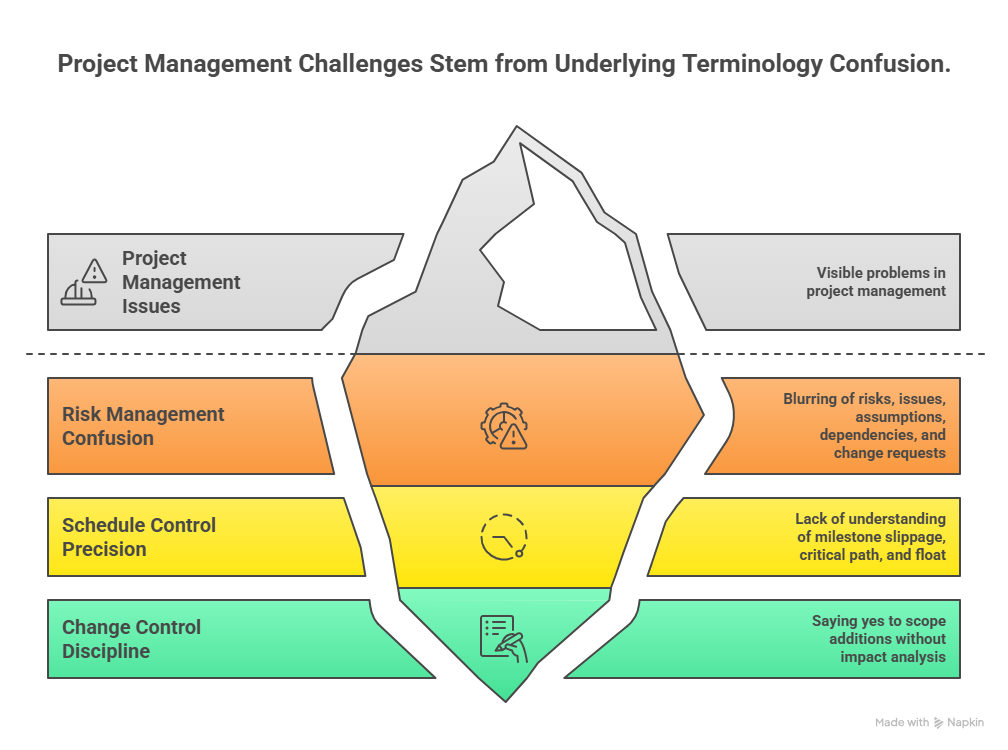
Monitoring and control gets harder when PMs confuse risks, issues, assumptions, dependencies, and change requests. That confusion creates bad escalation, weak meetings, and sloppy status language. A risk is a future possibility. An issue is a current problem. An assumption is something accepted as true for planning purposes until evidence proves otherwise. A dependency is a relationship where one task or decision relies on another. A change request is a formal proposal to alter the approved plan. When those terms blur together, teams either overreact to possibility or underreact to actual damage. PMs can reduce that noise by strengthening their command of risk assessment terms, issue tracking systems, procurement tools, and contract lifecycle management software, especially where external vendors drive project timing.
Schedule control introduces its own precision terms. Milestone slippage matters because a delayed milestone often compresses downstream testing, approval, training, or deployment windows. Critical path matters because not every delayed task is equally dangerous. Float matters because teams often burn schedule flexibility quietly, then act surprised when a minor issue suddenly affects the final delivery date. Project managers who lack this language end up prioritizing what is loud rather than what is structurally dangerous. That is a painful mistake in transformation work, software delivery, construction programs, and public-sector rollouts. Sharpening control here should involve not only critical path method concepts and project scheduling terms, but also the right calendar tools and mobile apps for on-the-go PMs, since delayed visibility often starts with fragmented tracking.
Change control is where many otherwise capable PMs get exposed. Teams say yes to “small” scope additions, skip impact analysis, and assume delivery will absorb the hit. It rarely does. Strong change control language forces discipline: what is changing, what baseline is affected, what cost and schedule effect follows, what approvals are required, what risks increase, and what happens to existing commitments if the change is accepted. That clarity protects the PM from becoming the human shock absorber for everyone else’s late ideas. It also connects naturally to stakeholder management, communication planning, quality management, and budget tracking, because uncontrolled change eventually damages all four.
5. How Strong PMs Use Monitoring and Control Terms in the Real World
Knowing these terms is useful.
Using them in live delivery pressure is what creates trust.
Consider a status review where a sponsor hears, “Testing is a little behind, but the team is working hard.” That update wastes everyone’s time. A better version sounds like this: test execution is two weeks behind the approved schedule baseline, schedule variance is widening across three workstreams, two unresolved defects are blocking integration, float on one noncritical stream is exhausted, and the current forecast shows a likely impact to the user acceptance milestone unless corrective action is approved by Friday. That language creates movement. PMs who want that level of control should also study project reporting platforms, dashboard tools, document management systems, and knowledge management tools, since strong status language depends on clean evidence.
The same principle applies to budget control. Saying “costs are higher than expected” invites debate and denial. Saying actual cost has exceeded earned value for three consecutive reporting periods, cost performance index has trended downward, remaining work assumptions are no longer realistic, and estimate at completion now requires sponsor review creates a decision frame. Sponsors may still dislike the message, but they cannot claim they were not informed. PMs who are targeting bigger opportunities in government project management, healthcare project management, IT project management, or international project management need this decision-grade language because complexity increases the cost of vagueness.
One more hard truth: monitoring and control is as much political as technical. A PM may have the right numbers and still fail if escalation is late, reporting is softened, or governance routines are weak. That is why terms such as threshold, tolerance, escalation, management reserve, and control account deserve attention. They define authority, accountability, and intervention timing. They tell the organization how much pain is acceptable and when leadership has to step in. PMs who can speak fluently across governance, performance, delivery, and stakeholder impact become far more valuable than PMs who simply update artifacts. That difference compounds over time, affecting not only outcomes but also access to higher-paying roles, stronger salary growth pathways, broader industry outlook opportunities, deeper methodology adoption insight, and long-term relevance in the future of project management leadership.
6. FAQs About Project Monitoring and Control Terms
-
Monitoring is the act of collecting, reviewing, and interpreting performance information such as schedule progress, cost movement, risk exposure, issue aging, and quality signals. Controlling is the action taken after that information is understood. Monitoring tells the PM what is happening. Controlling decides what to do about it. Strong PMs combine both by using project reporting tools, issue tracking systems, automation tools, and communication techniques to shorten the gap between signal and response.
-
Start with baseline, variance, forecast, milestone, dependency, issue, risk, change request, corrective action, and escalation. These terms appear constantly in status meetings and decision discussions. After that, build toward earned value metrics such as planned value, earned value, actual cost, CPI, and SPI. New PMs should strengthen these alongside broader project management terminology, project initiation concepts, stakeholder terms, and scheduling fundamentals so the language becomes practical, not isolated.
-
Dashboards can hide weak definitions, delayed data, inflated percent-complete updates, missing dependencies, softened escalation language, and poor ownership discipline. A visually clean report does not guarantee real control. Projects often deteriorate when teams track outputs but ignore decision latency, rework, approval bottlenecks, and aging issues. PMs should validate dashboards against reporting and analytics tools, dashboard data visualization practices, document evidence management, and quality management principles to ensure visibility reflects delivery truth.
-
A risk is a future event or condition that may affect the project. An issue is a current problem already affecting the project or requiring immediate action. Teams that confuse the two either escalate too late or clutter their logs with weak categorization. Clean separation improves ownership, response speed, and reporting quality. PMs can tighten this discipline by studying risk management glossaries, risk assessment terms, issue tracking systems, and knowledge management workflows so lessons are captured instead of repeated.
-
The right cadence depends on project volatility, stakeholder expectations, and delivery complexity, but most active projects need weekly review at minimum, with higher-frequency checks for critical workstreams, vendor dependencies, or unstable delivery phases. Monthly review alone is too slow for many projects. Metrics should be reviewed often enough to allow intervention while recovery is still possible. Teams benefit from pairing cadence discipline with calendar and scheduling tools, mobile collaboration apps, resource allocation platforms, and productivity software so monitoring becomes operational rather than ceremonial.
-
Good project control looks like approved baselines, visible thresholds, evidence-based status reporting, fast issue ownership, disciplined change approval, realistic forecasting, early escalation, and decisions tied to quantified impact. It also looks like fewer surprises. The best PMs do not wait for chaos to prove they were right. They build systems that make deterioration hard to hide. Professionals aiming for stronger delivery credibility should connect these habits to PMP preparation, CAPM career development, government PM career growth, and the larger future skill expectations for project managers, where clarity under pressure keeps getting rewarded.
