
Detailed Career Guide to Remote & Virtual Project Management Roles (2026-27)
Remote and virtual project management roles in 2026 to 2027 are not “the same PM job but from home.” The best remote PMs run an execution system that survives time zones, async work, and tool overload. Hiring managers now look for proof that you can reduce coordination drag, protect delivery quality, and keep stakeholders aligned without constant meetings. This guide shows the exact remote PM role types, the skills and signals that get you hired, and the operating model that makes you valuable fast, even in volatile markets like those covered in the global inflation impact on project budgets.
1: Remote Project Management in 2026 to 2027 (What Changed and What Employers Actually Want)
Remote PM demand is rising in two places at once: high growth teams that need speed, and cost pressured orgs that need efficiency. Both groups want a PM who can cut waste, not a PM who creates more reporting. The winners are the PMs who can run hybrid operating models cleanly, which is why understanding hybrid project management is now a baseline, not a niche.
Here is what changed:
Async competence became a hiring filter. If your workflow requires constant real time meetings, you will fail in distributed teams.
Tooling literacy became a performance lever. Remote teams will judge you by how well you reduce tool chaos, a trend reinforced by future PM software predictions.
Governance shifted from policing to acceleration. The best remote PMs create decision clarity and fast escalation paths, aligned with future project governance.
AI and automation became table stakes. Not for hype, but for cycle time and forecasting quality, as covered in AI and project management impacts and machine learning for estimation and scheduling.
Portfolio thinking moved into mid level roles. Remote teams cannot afford “busy delivery.” They need prioritization and WIP control, which connects directly to future PPM trends.
Remote PM roles also vary by context. A remote PM in a regulated environment needs stronger controls and documentation discipline, while a remote PM in a product led team needs faster iteration and stakeholder alignment. If you want a future proof path, build the skills described in future PM competencies and communicate them with the leadership lens from future PM leadership styles.
2: The Highest Paying Remote and Virtual PM Role Types (and How to Choose Yours)
Remote PM roles pay more when the cost of failure is high. That includes revenue critical launches, regulated work, security heavy environments, and large cross functional programs. For context on how markets value PM talent, compare salary and employer patterns in hubs like New York City PM careers, Los Angeles opportunities, and Chicago job market analysis. Even if you work remote, employers price you against these benchmarks.
Here are the most common remote PM categories and what makes them viable:
Remote product delivery PM
You coordinate product, engineering, design, analytics, and GTM. You win by reducing cycle time and improving decision clarity, which aligns with future PM software evolution and the shift to measurable outcomes in future PM skills.
Remote technical and platform PM
You manage dependencies across infrastructure, DevOps, data, and security. Your value is risk reduction and predictability. You need governance discipline from future project governance and estimation maturity supported by machine learning forecasting in PM.
Remote transformation and PMO programs
You build the operating system, templates, cadences, and portfolio visibility. This is where PMO trends matter, see future PMO role and the portfolio layer in future PPM.
Remote construction and capital work coordination
Remote does not mean hands off. It means you manage vendors, schedules, documentation, change control, and risk from a distance. If you want an industry anchor, see future of project management in construction.
Remote finance and compliance PM
High rigor, high documentation, high audit pressure. If you want a trend baseline, study financial services predictions and how governance becomes a performance tool in future governance.
Freelance and contract remote PM
This is growing as companies buy execution without adding headcount. Learn the market signals in future of freelance project management and how automation is reshaping the work in AI transforming PM careers.
Choose your lane based on what you can prove. Employers hire remote PMs who can show systems, not slogans.
3: The Remote PM Skill Stack That Gets You Hired (Proof, Not Claims)
Remote hiring managers look for evidence that you can operate without constant supervision. The mistake most candidates make is listing tools and methodologies instead of showing outcomes and artifacts. Build proof in four layers.
Layer 1: Async communication mastery
Async does not mean slow. It means predictable. You need written clarity, structured updates, and decision capture. This is why modern leadership patterns matter, see future PM leadership, and why hybrid process literacy matters in hybrid project management.
Proof artifacts:
Weekly one page stakeholder update
Decision log with tradeoffs
Async standup format with blockers and asks
Layer 2: Systems thinking and portfolio awareness
Remote work exposes weak prioritization fast. You need WIP control, sequencing, and capacity visibility. That connects directly to future of PPM and the role evolution in future PMO.
Proof artifacts:
Portfolio board with WIP limits
Capacity heatmap for bottleneck roles
Dependency map across teams
Layer 3: Data literacy and forecasting discipline
Remote PMs get punished for surprises because stakeholders cannot “see the work” in person. Improve forecasting using trend based signals, not optimism. This is where AI in project management and machine learning in scheduling become practical tools, not buzzwords.
Proof artifacts:
Risk trend dashboard
Cycle time and blocked time tracking
Forecast confidence ratings
Layer 4: Governance that accelerates
Remote teams collapse when decision rights are unclear. Governance must reduce ambiguity. Use the approach in future governance best practices and build a cadence that leaders trust.
Proof artifacts:
Stage gate checklist
Escalation ladder with triggers
Meeting agendas that end in decisions
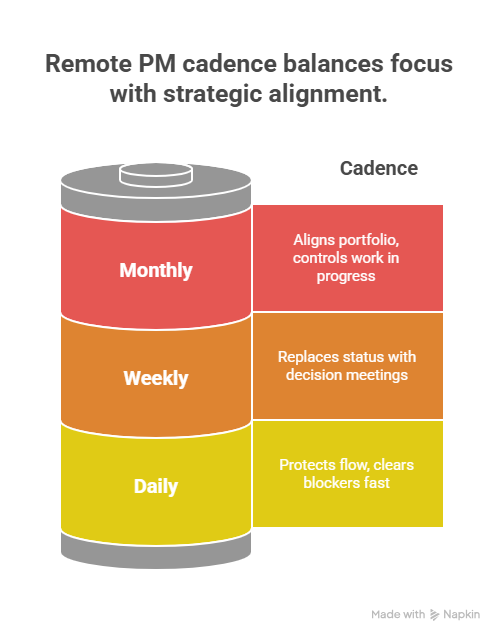
4: The Remote Delivery Operating Model (Daily, Weekly, Monthly) That Makes You Elite
If you want to be a top tier remote PM, you must run a cadence that protects focus and produces decisions. Use this operating model and tune it per team size.
Daily: protect flow, clear blockers fast
Async standup updates with blockers and asks
One overlap window for high risk coordination
Blocker escalation within 24 hours
This reduces meeting waste and aligns with efficiency pressures described in inflation and project budgets.
Weekly: replace status meetings with decision meetings
Publish a one page update with risks, progress, and decisions needed
Run a decision meeting only for items that require leadership action
Update dependency map and capacity heatmap
Tooling and automation support this pattern, especially as described in future PM software and AI impacts.
Monthly: portfolio alignment and WIP control
Remote delivery becomes chaotic when priorities drift. Run monthly portfolio alignment:
Reconfirm top initiatives
Adjust sequencing based on constraints
Pause work that no longer justifies cost
This connects directly to future PPM practices and the strategic PMO direction in future PMO role.
5: How to Get Hired for Remote PM Roles in 2026 to 2027 (Resume, Interviews, and Career Strategy)
Remote PM hiring is crowded. Your strategy must be positioning, proof, and relevance.
Build a remote focused resume narrative
Your resume should show how you reduced coordination cost and improved delivery confidence. Use proof language:
Reduced cycle time by improving handoffs
Lowered blocked time by implementing escalation triggers
Improved forecast accuracy by tracking trends
Back this with your capability story using future PM skills and leadership credibility from future PM leadership.
Use market leverage and location benchmarks even if remote
Remote employers still anchor pay and expectations to strong markets. Use salary signals from hubs like Washington State opportunities, Massachusetts PM careers, and Dallas Fort Worth market insights to negotiate and to choose the right remote employers.
Interview like a systems operator
In interviews, you must sound like someone who can run distributed execution:
Explain your async cadence and decision logging
Explain how you handle priority churn using WIP limits
Explain how you forecast and manage risk trends
Connect your approach to industry trends like hybrid PM and the automation shift in AI transforming PM careers.
Certifications and structured learning
If you need credibility, pick programs that tighten fundamentals. If you are early career, CAPM helps build structured thinking, see CAPM exam guide and the 30 day CAPM plan. If you work in agile environments, be able to explain tradeoffs clearly using Scrum vs Agile and the future direction in Scrum evolution by 2027.
6: FAQs
-
Roles that reduce risk and improve predictability will grow fastest: platform delivery, PMO transformation, portfolio coordination, and regulated work. These roles align with market pressure on efficiency described in inflation and project budgets, and with the operating model changes in future PM software. For senior growth, portfolio adjacent work will expand as orgs adopt the maturity described in future PPM.
-
Show artifacts, not claims. Build an async update template, a decision log, a dependency map, and a simple capacity view. Then describe how these reduced meetings and improved clarity. Tie your approach to modern leadership expectations in future PM leadership and the hybrid reality in hybrid PM.
-
The biggest trust killers are unclear decisions, hidden blockers, and reporting that does not match reality. Remote stakeholders do not forgive surprises. Fix this with decision logging, trigger based escalation, and exception based dashboards aligned with future governance and the signal driven approach described in future PM software.
-
Design for overlap, not for constant sync. Define one overlap window, enforce async documentation, and make handoffs explicit through checklists and dependency mapping. Track blocked time and cycle time by region and adjust sequencing. This is a practical extension of the process blending discussed in hybrid project management, and it supports better forecasting patterns in machine learning for scheduling.
-
Yes, if you can sell outcomes and run strong systems. Companies are buying execution without adding headcount, a trend explained in future of freelance PM. Your advantage is speed and clarity. Your risk is unstable scope and political stakeholders. Protect yourself with strong intake, decision logs, and change control, using governance principles from future governance best practices.
-
Prioritize tools that reduce coordination drag: documentation hubs, task tracking, portfolio views, automation, and dashboards. The goal is not to “use more tools.” The goal is to reduce noise and increase decision clarity. This matches where tooling is heading in future PM software predictions and why automation is becoming standard in AI transforming PM careers.
-
Not always, but structured credentials can improve credibility and hiring velocity. If you are early career, build fundamentals through CAPM and use the structure from the CAPM exam guide plus the 30 day CAPM plan. If you work in agile heavy environments, be able to explain framework tradeoffs using Scrum vs Agile and the future direction in Scrum evolution.
