
How to Become an IT Project Manager: Detailed Career Guide & Roadmap
IT project managers sit at the intersection of delivery, technology, budgets, and stakeholder trust. It’s a role that rewards people who can convert ambiguity into execution, keep teams aligned under pressure, and make smart trade-offs without losing sight of business outcomes. If you’re trying to break into this field (or level up into stronger IT PM roles), the biggest mistake is treating it like a generic PM path.
This guide gives you a practical roadmap: what skills hiring managers actually screen for, how to build proof of capability, which certifications help at different stages, how to position your experience, and how to avoid the common “you have PM experience, but not IT PM experience” rejection loop.
1) What an IT Project Manager Actually Does (and What Employers Really Expect)
An IT Project Manager is not just someone who runs meetings and updates a timeline. In real teams, IT PMs are responsible for orchestrating delivery across technical teams, business stakeholders, vendors, compliance requirements, and operational constraints. That means your value is measured less by “project coordination” and more by your ability to reduce delivery risk while protecting scope, timeline, and business outcomes.
If you’re coming from a non-IT PM background, the first mindset shift is this: you do not need to be the best engineer in the room, but you must be fluent enough to manage engineering risk and decision-making. Employers want a PM who can understand dependencies, ask the right questions, and prevent avoidable delivery failures.
A strong IT PM typically owns or drives:
project scope definition and change control
schedule planning and dependency mapping
stakeholder communication and governance
risk/issue management and escalation timing
vendor coordination and contract alignment
resource planning across engineering, QA, security, infra, and business teams
deployment readiness and transition to operations
documentation, audit trails, and status reporting
This is why many aspiring candidates get stuck: they present themselves as “organized and good at communication,” but not as someone who can manage a software release, infrastructure migration, or enterprise system rollout. To position yourself correctly, study adjacent PM pathways like general project management roadmaps, entry-to-executive PM career paths, and specialized tracks like remote & virtual PM roles and freelance PM careers. These help you understand how the IT PM path fits inside the larger profession.
Another major expectation: IT PMs are increasingly expected to work in hybrid delivery environments. A team may use Agile ceremonies, but still require formal governance, budget approvals, vendor milestones, and executive reporting. If your thinking is purely waterfall or purely scrum, you may struggle. It’s worth building context through APMIC resources on hybrid project management, future PM methodologies, and future PM skills by 2030.
The employers who hire faster are not just filling a PM seat — they are buying confidence that someone can keep a technical initiative from derailing. Your roadmap should be built around proving that confidence.
2) The Skill Stack You Need to Build (Technical, Delivery, and Business)
The fastest way to become an IT PM is to stop thinking in terms of “soft skills vs technical skills” and start building a three-layer stack:
Delivery execution skills (planning, tracking, risk, stakeholder management)
Technical context fluency (systems, SDLC, cloud/infrastructure concepts, integrations, data/security basics)
Business decision skills (prioritization, trade-offs, impact communication, cost/time/risk framing)
Candidates who only build layer 1 often get stuck in coordinator roles. Candidates who over-index on layer 2 without delivery discipline look like analysts or technical leads, not project managers. You need enough of all three to be credible.
A) Delivery execution skills (non-negotiable)
You can build these from PM-focused guides such as the complete PM career roadmap, project management consultant path, project portfolio manager guide, and project management director roadmap. For IT PM specifically, strengthen:
Scope framing: Convert business requests into manageable delivery chunks.
Work breakdown thinking: Not necessarily perfect WBS documents, but realistic decomposition.
Dependency management: IT delays often come from hidden dependencies, not slow teams.
Risk identification: Security review, environment readiness, vendor API delays, data quality, user access, compliance approvals.
Escalation quality: Escalate with options, impacts, and recommended next steps.
Status communication: Executives don’t need activity logs — they need decision-ready updates.
Pain point to solve: many candidates say they “managed timelines,” but they cannot explain how they handled a slipping dependency or conflicting stakeholder priorities. Interviews break here.
B) Technical fluency (enough to manage, not to code everything)
If you want to break into IT project management, your resume and interviews must show fluency in:
software development lifecycle (SDLC)
release cycles and deployment readiness
testing phases (SIT/UAT/regression)
integrations/APIs
cloud/infrastructure basics
cybersecurity/security review touchpoints
data migration and validation risks
incident/change windows in production environments
You can support this positioning by linking your learning to related APMIC content on AI and project management, future project management software, machine learning and estimation, and blockchain use in project management when relevant to your domain. You don’t need to become a specialist in each one, but you do need to understand how technical decisions affect schedules, scope, and risk.
C) Business-facing execution (where many IT PMs become high-value)
This is what moves you from “task tracker” to “trusted delivery lead”:
translate technical risk into business impact
quantify delay cost or scope reduction options
explain trade-offs without jargon overload
align milestones to operational readiness and user adoption
protect priority when multiple teams compete for scarce experts
This layer is why IT PMs can later move into broader leadership paths like PM Director, VP of PM, or even Chief Project Officer. If you build business framing early, your career ceiling rises significantly.
D) Tool fluency that actually helps (not resume decoration)
Know enough to run delivery cleanly using tools such as:
planning/scheduling platforms (calendar & scheduling tools, Gantt software)
team collaboration/mobile coordination (mobile PM apps, mobile collaboration tools)
productivity and automation (automation tools for PM efficiency, productivity software for busy PMs)
budget and tracking tools (project budget tracking software)
knowledge/documentation systems (project knowledge management software)
Hiring teams care less about the logo of the tool and more about whether you know how to create visibility, accountability, and risk signal with it.
3) Career Roadmap: Step-by-Step Path to Your First (or Better) IT PM Role
Most people do not become IT PMs by applying blindly to “IT Project Manager” jobs and hoping their generic PM experience converts. The path works better when you intentionally build evidence in stages. Below is a practical roadmap you can use whether you’re starting from support, coordination, QA, business analysis, operations, or a non-technical PM role.
Stage 1: Choose your entry angle (don’t market yourself as “everything”)
Pick one believable bridge into IT PM and build your story around it:
PM Coordinator / Project Analyst → IT PM
Business Analyst → IT PM
Scrum Master / Agile delivery support → IT PM
Operations / implementation specialist → IT PM
QA/UAT coordination → IT PM
Infrastructure support / technical operations → IT PM
If you’re already in Agile-oriented work, strengthen your narrative through Certified Scrum Master guidance, Agile coach career path, scrum master to agile PM consultant roadmap, and product owner path. These help you frame delivery experience in ways hiring teams understand.
Stage 2: Build “proof assets” before you apply
This is where most candidates lose momentum. They gain skills, but they do not build proof. Hiring managers don’t interview “potential” unless your profile already signals delivery readiness.
Create these proof assets:
A results-based resume
Each bullet should show:project type (software rollout, migration, system upgrade, integration, etc.)
your role in delivery
complexity (team count, stakeholders, cross-functional dependencies, timeline)
result (time saved, risk reduced, go-live achieved, defects reduced, adoption supported)
A project artifact portfolio (sanitized)
RAID log template
status report sample
milestone plan
stakeholder map
cutover checklist
action log
change log template
A role-targeted LinkedIn / professional summary
Position yourself as “IT project delivery” focused, not a generic organizer.Interview stories built around pain points
conflicting priorities
late requirement changes
environment delays
vendor misses
UAT failure loops
executive escalation decisions
Pain point to solve: if your resume only says “coordinated meetings and tracked progress,” ATS may pass you over and humans will assume low ownership. You need to signal decision support, risk control, and delivery impact.
Stage 3: Target the right projects (even inside your current role)
If your current title isn’t IT PM, you can still accumulate IT-relevant PM evidence by volunteering for or requesting ownership of delivery components:
UAT planning and coordination
release communication
defect triage tracking
dependency tracking across teams
migration cutover checklist management
vendor implementation coordination
stakeholder reporting for system changes
This is exactly how many people move from adjacent roles into IT PM without waiting for a perfect promotion. If you need broader career strategy, use the logic from remote PM career roadmaps, consultancy-building guides, and international PM career paths to see how transferable proof changes your marketability.
Stage 4: Apply by project type, not just job title
Instead of searching only “IT Project Manager,” search and apply to roles tied to delivery contexts you can already speak about:
Implementation Project Manager
Technical Project Coordinator
Systems Project Manager
Software Delivery Project Manager
Infrastructure Project Manager
PMO Analyst (IT)
Digital Transformation Project Manager
Applications Project Manager
This expands your opportunities and reduces the “must have exact title” barrier.
Stage 5: Level up into domain-specific IT PM tracks
Once you land an entry or mid-level IT PM role, specialize. Domain specialization increases both your value and your interview conversion rate. Common paths include:
software development / SaaS delivery
infrastructure / cloud migration
cybersecurity implementations
healthcare IT projects
public sector / government IT
enterprise systems (ERP/CRM)
data / analytics platform projects
You can strengthen adjacent positioning using healthcare PM career guidance, government PM roadmaps, CRM tools for PMs, and software PM tools for software development teams.
4) Certifications, Education, and Training: What Helps (and When)
Certifications can help, but only when they match your career stage and are paired with evidence of execution. A common mistake is collecting credentials before building real project examples. Certifications should accelerate trust, not substitute for delivery proof.
If you are early-stage (breaking into PM / IT PM)
Your goal is to show structured PM knowledge and readiness to support delivery. This is where entry-level and foundational learning helps more than advanced credentials. Useful resources and pathways include:
If your target roles are Agile-heavy, pair foundational PM learning with Scrum/Agile comparisons and CSM prep pathways.
If you are mid-career (already managing projects, moving into stronger IT PM roles)
This is where PMP often becomes a strong signal, especially when you already have project ownership examples. APMIC’s ecosystem offers strong prep support through:
For IT PM roles in enterprise environments, PMP + strong IT delivery examples is a powerful combination because it signals both structure and execution maturity.
If your environment is governance-heavy or global
PRINCE2 may be valuable depending on region, employer type, and methodology expectations. Helpful APMIC resources include:
Specialized / supplemental credentials
Depending on your path, you may also benefit from:
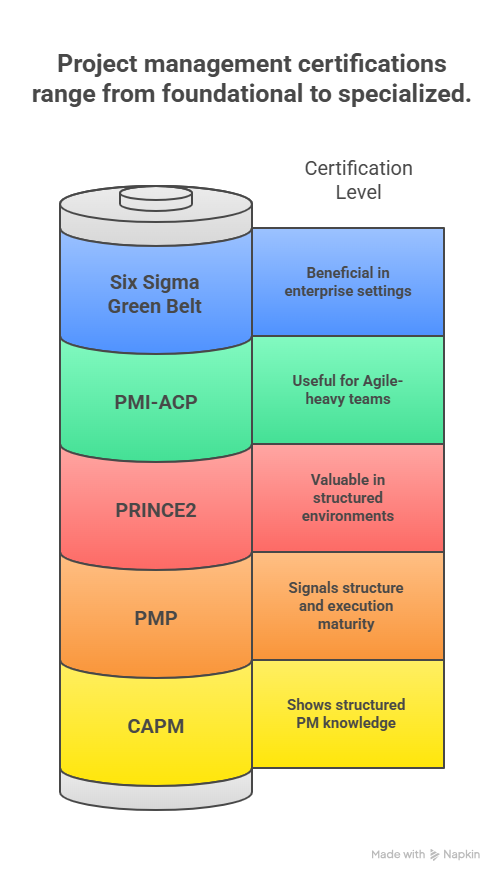
Agile-focused certifications (PMI-ACP prep, PMI-ACP questions)
broader PM credentials (IAPM guide, CPD certification guide, CPMP prep, CompTIA Project+ PK0-005)
process/quality credentials in some enterprise settings (Six Sigma Green Belt)
The right way to use certifications in your roadmap
Use certifications to solve a specific credibility gap:
No PM framework language? CAPM / foundational PM training.
Already delivering but need stronger market signal? PMP.
Agile-heavy teams? CSM / PMI-ACP or Agile-oriented training.
Governance-heavy / structured orgs? PRINCE2.
Need interview confidence? Certification study + mock scenario practice + proof assets.
Pain point to solve: if you earn a credential but your resume still lacks outcome-driven project bullets, your application performance may barely improve. Pair every certification milestone with portfolio updates and stronger project stories.
5) How to Get Hired Faster: Resume, Interview Strategy, and Career Growth Path
Getting hired as an IT PM is not just about qualifications — it’s about translation. Employers need to quickly see that you can manage technical delivery risk, communicate with engineers and executives, and keep outcomes moving when projects get messy. Your resume, LinkedIn, and interview answers must all tell the same story.
A) Resume strategy that gets interviews
Most IT PM resumes fail because they describe activity, not impact. Replace “responsible for” language with delivery evidence.
Weak bullet
Managed project timelines and coordinated meetings for IT initiatives.
Stronger bullet
Coordinated a cross-functional IT rollout across engineering, QA, and operations; built dependency tracking and weekly risk reviews that reduced milestone slippage and improved release readiness.
The second version demonstrates ownership, context, and impact. That’s what gets interviews.
What to include in each bullet:
project type (migration, implementation, upgrade, integration, rollout, infrastructure refresh)
stakeholders (engineering, QA, security, vendors, business)
complexity (cross-functional, multi-site, regulated, deadline-driven)
what you drove (risk log, cutover plan, governance cadence, dependency tracking)
result (on-time launch, fewer defects, faster decisions, reduced escalations)
You can cross-reference your growth direction using APMIC’s salary comparison by certification and global PM salary report to understand how credentials and specialization influence your positioning.
B) Interview strategy: answer like an IT PM, not a coordinator
Hiring managers often test the same core abilities in different wording. Prepare stories for:
a project that slipped and how you recovered it
a stakeholder conflict and how you re-aligned priorities
a technical dependency that threatened delivery
a risk you identified early and how you mitigated it
a late requirement change and scope control response
a release/cutover or UAT issue and decision path
When answering, use this structure:
Context: What kind of project and why it mattered
Constraint: What risk, conflict, or blocker appeared
Action: What you actually did (not what “the team” did)
Decision framing: How you communicated trade-offs
Outcome: What improved and what you learned
Pain point to solve: many candidates give “team hero” stories with no PM signal. Hiring managers then assume low ownership. Your answer must show your decision support, coordination design, and risk management role.
C) Targeting industries and geographies strategically
IT PM opportunities vary by region and industry concentration. If you’re job hunting aggressively, align your search with local demand and employer clusters. APMIC’s city/state career guides can help you localize your strategy, including:
This matters because your resume strategy should match the local market. A startup-heavy city may prioritize Agile/software delivery language; a healthcare-heavy market may value implementation, compliance, and stakeholder training.
D) Long-term growth after IT PM
IT PM can branch into several high-value tracks:
Program Manager (multi-project coordination)
Technical Program Manager (deeper engineering/technical integration ownership)
PMO leadership
Delivery Director
Portfolio Manager
Consulting / transformation roles
Executive project leadership (Director, VP, CPO)
Use APMIC’s consultancy guide, PM consultant career path, portfolio management guide, director roadmap, VP path, and CPO roadmap to plan your next move early instead of waiting until you feel “stuck.”
6) FAQs About Becoming an IT Project Manager
-
No. A CS degree can help with technical confidence, but it is not required for many IT PM roles. What matters more is your ability to manage delivery, understand technical dependencies, ask strong questions, and communicate risk clearly. Many successful IT PMs come from business analysis, QA, operations, support, and general PM backgrounds.
-
You need practical technical fluency, not full engineering depth. You should understand the SDLC, testing phases, release processes, infrastructure/environment dependencies, integration risks, and basic security/data considerations. Your job is to manage delivery decisions and coordination, not to replace engineers.
-
It depends on your stage:
Early-career: CAPM or foundational PM learning
Mid-career with real project ownership: PMP
Agile-heavy environments: CSM or PMI-ACP
Governance-heavy/structured environments: PRINCE2
The key is pairing certification study with resume improvements and real project proof.
-
Yes — and these are common pathways. The transition works best when you reframe your experience around delivery outcomes: risk management, dependency control, stakeholder alignment, release coordination, and decision support. Build proof assets and interview stories that show project ownership, not just participation.
-
Common reasons include:
resume reads as generic coordination work
weak or unclear project outcomes
no evidence of technical project context
poor explanation of risks/dependencies in interviews
certification-heavy profile with limited delivery proof
applying to roles far above current complexity level
Fixing your positioning often improves results faster than collecting another credential.
-
Start with tools that support real delivery visibility:
task/backlog tracking (e.g., Jira-style workflows)
documentation/knowledge tools
scheduling/calendar planning tools
RAID/status reporting templates
budget and action tracking sheets
Focus on using tools to create clarity, ownership, and decision signal — not just to “manage tasks.”
