
The Ultimate Guide to Getting Your Project Management Certification in Turkey: All You Need to Know in 2026-2027
Project management certification in Turkey has become a practical career lever for professionals who need stronger credibility across construction, IT, public sector, healthcare, finance, logistics, manufacturing, and international delivery teams. Employers want people who can control scope, defend timelines, manage vendors, translate strategy into execution, and communicate risk before it becomes expensive. The right credential can help, but only when it matches your role, sector, experience level, and proof portfolio.
This guide breaks down how Turkish professionals should choose, prepare for, and use certification in 2026-2027 without wasting money on the wrong path.

1. Why Project Management Certification in Turkey Is a Career Signal in 2026-2027
Project management roles in Turkey sit at the intersection of delivery pressure and stakeholder complexity. A project manager in Istanbul may handle digital transformation, vendor integration, fintech launches, telecom upgrades, or SaaS implementation; a project professional in Ankara may deal with governance-heavy programs, public procurement habits, institutional documentation, or regulated delivery; a project coordinator in Izmir, Bursa, Kocaeli, or Gaziantep may be closer to manufacturing, logistics, construction, export operations, or supplier coordination. The credential you choose should make your existing work easier to trust.
A certification gives hiring teams a faster way to understand your operating discipline. When your resume mentions how to become a project manager, project management career paths, IT project management, construction project management, and healthcare project management, you give recruiters a clearer map of where your skills belong. The certificate opens the door; your examples, metrics, and delivery language keep the conversation alive.
The biggest mistake Turkish candidates make is treating certification as a badge hunt. PMP, CAPM, PRINCE2, CSM, agile certifications, portfolio management credentials, and sector-specific training solve different problems. A junior coordinator who wants structure may benefit from CAPM or foundational agile training. A delivery lead with years of project ownership may gain more from PMP. A professional working with European vendors, government-style governance, or documentation-heavy environments may find PRINCE2 useful. A technology professional moving into Scrum teams may start with CSM, then build toward certified Scrum Master preparation, agile project management certification, agile coaching career growth, product owner career steps, and Scrum Master to agile consultant progression.
2. Choose the Right Certification Path Before You Spend Money
The best certification path in Turkey starts with your target role, not with the most famous acronym. PMP suits professionals who can document real project leadership and want broader recognition across sectors. CAPM suits candidates building credibility before they have enough full ownership. PRINCE2 suits professionals who need stronger governance language, especially when business cases, stage controls, decision gates, and supplier environments matter. CSM suits people working around Scrum teams, product delivery, software releases, and team facilitation.
Use this simple filter: choose the credential that explains your next job better than your current job. If you want to move from coordinator to PM, study project execution terms, monitoring and control terms, project reporting best practices, stakeholder engagement terms, and risk mitigation planning. If you want to move from Scrum Master to consultant, combine certification with Scrum glossary mastery, agile estimation techniques, essential agile metrics, sprint planning terms, and backlog terminology.
Turkey-based candidates also need to think about language and proof. Many professionals can understand exam material in English but struggle to describe their work in crisp English during interviews. Your certification plan should include vocabulary drills, not only mock exams. Practice explaining “I managed procurement delays,” “I controlled scope changes,” “I escalated approval risk,” and “I improved schedule visibility” in English and Turkish. That bilingual clarity matters for local employers and remote international roles.
A strong certification decision also considers the employer type. Enterprise employers often care about governance and cross-functional communication. Startups care about speed, product clarity, and ambiguity management. Construction employers care about scheduling, cost exposure, subcontractors, claims, and dependencies. Healthcare and public-facing organizations care about documentation, compliance, adoption, approvals, and risk communication. APMIC learners can sharpen each path through construction PM training direction, healthcare project manager preparation, government project manager planning, project financial management terms, and resource allocation concepts.
3. Build a Turkey-Ready Certification Plan: Eligibility, Language, Evidence, and Timeline
Your certification plan should answer four questions before you pay for training: Am I eligible? Which exam version or body applies to my target credential? Which language will I study in? What evidence will I show after passing? Candidates who skip these questions often collect lessons, PDFs, and practice questions but still feel unready because their preparation has no decision structure.
For PMP, document your projects early. Write project titles, organizations, dates, your role, outcomes, deliverables, stakeholders, methods used, and measurable results. A weak application describes duties; a strong application shows leadership decisions. “Prepared reports” sounds administrative. “Created weekly variance reporting that helped leadership approve a recovery plan before vendor delay affected launch” sounds like project management. Study PMP exam domains, review PMP exam mistakes, collect PMP exam resources, read PMP success stories, and plan future PMP renewal PDUs before the certificate becomes a forgotten line on your profile.
For 2026, pay close attention to PMP exam updates. A new exam cycle can shift emphasis, study material quality, mock exam relevance, and training alignment. Candidates in Turkey who plan to sit during a transition window should avoid old dumps, recycled slides, and generic bootcamps with unclear update policies. Ask providers which exam content outline they teach, whether scenario practice reflects the current test, and how they handle learners who schedule after a version change.
Language strategy is another career multiplier. If your target employers include international companies, multinational vendors, remote teams, EU clients, Gulf region employers, or global PMOs, prepare your project examples in English. Build a two-page “project story bank” with ten short STAR-style examples: scope control, procurement issue, budget pressure, stakeholder conflict, quality concern, schedule recovery, team resistance, risk escalation, benefits delivery, and failed assumption. Then connect those examples to conflict resolution terms, leadership and communication terms, quality management terms, ISO standards basics, and Gantt chart terminology.
The fastest certification progress comes from fixing one blocker, then building proof that makes employers trust the credential.
4. How to Prepare Without Wasting Months on Passive Study
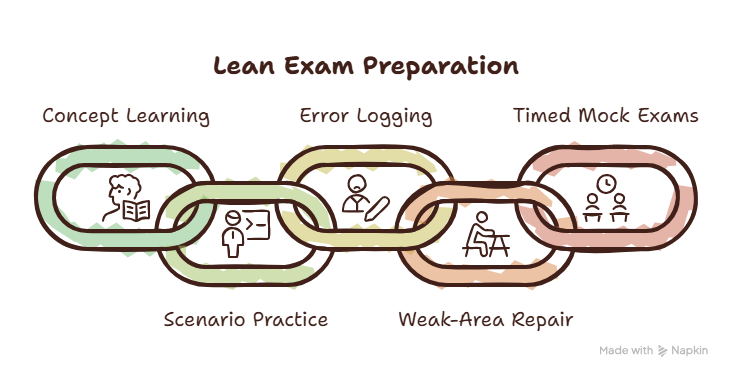
The most expensive study mistake is confusing exposure with readiness. Watching lessons, highlighting slides, and collecting notes can feel productive, but certification exams reward decision-making under pressure. A Turkey-based learner preparing around full-time work, family obligations, traffic, and unpredictable project deadlines needs a lean system: concept learning, scenario practice, error logging, weak-area repair, and timed mock exams.
Start with a 10-week plan if you already understand project work. Weeks 1-2 should cover core vocabulary, lifecycle logic, stakeholder roles, scope, schedule, risk, quality, procurement, and communications. Weeks 3-5 should move into scenario questions and method comparison. Weeks 6-7 should focus on weak domains. Weeks 8-9 should include timed mocks. Week 10 should reduce content intake and focus on review, sleep, confidence, and exam logistics. Use schedule compression terms, RFP RFQ RFI definitions, waterfall glossary terms, Kanban PM terms, and agile project management glossary as targeted repair tools, not random reading assignments.
Your error log should be ruthless. For every missed question, record the real reason: misunderstood term, rushed reading, wrong stakeholder priority, weak agile knowledge, weak procurement knowledge, overthinking, ignored keyword, or emotional panic. After 100-150 logged mistakes, patterns become obvious. Many candidates discover that their problem is judgment, not memory. They know the definition of risk but choose the wrong response when the question pressures them with sponsor urgency, team conflict, supplier delay, or customer dissatisfaction.
Practice with work examples, too. If you study stakeholder management, rewrite one real stakeholder issue from your career. If you study risk, build a mini risk register from a past project. If you study procurement, describe how vendor delay affected scope, schedule, cost, quality, or acceptance. If you study agile, map your team’s actual events against Scrum accountabilities, artifacts, and feedback loops. This turns exam preparation into career preparation, especially when paired with best project management templates, team communication platforms, project management software trends, project management APIs, and workforce management tools.
Exam prep should also include local timing decisions. Avoid booking an exam during a project go-live, Ramadan fatigue, major family commitments, annual leave chaos, or budget closing periods if those windows affect your energy. Certification requires mental sharpness. You need stable sleep, review blocks, and a realistic mock exam schedule. A candidate who studies fewer hours with better consistency often beats a candidate who binge-studies under panic.
5. Turn the Certificate Into Interviews, Promotions, and Cross-Border Opportunities
A certificate becomes valuable when employers can connect it to outcomes. After passing, update your resume with measurable project examples before you update your headline. Replace flat claims like “managed projects” with sharper evidence: “coordinated ERP rollout across three departments,” “reduced reporting delays by creating a weekly decision dashboard,” “managed vendor dependency risks during a migration,” or “improved sprint visibility by introducing backlog refinement and blocker tracking.” The certificate validates your language; evidence validates your impact.
For Turkey-based professionals targeting local roles, align your profile with sector pain. Construction roles want schedule, procurement, cost, site coordination, claims, and change control. IT roles want requirements, integrations, UAT, release planning, data migration, cybersecurity awareness, and stakeholder adoption. Healthcare roles want compliance, workflow redesign, patient-impact awareness, training, and documentation. Government-style roles want approvals, governance cadence, vendor management, budget discipline, and reporting accuracy. Use California project management career signals, New York project management careers, Texas PM trends, Chicago PM market analysis, and Dallas-Fort Worth PM insights to understand how global role language can sharpen your own positioning.
For remote and cross-border roles, your proof needs extra clarity. Hiring teams outside Turkey may have limited context about your employer, university, local vendors, or project environment. Explain project scale in simple numbers: budget range, team size, departments involved, vendors managed, timeline, users affected, locations supported, risks reduced, or savings protected. Strong project facts travel across borders. Vague titles do not.
LinkedIn should mirror your certification strategy. Your headline can combine credential, target role, and sector: “PMP-Certified IT Project Manager | ERP, Vendor Delivery, UAT, Risk Control” or “Agile Project Manager | Scrum Delivery, Stakeholder Alignment, Fintech Projects.” Your About section should state your delivery environment, strongest project types, proof areas, and next opportunity. Support that with posts about AI adoption in project management, digital transformation PMOs, blockchain in project management, cybersecurity project concerns, and economic demand for agile PM.
Salary growth usually follows a sequence: certification, proof rewrite, role targeting, interview stories, negotiation confidence, and continued delivery. The certificate alone may create visibility, but your career lift comes from showing how you prevent expensive confusion. Make your profile scream control: clean requirements, stable cadence, visible risks, disciplined escalation, strong stakeholder communication, vendor accountability, realistic planning, and measurable benefits.
6. FAQs: Project Management Certification in Turkey in 2026-2027
-
The best certification depends on your current experience and target role. PMP is usually the strongest choice for experienced project managers who can document leadership across projects. CAPM fits early-career professionals who need structured credibility. PRINCE2 fits governance-heavy environments, especially where stages, business cases, and controlled delivery matter. CSM fits software, product, startup, and agile teams. If you are unsure, map your target job descriptions against future PM skills, project management certifications by 2030, automation and PM careers, future freelance PM trends, and future project leadership.
-
Choose PMP if your goal is broad project leadership credibility across industries and you can support your application with real delivery experience. Choose PRINCE2 if your work depends heavily on governance, stage control, structured documentation, business cases, and formal roles. Many professionals eventually combine them: PMP for leadership credibility and PRINCE2 for method structure. The combination can help in vendor-heavy, public-facing, consulting, infrastructure, and international environments.
-
CSM can help if your target environment uses Scrum, product teams, software delivery, or agile ceremonies. It gives you vocabulary and team facilitation credibility, but project management roles often require more than Scrum knowledge. Build skills in budgeting, stakeholder management, reporting, risk, procurement, and governance. A smart route is CSM plus practical evidence from sprint delivery, then deeper study through agile metrics, Kanban software tools, Scrum project management tools, waterfall PM software, and top agile PM tools.
-
Most working professionals need 8-12 focused weeks for a serious exam plan, assuming they already understand project work. Early-career candidates may need longer because vocabulary and scenario judgment take time. The best timeline includes weekly study blocks, mock exams, an error log, and real project examples. A deadline helps because endless preparation becomes avoidance. Book your exam only when your mock scores, stamina, and weak-area repairs show readiness.
-
Create a globally readable profile. Translate local project experience into universal delivery terms: scope, budget, timeline, stakeholders, vendors, risks, benefits, adoption, governance, and outcomes. Show tools, reporting rhythm, remote communication habits, and English stakeholder communication. Pair your credential with a portfolio of project stories and targeted applications. Review remote PM roles, international PM careers, PM consultancy firm setup, project management consultant skills, and freelance project management careers for positioning ideas.
-
Update your resume with outcomes, rebuild your LinkedIn headline, write 8-10 project stories, prepare interview answers, and target roles where the credential solves a hiring doubt. Keep learning through PDUs, communities, events, templates, and tool practice. The strongest professionals keep turning the certificate into delivery evidence. Your goal is to become the person employers trust when scope is messy, vendors are late, stakeholders disagree, and leadership needs clean options.
