
Chicago Project Management Careers & Salaries
Chicago is one of the few U.S. cities where “project manager” means five different jobs depending on the industry. In 2026, the Chicago market rewards PMs who can prove measurable delivery outcomes, speak the language of finance, and run cross functional work without drama. If you only have “managed timelines” on your resume, you get filtered out. If you can show scope control, risk burn down, stakeholder alignment, and dollars protected, you get paid. This guide breaks down the real salary bands, which Chicago sectors are hiring, and the exact skills that move you up.

1. Chicago’s 2026 Project Management Job Market Snapshot
Chicago hiring is split into two lanes: companies rebuilding delivery muscle after years of tool chaos, and companies scaling fast enough that execution is now the constraint. That is why “PM” roles here are trending toward program ownership, not task tracking. If you want to win in this market, map your story to what leaders actually fear: missed revenue, regulatory exposure, vendor failure, and multi team misalignment. If you want a reality check on where the profession is heading, anchor your approach to the long arc in project management trends through 2030 and the shift toward hybrid delivery models that Chicago enterprises now treat as default.
In 2026, Chicago’s PM demand clusters around five buckets:
Financial services and fintech delivery (risk controls, platform modernization, data, compliance), tracked well in APMIC’s view of financial services project innovation and how governance is changing in future project governance practices.
Healthcare and health tech execution (EHR programs, patient ops, revenue cycle tooling, integrations), where tooling decisions mirror what APMIC covers in PM software for healthcare projects.
Logistics, supply chain, and manufacturing (network redesign, automation, quality programs, vendor transitions), heavily influenced by the same automation forces discussed in automation and AI’s impact on PM careers and the broader future of PM software.
Construction and infrastructure delivery (CapEx programs, risk, procurement, schedule control), aligned with APMIC’s industry outlook like construction PM trends.
Enterprise tech and SaaS implementations (CRM, ERP, cloud migration, security, data platforms), where strong PMs use the same playbooks described in AI and project management innovations and machine learning for estimation.
The fastest way to stand out in Chicago is to stop selling yourself as “organized” and start selling yourself as a delivery system. Leaders hire PMs who reduce uncertainty. That means you speak fluently about forecast accuracy, dependency control, governance cadence, and tradeoffs. If you want a skills benchmark for what employers increasingly expect, use the future project manager skill stack and pair it with modern PMO expectations in the future role of the PMO.
2. Salary Reality Check: What Chicago PMs Earn in 2026 and Why
Chicago compensation is not just “years of experience.” It is a pricing model for risk ownership. The more uncertainty you absorb and resolve, the more you earn. That is why a PM running a high stakes migration with tight regulatory constraints can out-earn a PM with more years who only runs internal process cleanups. If you want to forecast where compensation keeps moving, connect the dots between AI reshaping project delivery, smarter planning from machine learning estimation, and the way PMOs are evolving in future PMO leadership.
Here is what drives pay in Chicago in 2026:
1) Scope ownership beats task ownership.
Hiring managers pay for people who can run end-to-end delivery: problem framing, plan design, stakeholder alignment, execution, measurement, and stabilization. You become expensive when you can defend a plan in front of skeptical executives, which is why governance expertise connected to future project governance matters even if your job title is not “governance.”
2) Benefits realization is now a hard requirement.
A Chicago PM who can tie delivery to revenue, margin, risk reduction, or operational KPIs is operating at program level even if the title is “PM.” Modern portfolio language matters here, and the mindset is reinforced by portfolio management trends and the shift toward measurable outcomes in the future of PM leadership.
3) Hybrid execution is the baseline.
Chicago enterprises do not want methodology wars. They want predictability. That is why employers value PMs who can mix sprint execution with stage gates, and it aligns with hybrid PM becoming the norm plus how Scrum itself is evolving in Scrum’s coming changes.
4) Tooling literacy is now a pay lever.
PMs who can run clean dashboards, automate reporting, and keep stakeholders aligned earn more because they create leverage. If you want to sharpen that edge, study the stack choices in productivity software for busy project managers, execution platforms in PM training software platforms, and cost control visibility in budget tracking tools.
5) Certifications matter when they prove standardization.
In Chicago, certifications are less about “having a badge” and more about signaling you can operate inside large governance systems. If you are benchmarking options, compare pathways using PMP vs PRINCE2 and map your prep to practical resources like the PMP exam guide and PRINCE2 exam guide.
A simple rule for your salary strategy: your compensation rises when you can prove you reduce time-to-value and protect business outcomes. That is why the best Chicago PM resumes read like mini case studies, not job descriptions. Build your story using the future-facing skill profile in PM competencies by 2030 while staying grounded in what employers can measure.
3. Where the Money Is: Chicago Industries and Employers Paying for PM Talent
If your goal is higher compensation in Chicago, you do not just “apply more.” You choose the right arena. Industries with high regulatory stakes, high transaction volume, and high operational complexity pay for execution because failure is expensive. This is why financial services aligns naturally with APMIC’s perspective on finance sector project innovation, and why governance maturity in future governance best practices shows up in job descriptions as “controls,” “audit,” and “risk.”
Financial services and fintech
This lane pays when you can deliver under constraints: security, controls, vendor risk, and non negotiable timelines. Strong candidates show they can run a risk register that leaders actually use, not a template nobody reads. Your advantage grows if you understand how estimation is changing through machine learning scheduling and how PMs increasingly partner with AI tools described in AI’s impact on project management.
Healthcare and hospital systems
In Chicago, healthcare PMs get paid for navigating complex stakeholders and adoption risk. The technical plan is rarely the problem. The problem is workflow change, training, and alignment. If you want to sound like a hiring manager’s relief, tie your approach to modern tooling choices in healthcare PM platforms and show you understand cross-team dependencies the way portfolio leaders do in PPM trend forecasting.
Logistics, supply chain, and manufacturing
Chicago’s logistics footprint means delivery work is often physical plus digital: systems, warehouses, vendor integration, and process change. The top earners are PMs who can standardize operations, build measurable KPIs, and enforce vendor performance. This is where the career tailwinds discussed in automation’s effect on PM careers and the tooling evolution in future PM software become real.
Construction and CapEx delivery
In construction, pay rises when you control budget, schedule, and change orders while keeping safety and compliance clean. If your background is more tech, this is still relevant because construction is becoming more data-driven, matching what APMIC highlights in construction PM innovations.
Consulting and professional services
Consulting PMs earn more when they can lead clients confidently, protect scope, and deliver under ambiguity. Your differentiator is executive communication and crisp reporting. If you want a long-term moat, align your “how I work” story with future leadership styles in project management and show you can operate inside a modern PMO as described in the PMO’s future role.
The harsh truth: Chicago companies pay more when your work protects revenue or prevents disaster. Pick roles where failure has a price tag. Then position your experience around outcomes protected and risk reduced, not “projects completed.”
4. Skills, Tools, and Certifications That Move Your Pay Band
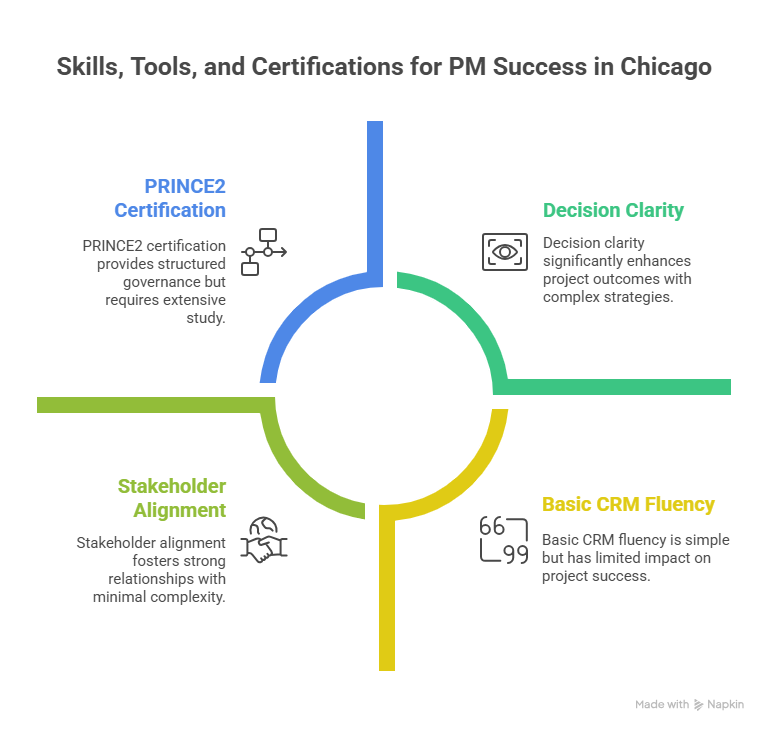
Chicago employers are quietly paying premiums for PMs who bring decision clarity. Not “more meetings.” Decision clarity means the right information shows up, at the right time, in a format leaders can act on. This is exactly why PMOs are evolving, as covered in the future of the PMO, and why governance is being redesigned in the future of project governance.
The four skills that raise your ceiling fastest
1) Estimation credibility.
Most PMs guess. Top PMs create confidence bands and update forecasts without ego. This is where modern approaches influenced by machine learning for estimation matter, even if you do not write models yourself.
2) Risk and dependency control.
Chicago enterprises pay more for PMs who prevent late-stage surprises. Use structured governance concepts aligned with future governance practices and portfolio alignment seen in future PPM trends.
3) Stakeholder communication that reduces friction.
The best PMs do not “give updates.” They create alignment moments. This is leadership, and it maps directly to future PM leadership styles.
4) Operationalizing methodology instead of preaching it.
Chicago hiring managers are tired of methodology theater. They want outcomes. Learn how hybrid is becoming standard through hybrid delivery forecasts and keep your agile language current with Scrum’s evolution.
Tools that signal you can run an “enterprise” cadence
Tool choice matters less than how you use it. What signals maturity is: single source of truth, clean dashboards, consistent reporting cadence, and automation for repetitive updates. Build that capability using APMIC’s practical stack guidance in top productivity software, learning platforms in PM training software, and cost visibility systems in project budget tracking tools.
If you work close to sales or customer teams, CRM fluency is a hidden accelerator. Many Chicago PM roles quietly involve revenue workflow changes, so it helps to understand the ecosystem described in CRM tools for PMs.
Certifications that actually pay off in Chicago
Certifications pay when they match the hiring environment. In Chicago, that usually means PMP for standardized enterprise delivery, or PRINCE2 for structured governance heavy environments, plus domain signals. If you want to choose wisely, start with PMP vs PRINCE2 and then use targeted prep resources like the PMP study plan and PMP exam day survival tips.
For PRINCE2, candidates often waste time studying the wrong way. Use the structure in PRINCE2 Foundation vs Practitioner and reinforce learning with practice style breakdowns in PRINCE2 exam questions.
A final note: employers increasingly want PMs who can navigate emerging priorities like sustainability programs. Even if you are not “ESG,” you may touch it in procurement, reporting, or operations. That direction is outlined in sustainability and ESG in project management.
5. High-Leverage Career Plays: How to Land Better Roles and Negotiate
If you want better Chicago PM roles, stop optimizing for applications and start optimizing for proof. Chicago hiring managers are drowning in candidates who claim they are “results-driven.” The ones who win show evidence.
Step 1: Rewrite your resume like a benefits report
Replace “responsible for” with “delivered.” Every bullet should contain:
the outcome (what changed)
the metric (how you measured it)
the constraint (why it was hard)
your lever (how you made it happen)
This is the same benefits logic that modern PMOs are pushing in future PMO success models and it aligns with portfolio thinking in PPM trend frameworks.
Step 2: Build a “Chicago ready” interview narrative
Chicago interviews often test for composure under pressure. Prepare three stories:
A delivery rescue where you stabilized chaos using governance principles aligned with future governance best practices
A stakeholder conflict where you created alignment using leadership behaviors described in future PM leadership
A planning story where your estimate improved over time, reflecting modern thinking from ML-driven scheduling
Step 3: Target the right job titles, not just “PM”
Chicago companies hide high-paying work behind titles like:
program manager
delivery manager
transformation lead
technical program manager
portfolio manager
These titles map to the market evolution described in project management’s next decade and how PM roles shift with automation and AI career changes.
Step 4: Negotiate like someone who understands business risk
The negotiation mistake most PMs make is arguing about “market rate” instead of risk reduction. Your pitch should sound like:
“I reduce delivery uncertainty. I protect your timeline and the dollars behind it.”
Then back it up with specifics: forecast accuracy, stakeholder cadence, risk controls, and adoption results. Tie your process to known systems by referencing PMP structured execution via PMP prep resources or PRINCE2 stage control via PRINCE2 certification guides.
Step 5: Use tools to create leverage, not noise
Executives do not want more dashboards. They want decisions. Pick a stack and run it well. Use frameworks from PM productivity tools, build stronger planning routines with PMP practice questions, and tighten your execution language using PMP exam day performance principles.
Chicago rewards PMs who act like operators: calm, direct, metrics-driven, and brutally honest about tradeoffs.
6. FAQs
-
Move closer to high-consequence delivery. That usually means programs tied to revenue, regulatory outcomes, or large operational risk. Build proof: quantify your impact and show how you reduce uncertainty. Employers pay more for PMs who can operate inside mature governance systems, so strengthen that muscle using future project governance practices and modern portfolio thinking from PPM trends. Pair that with stronger tooling habits supported by PM productivity software.
-
In Chicago, PMP often functions as a trust shortcut for enterprise roles because it signals standardized execution and stakeholder discipline. It helps most when you apply to finance, healthcare, or large multi-team environments where governance matters. If you choose PMP, do not treat it as trivia. Translate it into how you plan, manage risk, and track benefits. Use a structured path like the PMP exam guide and reinforce your readiness with PMP exam questions plus the PMP study plan.
-
PRINCE2 can be a strong fit when the role is governance heavy, stage gate driven, or embedded in environments that value formal control and documentation. If your target employers emphasize structured reporting, approvals, and decision gates, PRINCE2 language can match better. Start with PMP vs PRINCE2, then decide level using PRINCE2 Foundation vs Practitioner. Tighten your prep using the PRINCE2 exam guide and practice using PRINCE2 exam questions.
-
Finance, healthcare, logistics, and enterprise tech implementation stay resilient because execution failures are costly. Those environments also adopt modern delivery practices faster, including hybrid execution and AI-enabled planning. If you want to align your career to the direction of demand, study hybrid project management and the broader future impact from automation and AI on PM careers. If you are healthcare-focused, also benchmark your tooling expectations against healthcare PM platforms.
-
You prove impact by making invisible work measurable. Track cycle time improvements, reduced meeting load, faster decision turnaround, fewer blocked dependencies, cleaner status reporting, or risk items closed earlier. Turn your work into outcomes that leaders care about. Then present it using a PMO style narrative aligned with the future role of the PMO. Add tool credibility by mastering execution basics from productivity software for PMs and budgeting fundamentals from project budget tracking tools.
-
The biggest rejection triggers are: vague resumes with no metrics, weak stakeholder communication stories, unclear ownership boundaries, and an inability to explain tradeoffs under pressure. Chicago hiring managers do not want “busy.” They want clarity. Tighten your leadership narrative using future PM leadership styles and prepare for execution questions by practicing structured reasoning with PMP questions explained. If your interview answers lack structure, study how governance and decision cadence are evolving in future project governance.
-
Build skills that stay valuable when tools change: outcome design, prioritization, risk management, stakeholder alignment, and benefits realization. Then layer in AI literacy so you can use automation to create leverage, not replaceable work. Your roadmap should align with future PM skills, the technology shift discussed in AI and project management, and the continued evolution in project management methodologies through 2030.
