
Renewable Energy Project Management Trends
Project management in renewable energy is moving from feel-good ambition to hard-nosed infrastructure execution. Between 2025 and 2030, boards will judge wind, solar, storage, hydrogen, and grid-modernisation projects on the same financial, risk, and ESG metrics they apply to mega-rail or data-centre programmes. That means project leaders must blend energy-sector literacy, portfolio discipline, and governance skills drawn from advanced frameworks like those covered in APMIC’s guides on risk management, budgeting, ESG-focused delivery, and agile portfolio management.

1. The Renewable Energy Project Landscape 2025–2030
Renewable energy portfolios are no longer dominated by isolated wind farms and rooftop solar. Governments are backing multi-decade investment pipelines that link generation, transmission, and flexibility assets similar in scale to major transport initiatives like Crossrail 2, or urban redevelopments such as Centennial Yards. These portfolios combine onshore and offshore wind, utility-scale solar, grid-scale batteries, pumped hydro, green hydrogen clusters, and digital control centres.
For project managers, the challenge is not just building assets fast. It is orchestrating interdependent workstreams under volatile conditions captured in APMIC’s analyses of global inflation and project budgets and downturns in construction. Renewable programmes frequently span multiple jurisdictions, each with distinct permitting rules and local content requirements, echoing the regulatory pressures highlighted in Australian construction case studies.
At the same time, energy-transition portfolios must satisfy ESG investors, regulators, communities, and grid operators. This demands governance models similar to those discussed in sustainability-focused project management, backed by robust risk vocabularies drawn from the top 25 risk-identification terms and clear initiation language defined in project initiation terminology guides.
2. Key Trends Reshaping Renewable Energy Project Management
One defining trend is portfolio volatility: auction rules, grid tariffs, and incentive schemes are being rewritten almost yearly. Project managers therefore need strong economic literacy, drawing on concepts from cost-management terminology and budgeting guides to rewrite business cases rapidly. Another trend is the shift toward cluster-based development, in which ports, electrolysers, pipelines, and industrial offtakers are governed as single programmes similar in complexity to national highway upgrades.
The third trend is digitalisation of the energy system. PMs must manage cyber and data risk using concepts from the advanced persistent threats guide and lessons from cybersecurity-driven software overhauls. AI-enabled forecasting tools, portfolio optimisers and digital twins are enabling scenario-based planning similar to the capabilities described in APMIC’s articles on AI adoption in PM and digital PMO transformation.
Finally, renewable energy portfolios are becoming central to national growth strategies, mirroring arguments in project management as a driver of economic growth. That means PMs cannot hide in technical detail; they must communicate clearly to ministers, regulators, communities and investors using shared terminology from resources like the top 100 PM terms and team-building terminology.
3. Opportunities For Project Managers In Renewable Energy
For project professionals, renewable energy is one of the most attractive career arenas through 2030. First, the sector demands end-to-end portfolio leaders able to operate at the intersection of policy, finance and engineering. Experience gained on complex programmes like those covered in Crossrail 2 governance narratives or large urban redevelopments transfers directly into offshore wind hubs or hydrogen valleys.
Second, there is rising demand for agile-capable PMs who can run innovation pilots and digital initiatives using principles from agile demand surveys and economic-uncertainty agile responses. These skills are invaluable for microgrid pilots, VPP (virtual power plant) deployments, and AI-based forecasting tools. Third, renewable energy portfolios offer global mobility. Skills gained under one regulatory framework or grid operator can be applied in others with relatively small adaptation, particularly if professionals ground themselves in universal terminology via APMIC’s initiation, risk, and cost glossaries.
Finally, there is a significant demand for governance-savvy PMO leaders who can connect ESG, cyber, and financial perspectives. Organisations trying to emulate ESG-oriented practices from sustainability project-management case studies and financial discipline from inflation impact analyses need leaders who can tell a coherent story to rating agencies and investors.
4. Building A Future-Ready Renewable Energy PMO
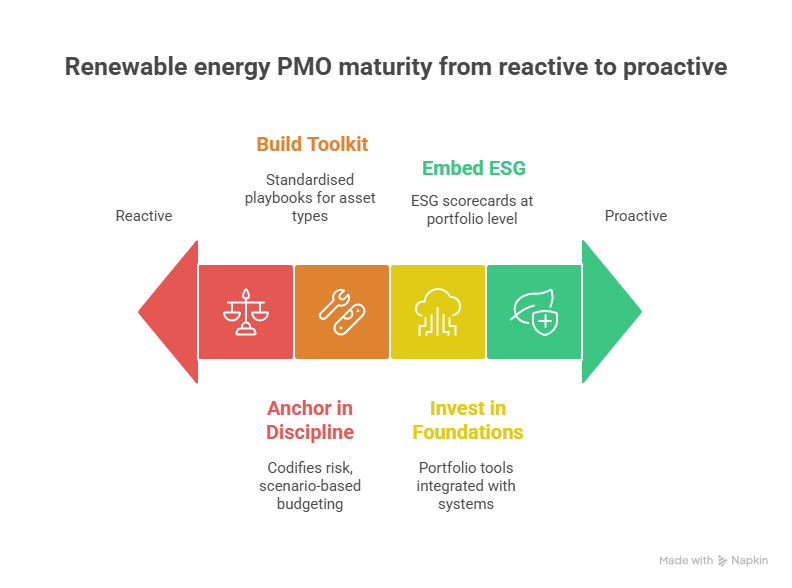
A renewable-focused PMO must first anchor itself in governance discipline. It should codify risk concepts using APMIC’s risk-management glossary and risk-identification terminology, then ensure these definitions appear in every charter and risk register. It must also design scenario-based budgeting processes, drawing on techniques from essential budgeting guides and macroeconomic insights from inflation impact analyses.
Second, the PMO should build a standardised toolkit for repeated asset types: wind farms, solar parks, battery installations and substation upgrades. These playbooks can leverage concepts from project initiation term guides and team-building terminology to clarify responsibilities among developers, EPC contractors, operators, and regulators. For mega-programmes such as offshore wind clusters or cross-border interconnectors, the PMO can learn from complex endeavours like Crossrail 2 and large highway projects including the Carpentaria upgrade.
Third, the PMO must invest in digital foundations. Portfolio tools should be selected and configured in line with trends profiled in investment in PM software, ensuring integration with risk, finance and asset-management systems. Cybersecurity hygiene must follow guidance from APT mechanism resources and lessons captured in cybersecurity overhaul studies.
Finally, the PMO should embed ESG at the portfolio level, rather than treating it as an afterthought. Insights from sustainability in project management can be used to design ESG scorecards, while macro arguments from project management as an economic growth driver help the PMO explain to boards why disciplined renewable portfolios are central to national competitiveness and community resilience.
5. Certification & Skills Roadmap For Renewable Energy PMs
Renewable energy employers increasingly expect formal certification as a proxy for governance maturity. For early-career professionals, CAPM-focused resources and 30-day CAPM study plans provide a foundation in scope, schedule, cost and risk management. These basics are essential when managing dozens of similar solar or storage projects concurrently.
At mid-career level, PMP and PRINCE2 become differentiators. The comparison in PMP vs PRINCE2 and the detailed guidance in the PRINCE2 exam guide help project managers choose a framework aligned to their organisation’s governance culture. PMP’s emphasis on integration, stakeholder engagement and earned value is invaluable for multi-contract offshore wind or grid-modernisation projects, while PRINCE2’s product-based planning supports structured work-breakdown in large hydrogen clusters or CCS programmes. APMIC’s real-life PRINCE2 success stories can be used to demonstrate business value to sceptical executives.
For portfolios where agile methods support software, data and customer-experience components, PMI-ACP-level skills are critical. The top 25 PMI-ACP exam questions show how agile principles and lean portfolio thinking can be applied to complex environments. These skills help PMs run iterative pilots for AI forecasting tools, customer portals or microgrid control systems. A structured exam-preparation strategy using articles like the PMP exam day survival guide and CAPM salary insights can also help professionals articulate the ROI of certification when discussing training budgets with their organisations.
Finally, renewable energy PMs should cultivate sector-specialist skills: understanding grid codes, auction rules, PPA structures and ESG disclosure frameworks. While these are not yet codified into a single certification, they can be layered onto generic project-management credentials by systematically studying terminology using references like the top 100 PM terms, human-resource terminology for PMs, and team-building guides.
6. FAQs: Project Management In Renewable Energy 2025–2030
-
PMs need scenario-based governance that anticipates policy shifts rather than reacting to them. Use macroeconomic thinking from inflation impact analyses and agile portfolio concepts from economic-uncertainty articles to define trigger points: for example, what happens to the portfolio if subsidies are cut, grid-connection charges rise, or carbon prices double. Risk vocabularies from the risk-management glossary help teams describe these scenarios consistently. Governance boards should rehearse responses in advance, similar to resilience planning for infrastructure in Australian construction case studies, so that decisions can be executed within weeks rather than months.
-
The most effective tools combine portfolio management, risk analytics, and asset information. APMIC’s overview of investment in PM software explains how organisations are consolidating onto integrated platforms that connect schedules, costs, and risks. For cyber-sensitive environments, guidance from APT defence resources and cybersecurity overhaul articles should shape configuration decisions. On top of this, AI-enabled capabilities showcased in AI adoption in PM and digital-twin initiatives described in digital PMO transformation pieces enable predictive insights into resource bottlenecks, schedule slippage and revenue cannibalisation across storage, solar and wind assets.
-
ESG should be embedded upfront in project initiation, not retrofitted during delivery. Use frameworks from sustainability-in-project-management resources to define ESG-critical requirements in charters and business cases. Connect these requirements to cost and benefit line items using concepts from budgeting guides and cost-management terminology, so stakeholders understand trade-offs. Risk registers should include ESG risks alongside classic technical and financial risks, using terminology from the risk-identification term guide. When ESG expectations are translated into clear design criteria and KPIs, they accelerate decision-making because debates about purpose and community impact are resolved early.
-
Renewable projects face policy, grid and offtake risks that are more pronounced than in many other sectors. Policy risk includes sudden changes in feed-in tariffs or tax credits; grid risk covers delays and constraints in connecting assets; offtake risk emerges when power prices or demand forecasts shift. These sit alongside technology and supply-chain risks, such as emerging battery chemistries or specialised vessel availability for offshore wind. Resources like the comprehensive risk-management glossary and risk-identification term lists help PMs categorise and monitor these systematically, while economic insights from global inflation analyses highlight how macro conditions can amplify them.
-
Renewable employers typically prioritise PMP and PRINCE2 Practitioner for complex capital projects, supported by foundational CAPM-level knowledge. Comparative insights in PMP vs PRINCE2 articles and exam resources like the PMP survival guide and PRINCE2 exam guide can help PMs choose a path. For early-career professionals, the ultimate CAPM exam guide and CAPM salary insights show how certification opens doors in energy-transition roles. In portfolios with significant digital and agile components, the PMI-ACP Q&A resource demonstrates the value of agile credentials for innovation pilots and customer-facing platforms.
-
Effective programmes treat stakeholder management as a core governance stream, not a communications afterthought. They map stakeholders in detail using vocabulary from the team-building terminology guide and HR terms for PMs, then design engagement strategies aligned with ESG obligations described in sustainability-focused resources. For mega-projects, they often create formal governance forums, inspired by transport and construction examples such as Crossrail 2 and Carpentaria Highway upgrades. These forums give regulators, communities, and investors predictable channels to influence decisions, reducing the risk of late-stage objections that can derail schedules and budgets.
