
Real-Life PMP Exam Success Stories: Inspiration & Proven Tips
PMP success rarely comes from “studying harder” in a vague way. It comes from diagnosing exactly why your answers are wrong, rebuilding weak judgment, and practicing until scenario questions feel familiar under pressure. Candidates who pass usually turn messy work experience into exam-ready thinking through structured review, mock analysis, and smarter habits. Before planning your own route, confirm the exam version you will sit for, because PMI lists the current PMP exam as 180 questions and 230 minutes, and has announced a revised PMP exam launching July 9, 2026 with updated timing and domain weights.
1. What Real PMP Exam Success Stories Actually Have in Common
The strongest PMP success stories usually start with frustration. A candidate has project experience, understands deadlines, handles stakeholders, and may even lead complex delivery work, yet their practice scores stay weak. That gap exists because the PMP exam rewards disciplined judgment, not workplace habit alone. A delivery lead studying through a complete project management career roadmap often realizes that the exam tests how a project manager should think across predictive, agile, and hybrid environments, which connects directly to project execution terms, monitoring and control concepts, and stakeholder engagement language that must become automatic.
One common success pattern is the “experienced but inconsistent” candidate. This person has managed vendors, change requests, meetings, and risks, but answers exam questions based on what their company usually does. The turnaround begins when they stop treating the PMP as a memory test and start treating it as a decision-quality test. They connect situational questions to risk registers, resource allocation tradeoffs, project reporting standards, and conflict resolution techniques instead of guessing from personal instinct.
Another success pattern is the “busy professional” who studies in short, targeted blocks. This candidate may be moving from an IT project manager career path, construction project management, healthcare project management, or government project management, and their schedule leaves little room for long study marathons. Their winning move is ruthless prioritization: review one weak domain, complete timed questions, document mistakes, and repeat until the same error pattern disappears.
The most inspiring stories share one practical lesson: the candidate builds proof before exam day. They do not wait for confidence to appear. They create it through mock scores, answer logs, formula fluency, and scenario drills linked to earned value management, schedule compression, agile estimation, and leadership communication. That is the real difference between hoping to pass and walking into the exam with evidence.
| Success Pattern | Starting Problem | Turnaround Move | Proof It Is Working | APMIC Resource to Reinforce It |
|---|---|---|---|---|
| Mock-score climber | Scores stay flat because every review session feels random. | Build a mistake log by domain, question type, and decision trap. | Wrong answers repeat less often across three timed sets. | Monitoring and control terms |
| Scenario thinker | Reads questions too quickly and misses the real conflict. | Underline role, project phase, stakeholder pressure, and immediate next action. | Fewer mistakes on “what should the PM do next?” questions. | Stakeholder engagement terms |
| Formula finisher | Knows formulas but freezes when wording changes. | Practice interpretation: what CPI, SPI, ETC, and EAC mean for decisions. | Formula questions become fast points instead of panic moments. | EVM terms |
| Agile adapter | Predictive background makes agile questions feel vague. | Study servant leadership, backlog flow, increments, and team ownership. | Agile answer choices start separating clearly. | Agile glossary |
| Scrum improver | Confuses ceremonies, roles, artifacts, and escalation paths. | Map each Scrum event to its purpose and decision output. | Scrum questions become process-of-elimination wins. | Scrum glossary |
| Hybrid builder | Treats agile and waterfall as separate worlds. | Practice choosing governance based on risk, uncertainty, and delivery cadence. | Hybrid scenarios feel less contradictory. | Hybrid project management |
| Risk controller | Answers risk questions with vague “communicate” choices. | Separate risk identification, analysis, response planning, and monitoring. | Risk scenario accuracy improves quickly. | Risk registers |
| Schedule fixer | Struggles with crashing, fast tracking, float, and critical path logic. | Study schedule decisions as tradeoffs between risk, cost, and time. | Schedule questions take less time. | Schedule compression terms |
| Communication cleaner | Overuses meetings as the answer to every people problem. | Match communication mode to urgency, stakeholder power, and documentation need. | Stakeholder questions become more precise. | Leadership and communication terms |
| Procurement learner | Vendor questions feel unfamiliar because daily work rarely includes contracts. | Study RFP, RFQ, RFI, SOW, contract risk, and acceptance criteria. | Procurement questions stop feeling like legal trivia. | RFP, RFQ, and RFI terms |
| Vendor manager | Confuses supplier control with team management. | Practice contract performance, issue escalation, and relationship boundaries. | Vendor scenarios become easier to rank. | Vendor management terms |
| Resource planner | Chooses unrealistic answers when team capacity is constrained. | Connect capacity, skill gaps, calendars, and conflict resolution. | Resource-related wrong answers drop. | Resource allocation terms |
| Finance-aware PM | Budget questions feel abstract or overly mathematical. | Link costs to baselines, forecasts, reserves, and business justification. | Financial choices become decision-based. | Financial management terms |
| Quality defender | Chooses speed over prevention in quality questions. | Separate quality planning, assurance, control, acceptance, and continuous improvement. | Quality answers align with prevention-first logic. | TQM terms |
| Governance-ready | Escalates too early or too late in scenario questions. | Identify authority, thresholds, change control, and decision rights. | Escalation questions become cleaner. | Project governance trends |
| Change-control master | Approves changes casually because real workplaces reward speed. | Practice impact analysis before approval, rejection, or implementation. | Scope-change questions become high-confidence items. | Waterfall project management terms |
| Backlog thinker | Agile prioritization feels like opinion rather than value logic. | Study backlog refinement, product ownership, and sprint goal alignment. | Agile product questions become predictable. | Product backlog and sprint backlog |
| Estimation improver | Confuses story points, velocity, duration, and effort. | Practice estimation by uncertainty level and planning horizon. | Estimation questions feel less technical and more logical. | Agile estimation techniques |
| Metrics reader | Sees charts but misses what the PM should do next. | Translate metrics into risk, communication, and corrective action. | Chart-based questions become less intimidating. | Agile metrics |
| Tool-aware candidate | Confuses software familiarity with project management judgment. | Use tools to understand workflow, transparency, and decision support. | Tool questions become concept-driven. | Agile PM tools |
| Career switcher | Feels behind because their job title differs from “project manager.” | Translate experience into scope, schedule, cost, risk, and stakeholder outcomes. | Application story and study focus become stronger. | PM career path |
| Salary-motivated learner | Studies only to earn the credential, then loses discipline. | Connect PMP prep to role readiness, promotion paths, and stronger interviews. | Study sessions gain a concrete career purpose. | PM salary comparison |
| Certification strategist | Cannot explain why PMP matters beyond resume value. | Connect certification to delivery confidence, credibility, and project outcomes. | Motivation stays high through difficult mock results. | Certification impact |
| Future-proof learner | Studies old habits while the profession keeps shifting. | Review AI, automation, hybrid delivery, and value-driven leadership. | Scenario questions feel connected to modern PM work. | Future PM skills |
| Remote PM candidate | Struggles with distributed-team communication scenarios. | Practice transparency, asynchronous updates, decision logs, and stakeholder rhythm. | Remote-team questions become easier. | Remote PM roles |
| Consultant mindset | Gives answers that solve symptoms instead of root causes. | Practice diagnosis before solution, especially in troubled projects. | Complex scenarios become more structured. | PM consultant path |
| Post-pass planner | Focuses only on exam day and ignores credential maintenance. | Plan PDUs, learning goals, and career use of the credential early. | The certification becomes an asset after passing. | PMP renewal and PDUs |
| Executive-track PM | Studies tasks but misses strategic business context. | Connect PMP logic to portfolio, value, benefits, and leadership maturity. | Business environment questions become stronger. | Project portfolio manager guide |
2. Success Story One: The Experienced PM Who Failed Mocks Until She Fixed Her Decision Logic
A common PMP success story begins with an experienced manager who expects the exam to reward years of delivery work. She has run meetings, managed risks, coordinated vendors, and handled executive pressure. Then her first mock score lands far below her target. The pain point feels personal: “If I already manage projects, why am I missing these questions?” The answer usually sits inside decision logic. Workplace experience may be strong, but the exam expects structured reasoning across project governance, change control, stakeholder engagement, and risk response planning.
Her breakthrough comes when she stops reviewing only the right answer. For every missed question, she records why the tempting answer looked attractive. Did she escalate before analyzing? Did she solve a people issue with documentation alone? Did she approve a change without assessing impact? Did she ignore the team’s ability to self-organize? This turns mock review into skill repair. A candidate following a certified project manager roadmap can use the same method with leadership communication terms, project reporting best practices, and conflict resolution concepts to repair judgment faster than rereading chapters.
The proven tip is simple: study your wrong-answer personality. Some candidates over-escalate. Some over-document. Some pick the most technical answer when the exam wants servant leadership. Some choose the fastest action when the project needs analysis. When you know your pattern, every question becomes feedback. This is especially valuable for candidates moving from agile project management, Scrum Master roles, IT project management, or construction project management, because each background creates different blind spots.
By the final month, this candidate’s study plan looks less impressive from the outside but works better inside the exam room. She completes timed sets, reviews only high-value mistakes, revisits weak concepts, and builds stamina. Her confidence comes from proof: rising accuracy, faster elimination, fewer repeated traps, and clearer reasoning. That same proof-driven style supports long-term growth after the exam through PMP renewal planning, future PM skills, project management workforce trends, and certification impact research.
3. Success Story Two: The Busy Professional Who Passed by Studying Less Randomly
Another powerful PMP success story belongs to the candidate with almost no clean study time. They work full-time, handle family responsibilities, answer late messages, and keep postponing mock exams because the perfect weekend never arrives. The trap is believing success requires large uninterrupted study blocks. In reality, many working candidates pass by replacing long, unfocused study sessions with short, targeted cycles. A 45-minute block can cover five risk questions, one risk register review, one EVM concept, one Gantt chart decision, and one schedule compression comparison.
Their first step is building a ruthless weekly plan. Monday becomes People-domain review. Tuesday becomes Process questions. Wednesday becomes agile and hybrid practice. Thursday becomes formulas and schedule logic. Friday becomes a mistake-log session. Saturday becomes one timed mock block. Sunday becomes light review and recovery. This structure helps candidates coming from remote project management, product owner paths, agile coaching, or project management consultancy because it turns career experience into exam categories.
The biggest pain point for this candidate is fatigue. A tired mind reads “first,” “next,” “best,” and “except” badly. That creates preventable errors. The fix is practicing under realistic conditions before exam day. Timed sets teach pacing. Short breaks teach recovery. Mixed questions teach mental switching. Scenario review teaches patience. Candidates who work with agile metrics, Kanban terms, Scrum terms, and waterfall definitions in short rotations usually build better exam flexibility.
Their proven tip is to study by decision type, not just by topic. For example, group questions into “stakeholder conflict,” “change request,” “team performance,” “vendor issue,” “schedule delay,” “quality defect,” and “risk event.” This mirrors the exam experience better than reading passively. It also connects naturally to vendor management terms, RFP and RFQ concepts, quality management terms, and project financial management, where the challenge is usually choosing the most professional next action.
4. Success Story Three: The Agile Practitioner Who Had to Learn PMP-Style Balance
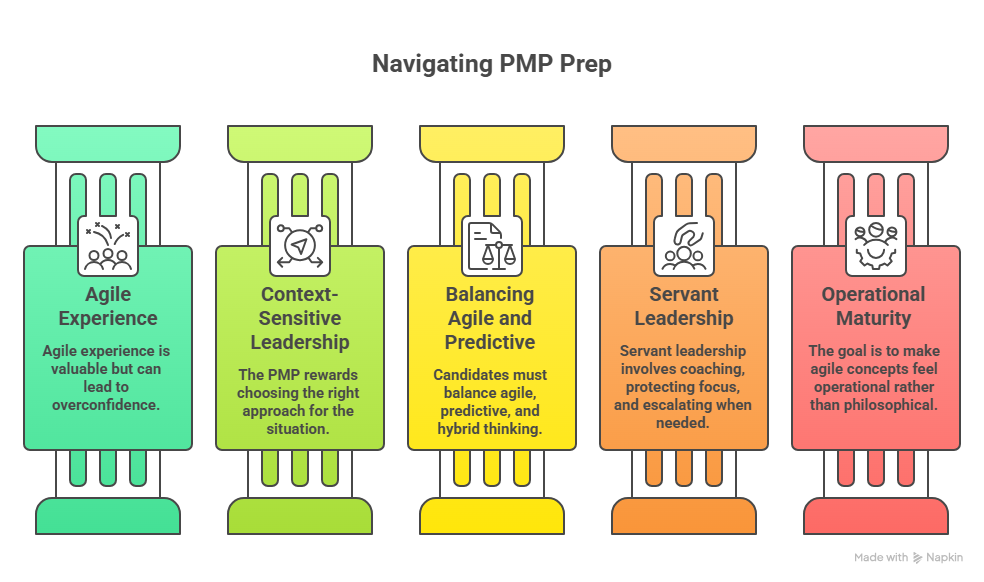
A Scrum Master, product owner, or agile delivery lead may enter PMP prep with strong team experience and still struggle. Their pain point is subtle: agile experience helps, but it can also create overconfidence. The PMP expects candidates to choose the right approach for the context, which may involve agile, predictive, or hybrid thinking. The candidate who passes learns to balance servant leadership with governance, value delivery with documentation, and team autonomy with organizational accountability. That balance becomes easier after reviewing the complete Agile glossary, Scrum glossary, agile estimation guide, and hybrid project management forecast.
This candidate’s early mistakes often come from choosing the most agile-sounding answer instead of the best project-management answer. For example, a self-organizing team still needs transparency when risk rises. A product owner can prioritize value, yet regulatory constraints may shape delivery. A team can inspect and adapt, yet contract obligations still matter. The exam rewards context-sensitive leadership. Candidates from certified Scrum Master paths, agile coach careers, Scrum Master to agile consultant routes, and product owner roadmaps can gain fast improvement by practicing mixed-method scenarios.
Their proven tip is to ask three questions before choosing an answer. First, what environment is the project in? Second, who owns the decision? Third, what action protects value while respecting process? These questions prevent impulsive answers. They also connect agile thinking to project governance, ISO standards, stakeholder engagement, and project reporting, which are essential when agile delivery sits inside a larger organization.
The success moment arrives when agile questions stop feeling philosophical and start feeling operational. The candidate sees that servant leadership may mean removing blockers, coaching the team, protecting focus, improving communication, or escalating when authority is needed. That maturity also supports career growth in remote project management, international project management, portfolio management, and future PM leadership, where adaptive judgment matters more than method loyalty.
5. Proven PMP Exam Tips You Can Copy From Passing Candidates
The first proven tip is to build a mistake log that captures the reason behind each miss. A weak log says, “wrong on risk.” A useful log says, “I treated an issue as a risk,” “I escalated before analysis,” or “I ignored stakeholder engagement before change control.” This level of review turns errors into training data. It works especially well when paired with risk mitigation terms, risk register examples, conflict resolution terms, and project monitoring concepts.
The second tip is to study transitions, because many PMP questions test what happens when a project shifts state. A risk becomes an issue. A request becomes a change. A stakeholder becomes resistant. A team conflict becomes a performance problem. A vendor delay becomes a schedule threat. Passing candidates learn the correct next move for each transition. That is where project execution terms, change-friendly waterfall concepts, schedule compression terms, and vendor management terms become practical exam tools.
The third tip is to practice stamina early. Many candidates can answer 20 questions well, then lose accuracy when the exam becomes mentally heavy. Use timed blocks to train pacing, reading accuracy, and emotional control. Track where fatigue begins. Review whether late errors come from knowledge gaps, careless reading, or decision shortcuts. Candidates preparing for growth through project manager salary outcomes, North America PM industry trends, Europe PM market insights, or Asia-Pacific PM trends should treat stamina as part of professional readiness.
The fourth tip is to translate every study topic into an interview-ready story. When you study scope control, recall a time requirements shifted. When you study stakeholders, recall a sponsor conflict. When you study procurement, recall a vendor delay. This makes the PMP useful beyond the exam and strengthens your career narrative. It also ties naturally to the project management consultant path, PM director roadmap, VP of PM career path, and chief project officer roadmap.
The fifth tip is to plan life after passing. A PMP credential should become a career asset, not a badge that sits untouched. After the exam, candidates can use their momentum to improve delivery language, update resumes, document project outcomes, and pursue roles aligned with stronger compensation and responsibility. That next step may involve PMP renewal and PDUs, future certification trends, AI in project management, and automation’s impact on PM careers.
6. FAQs
-
The biggest lesson is that passing candidates usually improve their thinking before they improve their confidence. They learn how the exam frames responsibility, timing, escalation, communication, and value delivery. A candidate who studies stakeholder engagement, project reporting, risk registers, and EVM terms with scenario logic usually improves faster than a candidate who only rereads definitions.
-
Use mock exams to prove readiness, not to collect scores. Many candidates benefit from several timed blocks plus at least one full-length simulation, but the quality of review matters more than the count. Your goal is stable performance, fewer repeated traps, and stronger pacing. Pair mocks with targeted review in monitoring and control, schedule compression, agile metrics, and conflict resolution.
-
Experienced PMs may struggle because the exam tests standardized professional judgment across multiple environments. Real workplaces sometimes normalize shortcuts, weak documentation, unclear governance, or rushed escalation. PMP prep requires candidates to align experience with disciplined decision-making. That is why experienced candidates should review project governance, resource allocation, quality management, and vendor management instead of relying only on workplace habit.
-
Stop taking more random quizzes for a few days and diagnose the score plateau. Separate errors into concept gaps, wording traps, pacing problems, and decision-rule mistakes. Then rebuild weak areas with smaller sets. For example, use agile estimation for planning confusion, RFP and RFQ terms for procurement confusion, financial management terms for budget confusion, and PM leadership communication for people-domain confusion.
-
PMP success can strengthen your resume, interview stories, promotion case, and confidence in higher-responsibility roles when you connect the credential to measurable project outcomes. After passing, update your project examples around scope, schedule, cost, risk, stakeholders, and business value. Then align your next move with a project management career path, salary comparison by certification, project management director roadmap, and portfolio manager guide.
