
Dallas Project Management Job Market Insights
Job Market Dallas-Fort Worth is built for project managers who can deliver in messy, multi stakeholder reality. In 2026 and 2027, DFW hiring rewards hybrid execution, stakeholder control, and measurement discipline, not trendy buzzwords. You will find real demand across telecom, defense, healthcare, finance, construction, logistics, and enterprise tech, especially where delivery risk is expensive. This guide breaks down where the jobs sit, what companies screen for, how salary bands typically stack up, and what to do if your resume feels invisible. Use it as your DFW playbook, not a generic overview.
1. DFW PM Market Reality in 2026-27: What Is Expanding and Why It Matters
DFW is not a single market. It is a set of delivery ecosystems that behave differently and punish different mistakes. If you come in with a one size methodology pitch, you will lose to candidates who speak execution outcomes and governance language. That is why the strongest positioning starts with modern delivery blends like hybrid project management, then ties into predictable decision systems like future project governance and scalable reporting via the evolving PMO role.
In 2026 and 2027, DFW demand clusters around programs where failure is visible and costly. Telecom and network builds punish missed dependencies. Defense and aerospace punish documentation gaps and weak risk control. Healthcare transformations punish poor adoption planning and stakeholder misalignment. Financial services punish weak controls and audit readiness. If you cannot translate your experience into risk reduction, you look like a meeting scheduler, not a delivery leader. Build your narrative around the capabilities in future PM competencies and connect it to portfolio level prioritization using future PPM trends.
DFW also leans heavily enterprise, which means the real battle is often internal. Your blockers will not be Jira. Your blockers will be conflicting priorities, funding approvals, vendor delays, and leadership changes that rewrite the roadmap without warning. That is why PMs who understand portfolio mechanics win promotions faster, especially when they can present tradeoffs like a portfolio leader, aligned with PPM trends and decision models and leadership patterns from the future of PM leadership.
One more shift is changing DFW hiring in 2026 and 2027. AI is no longer a side topic. Hiring managers want PMs who can run pilots, define guardrails, and measure outcomes without turning delivery into chaos. Do not claim AI skill because you used a tool. Claim AI skill because you can choose use cases, set success metrics, and protect quality. Anchor that language to AI impacts on project management and sharpen planning credibility using machine learning in estimation and scheduling.
If you want a clean positioning statement for DFW, use this. “I run hybrid delivery that protects outcomes through governance, portfolio clarity, and measurable execution.” Then back it with tool maturity from PM productivity software and workflow realism informed by future PM software trends.
2. Companies and Hiring Corridors in DFW: Where to Target and How to Position
DFW hiring is geographically clustered, but your real advantage is understanding what each corridor values. If you pitch the same resume to every corridor, you will feel like the market is “slow” when the truth is your message is misaligned. Start by tailoring your delivery story using dominant methodologies by the next decade and a blended execution posture rooted in hybrid delivery.
Telecom and enterprise tech corridors are heavy across Dallas and the broader metro. These teams hire PMs who can control dependencies, manage vendor timelines, and ship with stable reporting. The pain point is constant parallel work that collides. You win by showing you can keep delivery predictable using governance practices from future project governance and modern tool based reporting aligned with future PM software trends.
Defense, aerospace, and manufacturing corridors lean toward Fort Worth and surrounding areas, plus supplier networks across the metro. These programs punish weak documentation, sloppy scope control, and reactive risk management. If you come from fast moving tech, you need to translate your speed into control language. Use your execution story to show you can create evidence, sustain cadence, and keep risk visible, anchored to future PM skills and escalation systems supported by the future role of the PMO.
Financial services and regulated enterprise corridors are strong in DFW with large employers and major campuses. These teams pay for reliability and control because the cost of failure is not just money. It is audit exposure and reputational damage. Your advantage comes from speaking portfolio language and control frameworks, supported by PPM trend models and governance maturity described in future governance practices.
Healthcare and clinical adjacent corridors are large across Dallas and surrounding areas, with systems, payers, and vendors. Their pain point is adoption. You can ship the platform and still fail if workflows do not change. To stand out, build your story around stakeholder mapping, training rollouts, and measurable adoption, paired with tooling clarity from healthcare project management software guidance and leadership patterns from future PM leadership.
Construction and infrastructure corridors are always present because DFW keeps expanding. If you want this lane, your credibility is not in certifications alone. It is in schedule control, subcontractor coordination, and change order discipline. Build industry alignment by studying the future of PM in construction and bring stronger budget control narrative using project budget tracking tools.
One more corridor is rising fast in DFW: AI implementation and automation programs inside enterprises. These are not research projects. They are operational projects that need guardrails. You win if you can run pilots, manage risk, and prove ROI. Shape that pitch using AI impacts on PM and career positioning informed by automation transforming PM careers.
If your job search feels dead, it is usually one of three failures. Your resume is generic, your lane is unclear, or your proof is missing. Fix those by building a proof pack and matching your message to the corridor, supported by practical tools from PM productivity software and training platforms summarized in project management training software.
3. Salaries in Dallas-Fort Worth for 2026-27: How Pay Really Works and How to Push It Up
Salary in DFW is less about the title and more about the risk you can manage. Two project managers can share the same title and still sit far apart in compensation because one runs simple internal coordination while the other owns cross vendor delivery with compliance pressure. If you want higher pay, you need to attach yourself to work where failure is expensive and outcomes are measurable, aligning your positioning to future PM competencies and portfolio impact described in PPM trends.
Here is how compensation typically scales in DFW for 2026 and 2027.
Base salary grows fastest when you move from task ownership to system ownership. A PM who can manage a schedule is common. A PM who can manage dependencies, vendors, governance, and executive reporting is scarce. That scarcity premium is why program managers and PMO leaders often out earn generalists, especially when they operate like a portfolio leader as described in the future role of the PMO and future PPM trends.
Total compensation rises when you can prove risk control. Hiring managers will pay more if you can show that you prevented a major incident, stabilized delivery, reduced rework, or improved release reliability. Tie that story to governance principles from future project governance and execution models aligned with future PM software trends.
Certifications can push salary upward when paired with evidence. PMP tends to help in enterprise and regulated environments, especially when it is supported by outcomes. If you want the strongest prep path, build confidence using the ultimate PMP exam guide and structure your approach with a 30 day PMP plan. If you want a governance heavy lane, PRINCE2 can be useful when paired with program controls, supported by a PRINCE2 exam guide and clarity on levels from Foundation vs Practitioner.
Negotiation is easier when you shift the conversation from salary to risk. Instead of saying “I want more,” you show the employer what you protect. You protect uptime, budget, audit readiness, and delivery predictability. Build that language using future PM leadership approaches and the modern execution posture described in hybrid PM.
If you want a reliable salary lift inside DFW, pick one of these lever moves: move into regulated programs, move into vendor heavy delivery, move into portfolio visibility roles, or move into AI enabled transformation work. All four are supported by the broader shifts explained in AI impacts on PM and career trends in automation changing PM careers.
4. Skills and Tools That Win DFW Interviews: What to Master for 2026-27
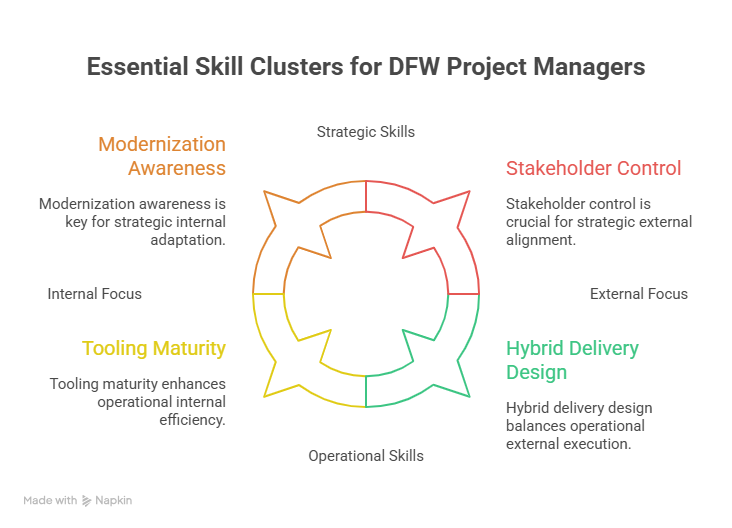
DFW interview panels are not impressed by a methodology label. They are impressed by how you think under constraints. The difference between a candidate who gets hired and a candidate who gets “we went with someone else” is usually one missing skill cluster.
First cluster is hybrid delivery design. You need to show how you tailor execution to the environment. If the work has vendors and contracts, you bring structure. If the work has product iteration, you keep agility. If the work has audit pressure, you create evidence without slowing progress. Build that story using hybrid PM frameworks and modern Scrum expectations from Scrum evolution.
Second cluster is stakeholder control that prevents late surprises. DFW enterprises have hidden decision makers. Security, finance, procurement, compliance, and operations can stall your delivery if you do not map them early. Winning PMs design decision paths and escalation routes up front. Anchor your approach to future governance practices and scalable reporting systems aligned with PMO evolution.
Third cluster is measurable planning. Estimation and scheduling are becoming more data driven. Hiring managers want PMs who can create forecasts that survive reality. You do not need to claim you are a data scientist. You need to show you can improve forecast accuracy and control risk. Support this narrative with machine learning and project planning and future ready delivery thinking from AI impacts on PM.
Fourth cluster is tooling maturity. DFW teams expect you to enter, diagnose, and stabilize a tool ecosystem. You win when you can simplify reporting, reduce noise, and create executive clarity. Build your stack literacy using PM productivity software, cost control capability using budget tracking tools, and stakeholder facing workflow clarity through CRM tools for PMs. If you want targeted training paths, use project management training platforms and test readiness resources like PMP exam prep software.
Fifth cluster is modernization awareness. In 2026 and 2027, companies want PMs who can see what is coming and prepare delivery systems for it. That includes AI, automation, and sustainability reporting pressures that show up even in non sustainability roles. Strengthen this signal using future PM software predictions and broader transformation shifts in automation transforming PM careers.
If you want one simple interview edge, bring a one page artifact to every final round. A governance cadence, a dependency map, a cutover plan, or a portfolio scoring model. Those artifacts align directly to what modern employers value as described in future PM skills and the operating models discussed in the future PMO role.
5. DFW Job Search Playbook: How to Land Strong Roles in 30-60-90 Days
DFW job searches fail when candidates rely on volume. Volume gets you ATS rejection at scale. Precision gets you interviews.
Days 1 to 30: Choose a lane and build proof.
Pick one lane from the matrix, then build a “proof pack” that shows you can run that lane. If you target regulated enterprise, build governance and evidence artifacts aligned to future governance practices and the reporting systems explained in PMO evolution. If you target product and platform, build cadence and release artifacts aligned to hybrid PM and future delivery shifts described in PM software trends.
Days 31 to 60: Convert proof into targeted outreach.
Your outreach message should lead with a measurable outcome, then attach a relevant artifact. This instantly separates you from generic applicants. Tie your message to modern leadership expectations from future PM leadership and show future readiness by referencing execution shifts from AI impacts on PM. If you want to sound like someone who can run portfolio tradeoffs, use language and structure from future PPM trends.
Days 61 to 90: Make yourself the obvious hire.
Most final rounds are scenario tests. They want to see if you can operate inside ambiguity. Build a first month plan for the role you are targeting: intake, baseline, stakeholder map, reporting cadence, and quick wins. If you want credibility fast, connect your plan to the skill expectations in future PM competencies and modernization shifts from automation changing PM careers.
If certifications are part of your plan, avoid the trap of collecting badges with no evidence. Use PMP as a credibility base by following the ultimate PMP guide, drilling with top PMP questions, and reinforcing execution strategy with a PMP exam day survival guide. If governance heavy roles are your target, build PRINCE2 structure using PRINCE2 exam prep guidance and preparation planning from a PRINCE2 study plan.
For contract and freelance work in DFW, do not sell availability. Sell a stabilization package: delivery reset, governance setup, and reporting rebuild. That positioning matches market shifts described in the future of freelance PM and ties cleanly into AI driven operational improvements from AI impacts on PM.
6. FAQs
-
The better question is which corridor matches your delivery strengths. Telecom and enterprise tech clusters reward dependency control and cadence design, best framed through hybrid PM and modern tooling maturity from future PM software trends. Defense and aerospace ecosystems reward evidence, risk control, and schedule rigor, aligned with future governance practices. Finance and regulated enterprise corridors reward control frameworks and portfolio thinking, best supported by PPM trends and PMO style operating models from PMO evolution.
-
Target a range that matches the risk profile of the work you own. Mid level PM pay rises when you manage vendors, compliance, or cross team dependencies, because those failures are expensive. Increase your leverage by documenting measurable outcomes and aligning your story with future PM skills. If you can connect your delivery to portfolio outcomes and capacity decisions, you position above typical mid level PM bands, supported by future PPM thinking. Use tooling and reporting maturity from PM productivity software and cost control methods from budget tracking tools to justify stronger compensation.
-
It depends on the environment. PMP often helps in broad enterprise hiring because it signals baseline credibility. PRINCE2 can help in governance heavy environments that value stage structure and documentation discipline. Decide based on your target corridor and the delivery style it values. Use the decision logic in PMP vs PRINCE2 and then commit to an execution plan. For PMP, use the ultimate PMP guide and a structured 30 day study plan. For PRINCE2, align preparation with PRINCE2 exam guidance and level clarity from Foundation vs Practitioner.
-
Generic positioning. DFW is full of enterprise hiring that filters quickly for role fit. If your resume reads like “managed timelines and stakeholders,” it blends into thousands of applicants. The fix is picking a lane and proving it with artifacts. Build a governance and reporting pack aligned to PMO evolution and future governance practices. If you target product and platform delivery, build cadence and dependency artifacts aligned to hybrid PM and modern expectations from Scrum evolution.
-
Talk in outcomes and guardrails. Show a simple pilot plan with a defined use case, success metrics, risk controls, and adoption steps. That makes you credible because it sounds like delivery, not a trend. Align your language to AI impacts on PM and strengthen planning credibility using machine learning for estimation and scheduling. If you can explain how you protect quality, privacy, and governance while still shipping, you match what DFW enterprises actually want, supported by future PM software trends.
-
Yes, but only if you package certainty. Businesses hire freelance PMs to stop delivery chaos, stabilize vendor timelines, and rebuild reporting clarity. Sell a defined stabilization sprint with intake, baseline, governance cadence, and measurable wins. That matches market shifts described in the future of freelance PM and the broader delivery change created by automation changing PM careers. Support your offer with practical tooling credibility using PM productivity software and cost visibility approaches from budget tracking tools.
