
Complete Glossary of Agile Project Management Terms
Agile project management sounds simple until teams hit the real friction points: backlog chaos, sprint plans built on guesses, ceremonies that waste time, velocity used badly, scope changing faster than delivery, and stakeholders demanding predictability from a system they do not fully understand. This glossary is built to solve that. It gives you working definitions, practical context, and decision-level clarity so you can speak Agile fluently in interviews, project meetings, PMO reviews, and delivery environments.
You will see how core Agile terms connect to planning, risk, stakeholder alignment, budgeting, scheduling, team operations, quality control, and career growth. Along the way, this guide also connects you with deeper resources such as top 100 project management terms, essential Scrum roles and responsibilities, project scheduling terms, critical stakeholder terms, and the state of Agile project management.
1. Why Agile Terminology Matters More Than Most Project Managers Think
Agile failure often starts with vocabulary failure. Teams say “priority” when they mean urgency, “commitment” when they mean forecast, “definition of done” when they mean partial completion, and “MVP” when they mean an unfinished draft. That language drift damages planning accuracy, stakeholder trust, and team accountability. A project manager who cannot distinguish backlog refinement from sprint planning or lead time from cycle time will struggle to control expectations, manage risk, and report delivery health with precision.
This matters even more in hybrid delivery environments where Agile practices must coexist with governance, procurement, budget controls, and executive reporting. A PM may need the language of risk management, cost management, project budgeting, communication techniques, and contract management while still running Agile ceremonies and delivery cadences correctly.
Agile terminology also affects hiring. Interview panels can quickly detect whether a candidate has real delivery exposure or just memorized theory. Someone who explains epics, stories, acceptance criteria, dependencies, and impediments with business context sounds credible. Someone who gives textbook-only definitions sounds untested. That is why professionals pursuing PMP certification, CAPM certification, PMI-ACP preparation, or Scrum Master certification need operational command of the language, not surface familiarity.
Just as important, terminology shapes decisions. When a team understands throughput, work in progress, dependency risk, sprint goal integrity, and incremental value, it plans differently. It escalates differently. It protects capacity differently. It avoids the false comfort of vanity metrics and focuses on actual delivery outcomes. This is the same reason teams that study project failure rates and root causes, factors driving project success, AI and automation adoption in project management, and methodology adoption trends outperform teams that treat Agile as a set of ceremonies rather than a delivery system.
2. Core Agile Terms Every Project Manager Must Use Correctly
Agile is an adaptive delivery approach built around iteration, learning, responsiveness, and frequent value release. It does not mean loose governance or constant change without discipline. Strong Agile teams still require stakeholder management, project communication, issue tracking software, reporting and analytics tools, and project knowledge management systems.
Scrum is the most recognized Agile framework. It uses roles, timeboxed events, and artifacts to create transparency and a repeatable delivery cadence. Teams that use Scrum badly often perform the events mechanically but fail to make clear product decisions. That is why understanding Scrum roles and responsibilities, resource allocation tools, calendar and scheduling tools, and Gantt software in hybrid planning still matters.
Kanban focuses on flow rather than timeboxed iterations. It emphasizes visibility, work-in-progress limits, and continuous movement through a system. It is powerful in maintenance-heavy, service, support, and mixed-priority environments where sprint boundaries can become artificial.
User stories describe work from the user’s perspective. A strong story makes the value visible. A weak story turns into a technical task with no user outcome. Acceptance criteria define the conditions that make the story acceptable. These are crucial because they reduce rework, shorten review cycles, and strengthen project quality management and Six Sigma thinking.
Epics group related work at a higher level. They connect strategy to execution and help teams manage sequencing without losing the larger outcome. They are especially useful when aligning Agile delivery with portfolio thinking, future PPM trends, project software decisions, and automation opportunities.
Definition of Ready and Definition of Done are operational quality controls. The first protects the team from starting unclear work. The second protects the organization from calling incomplete work “done.” When these two are weak, sprint plans degrade, quality slips, predictability collapses, and stakeholders begin to distrust delivery data.
3. Planning, Estimation, and Flow Terms That Shape Delivery Accuracy
A surprising number of Agile problems are planning problems disguised as team problems. The team may appear slow, but the real issues are usually poor intake quality, unstable priorities, weak dependency control, or a mismatch between forecast and actual capacity. That is why Agile planning language matters.
Backlog refinement is the ongoing process of clarifying, splitting, ordering, and sizing future work. Teams that skip refinement force planning conversations into sprint planning, where time pressure produces shallow decisions. Good refinement improves delivery predictability more than most teams realize. It works best when paired with project initiation clarity, procurement awareness, contract understanding, and disciplined document management.
Sprint planning turns refined work into a short-range delivery commitment. The most important output is not the task list. It is the sprint goal. A strong sprint goal helps the team make tradeoffs when reality changes mid-sprint. Without that anchor, the sprint becomes a loose collection of disconnected items.
Story points are relative estimates. They represent effort, uncertainty, and complexity in a team-specific way. They are helpful when used for learning and forecasting. They become destructive when leadership uses them for performance comparison across teams. That misuse encourages inflated estimates, unhealthy gaming, and reporting noise.
Velocity is the average amount of completed work per sprint, based on the team’s own point system. Its purpose is forecasting, not comparison. Mature project managers explain this clearly to executives so velocity remains a planning tool instead of a weapon.
Lead time and cycle time matter even more in flow-heavy environments. Lead time captures the time from request to completion. Cycle time measures from active start to completion. When teams confuse them, they misdiagnose where delay actually lives. Lead time exposes waiting. Cycle time exposes execution drag. Together, they surface the truth about responsiveness.
Work in progress limits, or WIP limits, prevent teams from starting too much and finishing too little. Multitasking creates a false sense of activity while hiding queue buildup and delay. Teams that respect WIP limits usually improve flow, quality, and clarity faster than teams chasing busyness.
The fastest improvement comes from fixing one broken part of the delivery system, then building repeatable proof through better language, better flow, and better reporting.
4. Team, Ceremony, and Governance Terms That Separate Mature Agile Teams From Chaotic Ones
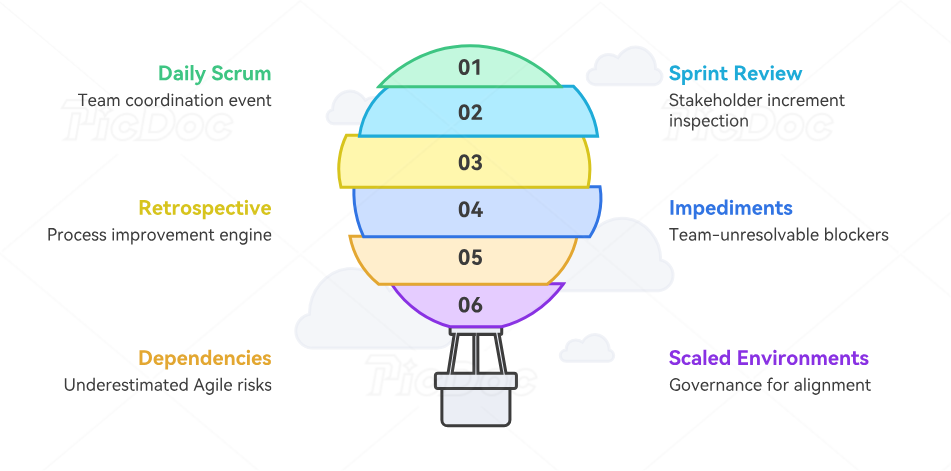
Daily Scrum is a short coordination event for the team, not a management status meeting. Its purpose is to inspect progress toward the sprint goal and adapt the plan. When leaders hijack it for updates, teams become guarded and real blockers stay hidden. Mature PMs protect the intent of the event while still maintaining executive visibility through separate reporting systems, dashboards, mobile project apps, and collaboration tools.
Sprint review is where the team inspects the increment with stakeholders. This is where many teams lose value by turning the review into a one-way demo. A real review invites reaction, challenge, refinement, and decisions. It helps protect future backlog quality.
Retrospective is the engine of process improvement. It should identify patterns, not just frustrations. Strong retrospectives convert vague complaints into actionable system changes: clearer intake criteria, faster dependency escalation, better acceptance criteria, improved testing habits, smaller work items, or tighter stakeholder alignment.
Impediments are delivery blockers that the team cannot solve alone. A good Scrum Master or Agile PM knows how to classify impediments quickly: approval delay, environment issue, access problem, cross-team dependency, requirement ambiguity, or governance friction. That classification matters because response speed depends on correct routing.
Dependencies are among the most underestimated Agile risks. Teams speak confidently about speed, then get trapped by another team’s release window, procurement cycle, security review, or vendor contract. This is why Agile leaders still need fluency in project procurement, contract lifecycle management tools, project budgeting controls, budget tracking software, and stakeholder language.
Scaled environments add more governance language: program increment, release train, cross-team synchronization, and portfolio alignment. These concepts matter because one team can be Agile locally and still fail organizationally if upstream decisions, downstream approvals, and shared dependencies are not managed coherently.
5. Agile Metrics, Roles, and Career Terms That Influence Hiring, Promotion, and Delivery Trust
Agile roles are easy to name and hard to perform well. The Product Owner is accountable for maximizing value and ordering the backlog. This role fails when too many stakeholders bypass it, when priorities are not truly ranked, or when “urgent” requests constantly override strategic sequencing. Good Product Owners bring clarity to tradeoffs and protect the link between business goals and delivery work.
The Scrum Master enables team effectiveness, coaching, facilitation quality, and impediment removal. Weak organizations reduce the role to ceremony administration. Strong organizations use the role to improve flow, protect focus, and elevate delivery maturity. Anyone building toward this path should understand Agile certification options, PMI-ACP preparation, CAPM versus PMP, and career roadmaps into Agile leadership.
A cross-functional team contains enough capability to deliver real increments with minimal handoff drag. That does not mean every person can do everything. It means the team as a unit can move work from idea to usable output without constant external dependence.
MVP, or minimum viable product, is another term frequently abused. A real MVP creates learning with enough usefulness to validate demand, behavior, or value. It is not a sloppy first draft. Teams that misuse MVP language often ship low-trust experiences that damage user confidence rather than accelerate learning.
Metrics also influence credibility. Burndown charts help track remaining work. Burnup charts show delivered work against total scope. Burnup is often better when stakeholders keep changing scope because it reveals whether the team is slow or the target is moving. Pairing those visuals with project reporting tools, data visualization platforms, automation tools, and productivity systems improves executive understanding.
For career growth, terminology fluency also strengthens interviews, resumes, and promotion cases. It connects naturally to how to become a project manager, entry-level to executive career paths, government PM careers, remote and virtual PM roles, and the future project manager skills needed by 2030.
6. FAQs About Agile Project Management Terms
-
Agile is the broader mindset and delivery philosophy. Scrum is one specific framework used to apply Agile principles through defined roles, events, and artifacts. A team can be Agile without using Scrum exactly, but a Scrum team should still understand the broader Agile philosophy behind its practices.
-
A user story expresses value from a user or stakeholder perspective. A task describes the work needed to complete part of that story. Stories define the outcome. Tasks define the effort. When teams confuse the two, they lose visibility into why the work matters.
-
Definition of Done protects delivery trust. It sets a shared standard for what complete means, including quality checks, validation, documentation, testing, and any release conditions. Without it, teams report progress optimistically while stakeholders experience defects, rework, and surprise gaps.
-
No. Velocity is team-specific because story points are team-specific. Comparing teams using velocity drives unhealthy behavior, distorted estimating, and misleading performance conclusions. Velocity works best as an internal forecasting signal for one team over time.
-
Lead time measures how long the requester waits from request to completion. Cycle time measures how long the team spends once work actually starts. Lead time is broader and includes waiting. Cycle time is narrower and focuses on active delivery flow.
-
A good sprint goal describes the business outcome or delivery intent of the sprint in one clear statement. It guides decision-making when capacity tightens or new information appears. A weak sprint goal is just a list of unrelated backlog items.
