
The Ultimate Guide to Getting Your Project Management Certification in Poland: All You Need to Know in 2026-2027
Poland’s project management market rewards candidates who can turn messy delivery into measurable control: better schedules, cleaner vendor coordination, stronger stakeholder reporting, and fewer handoff failures. A certification helps only when it fits the role you want, the sector you are targeting, and the proof you can show. This guide gives you a practical route for choosing between PMP certification renewal planning, Agile project management certification, Scrum Master training, and Poland-focused career positioning.
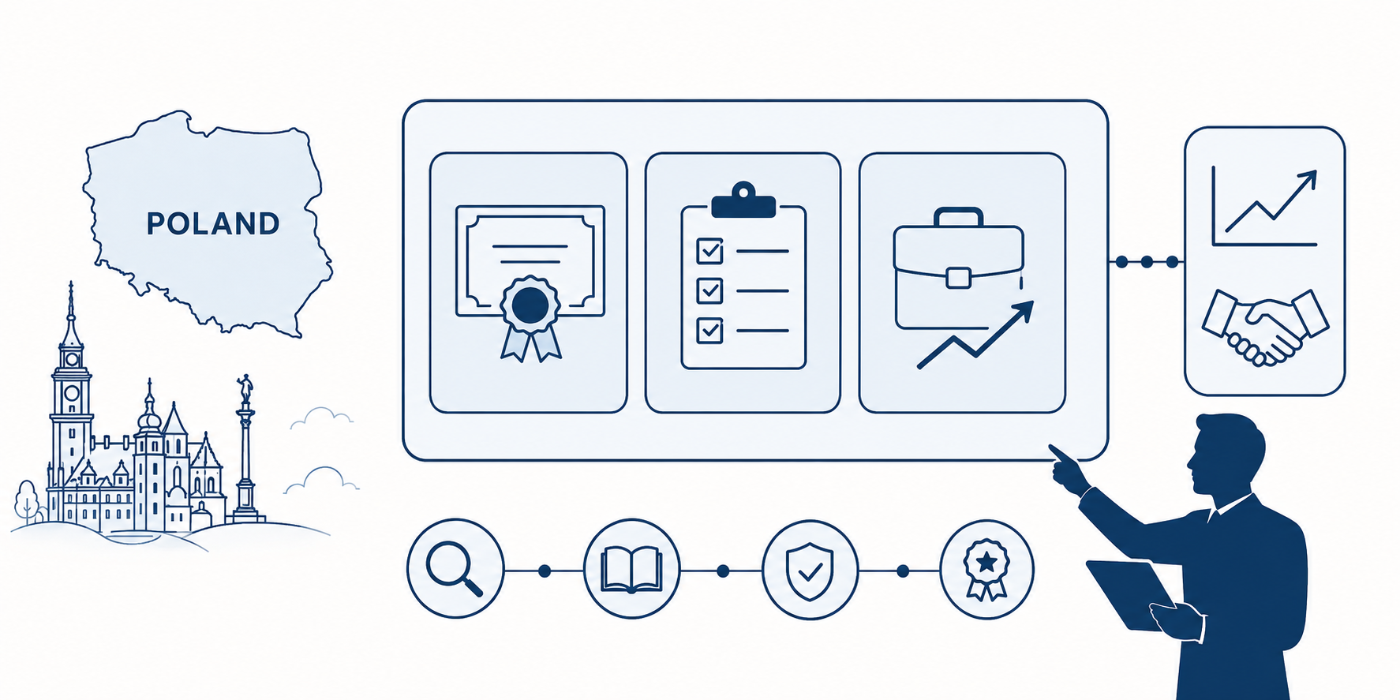
1. Why Project Management Certification Matters in Poland in 2026-2027
Poland has become one of Europe’s most practical project markets because employers need people who can manage cross-border delivery, vendor deadlines, software teams, infrastructure upgrades, shared-services transformation, and public-sector documentation. A hiring manager in Warsaw, Kraków, Wrocław, Gdańsk, Katowice, Łódź, or Poznań usually cares about three things: can you control ambiguity, can you communicate across business and technical teams, and can you prove delivery discipline before the interview gets too theoretical. That is where a strong certification path, backed by a project management career roadmap, a PM career progression plan, and a project execution vocabulary, gives you leverage.
The biggest mistake candidates make in Poland is treating certification as a badge instead of a hiring signal. A junior coordinator may gain more from CAPM-style fundamentals, Kanban terms, Agile estimation techniques, and stakeholder engagement language than from rushing into an advanced credential. A delivery lead with years of experience can use PMP, PRINCE2, or hybrid training to package real experience into a stronger story. A Scrum-heavy IT candidate should pair Scrum Master preparation with Product Owner knowledge and Agile metrics, because Polish tech employers often hire around product delivery, sprint predictability, and stakeholder confidence.
A certification also helps Polish candidates compete for remote EU roles, international outsourcing projects, and English-speaking delivery jobs. Employers hiring for regional hubs want PMs who can write clean status reports, manage risk registers, handle vendor escalation, and explain trade-offs to senior stakeholders. That makes risk register knowledge, project reporting terms, resource allocation concepts, and financial management vocabulary valuable alongside the credential itself. The certificate opens attention; your proof assets close the trust gap.
| Candidate Situation | Best Certification Focus | Poland Market Fit | Proof Asset to Build | Helpful APMIC Link |
|---|---|---|---|---|
| Entry-level PM | CAPM-style fundamentals | Junior coordinator, PM assistant, project analyst roles | One-page project lifecycle map | project manager roadmap |
| IT graduate | Agile + Scrum basics | Software houses, SaaS teams, product squads | Sprint board sample with metrics | Agile PM roadmap |
| Junior Scrum candidate | Certified Scrum Master path | IT delivery teams in Kraków, Warsaw, Wrocław | Facilitation agenda and retrospective plan | Scrum Master guide |
| Product-facing PM | Product Owner + Agile delivery | Fintech, SaaS, marketplace, e-commerce teams | Prioritized backlog with acceptance criteria | Product Owner guide |
| Experienced delivery lead | PMP or advanced PM credential | Senior PM, program lead, regional delivery roles | Achievement-based project portfolio | PMP exam domains |
| Public-sector candidate | Governance + procurement fluency | Government, EU-funded, municipal, compliance-heavy projects | RACI, steering deck, procurement timeline | government PM roadmap |
| Construction PM | Waterfall, risk, schedule control | Infrastructure, real estate, industrial development | Milestone schedule and change-control log | construction PM guide |
| Healthcare PM | Compliance + stakeholder coordination | Hospital systems, medtech, health IT, process improvement | Stakeholder map and risk register | healthcare PM guide |
| Remote PM | Virtual delivery + communication systems | International teams and EU remote roles | Remote meeting cadence and escalation rules | remote PM roles |
| Consultant path | PM consulting + diagnostic frameworks | Process improvement, transformation, advisory work | Client discovery checklist | PM consultant path |
| Freelance PM | Scope, pricing, contracts, reporting | Independent work with startups and SMEs | Service offer and delivery dashboard | freelance PM career |
| PMO analyst | Reporting, governance, portfolio basics | Shared services, banks, telecom, enterprise PMO | Dashboard with traffic-light status logic | future PMO role |
| Portfolio candidate | PPM, prioritization, benefits tracking | Enterprise transformation and multi-project environments | Portfolio scoring model | portfolio manager guide |
| International PM | Cross-cultural delivery + governance | EU, UK, US, DACH-region collaboration | Stakeholder communication matrix | international PM guide |
| Leadership track | Director-level PM capability | Senior PM, head of delivery, transformation lead | Delivery operating model | PM director roadmap |
| Executive ambition | Program, portfolio, strategy alignment | VP of PM, PMO director, transformation executive | Benefits realization plan | PM to VP path |
| CPO path | Enterprise project leadership | Large organizations and transformation portfolios | Governance charter | Chief Project Officer roadmap |
| Hybrid PM | Agile + waterfall blending | Tech-enabled operations, finance, infrastructure | Hybrid delivery playbook | hybrid project management |
| Risk-heavy role | Risk mitigation and controls | Regulated industries, finance, public delivery | Risk register with response owners | risk mitigation terms |
| Vendor-heavy role | Supplier and contract management | Outsourcing, IT vendors, construction suppliers | Vendor scorecard | vendor management terms |
| Finance-aware PM | Budgeting, forecasting, EVM | Enterprise PMO, infrastructure, finance teams | Budget variance report | EVM terms |
| Schedule-control PM | Gantt, critical path, compression | Construction, manufacturing, migration projects | Baseline schedule and recovery plan | Gantt chart terms |
| Quality-focused PM | TQM, ISO, acceptance criteria | Manufacturing, healthcare, regulated delivery | Quality checklist and defect trend | TQM terms |
| AI-aware PM | Automation, estimation, AI tools | Digital transformation and productivity initiatives | AI-assisted estimation workflow | AI and PM |
| Software-tool PM | PM platforms and integrations | Distributed tech teams and operations PMO | Tool governance checklist | future PM software |
| Agile tool user | Scrum/Kanban tool fluency | Software delivery and product teams | Board policy and WIP rules | Agile PM tools |
| Template-driven learner | Reusable PM documents | Any candidate building interview proof fast | Risk, scope, schedule, stakeholder templates | PM templates |
| Exam-focused candidate | Study plan and mistake prevention | Candidates preparing under deadline pressure | Mock exam error log | PMP mistakes guide |
2. How to Choose the Right Project Management Certification in Poland
Start with the role title you want, then work backward. A candidate targeting IT project manager roles should build a different certification stack from someone targeting construction, public administration, healthcare, logistics, or a PMO analyst position. For IT roles, combine IT project manager career planning, Scrum glossary fluency, Agile metrics knowledge, and team communication tools. For infrastructure or construction roles, give more weight to schedule baselines, vendor control, safety documentation, change orders, procurement milestones, and construction project management software.
For beginners in Poland, a foundation-level certification works best when paired with evidence of execution. That evidence can be a case study from university, a volunteer project, an internship, a small business process improvement, or a personal project managed with proper documentation. You should be able to explain scope, stakeholder needs, risks, budget assumptions, timeline, handoffs, and lessons learned. Use project monitoring and control terms, project closure concepts, resource allocation terms, and conflict resolution language to make that experience sound professional instead of casual.
For experienced PMs, the question becomes credibility. PMP-style certification helps when your work already includes leadership, planning, stakeholder management, risk decisions, and delivery accountability. PRINCE2 can be useful for governance-heavy environments, especially when employers value defined roles, business cases, stages, controls, and exception management. Agile or Scrum credentials help when teams work through sprints, backlogs, increments, product ownership, continuous feedback, and delivery metrics. Your best stack may be PMP plus Agile, PRINCE2 plus Scrum, or CAPM plus a targeted Polish-market role plan. Use the PMP exam domains guide, Agile project management glossary, waterfall glossary, and hybrid project management forecast to compare the language employers will expect.
Poland’s market also rewards specialization. A generic certificate may get you screened; a certificate plus sector vocabulary gets you interviewed. A healthcare PM should speak about compliance, clinical operations, privacy, patient-flow improvements, and vendor coordination. A government PM should understand procurement, approvals, audit trails, steering committees, and public accountability. A product delivery PM should discuss sprint goals, backlog health, acceptance criteria, customer feedback, and release planning. That is why pairing healthcare project management, government project management, Product Owner skills, and stakeholder engagement terms with your certification creates a sharper market signal.
3. Step-by-Step Plan to Get Certified in Poland
Your first step is to choose the credential based on eligibility, career stage, and target role. Beginners should check foundation requirements, build project vocabulary, and use a structured study plan. Experienced candidates should map their project history before paying for advanced exam prep. Write down every project you led or coordinated, then capture dates, objectives, stakeholders, budget exposure, team size, delivery method, risks, and outcomes. This protects you from vague application writing and weak interview answers. Use PMP success stories, PMP exam preparation resources, PMP exam mistakes, and PMP renewal planning to understand the full certification lifecycle.
Your second step is training selection. In Poland, many candidates study in English because international employers, shared-services centers, IT hubs, and remote EU roles often interview in English. Polish-language support can still help if your current work environment uses local documentation or public-sector terminology. Choose a course that gives you practice questions, scenario explanations, templates, and exam simulations. A weak course teaches definitions; a strong course teaches decision-making under pressure. Supplement your study with Agile estimation techniques, sprint planning terms, risk mitigation planning, and earned value management terms so your knowledge connects to real delivery.
Your third step is exam preparation. Build a 6-to-10-week plan if you already have PM experience, and a 10-to-14-week plan if you are learning the field from scratch. Spend the first phase on concepts, the second phase on scenarios, and the final phase on mock exams and error analysis. Track every wrong answer by cause: misunderstood term, missed keyword, poor elimination, weak domain knowledge, or panic guessing. This turns failure into a study map. Candidates who keep repeating mock exams without diagnosis often plateau. Use project reporting best practices, Gantt chart concepts, schedule compression terms, and ISO standards for PM to strengthen the areas that repeatedly cost marks.
Your fourth step is building interview proof while studying. Create a mini portfolio with five assets: a project charter, stakeholder register, risk register, status report, and lessons-learned summary. Add one Agile asset if you want IT roles, such as a sample backlog, sprint review summary, or Kanban board policy. Add one finance asset if you want enterprise roles, such as a budget variance report or benefits tracker. These documents make your certification practical. They also give recruiters evidence when your title history looks messy. Pair them with project templates, PM software tools, Kanban software tools, and Scrum project management platforms.
4. How Certification Translates Into Better PM Roles in Poland
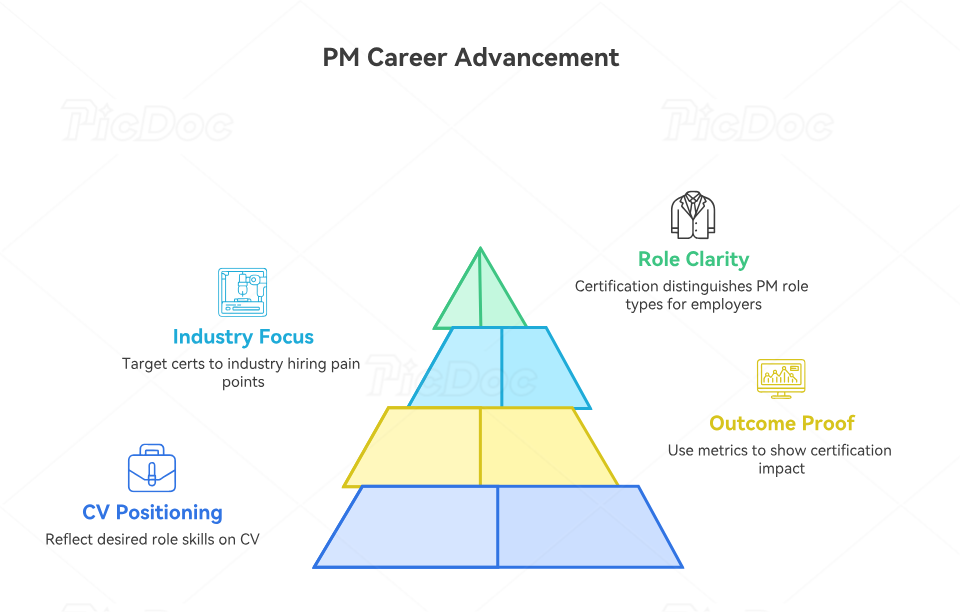
Certification creates the best return when it helps you move from “I helped manage projects” to “I can run delivery under pressure.” Polish employers often screen for role clarity. A project coordinator tracks actions; a project manager owns delivery coordination; a Scrum Master improves team flow; a Product Owner manages value and backlog decisions; a PMO analyst improves governance and reporting; a program manager coordinates linked projects; a portfolio manager aligns investment with strategy. Study these differences through PM career path planning, Scrum Master career direction, portfolio management guidance, and PMO future trends.
Poland’s strongest PM opportunities often cluster around IT delivery, shared services, finance operations, manufacturing, construction, energy transition, logistics, healthcare modernization, and public projects. Each area has its own hiring pain. IT employers fear missed releases and weak stakeholder translation. Construction employers fear schedule slippage, procurement surprises, and uncontrolled change. Finance employers fear poor controls and audit gaps. Government employers fear documentation errors, approval delays, and procurement exposure. Healthcare employers fear compliance risk and operational disruption. A good credential gives you shared language; targeted proof shows you understand the employer’s pain. Combine IT PM training, construction PM training, healthcare PM training, and government PM skills with the certification you choose.
For salary growth, certification works best as a negotiation tool when paired with outcomes. “Certified project manager” sounds weaker than “Certified project manager who reduced vendor delays, rebuilt reporting cadence, recovered a slipping timeline, and improved stakeholder visibility.” Polish employers, especially international companies, want evidence that you can survive complexity. Track achievements in numbers whenever possible: cycle time improved, backlog aging reduced, defects lowered, invoice disputes closed, milestones recovered, budget variance controlled, or handoff delays reduced. Strengthen this with project financial management terms, earned value management, project monitoring terms, and project closure terms.
Your CV should reflect the role you want next. If you want IT PM roles, mention Agile ceremonies, sprint planning, release coordination, vendor handoffs, and technical stakeholder communication. If you want PMO roles, mention governance, dashboards, RAID logs, portfolio reporting, and decision forums. If you want construction or infrastructure roles, mention schedule baselines, procurement milestones, change control, supplier coordination, and acceptance criteria. If you want consulting, mention discovery, diagnosis, operating model gaps, stakeholder interviews, and recommendations. Use remote PM career advice, PM consulting steps, project governance trends, and leadership communication terms to sharpen your positioning.
5. Common Certification Mistakes Polish Candidates Should Avoid
The first mistake is choosing a certification because it sounds prestigious rather than because it matches the target job. A beginner applying for junior coordinator roles may need fundamentals, templates, and tool fluency before advanced theory. A senior delivery lead may need a stronger application narrative and measurable achievements more than another entry-level course. A tech candidate may need Scrum, Kanban, metrics, and product delivery language before a broad credential. Use Agile glossary terms, Kanban software rankings, Scrum tools, and Trello vs Basecamp comparison to connect certification with daily work.
The second mistake is ignoring documentation. Certification bodies, recruiters, and hiring managers all reward clarity. If your experience descriptions sound vague, your credibility drops. Build a project inventory with role, objective, timeline, team, stakeholders, tools, delivery method, risks, decisions, and results. Turn each project into a short case study. This also prepares you for behavioral interviews where employers ask about conflict, missed deadlines, scope changes, budget pressure, and stakeholder disagreement. Support this with stakeholder engagement terms, conflict resolution terms, vendor management terms, and RFP/RFQ/RFI terms.
The third mistake is studying definitions without practicing scenarios. Modern PM exams often test judgment: what should the PM do next, who should be engaged, which risk response fits, how to handle change, when to escalate, and how to protect value. Scenario practice forces you to think like a project leader. After every mock exam, ask which mindset failed: servant leadership, governance discipline, risk thinking, stakeholder communication, benefits focus, or Agile adaptability. Use PMP exam domains, PMP resource planning, PMP exam mistake prevention, and real PMP success stories to build a smarter study loop.
The fourth mistake is failing to convert the certificate into a job campaign. Certification should change your LinkedIn headline, CV summary, skills section, portfolio, interview stories, and application targeting. Create one version of your CV for IT and Agile roles, one for PMO and governance roles, and one for sector-specific roles such as construction, healthcare, finance, or public-sector delivery. Each version should show different proof. Pair your credential with future PM skills, automation and PM careers, digital transformation PMO trends, and AI adoption in project management.
The fifth mistake is waiting until after the exam to understand renewal and continuous learning. Some credentials require ongoing professional development, and even when renewal requirements feel far away, the best candidates build a learning system early. Track webinars, workshops, mentoring, volunteering, writing, tool training, and leadership learning. Keep a simple spreadsheet with date, activity, hours, category, and evidence. This habit also helps with promotions because it proves growth. Use PMP PDU renewal guidance, PM certification evolution, future project leadership, and sustainability project management.
6. FAQs About Getting Project Management Certification in Poland
-
The best certification depends on your target role. CAPM-style fundamentals suit beginners, PMP-style credentials suit experienced project leaders, PRINCE2 suits governance-heavy environments, and Scrum or Agile certifications suit IT, product, and software delivery roles. For Poland, the smartest path often combines a global credential with market-specific proof: IT project management, construction project management, government project management, or remote project management depending on your career target.
-
Choose CAPM-style learning if you need fundamentals, PMP if you already lead projects, PRINCE2 if you want structured governance language, Scrum if you want team facilitation roles, and Agile PM if you want broader adaptive delivery skills. Polish employers usually care less about the credential name alone and more about whether you can manage scope, stakeholders, risk, reporting, and delivery pressure. Strengthen your choice with Agile terms, Scrum terms, waterfall terms, and project execution terms.
-
Yes, but your first target should be coordinator, PM assistant, project analyst, junior Scrum Master, delivery support, or PMO support roles. Limited experience becomes more credible when you show proof assets: a project charter, stakeholder map, risk register, status report, Kanban board, backlog sample, or lessons-learned summary. A certificate tells employers you studied the field; proof assets show you can work in it. Start with the project manager roadmap, PM templates, risk register guide, and project reporting guide.
-
English is valuable because many PM roles in Poland connect to international clients, EU teams, shared services, outsourcing hubs, software delivery, and remote work. Studying in English can help with interviews, documentation, job descriptions, and stakeholder communication. Polish-language support can help when your target role involves local administration, public documentation, or domestic stakeholders. A strong candidate can explain delivery clearly in both business language and project language. Build vocabulary through leadership communication terms, stakeholder terms, reporting terms, and governance trends.
-
Beginners often need 10 to 14 weeks because they must learn vocabulary, frameworks, tools, and scenario logic. Experienced candidates can often prepare in 6 to 10 weeks if they already understand scope, schedule, risk, stakeholders, change control, and delivery governance. The best plan includes concept study, scenario practice, mock exams, and an error log. Use PMP preparation resources, PMP exam domains, Agile estimation, and schedule compression terms.
-
Add the certification near your name or summary, then prove it through achievement bullets. Replace vague lines like “managed projects” with sharper evidence: “coordinated five vendor workstreams,” “built weekly risk reporting,” “recovered delayed milestones,” “reduced backlog aging,” “improved stakeholder approval cadence,” or “created dashboard visibility for leadership.” Align the CV with your target sector. IT PM roles need Agile delivery language; PMO roles need governance and reporting; construction roles need schedule and procurement language. Use IT PM guidance, PMO trends, vendor management terms, and EVM terms.
