
Project Management Industry Outlook in North America: Original 2026-27 Data & Trends
Project management in North America is entering a sharper, more selective phase. Hiring is still growing, but employers are no longer rewarding “general PM” profiles that look interchangeable on paper. They are paying for delivery leaders who can manage risk, align stakeholders, work across procurement and contracts, translate strategy into execution, and operate confidently inside digital, regulated, and cross-functional environments.
That is the real 2026-27 story: more demand, higher expectations, and far less patience for vague experience. For professionals who position themselves correctly, this market is still full of opportunity. For everyone else, it is becoming more competitive by the quarter.
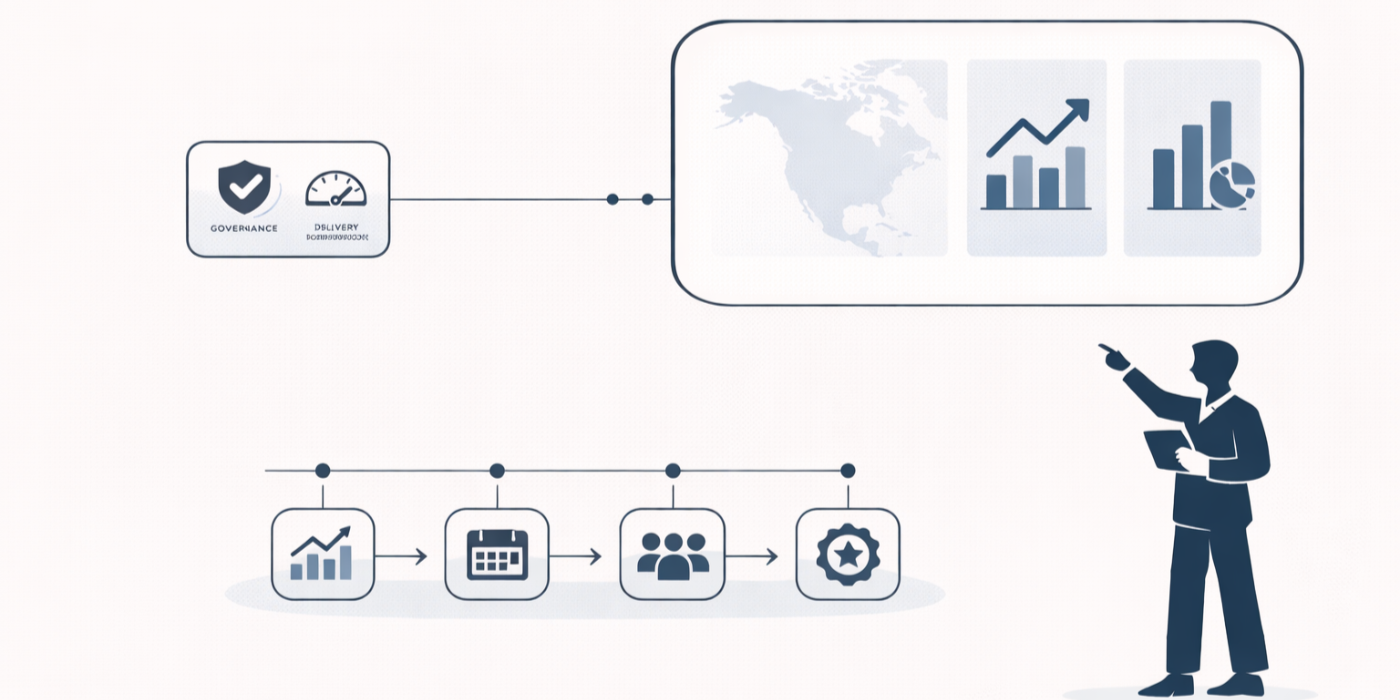
1. North America’s project management outlook is growing, but the market is becoming more selective
The headline is positive, but the opportunity sits behind nuance. In the U.S., employment for project management specialists is projected to grow 6% from 2024 to 2034, with about 78,200 openings per year on average. Median annual pay reached $100,750 in May 2024, and the BLS specifically ties demand to productivity pressure and the growing complexity of IT work.
That matters because it tells you the market is not expanding for passive coordinators. It is expanding for professionals who can run work that is cross-functional, time-sensitive, budget-sensitive, and increasingly technology-enabled. If your current profile still reads like task tracking, meeting scheduling, and status updates, you are exposed. If your profile communicates business alignment, governance, delivery control, and stakeholder influence, you are much closer to where demand is moving.
This is why professionals exploring a broader project management career roadmap, a longer-term entry-level to executive progression, or a more advanced project management director path need to stop thinking in titles alone. North American employers are reorganizing around proof of delivery strength, not just years of experience.
The Canadian picture reinforces the same lesson in a different way. Canada’s Job Bank shows moderate outlooks for non-technical project manager roles in several provinces, but limited outlooks in Ontario, Manitoba, British Columbia, and Yukon for the current three-year window. That does not mean project work is collapsing. It means competition is uneven and positioning matters more by geography, sector, and specialization.
So the real opportunity is not “be a PM.” It is “be a PM the market can justify hiring.” That usually means one of five moves. First, attach yourself to a strong domain like IT project management, construction project management, healthcare project management, government project management, or international project management. Second, strengthen your certification signal with a path like PMP, CAPM, PRINCE2, or CSM. Third, become visibly stronger in communication, issue control, and contract language through resources on stakeholder terms, communication terms and techniques, and contract management terminology. Fourth, build tool fluency with project reporting and analytics software, budget tracking tools, and document management platforms. Fifth, decide whether you are climbing internally, going advisory through a project management consultancy path, or building a more flexible freelance PM career.
That is the uncomfortable truth many candidates avoid: North America still wants project managers, but not generic ones.
2. The strongest North American PM opportunities are forming around specialization, not generic coordination
The biggest mistake candidates make is assuming the PM market rewards interchangeable experience. It does not. Demand is increasingly clustering around sectors where complexity is expensive: technology transformation, healthcare operations, infrastructure and construction, public-sector delivery, financial-services modernization, renewable energy, and enterprise portfolio management.
In the U.S., BLS notes that demand for project management specialists is expected to come partly from the need to manage the growing volume and complexity of IT projects. Separately, BLS says overall U.S. employment growth from 2024 to 2034 is driven mainly by healthcare and social assistance. That combination matters. It means many of the strongest PM opportunities will sit where digital change and operational scale collide.
That is why IT project management, healthcare project management, and broader future PM skills planning deserve serious attention. A PM who can coordinate a rollout is useful. A PM who can run a system migration, stakeholder-heavy healthcare initiative, compliance-sensitive transformation, or cross-vendor implementation is much harder to replace.
Construction and infrastructure remain attractive for a different reason. They punish weak planning visibly and quickly. When procurement slips, crews sit idle. When contracts are vague, claims grow. When dependencies are misread, the budget absorbs it. That is why professionals looking at construction project management, procurement management tools, contract lifecycle platforms, and budget tracking software can build a much stronger market position than someone presenting only generic waterfall language.
Government and regulated environments are another major North American lane. These roles often attract candidates who underestimate the documentation burden, approval cadence, and stakeholder complexity. That is exactly why strong professionals can stand out there. Hiring panels in public-sector and regulated settings reward PMs who understand governance, change control, procurement, reporting cadence, and escalation discipline. The professionals who study the government PM career roadmap, strengthen their communication techniques, and sharpen their stakeholder management vocabulary usually outperform candidates who only present speed and enthusiasm.
And then there is the leadership track. North American firms are still trying to solve the same expensive problem: too many people can manage a project plan, too few can align multiple initiatives with strategy. That is why project portfolio management, the path from project manager to vice president of PM, and the route toward chief project officer matter more in 2026-27 than many candidates realize.
3. The most valuable PM skills in 2026-27 are shifting from process familiarity to execution intelligence
The next two years will reward project managers who can do three things at once: protect execution, translate business priorities, and adapt delivery methods without losing control. That is a different profile from the old “method-first” PM who relies on templates and ceremonies to prove competence.
The broader labor market is already signaling this shift. The World Economic Forum reports that employers expect 39% of workers’ core skills to change by 2030, while resilience, flexibility, agility, resource management, operations, quality control, and technological literacy continue to gain importance. That mix maps directly onto the strongest PM profiles in North America.
In practical terms, this means several skills are becoming disproportionately valuable.
First is execution judgment. Tools can generate timelines, summarize updates, and surface risks, but they cannot decide which dependency actually threatens business value. That is why reading resources on AI and project management, machine learning for estimation and scheduling, and future PM software trends should not make you passive. They should make you more strategic.
Second is stakeholder control. North American project environments are crowded with product leaders, delivery leads, finance partners, vendors, legal reviewers, security teams, and executive sponsors. If you cannot shape decisions across that group, your technical plan will still fail. This is why sharpening your use of stakeholder terminology, reporting tools, dashboard tools, and calendar and scheduling systems has become more important than memorizing theory.
Third is method flexibility. Organizations no longer care whether you love agile or waterfall as an identity. They care whether you can deliver in their environment. That is why hybrid project management, the evolution of Scrum, the PMI-ACP exam path, and the comparison between Scrum and agile certifications are all strategically useful. They help you stop talking in labels and start talking in operating models.
Fourth is proof. This is the hardest truth for ambitious candidates: hiring managers believe examples more than adjectives. If your resume says “led cross-functional teams,” you sound like thousands of other applicants. If it says you reduced approval cycle time, stabilized scope through change control, improved reporting cadence, or recovered a slipping vendor milestone, you sound employable. That is why many professionals benefit from tightening both certification strategy and narrative clarity through the PMP guide, PMP exam questions, CAPM career pathways, and salary comparisons by certification.
The fastest PM career growth usually comes from fixing one weak signal first, then building proof assets around it.
4. Salaries and career growth in North America will favor PMs who reduce uncertainty for employers
The salary conversation gets oversimplified too often. Professionals ask which credential pays more or which industry pays best. Those are useful questions, but they miss the more important one: what makes an employer comfortable paying more for you?
In the U.S., the BLS median wage for project management specialists was $100,750 in May 2024, with top-industry medians higher in finance and insurance and in professional, scientific, and technical services. That tells us two things. First, PM work is valuable. Second, pay improves when project work sits close to higher-margin, more complex, or more specialized operating environments.
That is why smart salary positioning starts with risk reduction. Employers pay more when they believe you will make delivery cleaner, faster, safer, or more predictable. A PM who can support a financial-services transformation outlook, contribute to renewable energy project delivery, or strengthen a healthcare project environment becomes easier to justify financially than someone selling only generic planning experience.
Certifications still matter here, but only when paired with narrative clarity. A PMP credential can strengthen salary leverage because it helps reduce screening friction. A CAPM pathway can help early-career professionals become easier to shortlist. A PRINCE2 route can matter where process rigor is valued. A CSM track helps where agile facilitation is central. But the credential alone is not the story. The story is what the credential helps you prove.
This is also why geography still matters. Professionals comparing state and city opportunities should study California PM careers, New York PM opportunities, Texas PM trends, Florida market insights, Washington State opportunities, and Los Angeles PM roles. Stronger market positioning often comes from matching your skill mix to the right regional demand pattern, not from chasing the loudest job title.

5. The best way to future-proof your PM career in 2026-27 is to become harder to compare
PMI’s 2025 talent-gap update estimates North America’s project management profession at about 4.1 million in 2025, with projected demand rising to roughly 4.9 million to 5.1 million by 2035 and a regional talent gap of about 1.3 million to 1.6 million. That is encouraging, but it should not make you complacent. A growing market can still feel brutal when too many candidates look identical.
The professionals who win over the next two years will usually do four things differently.
They will build a clearer specialization. That might mean moving deeper into IT project management, construction, healthcare, government, or remote and virtual PM roles. Specialization makes your story easier to trust.
They will develop stronger operating leverage. That means learning the tools that reduce friction around reporting, scheduling, documentation, collaboration, and automation through resources on project software for small businesses, resource allocation tools, mobile collaboration apps, automation tools, and productivity software for PMs. Hiring managers increasingly notice who can create order at scale.
They will keep upgrading their career architecture. That means thinking beyond the next role into the next layer of responsibility through paths like project management consultant, agile project manager, agile coach, project portfolio manager, and eventually project management leadership.
And they will stop hiding behind effort. This is a critical mindset shift. Employers do not promote effort. They promote confidence. They promote predictability. They promote people who can reduce uncertainty, communicate clearly, and create momentum when work becomes politically messy. That is why the future belongs to PMs who combine delivery discipline, business understanding, tool fluency, and human influence. In a market where 39% of core skills are expected to change by 2030, standing still is a career decision whether you admit it or not.
6. FAQs About the North America Project Management Industry Outlook in 2026-27
-
Yes, but the strongest opportunities are going to specialized and higher-signal candidates. U.S. demand remains positive, Canadian demand is mixed by province, and the broader talent gap still supports long-term opportunity. The difference is that employers increasingly want PMs who can prove execution strength, not just coordination experience.
-
Technology-enabled delivery, healthcare, infrastructure, regulated environments, and portfolio-level transformation all look strong because they combine business pressure with operational complexity. Those are exactly the environments where clear governance, reporting quality, and stakeholder control create measurable value. A smart place to deepen your positioning is through IT project management, healthcare project management, and project portfolio management.
-
Yes, when they reduce hiring uncertainty and match your target role. A PMP is still powerful for broad professional credibility. A CAPM helps earlier-career professionals. A CSM matters in agile-heavy settings. A PRINCE2 path can be useful in more structured delivery environments. The key is pairing the credential with real examples.
-
Presenting themselves as generalists with weak proof. Too many resumes talk about “cross-functional leadership” without showing scope control, reporting discipline, budget management, decision support, procurement fluency, or measurable results. Candidates who use resources like stakeholder terms, communication techniques, and contract terminology often sharpen their positioning faster.
-
AI will likely reduce low-value administrative work before it reduces demand for strong PM judgment. Employers still need people who can align stakeholders, manage tradeoffs, escalate intelligently, and drive execution through ambiguity. PMs who understand AI in project management, automation workflows, and future software trends will usually become more valuable, not less.
-
Move closer to complexity, not just activity. Strong salary growth usually comes from specialization, certification fit, cleaner proof of outcomes, better reporting and governance skills, and alignment with sectors that can justify stronger compensation. Studying salary by certification, global PM salary trends, and state-level market guides like California or New York City can help you choose the right move.
