
Blockchain in Project Management Applications
Blockchain is not a magic feature you sprinkle on a PMO. In project management, it only earns its place when it removes a real source of pain: disputes over “what changed,” broken handoffs across vendors, weak audit trails, or slow approvals that choke delivery. Between 2025 and 2030, the winners will not be the teams that “pilot blockchain.” They will be the teams that use it to harden governance, speed up execution, and reduce the cost of mistrust across complex delivery ecosystems.

1) Why Blockchain Becomes a Real PM Advantage Between 2025 and 2030
Most PM failures are not technical. They are trust failures that become schedule failures, budget failures, and then career ending postmortems. If your delivery relies on multiple parties who do not share incentives, a shared source of truth becomes more valuable than another dashboard.
Blockchain matters most in PM when you have three conditions at the same time. Condition one is multi party delivery with competing interests, like consortium programs, public private infrastructure, multi vendor IT delivery, or cross border supply chains. Condition two is high consequence evidence, meaning audit, compliance, safety, ESG, or financial reporting stakes. Condition three is repeated disputes about records: change requests, approvals, handover artifacts, or data lineage.
These pressures are rising because PMOs are under economic squeeze, and leaders want defensible decisions, not “status confidence.” You can see that same squeeze reflected in global inflation’s impact on project budgets, the surge in investment in project management software, and the broader push for digital transformation across PMOs. At the same time, governance is tightening because risk has become operational, especially when major cybersecurity concerns can shut down delivery systems and create reputational damage.
Blockchain is not competing with AI. AI is accelerating triage and forecasting, which you can track through AI adoption in project management. Blockchain strengthens trust and traceability. Used together, AI can predict risk while blockchain hardens evidence, which improves decision speed and reduces dispute costs.
If your PMO already struggles with ambiguous scope, weak change control, and inconsistent terminology, start by tightening the basics with project initiation terms, a shared language from top project management terms, and structured controls from the project risk management glossary. Blockchain amplifies discipline. It does not replace it.
2) Predictive Insights: Where Blockchain Will Win First in PM (And Where It Will Fail)
Between 2025 and 2030, blockchain wins first in places where “proof” is expensive today. If a dispute takes months, lawyers, and executive time, the ROI of traceability is real. That is why the strongest adoption patterns will cluster around commercial governance, compliance evidence, and multi party delivery.
Expect faster traction in construction and infrastructure, where change orders, approvals, and handovers create constant conflict, especially in environments already pressured by UK construction sector challenges and large program governance such as London Crossrail 2 planning. When budgets are tight, as highlighted by project budget inflation impacts, proving entitlement and approvals becomes a survival capability.
Expect growing adoption in financial services and regulated industries, where audits and operational resilience demands are rising, especially after cybersecurity driven PM software overhauls. Blockchain helps when you need to prove who approved what, which version was released, and how evidence was preserved, which pairs well with stronger governance patterns seen in digital transformation of PMOs and project management software investment.
Now the failure zone. Blockchain fails when teams treat it as a pilot trophy. If you cannot define a measurable outcome, do not build it. If you cannot name the dispute cost it removes, do not build it. If you cannot integrate it into existing workflows, adoption will collapse. That is why many teams will first learn blockchain through real examples and case style evidence, like blockchain momentum in real world PM applications and adjacent trends such as AI adoption in PM and agile demand under economic uncertainty.
The predictive takeaway is simple. The first wave of winners will not be “blockchain projects.” They will be PMOs that improve dispute speed, audit readiness, and vendor accountability, using blockchain as an evidence layer inside a broader governance system grounded in project initiation standards and consistent language from top PM terminology.
3) Future Applications That Matter: Blockchain as the Trust Layer for Modern PMOs
Blockchain becomes valuable in PM when it sits under the right workflows. Think of it as a trust layer that prevents silent edits, backdated approvals, and “lost” records. It does not replace your PM tools. It hardens them.
Application one is immutable change control. In many programs, change control is a theater process. People agree verbally, work moves, and paperwork catches up later. Then cost disputes erupt. A blockchain backed change ledger changes incentives because approvals become provable events. This pairs naturally with strong cost discipline from project budgeting terms and variance clarity via cost management terms for PMs.
Application two is ESG and sustainability provenance. Many ESG programs fail because data is not traceable. You cannot defend a metric if you cannot show the source, assumptions, and transformations. Blockchain is not the whole solution, but it anchors evidence and reduces tampering risk, which complements the direction in sustainability and ESG project management and broader governance pressure across enterprise delivery.
Application three is multi party procurement and supplier compliance. If you have multiple tiers of vendors, a shared record of certifications, audits, and deliveries prevents misinformation and accelerates approvals. This becomes more important as organizations restructure delivery for efficiency and tighter control, similar to patterns seen in Google framework changes and economic pressure driving PM stack investment.
Application four is portfolio governance integrity. Portfolio boards often suffer from retroactive logic. Leaders approve a direction, then rewrite the rationale later when results disappoint. If you anchor assumptions, approvals, and tradeoffs, portfolio governance becomes more honest. That aligns with the idea that project management drives economic growth and why leaders demand defensible decision making under pressure.
These applications also work better when delivery teams use faster feedback cycles. Blockchain does not require agile, but agile improves the value of traceability by creating more frequent approvals and measurable increments, reinforced by rising agile demand globally and practical execution clarity through Scrum roles and responsibilities.
4) Implementation Playbook: How to Deploy Blockchain in a PMO Without Wasting a Year
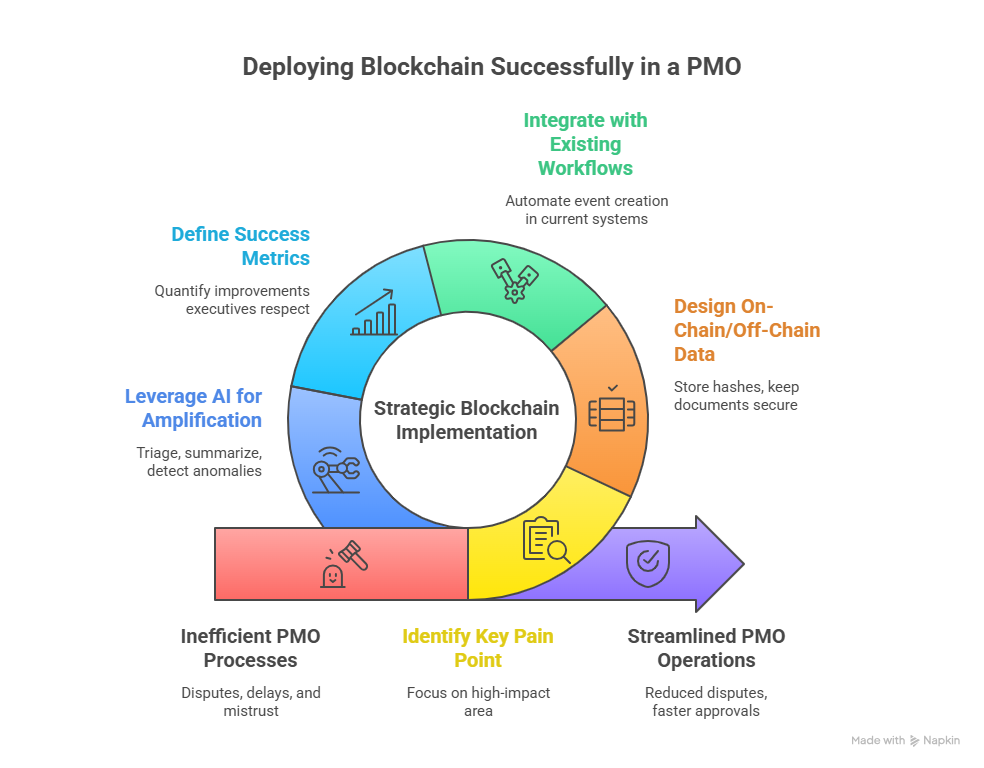
If you roll out blockchain like a technology program, you will lose. Roll it out like a dispute reduction and governance acceleration program.
Start with a single pain that hurts today. Examples include change order disputes, vendor payment conflicts, ESG data defensibility, or regulatory evidence preservation. Your selection should be driven by cost of mistrust. Tie this to your existing risk and governance system using the risk management glossary and the shared baseline in risk identification terms. If you cannot define the risk and its triggers, you cannot prove improvement.
Next, design what goes on chain and what stays off chain. Most teams should store hashes and event proofs on chain, while keeping documents in secure repositories. This avoids data privacy issues while preserving integrity. Pair this with cyber discipline because blockchain does not remove cyber risk. Your PMO still needs strong controls, especially given signals like cybersecurity concerns prompting overhauls.
Then integrate with existing workflows. Your PMs and vendors should not “go to blockchain” as a separate tool. The events should be created automatically when approvals, sign offs, and milestone acceptances happen in the systems people already use. This is where your broader modernization effort matters, aligned with digital transformation across PMOs and the pressure that drives PM software investment.
Finally, define success metrics that executives actually respect. Examples include cycle time to approve change, time to resolve claims, audit findings related to evidence, reduction in vendor disputes, or fewer restatements in ESG metrics. Tie financial outcomes to budget control principles grounded in project budgeting terms and cost clarity from cost management terms. If you cannot quantify improvement, the program becomes vulnerable during cost cutting cycles.
This is also where AI can amplify results. Use AI for triage, summarization, and anomaly detection, which aligns with AI adoption trends. But keep governance tight, and do not let AI outputs bypass approvals and evidence rules.
5) Skills and Certifications That Make Blockchain PM Initiatives Actually Succeed
Blockchain in PM is not a “blockchain specialist” job. It is a governance and delivery job with technical edges. The PM who wins combines system thinking, risk fluency, and stakeholder control.
First, you need strong fundamentals in initiation, scope, and stakeholder alignment. If your teams do not share terminology, blockchain only records confusion. Ground your execution using project initiation terms and cross team language from top PM terms. Then build risk leadership through the risk management glossary and practical context from risk identification terms.
Second, you need governance frameworks that fit your environment. For structured, controlled delivery, compare paths through PMP vs PRINCE2, then deepen PRINCE2 execution using the PRINCE2 exam guide and selection clarity through PRINCE2 Foundation vs Practitioner. If you operate in hybrid environments that require adaptive delivery, strengthen execution readiness through agile demand insights and practical role clarity via Scrum roles.
Third, you need people leadership. Blockchain initiatives touch vendors, procurement, legal, compliance, and operations. If you cannot align incentives, adoption fails. Improve your ability to structure teams using human resource management terms in PM and collaboration foundations through team building terminology. Many blockchain pilots die because the PM underestimates change fatigue and overestimates excitement.
For earlier career PMs building structure fast, CAPM can help with baseline discipline via the CAPM exam guide and direction through CAPM vs PMP. If you are operating in agile heavy product environments, keep an eye on PMI ACP pathways like top PMI ACP exam questions to strengthen adaptive delivery thinking.
6) FAQs: Blockchain in Project Management (2025–2030)
-
The fastest ROI shows up where disputes are expensive and frequent: change control, milestone acceptance, vendor payments, and compliance evidence. If your teams spend weeks arguing over who approved what, blockchain anchored event proofs reduce the cost of mistrust. This works best when paired with strong governance language from project initiation terms and financial discipline rooted in project budgeting terms. Without that foundation, blockchain records messy decisions instead of strengthening them.
-
It should sit alongside it as an integrity layer. Most PMOs keep documents and workflows in existing tools, and store hashes and event proofs on chain. That approach fits modern integration strategies in digital transformation across PMOs and avoids creating yet another system people must learn. The main goal is to prevent silent edits and preserve provable decisions without disrupting delivery.
-
They fail because the team cannot define a measurable business outcome. “Transparency” is not a KPI. Choose a concrete metric like approval cycle time, dispute resolution time, audit findings, or vendor payment conflicts. Tie the work to risk framing using the risk management glossary and execution discipline from cost management terms. If the program cannot prove value quickly, it becomes an easy target during cost pressure cycles.
-
It helps by anchoring provenance. ESG issues often come from weak data lineage and unverifiable sources. Blockchain can store proofs that a metric was derived from specific sources and transformations, supporting audit readiness. This complements the direction in sustainability and ESG project management and reduces reputational risk when stakeholders question assumptions. It is not the whole solution, but it strengthens defensibility.
-
Yes, because AI and blockchain solve different problems. AI improves prediction and triage, supported by trends in AI adoption in PM. Blockchain improves trust, integrity, and traceability. Together, AI can flag risks early while blockchain preserves approval proofs and evidence trails, which reduces blame shifting and speeds governance decisions.
-
Start with one workflow where proof matters and integrate blockchain proofs into the tools people already use. Pick a high friction area like change approvals or milestone acceptance, define success metrics, and design what to anchor on chain versus off chain. Ensure security and resilience are addressed early, especially given signals like cybersecurity concerns prompting system overhauls. Then scale only after you can prove outcomes that executives respect.
