
Project success in 2026–27 is being driven less by heroic recovery at the end and more by disciplined advantage at the beginning. Organizations that deliver consistently are not merely using better tools; they are designing stronger decision environments. They define value earlier, control scope harder, align stakeholders faster, manage resource truth more honestly, and build governance that supports action instead of theater. As project management 2030 trends, future leadership models, future PM skills, and future governance practices continue evolving, the companies winning on delivery are those treating project success as a system, not a slogan.
This 2026–27 report breaks down the real factors now shaping successful outcomes across industries. The patterns are clear: the strongest projects are no longer driven by schedule obsession alone, but by portfolio clarity, stakeholder architecture, decision speed, execution discipline, and the ability to translate changing business pressure into controlled action. Teams that understand these drivers build resilience before trouble appears, which is exactly why PMO evolution, AI in project management, hybrid delivery, and project portfolio trends now matter directly to delivery performance.
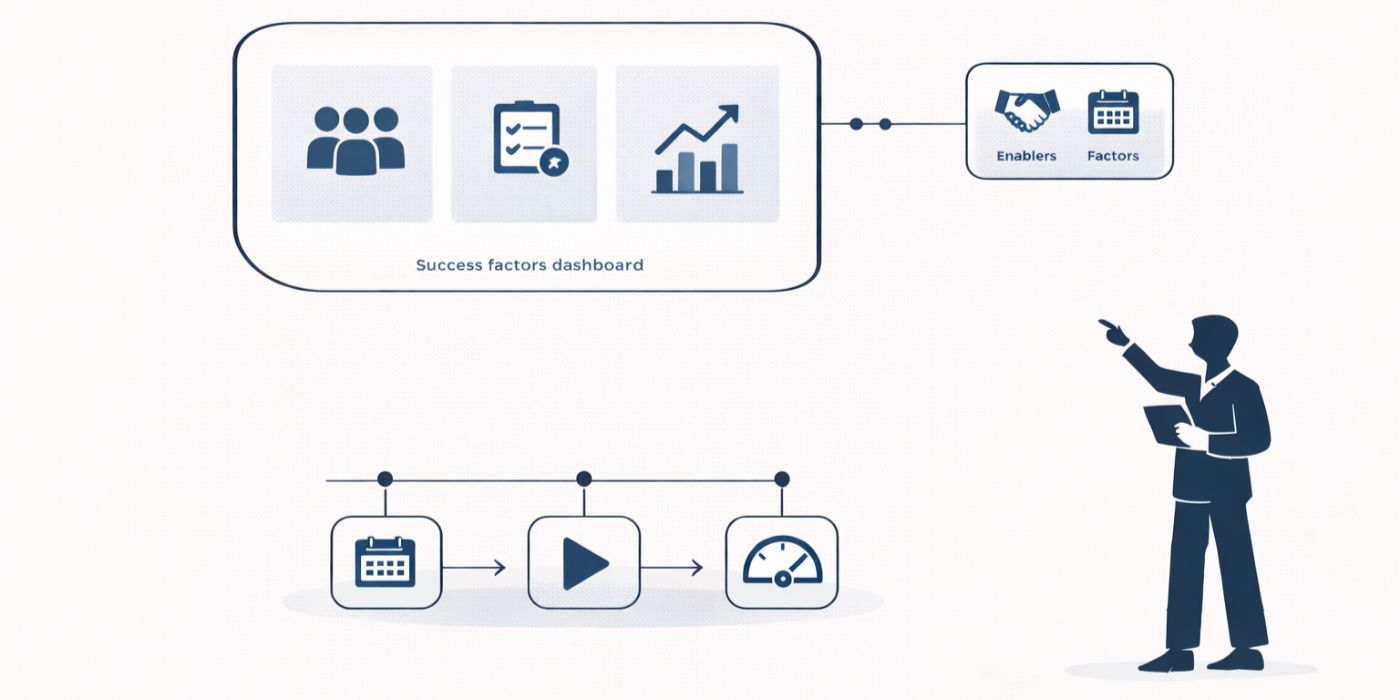
1. Why Project Success Is Being Redefined in 2026–27
For years, organizations measured success too narrowly. Finish on time, stay on budget, and avoid open conflict long enough to declare victory. That approach created a damaging illusion. A project could hit a date and still fail commercially, operationally, politically, or strategically. In 2026–27, that shallow definition is breaking down. Executives increasingly want evidence that a project delivered usable value, protected resources, aligned with strategy, and strengthened future execution capability. That is why modern delivery conversations are now linked much more tightly to project portfolio management, project governance trends, future PM software, and project reporting analytics.
The most important shift is that project success is now being judged under much harsher business conditions. Inflation pressure, talent shortages, digital transformation overload, cybersecurity concerns, procurement delays, and executive impatience have made weak delivery systems impossible to hide. A mediocre project environment used to limp forward. Now it gets exposed. That is why teams are paying closer attention to economic uncertainty and agile demand, global inflation’s impact on budgets, cybersecurity concerns in PM software, and digital transformation across PMOs.
Another reason success is being redefined is that delivery environments are now more interconnected. A schedule slip is rarely just a scheduling problem. It may be a procurement issue, a decision-latency issue, a resource conflict, a bad business case, or a governance design flaw. High-performing teams understand that projects fail upstream long before they fail publicly. That is why stronger organizations build connections among procurement management tools, contract lifecycle management, document control systems, and knowledge management platforms.
This also explains why project success is becoming more role-dependent. Sponsors must make faster decisions. PMOs must move beyond reporting. Project managers must combine delivery discipline with commercial awareness. Functional leaders must stop treating projects as side work that can be supported “when time allows.” The real 2026–27 lesson is brutal but useful: success is no longer driven by one strong project manager covering for a weak system. It is driven by a strong system making good project management scalable.
2. The Core Organizational Factors That Now Drive Project Success
The first driver is business-case integrity. Projects succeed more often when their original value logic is explicit, measurable, and still defended after new information arrives. Weak projects often begin with vague ambition, political enthusiasm, or generic transformation language. When outcomes are not defined tightly, teams cannot prioritize tradeoffs intelligently. They simply stay busy. That is why mature organizations tie project initiation to portfolio management discipline, future PPM trends, project management market signals, and global salary and industry benchmarks.
The second driver is sponsorship quality. Too many projects have nominal sponsors and functional orphans. A sponsor who only appears in kickoff slides does not reduce risk; that sponsor increases it. In 2026–27, project success is strongly correlated with sponsors who can clear decisions, resolve conflicts, secure cross-functional support, and intervene before the team burns time waiting. This factor links directly with future leadership approaches, career paths to director-level roles, vice president of PM pathways, and the long-range responsibilities of a chief project officer.
The third driver is stakeholder architecture. Projects rarely fail because nobody worked hard. They fail because influence was misread. A technically strong plan can die from legal delay, procurement friction, regional resistance, operational overload, or a senior leader quietly unconvinced about timing. High-performing teams map not only stakeholders, but stakeholder power, incentives, likely resistance, timing sensitivity, and decision ownership. This is especially visible in more complex sectors such as government project management, healthcare project management, construction project management, and international project management.
The fourth driver is governance quality. The best organizations do not have more governance because they love bureaucracy. They have better governance because decision rights are explicit, escalation logic is clear, and risk is reviewed with enough structure to matter. Weak governance creates a false calm. Strong governance surfaces tension early, which is precisely what protects outcomes. This is why growing attention is being paid to future project governance, PMO evolution, reporting and analytics tools, and dashboard visibility platforms.
The fifth driver is resource realism. Plans collapse when headcount is treated as capability. A project needs the right people at the right time with the right authority and availability. Teams that keep pretending half-allocated specialists are truly available will keep producing optimistic schedules and predictable disappointment. The organizations succeeding now are the ones connecting planning to scheduling tools, Gantt platforms, mobile collaboration tools, and productivity software for PMs.
The sixth driver is change readiness. A project can technically deliver and still fail if adoption, transition, training, and operational behavior were ignored. In 2026–27, this is one of the clearest dividing lines between “delivered” and “successful.” High-performing organizations treat adoption risk as a core delivery variable, not a soft afterthought.
3. Execution Factors That Separate Strong Projects From Fragile Ones
Execution quality starts with scope control. Successful teams do not confuse flexibility with endless accommodation. They understand that uncontrolled additions dilute focus, destabilize sequencing, and slowly transfer pain into schedule, cost, and morale. Strong projects define what will not be done just as carefully as what will be done. This is closely tied to future governance discipline, hybrid delivery practices, Scrum evolution, and the day-to-day judgment expected from a certified agile project manager.
Another decisive factor is dependency control. Teams often track their own tasks carefully while assuming adjacent functions will somehow align. That assumption destroys projects. Dependencies must be identified, assigned, reviewed, and escalated with the same seriousness as internal work. The more cross-functional the environment, the more success depends on seeing the project as a chain rather than a task list. This is why successful teams increasingly rely on document management software, knowledge management systems, automation tools, and mobile apps for PMs.
Financial discipline is another major execution separator. Teams that update forecasts only to satisfy reporting cycles usually discover cost problems too late. Strong projects analyze the real drivers of variance: slower approvals, vendor slippage, underestimated integration work, low decision quality, or overly optimistic resourcing. Cost control is not an accounting exercise. It is an operational truth system. That is why strong delivery ecosystems increasingly connect to budget tracking software, project analytics tools, future PM software ecosystems, and broader AI-enabled estimation trends.
Communication precision matters just as much. Weak projects over-communicate activity and under-communicate decisions, risks, and implications. Strong projects tailor communication by audience. Sponsors need tradeoffs. Functional leaders need action asks. Delivery teams need clarity on dependencies and changes. Governance bodies need decision-grade signals, not narrative fog. This discipline has become more important as delivery environments stretch across remote and virtual PM roles, freelance PM structures, consultancy-driven delivery models, and project management consultancy firms.
Finally, execution strength depends on the team’s ability to surface bad news without fear. Projects deteriorate fastest in cultures where risk is hidden until it becomes undeniable. The strongest teams are not the ones with no problems. They are the ones that convert emerging trouble into early action while options still exist.
The fastest project improvements usually come from fixing one structural weakness before trying to optimize everything at once.
4. How Technology, AI, and Tooling Are Changing Success Rates
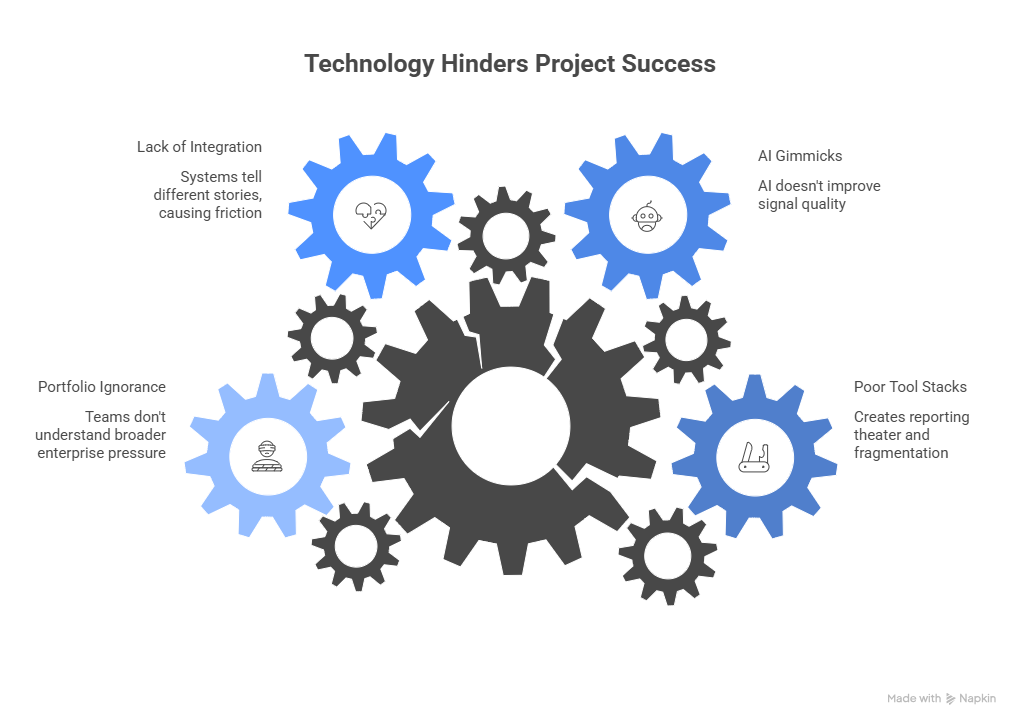
Technology is not automatically a success driver. Poor tool stacks can create reporting theater, fragmented truth, and administrative drag. But well-designed tooling is increasingly a differentiator because it reduces friction in the places where projects usually bleed value: status visibility, resource planning, document control, dependency tracking, budget forecasting, and decision support. That is why delivery performance is becoming more closely tied to future PM software, AI adoption in PM, automation tools for efficiency, and top productivity platforms.
AI is starting to matter most where it improves signal quality. The best use cases are not gimmicks. They include schedule risk detection, variance pattern recognition, dependency alerts, portfolio prioritization support, smarter forecasting, and natural-language access to project data. This allows PMs and PMOs to spend less time assembling information and more time interpreting it. That evolution connects naturally with machine learning in estimation and scheduling, future PM competencies, automation reshaping PM careers, and future certification evolution.
The next tooling factor is integration. A project environment becomes fragile when finance, reporting, schedules, documents, and communication platforms tell slightly different stories. Teams then spend energy reconciling systems instead of managing delivery. Organizations improving success rates are increasingly selecting ecosystems that connect budget tools, document platforms, calendar tools, dashboard software, and knowledge systems.
Another important trend is the rise of portfolio-aware tooling. Projects now succeed more often when teams understand not just local execution, but broader enterprise pressure. A project may be well managed and still fail because it was launched into a capacity-constrained portfolio, a sponsor-saturated decision environment, or a low-readiness change window. That is why project success is increasingly linked to PPM trends, PMO evolution, future project governance, and strategic thinking usually associated with portfolio managers.
The real lesson is that tooling improves success only when it helps people make better decisions sooner. Software that increases visibility but not judgment will disappoint. Software that reduces administrative drag, improves forecasting, strengthens control, and surfaces risk before it hardens can materially improve outcomes.
5. What High-Performing Organizations Are Doing Differently
High-performing organizations begin by refusing vague starts. They do not reward momentum without clarity. Before execution begins, they stress-test business rationale, stakeholder commitment, required capabilities, timing risk, and dependency exposure. This discipline is one reason their projects look calmer later. They absorbed the discomfort earlier. That mindset aligns with the best lessons from career roadmaps for project managers, entry-level to executive PM growth, consultative PM roles, and the more strategic lens seen in project management director pathways.
They also manage decisions as rigorously as tasks. Many struggling organizations track activities obsessively while treating major unresolved decisions as informal background noise. High performers do the opposite. They know that aged decisions quietly create schedule erosion, cost waste, and morale damage. They track decision ownership, deadlines, consequences, and escalation routes. This operating style fits naturally with stronger governance models, more mature PMO design, better project analytics, and improved dashboard visibility.
High-performing organizations are also more realistic about people. They do not treat project staffing as an abstract spreadsheet exercise. They consider availability, capability, decision authority, change fatigue, and competing priorities. They understand that delivery fragility often begins with overcommitted specialists and invisible functional bottlenecks. This is especially true in fast-moving markets like California PM careers, New York project management careers, Texas PM job markets, and Florida PM career insights.
Another differentiator is their relationship with learning. Weak organizations perform a postmortem and move on. Strong organizations convert lessons into templates, risk assumptions, estimation guidance, vendor criteria, and governance improvements. They operationalize memory. That is why they increasingly invest in knowledge management software, training platforms for PMs, certification prep ecosystems, and broader professional development around project management certifications.
Most importantly, high-performing organizations do not romanticize resilience. They engineer it. They use better governance, cleaner prioritization, faster escalation, stronger sponsorship, and more truthful planning to make success less dependent on last-minute heroics.
6. FAQs: Original Industry Analysis: Factors Driving Project Success (2026–27 Report)
-
The biggest factor is not one isolated skill but alignment quality across value, sponsorship, governance, and execution. Projects succeed when the business case is clear, decisions are timely, stakeholders are aligned, and delivery conditions are realistic. Weakness in any one of those areas can overpower strong scheduling or technical execution.
-
Because tools do not fix unclear objectives, weak sponsorship, political resistance, unrealistic staffing, or slow decisions. Technology helps only when it supports a strong operating model. That is why organizations increasingly pair tool investment with stronger PMO design, governance discipline, and future-ready PM skills.
-
It is critical. Strong sponsors shorten decision cycles, remove obstacles, align senior stakeholders, and protect delivery momentum. Weak or absent sponsorship usually creates ambiguity, escalation delays, and political drift that no project manager can fully compensate for.
-
They can, but only when matched to project reality. Hybrid models are increasingly effective because they reflect how real organizations work across compliance, technology, procurement, and operational change. Blind methodology loyalty is less effective than choosing the right delivery model for the context, which is why hybrid PM, Scrum, and the product owner role remain central conversations.
-
AI increasingly improves forecasting, risk detection, reporting efficiency, and portfolio visibility. It does not replace leadership judgment, but it can materially improve the speed and quality of project decisions. The best impact comes when AI strengthens signal detection rather than just rewriting updates.
-
They should identify the most structural failure point first: unclear project entry criteria, weak sponsorship, unrealistic resourcing, poor governance, slow decisions, or low adoption readiness. Trying to optimize everything at once usually produces more activity than improvement. The fastest gains come from solving the one weakness that keeps turning manageable risk into recurring failure.
