
How to Leverage Your CAPM Certification for Career Advancement
CAPM certification can become a career accelerator when you use it as proof of readiness, not just a line under education. PMI lists CAPM eligibility as a secondary degree plus at least 23 hours of project management education before the exam, while PMI’s maintenance guidance explains that certification holders renew through professional development units entered in CCRS. The real advantage comes after passing: using CAPM to win coordinator roles, junior PM opportunities, PMO exposure, better interviews, and a cleaner path toward project manager career growth, PMP planning, Agile project management, and future PM skills.

1. Understand What CAPM Actually Proves to Employers
CAPM tells employers you understand project language, delivery structure, risk awareness, stakeholder coordination, schedule thinking, scope discipline, and the basic mechanics of professional project management. That makes it useful for early-career candidates, career changers, operations staff, administrative professionals, analysts, coordinators, and technical employees trying to move into formal project roles. The strongest candidates connect CAPM with practical capability from project execution terms, project monitoring and control, stakeholder engagement, and project reporting best practices.
The biggest pain point for CAPM holders is the “certified but inexperienced” label. Hiring managers may respect the certification, then still hesitate because the resume lacks proof of decisions, documentation, meeting control, stakeholder follow-up, risk tracking, or delivery ownership. You fix that by translating CAPM into work evidence. Use it to build artifacts: a RAID log, a simple project charter, a stakeholder map, a communication plan, a change tracker, a benefits summary, and a closeout checklist. These assets turn certification knowledge into visible readiness for entry-level to executive PM growth, remote project management roles, PM templates, and team communication tools.
2. Turn CAPM Into Better Resume, LinkedIn, and Interview Positioning
CAPM works best when your resume shows the certification beside project proof. A weak resume says “CAPM certified” and then lists general duties. A strong resume says you supported project schedules, tracked risks, maintained action logs, coordinated stakeholders, prepared status updates, documented decisions, and helped teams move work through delivery gates. Build bullet points around risk registers, resource allocation, schedule compression, and earned value management basics when those skills match your experience.
A useful CAPM resume formula is action + project environment + PM method + measurable value. For example: “Coordinated weekly implementation reporting across five internal teams, using action logs and risk tracking to reduce missed follow-ups.” Another strong line: “Supported project documentation for a vendor rollout by maintaining requirements notes, meeting minutes, and change request records.” These examples make CAPM feel alive. They also support career movement into IT project management, healthcare PM roles, construction project management, and government project management.
Your LinkedIn headline should also carry direction. “CAPM Certified | Project Coordinator | Risk, Reporting & Stakeholder Support” says far more than “CAPM Certified Professional.” Your About section should explain the type of projects you want, the tools you use, the artifacts you can manage, and the outcomes you help protect. Mention tools only when you can discuss workflows inside them. Pair your profile with learning from best project management templates, workforce management tools, Kanban software tools, and Scrum platforms.
Interview positioning should focus on applied understanding. When asked why CAPM matters, answer with delivery behavior: “It gave me a structured way to think about scope, schedule, risk, stakeholder communication, and project documentation. I use that structure to keep work visible, make handoffs clearer, and reduce confusion before it becomes delay.” Then prove it with one real example from work, school, volunteering, freelancing, or a simulated portfolio project. Hiring managers remember specific evidence from stakeholder engagement, conflict resolution, project closure, and quality management.
3. Use CAPM to Break the Experience Barrier
CAPM holders often face a brutal loop: entry-level project roles ask for experience, yet experience is hard to get without a project role. The way through is to create credible project evidence before someone gives you the title. Volunteer for internal initiatives, process cleanups, onboarding improvements, software rollouts, event planning, documentation upgrades, data cleanup, customer handoff improvements, or cross-team reporting. Then manage those efforts with CAPM language from project execution, monitoring and control, project reporting, and risk response planning.
Your first goal is proof of coordination. Employers need to see that you can follow up without being chased, document clearly, spot blockers early, keep people aligned, and protect deadlines. CAPM gives you the language; your mini-projects give you the evidence. A small project with a clear charter, timeline, stakeholder list, risk log, and closeout summary can outperform a vague job description. This is especially valuable for candidates targeting remote PM roles, Agile PM careers, Scrum Master roles, or project coordinator growth.
Build a portfolio with five simple assets: a project charter, a stakeholder map, a schedule snapshot, a risk register, and a final lessons-learned document. Each asset should be short, clean, and easy to explain in an interview. Use a real problem if possible: reducing onboarding confusion, improving report turnaround, organizing a department event, implementing a new tool, or standardizing a recurring workflow. Then connect the portfolio to role-specific skills from Agile estimation, sprint planning, product backlog terms, and hybrid project management.
The strongest early-career CAPM strategy is to target jobs where the certification removes doubt. Search for project coordinator, PMO coordinator, project assistant, implementation coordinator, operations project coordinator, business analyst associate, delivery coordinator, project scheduler assistant, and junior project manager. Then customize every application around that job’s pain: reporting backlog, stakeholder confusion, missed deadlines, scattered documentation, vendor delays, scope changes, or meeting overload. Use APMIC resources on vendor management, RFP RFQ RFI terms, ISO standards, and future project governance to sharpen your language.
4. Match CAPM With the Right Specialization Path
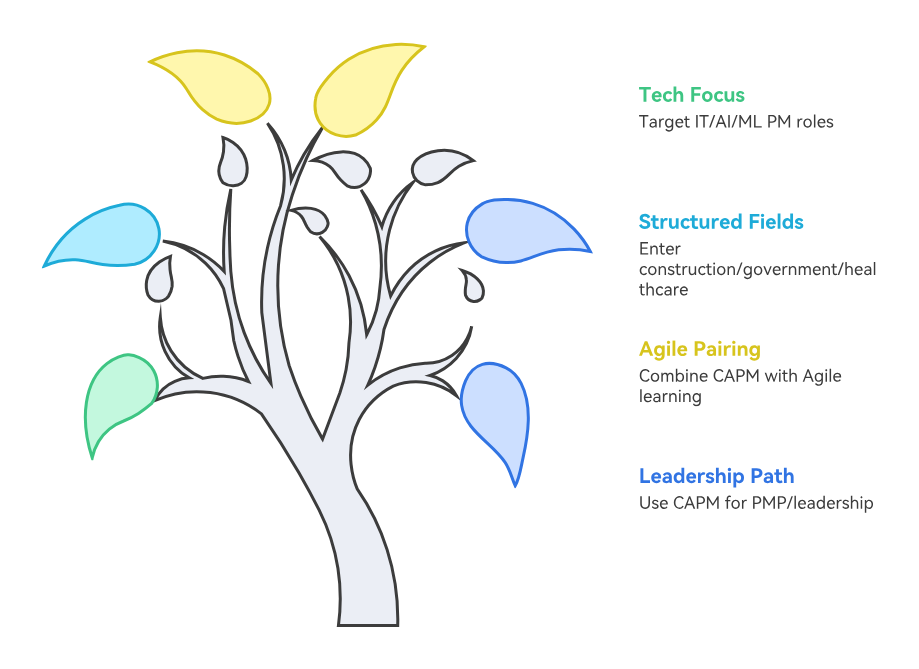
CAPM becomes more powerful when it points toward a specific career lane. A general “project management” goal is too broad for competitive hiring. Choose a lane based on your background, interests, local market, and proof you can build quickly. If you have technical exposure, target IT project management, AI project management trends, machine learning project estimation, and PM software automation.
If you prefer structured environments, CAPM can support moves into construction, government, healthcare, education, finance, and enterprise PMO work. These spaces reward documentation, risk discipline, stakeholder alignment, status reporting, and approval tracking. Connect your certification to construction project management, government PM careers, healthcare PM careers, and financial services project management.
If you prefer team flow, product work, software delivery, or adaptive planning, pair CAPM with Agile learning. CAPM gives you a foundation in project structure; Agile gives you modern delivery language. This combination helps you speak to traditional PMOs and fast-moving product teams. Build fluency through Agile glossary terms, Scrum glossary terms, Kanban terms, and Agile coaching career paths.
If your long-term goal is leadership, use CAPM as the first proof point in a credential ladder. PMI’s PMP certification page states that the 35 hours of project management education requirement can be met with a CAPM certification, which makes CAPM useful as part of a longer PMP path when paired with qualifying experience. From there, build toward project management director, VP of project management, Chief Project Officer, and portfolio management.
5. Create a 12-Month CAPM Career Advancement Plan
Your first 30 days after CAPM should focus on positioning. Update your resume, LinkedIn, portfolio, and job-title target list. Write five strong resume bullets that connect CAPM knowledge to planning, tracking, reporting, risk, and stakeholder coordination. Build a simple portfolio folder with your strongest proof assets. Study job descriptions for project coordinator, PMO coordinator, junior PM, implementation coordinator, and delivery coordinator roles. Use project management career roadmaps, remote PM career guidance, project coordinator skill language, and project reporting terms.
Months 2 to 4 should focus on evidence. Volunteer for one internal project, one process improvement, or one cross-functional coordination task. Track it with real PM artifacts. Your target is a clean story: problem, stakeholders, constraints, plan, risks, actions, result, lessons. This story becomes interview fuel. Build skill depth using risk mitigation terms, Gantt chart terms, resource allocation terms, and conflict resolution terms.
Months 5 to 8 should focus on specialization. Choose IT, Agile, construction, healthcare, government, PMO, product, or operations project management. Then build proof around that lane. For IT, document requirements, testing, rollout, and support handoff. For Agile, manage a board, backlog, blocker log, and sprint reporting. For construction, track schedule, vendors, site issues, and approvals. For healthcare or government, emphasize compliance, documentation, stakeholders, and decision traceability. Match your path with IT PM careers, construction PM careers, government PM careers, and Agile PM certification.
Months 9 to 12 should focus on advancement. Apply more strategically, ask for internal project ownership, request PMO exposure, build references from managers or stakeholders, and prepare for PMP planning if your experience path supports it. Maintain your CAPM properly through PMI’s renewal system, where PMI says certification holders earn required PDUs, enter them in CCRS, complete the renewal process, and submit payment when applicable. By the end of the year, your CAPM should support a stronger title, clearer project evidence, and a practical next step toward PMP exam domains, PMP exam preparation, PMP renewal habits, and future certification trends.
6. FAQs About Leveraging CAPM Certification for Career Advancement
-
CAPM can support roles such as project coordinator, PMO coordinator, project assistant, junior project manager, implementation coordinator, operations coordinator, delivery coordinator, business analyst associate, scheduling assistant, and project support specialist. The best route depends on your background. A technical candidate may target IT project manager careers, while an organized admin professional may move toward project coordinator and PM growth.
-
Build proof through small projects. Create a charter, schedule, risk register, stakeholder map, status report, and lessons-learned document for a real workplace improvement, volunteer effort, school project, freelance task, or simulated portfolio case. Employers need evidence that you can manage communication, deadlines, risks, and documentation. Support that proof with project reporting, risk registers, and stakeholder engagement.
-
Yes, when it supports your target role. Use a clear headline such as “CAPM Certified Project Coordinator | Reporting, Risk & Stakeholder Support” or “CAPM Certified | Junior Project Manager | Agile & PMO Support.” Then make the profile prove the claim with project artifacts, tools, results, and role direction. Pair the credential with Agile tools, PM templates, and team communication platforms.
-
CAPM helps you build foundational project management credibility and can support your longer PMP path when paired with qualifying project experience. PMI’s PMP page says CAPM certification can meet the 35-hour project management education/training requirement for PMP eligibility. Use your CAPM period to collect experience, build project proof, understand PMP exam domains, and avoid common PMP exam mistakes.
-
Your resume should connect CAPM with real work. Use bullets such as “Maintained project action logs and weekly status updates across cross-functional teams,” “Tracked risks, blockers, and owner follow-ups for implementation work,” or “Supported project documentation, schedule updates, and stakeholder communication.” Add proof from resource allocation, project financial terms, vendor management, and project closure.
-
CAPM can be useful for Agile roles when you pair it with Agile vocabulary and practical board experience. CAPM gives you structured project thinking; Agile skills show you can support fast-moving teams, changing priorities, backlog refinement, sprint flow, and delivery metrics. Strengthen your profile with Agile glossary terms, Scrum terms, sprint planning terms, and Agile metrics.
