
Financial Services Project Management Insights
Financial services PM is entering a five year window where “good enough” delivery gets punished fast. Regulators tighten timelines, cyber risk becomes operational risk, and legacy systems keep turning simple changes into multi quarter migrations. Meanwhile leadership wants faster releases, clearer ROI, and fewer surprises. If your PM approach still relies on long plans and monthly reporting, you will lose trust before you miss the deadline. This guide breaks the real 2025 to 2030 shifts, the innovations that actually stick, and the execution system PMs need to ship complex change inside banks, fintechs, insurers, and capital markets.

1) What Will Force Financial Services Project Management to Evolve (2025–2030)
Financial services change is rarely “one project.” It is usually a chain reaction across channels, data, risk, legal, operations, vendors, and regulators. That makes delivery hard even when teams are smart. The pain is that most PMO systems were built for predictability, but finance is entering a period where uncertainty is normal.
First pressure is cost and efficiency. Leaders are cutting layers and expecting tighter execution, similar to how organizations restructure for efficiency in examples like Microsoft’s efficiency driven PM structure shifts and Blue Origin’s middle management reductions. Translation in banks and insurers is simple: fewer coordinators, more accountability, less tolerance for meetings that do not move decisions.
Second pressure is economic volatility. When the baseline keeps moving, leadership stops trusting plans that do not include scenarios. You can see the same theme in global inflation’s impact on project budgets and the broader signal that investment in PM software is rising under economic pressure. If you cannot forecast cost and delivery impacts early, your program becomes the first target for cuts.
Third pressure is risk. Cyber is no longer “an IT issue,” it is a delivery risk that can freeze operations and damage trust overnight. The market signal is loud in major cybersecurity concerns prompting PM software overhaul. Add regulatory change, third party exposure, and resilience expectations, and suddenly PM is not just schedule management. It is risk leadership.
Fourth pressure is governance speed. If governance slows, teams ship late. If governance loosens, teams ship unsafe. The winning PMOs solve this using shared language and consistent standards grounded in project initiation terms every PM must know and a common vocabulary from top project management terms. When definitions are aligned, decisions stop getting stuck in semantics and start getting made.
2) Top Predictions for Financial Services PM (2025–2030)
Prediction one is that PMOs become value engines, not reporting engines. The executive question will stop being “are you on track” and become “are you producing measurable outcomes.” This aligns with the broader narrative that project management is being positioned as a driver of economic growth. In financial services, that means benefits tracking becomes non optional, and every program needs evidence of impact.
Prediction two is two speed governance becomes standard. High risk initiatives like core banking, customer data, or AI models get structured gates. Low risk improvements get fast approvals with clear thresholds. This is how you stay compliant without becoming slow. To make it work, you need disciplined risk framing pulled from a shared baseline like the project risk management glossary and operational terms like risk identification and assessment terms. Without that, governance becomes politics and delivery becomes gridlock.
Prediction three is that agile becomes less about ceremonies and more about speed with proof. Financial services is already moving toward shorter cycles because uncertainty demands faster feedback, consistent with increased demand for agile under economic uncertainty and signals like a global survey highlighting rising agile demand. The winning pattern is simple: small increments, strong controls, and measurable outcomes, not “agile theater.”
Prediction four is that ESG delivery becomes part of project governance. It will not stay in a separate reporting team. You will see ESG requirements enter intake forms, vendor assessments, and data lineage standards, consistent with sustainability and ESG project management adaptation globally. If you ignore this, you discover late that your data is not defensible, your suppliers are not compliant, and your disclosures are exposed.
Prediction five is the consolidation of tools and the rise of integrated delivery stacks. PMOs will be forced to reduce manual reconciliations and build a single operational story, which is exactly why digital transformation is accelerating across PMOs and why organizations respond to pressure by upgrading systems via increased investment in PM software. If your teams still copy data between spreadsheets and status slides, you will not scale.
3) The Innovations That Will Actually Move the Needle in Finance Delivery
Innovation that matters in financial services has one job: reduce risk while increasing speed. That means fewer handoffs, less ambiguity, and more traceable decisions.
AI is the loudest innovation, but it only helps when used with discipline. The practical win is triage. AI can categorize incidents, summarize requirements, detect anomalies in delivery signals, and prioritize risks before they explode, aligning with AI adoption reaching record levels in PM. The failure mode is using AI without governance. In finance, you need model oversight, drift monitoring, and an audit trail. Your PMO must treat AI like a regulated product, not a productivity hack.
Cyber resilience is the second innovation wave. Many firms are hardening delivery pipelines, access, and monitoring because cyber events create business outages. This is why the market is reacting to cybersecurity concerns with software overhauls. The PM innovation is that security becomes part of the plan from day one. Threat modeling, access reviews, and logging are scheduled deliverables, not last minute tasks.
Blockchain and tokenization will continue to show up in specific use cases where shared truth reduces reconciliation pain. The key is refusing “pilot addiction.” If there is no adoption plan, it is theater. Focus on measurable outcomes like cycle time reduction, transparency, and reduced disputes, using the lens of blockchain momentum in PM applications. If the business cannot name the measurable win, do not ship it.
Integration and data governance are the unsexy innovations that pay the bills. Lineage, data contracts, and consistent definitions reduce reporting risk and speed delivery. This fits the broader theme of digital transformation across PMOs and the pressure to build defensible budgets using project budgeting terms plus control on variance through cost management terms. If your data is messy, your decisions are weak.
4) The Financial Services PMO Playbook for 2025–2030
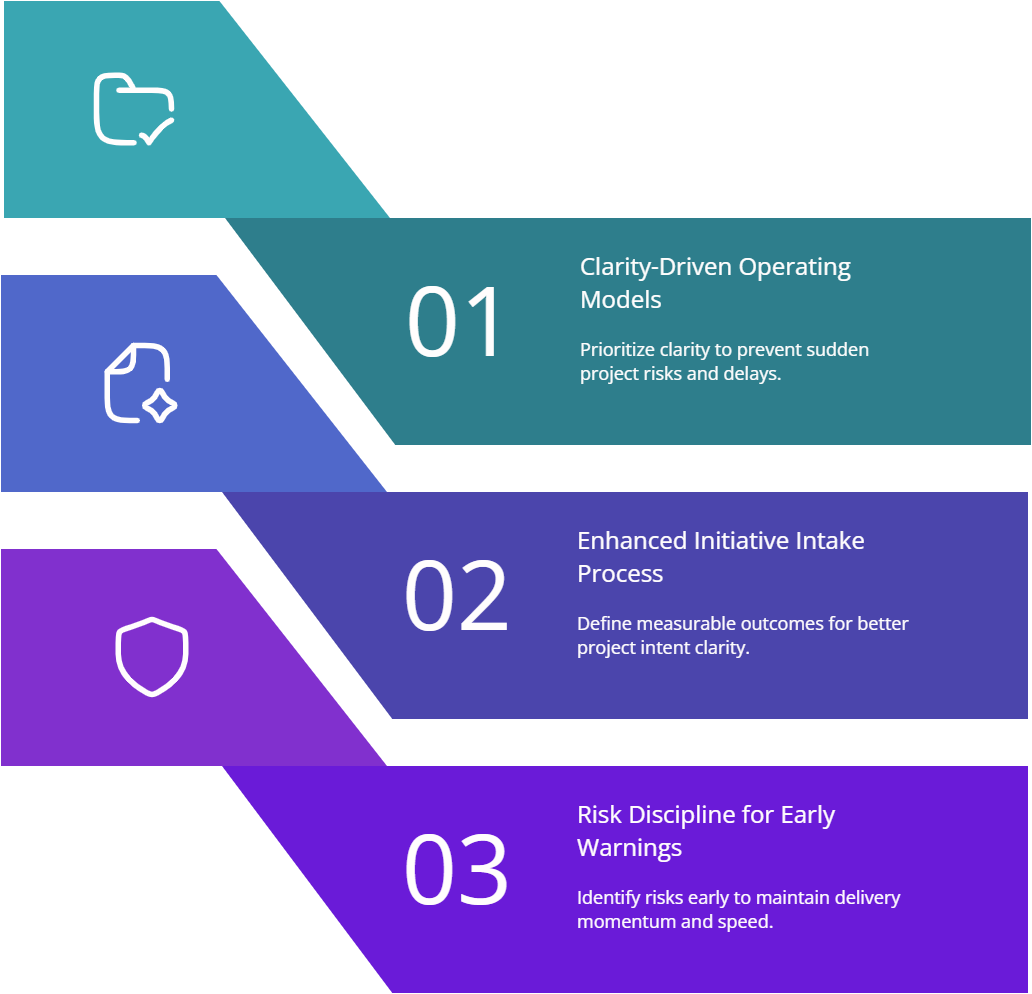
If you only implement one thing, implement an operating system that forces clarity early. Most delivery failures in finance happen because ambiguity is allowed to live too long. The project feels fine until it is suddenly late, suddenly over budget, or suddenly blocked by risk.
Step one is a better intake. Every initiative should start with clear intent, control impacts, data impacts, and an owner for benefits. Do not accept “improve customer experience” as a scope statement. Force measurable outcomes. Anchor the language using project initiation terms and a shared baseline from top PM terms. When teams share definitions, they stop hiding behind vague words.
Step two is risk discipline that creates speed. The goal is not to create more risk logs. The goal is to make risk visible early so it does not ambush you later. Use structured definitions from the risk management glossary and practical framing from risk identification terms. Build triggers that tell you when the risk is becoming real, such as vendor delays, data quality failures, or security approvals aging.
Step three is integrated forecasting. Monthly forecasts are too slow for finance. Between 2025 and 2030, volatile environments require tighter loops. Use baseline concepts from project budgeting terms and keep variance honest through cost management terms for PMs. Your forecast should change when scope changes, when productivity changes, or when dependency health changes. If it only changes when finance asks, it is not a forecast, it is a report.
Step four is two speed governance with evidence. Low risk decisions get fast approvals. High risk decisions get controlled review, but with clear deadlines and escalation. This reduces the pain point where governance becomes a parking lot. The reason this matters is that economic pressure is increasing. When leadership is cutting spend, they favor projects with clear evidence and predictable delivery, consistent with PM software investment under pressure and the broader shift toward agility under uncertainty shown in rising agile demand.
Step five is portfolio hygiene. Financial services firms often run overlapping initiatives because different groups fund similar work with different names. Between 2025 and 2030, that waste becomes unacceptable. Your PMO needs dependency mapping and consolidation routines, similar to how organizations reframe PM frameworks during restructuring like Google’s new internal PM frameworks. Your goal is simple: fewer initiatives, better shipped.
5) The Skills and Certifications That Will Matter Most for Finance PMs
Financial services PMs who thrive will combine three capabilities: risk fluency, delivery speed, and executive grade communication. Domain knowledge matters, but execution skill is what keeps you valuable when the organization tightens.
Risk fluency is not optional. You must be comfortable with controls, audit evidence, third party risk, and cyber. Build your vocabulary and precision using the project risk management glossary and practical terms from risk identification and assessment. When you can speak risk clearly, stakeholders stop treating risk teams as blockers and start treating them as partners.
Delivery speed requires structured frameworks. If you are choosing a professional path, start by clarifying whether your environment rewards predictive control or adaptive delivery. The comparison in PMP certification vs PRINCE2 is useful because financial services often needs both mindsets. For predictable regulatory programs, PRINCE2 discipline helps, supported by the PRINCE2 certification exam guide and decision confidence through PRINCE2 level selection. For complex programs with many stakeholders, PMP rigor and stakeholder leadership matter, and you can tighten execution readiness using the PMP exam day survival guide.
If you are earlier in your career, CAPM builds the structured thinking needed to survive in finance environments where stakeholders demand precision. The CAPM exam guide helps anchor fundamentals, and career direction clarity can be supported by CAPM vs PMP comparison. In finance, credibility grows when your language is exact and your controls are consistent.
Finally, people leadership will still decide outcomes. Financial services delivery is full of competing priorities, politics, and fatigue from constant change. Strengthen your capability through clear role design using human resource management terms in PM and collaboration structure from team building terminology for PMs. When teams trust the system, they stop protecting turf and start delivering.
6) FAQs: Financial Services Project Management (2025–2030)
-
PMOs will be judged less on reporting and more on outcomes with defensible evidence. Leaders will want programs that can explain risk, prove progress, and show measurable value, reflecting the broader narrative that project management is a key driver of economic growth. The PMO that survives cost pressure is the one that reduces duplication, accelerates decisions, and builds audit ready delivery through consistent standards and integrated data.
-
AI improves speed when used for triage and signal detection. It can prioritize risks, classify issues, summarize requirements, and spot anomalies earlier, consistent with AI adoption trends in PM. The key is governance. Financial services must treat AI releases like regulated products with model oversight, monitoring, and evidence, so speed increases without increasing exposure.
-
They get stuck because decision rights are unclear and risk reviews arrive late. Fix it with two speed governance where low risk decisions move fast and high risk decisions follow a structured gate with deadlines. Shared terminology from project initiation terms and a unified baseline in the risk management glossary prevents teams from arguing about definitions and forces clarity on what must be decided, by whom, and by when.
-
Data lineage and evidence. When you can trace critical metrics to sources, transformations, and owners, reporting becomes defensible. This aligns with the broader direction of digital transformation across PMOs and the need to control budget and variance using project budgeting terms. The biggest win is making lineage a deliverable, not a side task, so audits and disclosures stop becoming emergency projects.
-
Treat them as planned deliverables from day one, not last minute gates. Build threat modeling, access reviews, logging, and resilience testing into the schedule and acceptance criteria. The urgency is clear in signals like cybersecurity concerns driving software overhauls. When security and resilience are part of the plan, approvals speed up and incidents drop, which protects both customers and credibility.
-
It depends on your delivery context. If you run structured programs with strict governance, PRINCE2 can fit well, supported by the PRINCE2 exam guide. If you lead complex cross functional programs where stakeholder alignment and scope control are critical, PMP can be better, and readiness improves with the PMP exam day survival guide. Earlier career PMs can build fundamentals through the CAPM guide and then specialize based on role demands.
