
Future of Project Management Certifications: Which Will Dominate in 2026 and Beyond?
Project management certifications are entering a harder, more selective market. Employers still value recognizable credentials, yet a badge alone rarely overcomes weak delivery evidence, limited commercial awareness, or poor industry alignment. The strongest candidates now combine a respected core credential with capabilities in AI, hybrid delivery, business analysis, governance, and sector-specific execution. As the profession moves toward a possible global shortage of up to 30 million project professionals by 2035, choosing the right certification path could materially improve career mobility, credibility, and earning power.
1. How Project Management Certification Demand Is Changing in 2026
The project management certification market is shifting from knowledge validation toward capability signaling. Recruiters increasingly need evidence that a candidate can convert strategy into measurable outcomes, manage ambiguity, control risk, and make responsible decisions with AI-supported information. This explains why the updated PMP exam domains now place greater emphasis on business environment, value, sustainability, stakeholder engagement, and AI-enabled scenarios. Professionals studying through older, process-heavy material risk preparing for a version of project management that hiring teams are leaving behind.
The July 2026 PMP update materially increased the Business Environment weighting from 8% to 26%, while People and Process remain substantial parts of the examination. That change supports a broader direction already visible in future project manager competencies, hybrid project management, AI-enabled project delivery, and the expanding role of project governance. Certification providers are responding by testing judgment, adaptability, business impact, and technology governance alongside traditional planning competence.
Entry-level credentials are broadening too. CAPM now covers predictive approaches, agile principles, and business analysis, making it more useful for aspiring coordinators, analysts, and project support professionals than a purely terminology-based credential. A candidate can strengthen this foundation through CAPM preparation resources, avoid common CAPM exam mistakes, develop a practical career advancement strategy, and understand ongoing CAPM renewal requirements. The painful reality remains: candidates who stop at passing the exam often struggle because employers still need examples of planning, reporting, stakeholder coordination, and problem resolution.
Agile certification demand is becoming more role-sensitive. A general Scrum credential can open an interview, while advancement increasingly depends on facilitation, product thinking, portfolio alignment, coaching, and organizational change. Professionals comparing PMI-ACP, CSM, and SAFe should examine the delivery environment they intend to enter. PMI-ACP covers multiple approaches, including Scrum, Lean, and Kanban; Scrum Alliance offers a progression from CSM through A-CSM to CSP-SM; and SAFe targets enterprise-scale coordination.
The matrix forecasts hiring utility rather than promising a universal ranking. Credential strength changes by country, industry, employer methodology, role seniority, and candidate experience. A PRINCE2 Practitioner can outrank a PMP for a method-specific public-sector vacancy, while a CCM preparation path may produce more value than either credential for a construction manager. The correct question is therefore: which certification reduces the employer’s perceived hiring risk for the exact role you plan to pursue?
| Certification or Path | Strongest Career Use | 2026 Market Strength | Likely 2026–2030 Direction | Best Companion Capability |
|---|---|---|---|---|
| PMP | Experienced cross-industry project leadership | Very high | Likely global market leader | AI, finance, or industry depth |
| CAPM | Entry-level project coordination | High | Stronger graduate and career-switcher route | Project portfolio and work samples |
| PMI-ACP | Multi-framework agile delivery | High | Growth as hybrid delivery expands | Product, coaching, or DevOps |
| PMI-CPMAI | AI initiative leadership and governance | Emerging rapidly | Major specialist growth opportunity | PMP, data literacy, AI governance |
| PMI-PBA | Requirements and benefits realization | Strong specialist | Rising with transformation complexity | Process mapping and product discovery |
| PgMP | Coordinated program leadership | High at senior level | Greater value in transformation offices | Benefits and dependency management |
| PfMP | Enterprise investment prioritization | Selective and influential | Increasing strategic importance | Finance and portfolio analytics |
| PMI-RMP | Enterprise and project risk | Strong specialist | Growth in regulated and capital projects | Quantitative risk analysis |
| PMI-SP | Scheduling and controls | Strong in complex delivery | Stable demand in engineering sectors | Primavera, forecasting, EVM |
| PMI-CP | Construction project delivery | Growing | Expansion with infrastructure demand | Contracts and field controls |
| CCM | Construction management leadership | High within its sector | Durable specialist credential | Claims, safety, contracts |
| CCP | Cost engineering and controls | High in capital programs | Strong as cost pressure intensifies | Estimating and commercial management |
| EVMP | Performance measurement and forecasting | Specialized | Valuable in government and defense | Scheduling and cost control |
| PRINCE2 Foundation | Structured method fundamentals | High in specific regions | Stable entry and public-sector route | Practical project support experience |
| PRINCE2 Practitioner | Tailored governance and project control | Very high in UK-linked markets | Continued regional dominance | PMP or sector experience |
| PRINCE2 Agile | Governance with adaptive delivery | Moderate to high | Growth in hybrid organizations | Scrum or Kanban practice |
| CSM | Initial Scrum team facilitation | High awareness | Strong entry badge with crowded supply | Facilitation evidence |
| A-CSM | Advanced Scrum leadership | Strong for progression | Greater value than entry-only stacking | Coaching and conflict resolution |
| CSP-SM | Organizational Scrum leadership | Selective | Useful for senior practitioners | Transformation outcomes |
| CSPO | Product ownership fundamentals | High in product teams | Sustained product-market relevance | Discovery and product analytics |
| A-CSPO / CSP-PO | Advanced value and product leadership | Growing | Stronger as PM and product roles converge | Commercial and customer research |
| PSM I | Scrum knowledge validation | High awareness | Stable independent study option | Team delivery evidence |
| PSM II / III | Advanced Scrum mastery | Respected specialist | Durable for experienced practitioners | Coaching and organizational influence |
| SAFe Agilist | Enterprise agile leadership | High in SAFe organizations | Strong enterprise and AI-enabled path | Transformation delivery |
| SAFe Scrum Master | Facilitation in Agile Release Trains | Role-dependent | Stable where SAFe adoption continues | ART coordination |
| SAFe POPM | Enterprise product ownership | Strong in large organizations | Growth with product operating models | Backlog economics and discovery |
| SAFe LPM | Lean portfolio management | High-value niche | Rising with strategic funding reform | Portfolio finance and OKRs |
| IPMA Levels D–A | Competence-based career progression | Regionally strong | Stable where competence assessment is valued | Documented delivery evidence |
2. Which Certifications Will Dominate in 2026 and Beyond?
PMP Will Remain the Broadest Global Leadership Credential
PMP is positioned to remain the dominant general project management certification through the late 2020s. Its market power comes from three factors: experience-based eligibility, cross-industry recognition, and coverage spanning predictive, agile, hybrid, leadership, and business decision-making. The 2026 exam update strengthens that position by incorporating AI, sustainability, stakeholder engagement, value, and business impact. Candidates should combine high-quality PMP resources with realistic scenario practice, study documented PMP success strategies, eliminate recurring PMP exam errors, and plan for PDU-based PMP maintenance.
PMP’s main weakness is saturation at the résumé level. Thousands of candidates display the same three letters, so differentiation comes from the proof surrounding them. A strong PMP profile connects certification knowledge to a requirements baseline, a stakeholder map, a risk register, a benefits plan, a project dashboard, or a recovery case. Familiarity with project reporting practices, stakeholder engagement terminology, project execution concepts, and monitoring and control language helps candidates communicate delivery competence during interviews instead of reciting exam concepts.
AI Credentials Will Become the Fastest-Growing Companion Certifications
PMI introduced PMI-CPMAI in September 2025 as a certification focused on managing AI initiatives. Its curriculum covers business alignment, data needs, model evaluation, operationalization, governance, explainability, and measurable outcomes. It can become a powerful companion to PMP, PMI-PBA, product ownership, or sector-specific credentials because AI projects create delivery risks that conventional scheduling knowledge cannot resolve alone.
A project professional planning to lead AI work should understand machine-learning estimation and scheduling, the expanding automation impact on PM careers, changing project management software capabilities, and emerging cybersecurity concerns in PM platforms. The market will reward professionals who can challenge an AI use case, identify weak data, define human oversight, manage model risk, and connect experimentation to a defensible business benefit.
PRINCE2 Will Retain Regional and Governance-Heavy Dominance
PRINCE2 Project Management Version 7 remains highly relevant for organizations that prefer defined roles, decision points, management products, tolerances, and method-based governance. Its durability will be strongest in the United Kingdom, Europe, government-linked delivery environments, consulting, and employers that explicitly name PRINCE2 in job descriptions. Version 7 emphasizes tailoring, communication, people, sustainability, and digital context, which gives the method greater compatibility with modern delivery environments.
Professionals should compare PRINCE2 and PMP directly, assess potential PRINCE2 salary and career benefits, understand PRINCE2 renewal obligations, and avoid common PRINCE2 exam pitfalls. Candidates lose money when they purchase PRINCE2 because of brand recognition and later discover that target employers ask for PMP, agile delivery experience, security clearance, or industry-specific controls.
PMI-ACP, Scrum, and SAFe Will Dominate Different Agile Segments
No single agile credential will control the entire market. PMI-ACP has an advantage where employers need broad agile judgment across Scrum, Lean, Kanban, and other adaptive approaches. CSM and PSM remain visible entry points for Scrum roles, while A-CSM, CSP-SM, PSM II, and PSM III offer stronger signals for experienced facilitators and coaches. SAFe certifications will remain influential in enterprises using Agile Release Trains, lean portfolio management, and scaled product delivery.
The painful hiring gap appears when a candidate knows ceremonies yet cannot improve flow, resolve conflict, challenge weak prioritization, or connect team output to business value. Stronger profiles combine an advanced Scrum Master pathway with agile estimation competence, agile metrics fluency, and command of product and sprint backlog concepts. SAFe has also added AI-oriented learning to its certification ecosystem, reinforcing the movement toward technology-enabled agile leadership.
3. Why Stackable and Hybrid Credentials Will Beat Standalone Badges
The dominant certification model will become a stack: one core credential, one operating-model credential, and one specialist capability. A generalist might combine PMP with PMI-ACP and PMI-CPMAI. A construction professional could pair PMP with CCM or PMI-CP and then add CCP or EVMP. A transformation leader might combine PRINCE2 Practitioner with SAFe Agilist and portfolio management expertise. This architecture matches the direction outlined in certification evolution forecasts, Project Management 2030 predictions, changing PMO effectiveness research, and the evolving future role of the PMO.
Stacking works only when each credential closes a visible capability gap. Three overlapping Scrum certificates may add less market value than one advanced Scrum credential plus business analysis, product analytics, or change leadership. A PMP holder working on requirements-heavy transformation could gain more from PMI-PBA preparation or CPRE requirements engineering than from another general PM course. A controls professional may benefit more from the earned value management certification route and a strong command of project financial management terms.
Hybrid credibility will also become more valuable than methodology loyalty. Most complex organizations use combinations of stage gates, annual funding, agile teams, fixed supplier contracts, rolling forecasts, and regulatory approvals. Professionals must understand Waterfall terminology, the complete agile vocabulary, practical Kanban concepts, and the mechanics of RFPs, RFQs, and RFIs. Employers need people who can select and tailor an approach according to risk, uncertainty, contract structure, product maturity, and stakeholder tolerance.
4. The Best Certification Path for Each Career Goal
Entry-Level Project Coordinator or Career Switcher
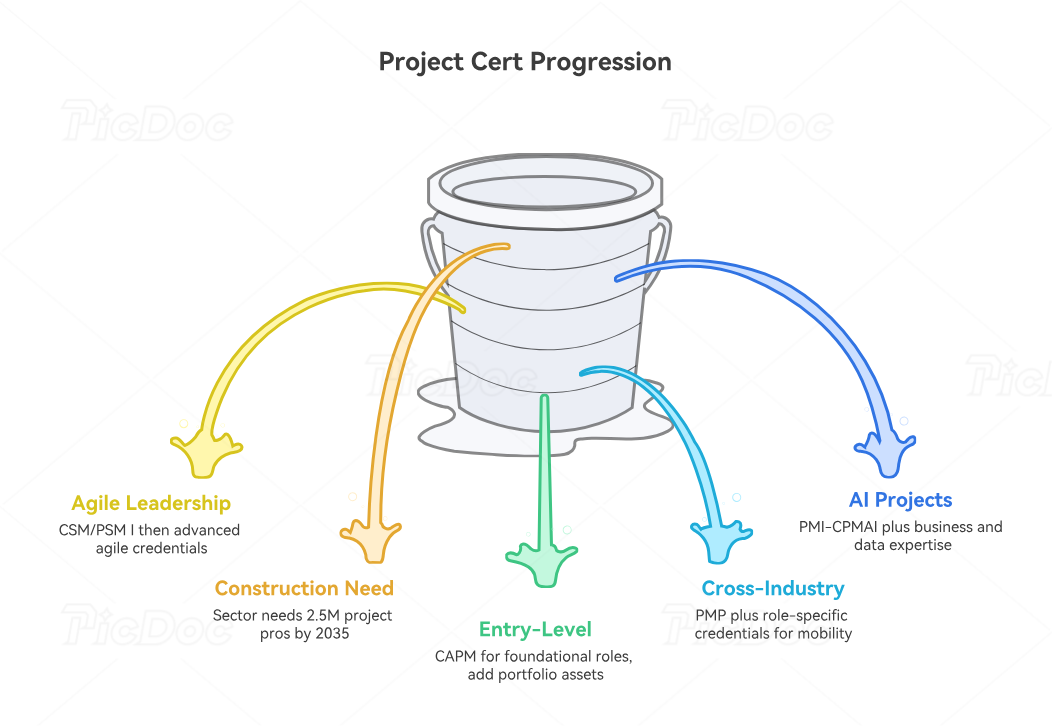
Start with CAPM when target vacancies request foundational project knowledge and you lack the experience required for PMP. Use CAPM exam-day guidance, build fluency in Gantt chart terminology, study resource allocation concepts, and learn project closure practices. CAPM requires no project experience, though applicants need relevant project management education.
Your first portfolio should contain a charter, work breakdown structure, schedule, RAID log, stakeholder register, status report, and lessons-learned document. These assets allow an employer to inspect your thinking. The candidate who merely writes “CAPM certified” remains difficult to assess; the candidate who shows how scope, risk, milestones, and decisions were managed appears ready for project support work.
Experienced Project Manager Seeking Cross-Industry Mobility
PMP should usually become the anchor credential. Then select one companion based on the vacancies you intend to pursue: PMI-ACP for adaptive delivery, PMI-CPMAI for AI initiatives, PMI-PBA for requirements-led transformation, or PRINCE2 Practitioner for governance-heavy environments. Strengthen commercial credibility through vendor and supplier management, financial management terminology, risk register expertise, and leadership communication concepts.
Agile Delivery or Scrum Leadership
Choose CSM or PSM I for foundational Scrum recognition, then earn an advanced credential after building real delivery experience. Professionals already operating across several agile methods may gain broader signaling from PMI-ACP. Those working inside SAFe organizations should consider SAFe Agilist, SAFe Scrum Master, POPM, Release Train Engineer, or Lean Portfolio Management according to role scope. Scrum Alliance currently maintains clear progression routes through CSM, A-CSM, and CSP-SM, while its product owner pathway progresses from CSPO toward advanced and professional levels.
Pair the credential with evidence: reduced cycle time, improved sprint predictability, stronger refinement, lower work-in-progress, better stakeholder feedback, or successful conflict resolution. Study sprint planning terminology, Scrum vocabulary, agile project tools, and Scrum platforms. A certificate proves structured learning; measurable flow improvement proves professional value.
AI Project or Transformation Leader
Pair PMI-CPMAI with PMP, PMI-PBA, product ownership, data governance, or sector expertise. Build a portfolio containing an AI opportunity assessment, data-readiness analysis, risk taxonomy, human-oversight model, evaluation plan, adoption roadmap, and benefits case. Explore the future of AI in project delivery, blockchain applications in projects, project management API integrations, and current software adoption patterns.
AI competence requires more than prompt writing. Hiring teams need leaders who can connect an initiative to a business problem, assess data limitations, identify affected stakeholders, establish governance, plan experimentation, manage change, and define acceptable performance. PMI-CPMAI addresses AI project execution from business alignment through operationalization and ongoing monitoring.
Construction, Infrastructure, and Capital Projects
Choose credentials according to decision responsibility. CCM supports construction management leadership; PMI-CP targets construction project practice; CCP strengthens cost engineering; EVMP supports performance measurement; PMI-SP deepens scheduling credibility; and PMP provides broader leadership recognition. The sector’s projected talent need makes this a significant certification-growth area: PMI’s 2026 research estimates construction may require nearly 2.5 million additional project professionals by 2035.
Candidates should study construction project software, future construction delivery trends, earned value terminology, and schedule compression techniques. Construction employers often care deeply about change control, procurement, claims, schedule integrity, safety, payment, field coordination, and forecast accuracy. A generic credential stack that ignores these commercial realities produces weak interview credibility.
5. How to Choose a Certification That Produces Career ROI
Begin with job-market evidence. Collect at least 30 relevant vacancies across your target location, industry, seniority, and employer type. Record each requested certification, methodology, tool, regulatory requirement, experience threshold, and technical skill. Compare demand in specific markets through resources such as project management careers in Illinois, opportunities in Pennsylvania, Georgia’s project management market, and Arizona project management careers. Marketing popularity should never substitute for vacancy-level demand.
Calculate total certification ownership cost. Include required training, exam fees, retakes, membership, books, practice tools, renewal fees, continuing education, travel, and time away from paid work. Scrum Alliance certifications, for example, operate with two-year terms and education-unit requirements that vary by credential level. PRINCE2 and PMI credentials also have maintenance considerations that should enter the ROI calculation.
Evaluate the provider’s assessment rigor. A credential that requires relevant experience, scenario-based judgment, supervised training, or competence evidence usually carries a stronger signal than an unrestricted completion badge. Examine the exam content outline, eligibility rules, renewal structure, authorized training network, and verification process. Use PRINCE2 training-provider comparisons, PMP preparation resources, SAFe exam preparation guidance, and agile credential comparisons to inspect the full pathway.
Finally, design proof assets before the exam. Create anonymized documents that show how you define scope, evaluate options, control change, forecast outcomes, resolve conflict, communicate status, and capture benefits. Use professional project management templates, apply sound quality management terminology, understand relevant ISO standards, and strengthen your project closure discipline. Employers hire professionals who can reduce delivery uncertainty. Your credential should make that capability easier to see.
6. FAQs About the Future of Project Management Certifications
-
PMP is likely to remain the broadest global leadership credential because it combines experience requirements with cross-industry coverage. Its 2026 exam now gives greater attention to business environment, AI, sustainability, stakeholder engagement, outcomes, and value. PRINCE2 will retain strong regional and governance-heavy demand, while PMI-ACP, Scrum, and SAFe will lead different agile segments. Specialist credentials will dominate narrower functions where technical depth outweighs general recognition.
-
AI credentials will usually complement PMP. PMP validates broad project leadership, while PMI-CPMAI addresses the distinctive lifecycle and governance demands of AI initiatives. A combined pathway can support professionals leading automation, analytics, machine learning, or AI-enabled transformation. Candidates should also understand AI’s impact on PM careers, machine-learning estimation, and emerging software automation trends.
-
CAPM remains valuable for aspiring project coordinators, analysts, administrators, and career switchers whose target employers recognize PMI. Its coverage includes predictive project management, agile principles, and business analysis, giving beginners a broader foundation. The strongest candidates combine CAPM preparation with project documents, volunteer delivery experience, software competence, and a planned route for using CAPM professionally.
-
Choose according to employer demand and operating environment. PMP usually offers broader international and cross-industry recognition. PRINCE2 Practitioner can offer stronger alignment with organizations that use structured governance, management stages, tolerances, and defined project roles. Review a detailed PMP versus PRINCE2 comparison, then inspect target vacancies. Some senior professionals gain value from holding both because the credentials validate different aspects of project leadership.
-
PMI-ACP has strong potential for professionals working across several agile approaches. CSM and PSM remain accessible Scrum credentials, while A-CSM, CSP-SM, PSM II, and PSM III create deeper practitioner signals. SAFe certifications will remain valuable inside enterprises using SAFe. Use the A-CSM preparation guide, SAFe Agilist exam guide, and Scrum glossary to compare depth, role alignment, and progression.
-
Specialist credentials can produce greater ROI when the target role depends on a defined technical discipline. A construction manager may gain more immediate credibility from CCM certification, a cost professional from CCP certification, a controls professional from EVMP certification, and a business analyst from PMI-PBA preparation. PMP becomes especially powerful when paired with such domain depth.
