
SAFe Agilist Certification Guide: How to Pass Your Exam Successfully
The SAFe Agilist certification validates your ability to connect enterprise strategy, Lean-Agile leadership, Agile Release Trains, product development flow, portfolio funding, and organizational change. Passing requires deeper preparation than memorizing the top project management terms or reviewing basic Scrum roles. You need to understand how value moves through an enterprise, how leaders remove delivery friction, and how decisions affect teams, customers, portfolios, and business outcomes. This guide provides a practical preparation system for the current exam.
1. What the SAFe Agilist Certification Covers and Who Should Take It
The SAFe Agilist credential is earned through the Leading SAFe learning and examination pathway. Scaled Agile currently describes it as a foundational certification for professionals who want to lead Lean-Agile enterprises, align strategy with execution, improve enterprise delivery, and apply AI-supported practices in complex organizations. The certification page lists no formal prerequisites, making the pathway accessible to aspiring leaders as well as experienced managers, product professionals, Agile coaches, consultants, and transformation specialists.
Accessibility still requires preparation. Candidates with experience in Agile project-management tools, Scrum platforms, Kanban software, stakeholder engagement, or project risk management may recognize parts of the language, yet SAFe examines how these practices operate across multiple teams and organizational levels. A candidate who only understands a single Scrum team may struggle with Agile Release Trains, portfolio alignment, Lean budgeting, value streams, and enterprise transformation.
The certification is particularly relevant for professionals working in large organizations where several teams contribute to shared products, platforms, programmes, or value streams. Project managers can use it to understand how traditional project scheduling, resource allocation, budget management, vendor coordination, and executive reporting interact with decentralized decision-making, iterative delivery, product thinking, and flow. Scrum Masters can develop an enterprise view beyond team ceremonies, while product managers can strengthen their understanding of portfolio strategy, ART backlogs, PI Planning, and customer-centric delivery.
The current Leading SAFe pathway also includes AI-empowered content. The updated examination covers AI applications within SAFe, practical prompting, and responsible AI. Scaled Agile has moved away from traditional framework version labels for this course and now identifies releases by date; the current AI-Empowered SA courseware was introduced under the 2026.02.24 release. Candidates using older “SAFe 6 exam dumps” or legacy notes may therefore miss assessed material even when many foundational concepts remain familiar.
Your professional objective should determine whether this is the right certification. A team member seeking detailed daily execution practices may gain more direct value from SAFe Practitioner. Someone pursuing a Scrum Master role may prefer the role-focused SAFe Scrum Master pathway. Product owners may require SAFe Product Owner/Product Manager, while transformation leaders who want to teach SAFe or guide implementation may eventually pursue SAFe Practice Consultant. The SAFe Agilist pathway serves professionals who need a broad leadership and enterprise-delivery perspective connecting strategic governance, team communication, customer value, portfolio risk, and organizational change.
A common candidate pain point appears during the first practice test. The course material feels logical during instruction, yet the questions use several plausible options. Each answer may contain familiar terminology, while only one aligns fully with SAFe principles, role ownership, flow, customer value, and the decision level described. The matrix below shows the knowledge weaknesses that commonly create these mistakes and the evidence that demonstrates genuine readiness.
| Knowledge Area | What You Must Understand | Common Exam Trap | Readiness Evidence | Best Revision Action |
|---|---|---|---|---|
| Business agility | How the enterprise responds to market change through faster learning and value delivery | Treating agility as faster software development | You can connect strategy, people, flow, technology, and customer outcomes | Explain business agility using a non-IT example |
| Lean-Agile mindset | How Lean thinking and Agile values influence leadership decisions | Memorizing values without applying them | You can select behavior consistent with respect, flow, learning, and value | Translate each principle into a management action |
| Core Values | Alignment, transparency, respect for people, and relentless improvement | Choosing a technically correct action that weakens transparency | You can identify which value a scenario places under pressure | Create one workplace example for every value |
| SAFe principles | The economic and systems-thinking logic behind SAFe decisions | Recalling names while missing decision implications | You can explain why a principle changes prioritization or governance | Build a principle-to-scenario revision sheet |
| Systems thinking | How local decisions affect the wider value-delivery system | Optimizing one team while damaging overall flow | You can identify downstream constraints and feedback effects | Map one end-to-end value stream |
| Economic view | How decisions account for cost, delay, value, risk, and trade-offs | Prioritizing the loudest stakeholder request | You can compare options through economic impact | Practise cost-of-delay scenarios |
| Decentralized decisions | Which decisions remain strategic and which can move closer to the work | Escalating every decision to senior management | You can explain the cost and frequency logic behind decentralization | Classify ten decisions by appropriate authority level |
| Value streams | How organizations organize around continuous value delivery | Confusing departments, projects, and value streams | You can trace value from trigger to customer outcome | Map operational and development value streams |
| Agile Release Train | How long-lived teams align around a shared mission and cadence | Describing an ART as a temporary project team | You can explain ART purpose, roles, cadence, and outcomes | Draw an ART operating model from memory |
| Cross-functional teams | How teams contain enough capability to deliver meaningful value | Equating cross-functionality with every person doing every job | You can explain skill coverage and collaborative ownership | Evaluate capability gaps in a sample team |
| Built-in quality | How quality becomes part of every delivery activity | Leaving quality verification until the release stage | You can connect quality practices with faster flow and lower rework | List quality controls across the delivery lifecycle |
| DevOps | How development, operations, automation, and continuous learning support delivery | Reducing DevOps to deployment automation | You can explain cultural and technical dimensions | Map the continuous delivery pipeline |
| Customer-centricity | How customer needs guide product decisions | Allowing internal assumptions to replace customer evidence | You can distinguish output requests from customer outcomes | Rewrite feature requests as customer problems |
| Design thinking | How teams explore problems and develop desirable solutions | Jumping directly from request to implementation | You can explain personas, empathy, problem framing, and validation | Build a short customer-problem case |
| ART backlog | How features are refined, prioritized, and prepared for delivery | Confusing features with team-level stories | You can describe hierarchy, ownership, and readiness | Decompose a feature into team-level work |
| WSJF | How relative cost of delay and job size support prioritization | Ranking work through business value alone | You can calculate and interpret WSJF correctly | Complete at least ten prioritization examples |
| PI Planning | How teams align objectives, dependencies, capacity, and risks | Viewing PI Planning as a detailed task-assignment meeting | You can explain inputs, outputs, participants, and decision points | Reconstruct the event from preparation to commitment |
| PI Objectives | How teams communicate intended business and technical outcomes | Writing objectives as activity lists | You can create measurable outcome-focused objectives | Convert ten tasks into objectives |
| Program risks | How risks are surfaced and addressed during planning | Leaving every risk with an undefined owner | You can apply the ROAM logic appropriately | Classify sample risks through each response category |
| PI execution | How teams maintain alignment and adapt during the increment | Assuming the PI plan becomes fixed after commitment | You can explain synchronization, review, adjustment, and learning | Map the main execution feedback loops |
| Inspect and Adapt | How ARTs measure outcomes, identify systemic problems, and improve | Using the event as a general retrospective | You can explain quantitative review and structured problem-solving | Practise root-cause analysis on a flow problem |
| Lean Portfolio Management | How strategy, investment, governance, and portfolio flow connect | Treating the portfolio as a collection of approved projects | You can connect strategic themes with value-stream funding | Build a one-page portfolio logic map |
| Lean budgets | How funding moves toward value streams with appropriate controls | Assuming Lean budgeting removes financial governance | You can explain funding flexibility and guardrails | Compare project funding with value-stream funding |
| Portfolio guardrails | How spending remains aligned with strategy and responsible governance | Describing guardrails as restrictive approval gates | You can explain the purpose of each governance boundary | Create scenarios where a guardrail protects value |
| Portfolio flow | How epics move from idea through analysis and implementation | Starting too much work without controlling WIP | You can identify queues, bottlenecks, and policy decisions | Visualize an example Portfolio Kanban |
| Lean-Agile leadership | How leaders model behavior and create the conditions for agility | Expecting teams to transform while leadership behavior remains unchanged | You can identify leadership actions that enable autonomy and learning | Write a leadership response for five resistance scenarios |
| Leading change | How transformation gains urgency, participation, reinforcement, and momentum | Relying entirely on training or executive announcements | You can explain a sustained change approach | Map stakeholders, resistance, and reinforcement mechanisms |
| AI-empowered SAFe | How AI can support analysis, leadership, flow, and decision-making responsibly | Selecting AI output without validation, context, or governance | You can create effective prompts and evaluate responsible use | Practise role-specific prompts with review criteria |
2. SAFe Agilist Exam Format, Domains, Scoring, and Current Rules
The current AI-Empowered SAFe Agilist examination contains 45 multiple-choice, single-select questions. Candidates receive 90 minutes, the exam is web-based and closed book, and the passing score is 80%. Scaled Agile calculates the result from correctly answered questions, while unanswered items count as incorrect. This means candidates should aim for at least 36 correct answers and should provide a response to every question before time expires.
The average time available is two minutes per question. That sounds generous until a candidate reaches a scenario involving PI Planning, Lean budgeting, prioritization, leadership behavior, or portfolio flow. A disciplined approach resembles strong issue-tracking practice, schedule control, risk assessment, stakeholder analysis, and conflict diagnosis. You identify the situation, locate the governing principle, eliminate choices that create delay or weaken flow, and select the answer that supports the wider system.
The largest examination domain is Product Development Flow, representing approximately 25–28% of the questions. It covers customer-centricity, design thinking, ART backlog prioritization, PI Planning, and PI execution. A learner who feels comfortable with Agile terminology but cannot distinguish a feature from a story, explain PI Objectives, identify PI Planning outputs, or reason through WSJF may lose a major share of available marks. Your revision should connect these concepts with Agile delivery tools, Scrum platforms, Kanban systems, resource planning, and team communication.
Two other heavily weighted domains deserve equal attention. Building a Foundation with Mindset, Values, and Principles represents approximately 21–23%, while Lean Portfolio Management also represents approximately 21–23%. Together, these areas may account for close to half the examination. The first covers the Lean-Agile mindset, SAFe Core Values, SAFe principles, and AI-supported agility. The portfolio domain includes portfolio definition, strategic connection, portfolio vision, flow, Lean budgets, and guardrails. Candidates with traditional project budgeting, procurement management, contract governance, project reporting, and vendor oversight experience should pay close attention to how SAFe changes decision authority and funding logic.
Establishing Team and Technical Agility accounts for approximately 10–12%. This domain covers cross-functional Agile teams, Agile Release Trains, built-in quality, DevOps, and the continuous delivery pipeline. Adapt and Thrive with SAFe and Lead the Change each represent approximately 7–9%. Smaller percentages can still determine the result, especially when the pass requirement allows limited mistakes. A learner scoring strongly in PI Planning may still fail after neglecting quality-management terminology, team-building concepts, communication techniques, organizational risk, and leadership conflict.
The official practice test deserves serious use because it mirrors the exam’s question count, domain areas, timebox, and expected difficulty. Scaled Agile allows unlimited practice-test attempts and provides question-level feedback with references after an attempt. Passing the practice assessment offers evidence of progress, while the organization explicitly states that it does not guarantee an examination pass. Repeatedly clicking through the same answers produces inflated scores, so each attempt should be followed by analysis similar to reviewing project dashboards, reporting analytics, quality failures, schedule variance, and risk-response effectiveness.
Under the examination policy introduced in April 2026, SAFe Agilist is treated as a foundational certification. Candidates completing the course under the current policy receive two examination attempts within 60 days of course completion. A third attempt requires payment and becomes available immediately after the first two unsuccessful attempts. A fourth overall attempt requires a ten-day wait, while the fifth and subsequent attempts require 30-day intervals. This structure gives candidates valuable protection, although using the first attempt as an unprepared trial can waste time, confidence, and the strongest retention period after training.
3. How to Build a SAFe Agilist Study Plan That Produces a Passing Score
An effective preparation plan begins with the official learning objectives and domain percentages. Divide your study time according to exam weight, current weakness, and conceptual dependency. Product Development Flow, Lean Portfolio Management, and mindset-principle questions deserve the largest blocks. Team and Technical Agility should follow, with targeted revision for transformation leadership and business agility. This approach resembles intelligent resource allocation, project scheduling, critical-path management, workforce planning, and risk-based prioritization.
During the first phase, build a conceptual map rather than producing hundreds of disconnected flashcards. Connect business agility with Lean-Agile leadership, then connect leadership with principles, value streams, ART design, portfolio funding, and change. Connect customer-centricity with design thinking, features, WSJF, PI Planning, PI execution, and Inspect and Adapt. The exam becomes easier when you understand these relationships because unfamiliar wording can still be traced to a known system. Use project initiation concepts, stakeholder terminology, quality-management language, team-role clarity, and reporting discipline to support those connections.
The second phase should convert concepts into scenarios. Ask how a leader responds when teams depend on centralized approvals, how an ART handles an unresolved risk, how portfolio leaders address excess work in process, how teams create customer evidence, and how economic prioritization changes backlog order. Each scenario should identify the affected level: team, ART, solution, portfolio, or enterprise. Many incorrect answers describe a useful action at the wrong organizational level. Practising stakeholder mapping, escalation decisions, project communication, risk ownership, and decision reporting helps strengthen this diagnostic skill.
Create an error log from the first practice session. For every incorrect response, record the domain, tested concept, clue you missed, reason your answer appeared attractive, principle supporting the correct option, and revision source. Categorize errors as knowledge gaps, role confusion, terminology confusion, rushed reading, weak elimination, or overthinking. After 50–100 questions, patterns will become visible. A learner may discover that most mistakes involve portfolio-level decisions, even though the overall score originally suggested broad weakness. This method follows the same logic as project issue tracking, quality root-cause analysis, dashboard reporting, risk monitoring, and continuous improvement.
A two-week study plan can work for candidates with strong Agile experience and recent course attendance. The first three days can cover mindset, values, principles, business agility, and leadership. The next three can address team agility, ARTs, quality, DevOps, and the delivery pipeline. Four days should then focus on product development flow, while three days cover portfolio management and change leadership. The final day should combine a timed assessment, error review, and targeted revision. Candidates with limited Agile exposure should expand this structure across four to six weeks and use Scrum role guidance, Agile software comparisons, Kanban platforms, team communication systems, and project-management integrations to create practical context.
Your final readiness test should include fresh questions completed under exam conditions. Use a closed-book environment, silence notifications, apply the 90-minute time limit, and complete every question. A score near the exact passing threshold leaves little protection against stress, unfamiliar wording, or concentration loss. Aim for repeatable results above the required score and the ability to explain why each correct option fits SAFe. The explanation requirement prevents answer-pattern memorization and develops the reasoning needed for budget decisions, stakeholder trade-offs, flow constraints, quality choices, and leadership conflicts.
4. How to Answer Difficult SAFe Agilist Exam Questions
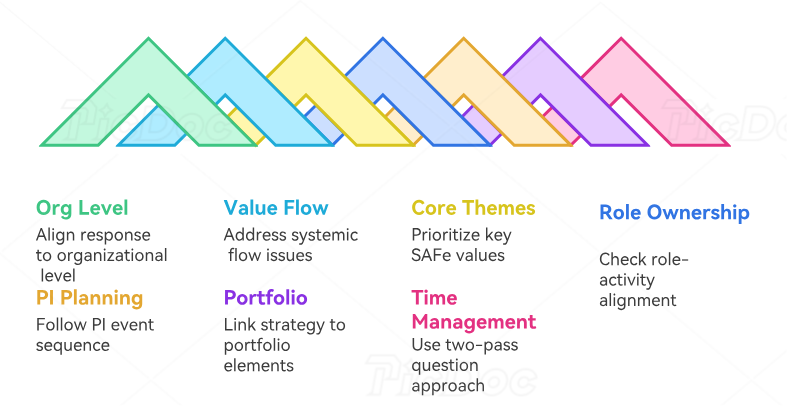
Begin every scenario by identifying the organizational level. A question about one Agile team requires a different response from a question about an ART, portfolio, or enterprise transformation. Many distractors present useful practices at the wrong level. A senior leader should create enabling conditions, alignment, and appropriate decision boundaries rather than directing individual team tasks. A portfolio decision should protect strategic alignment and investment flow rather than resolve a minor delivery issue. This level-based reasoning complements project governance, stakeholder authority, resource management, communication planning, and risk escalation.
Next, identify the value-flow problem. The scenario may describe excessive work in process, delayed feedback, functional handoffs, weak customer evidence, centralized decisions, hidden dependencies, quality problems, or funding constraints. Choose the response that addresses the systemic cause and improves end-to-end flow. An option that asks one team to work harder may increase local output while leaving the underlying constraint untouched. Use the same analytical discipline found in critical-path management, schedule compression, issue-tracking systems, quality analysis, and project dashboards.
SAFe questions frequently reward customer value, fast feedback, transparency, decentralized authority, built-in quality, and relentless improvement. Evaluate each answer against these themes. Options that delay validation, hide information, strengthen functional silos, create large batches, or require unnecessary escalation usually deserve greater scrutiny. The strongest answer often improves both learning and delivery while respecting role ownership. Connect this logic with stakeholder engagement, team collaboration, risk transparency, quality controls, and reporting practices.
Role ownership can eliminate several answer choices. Learn what Lean-Agile leaders, Business Owners, Product Management, System Architects, Release Train Engineers, Scrum Masters, Product Owners, Agile teams, Epic Owners, and portfolio stakeholders contribute. A correct activity assigned to the wrong role remains a weak response. Build a role matrix showing decisions, artefacts, events, and accountabilities, then compare it with Scrum responsibilities, human-resource terminology, team-building language, stakeholder influence, and conflict ownership.
For questions involving PI Planning, reconstruct the event sequence. Consider preparation, vision, context, features, architecture, team planning, dependencies, risks, objectives, management review, confidence, and commitment. Determine which output is missing and which participant owns it. Candidates often choose an answer that sounds collaborative but occurs at another point in the event. Practise with a visual map supported by Gantt-chart thinking, dependency management, risk registers, resource planning, and team communication tools.
For portfolio questions, trace the relationship between strategy, development value streams, investment horizons, Lean budgets, guardrails, epics, Portfolio Kanban, and measurable outcomes. Avoid importing rigid project-funding assumptions into a Lean portfolio scenario. The goal is strategic alignment with responsible financial governance and controlled portfolio flow. Strengthen this area through budgeting terminology, cost-management principles, project reporting, dashboard analytics, and risk-assessment concepts.
Manage time through two deliberate passes. During the first pass, answer questions you can resolve through a clear principle or role distinction. Flag questions requiring deeper comparison and return after completing the full set. Since unanswered questions count as incorrect and the timer continues until submission, complete an answer for every item. Change a response only when you identify a missed clue, incorrect role assumption, misunderstood term, or stronger governing principle. Anxiety alone provides poor grounds for revision.
5. Common Failure Reasons, Retakes, Renewal, and Career Value
Candidates frequently fail because they memorize definitions without understanding the operating system those definitions create. They can describe PI Planning, WSJF, an ART, and Lean budgets independently, yet cannot explain how strategy becomes funded work, how work moves through trains, how teams coordinate dependencies, and how outcomes inform portfolio decisions. Correct this weakness by linking every topic to adjacent concepts using project initiation, scheduling terminology, risk-management language, stakeholder engagement, and quality governance.
Another major failure pattern comes from outdated preparation material. The current SAFe Agilist assessment includes AI-empowered topics, prompting practices, and responsible AI, while the course-release system now uses release dates. Check every commercial mock exam, video course, downloadable guide, and study note against the current official blueprint. A large question bank offers limited value when it reinforces legacy wording or excludes entire assessed areas. Use current material alongside Agile software knowledge, Scrum platforms, Kanban systems, project-management integrations, and team collaboration tools.
Overconfidence after course attendance creates another painful outcome. Instructor explanations and group exercises make concepts feel easier because context and guidance remain available. The closed-book exam requires independent recognition under time pressure. Complete the official practice assessment, review every missed question, revisit weak lessons, and test yourself with fresh examples. Scaled Agile provides unlimited practice-test attempts, although repeated exposure can create answer memory. Track performance by domain through analytics thinking, dashboard design, issue classification, quality analysis, and risk monitoring.
After an unsuccessful attempt, use the coaching or performance feedback to identify the weakest domains before retesting. Current foundational policy provides two included attempts within the 60-day window for eligible course registrations under the updated policy. Further attempts involve fees and waiting periods. Spend the recovery period rebuilding reasoning rather than repeatedly rereading the workbook. Recreate the difficult scenarios, explain the correct principle aloud, and write a different example that tests the same decision.
Certification maintenance also deserves advance planning. SAFe Agilist sits in the Foundational certification tier, currently priced at $195 per year plus applicable tax. The Foundational renewal tier covers SAFe Agilist and other foundational credentials held by the same professional. Renewal maintains access to the active credential, badge, learning assets, Framework content, professional resources, and Studio benefits. Scaled Agile states that expired credentials can be renewed later without a late fee or examination retake, although expired certificate copies remain inaccessible until renewal.
Career value comes from applying the knowledge to visible business problems. Update your CV with the credential, then show where you improved portfolio transparency, reduced handoffs, strengthened PI Planning, accelerated feedback, clarified dependencies, supported customer-centric prioritization, or improved delivery flow. Pair the badge with evidence from project reporting, resource-allocation systems, project dashboards, Agile tools, and stakeholder communication.
Prepare interview stories around enterprise alignment, cross-team dependencies, flow improvement, customer discovery, portfolio prioritization, and organizational resistance. Explain the situation, systemic constraint, competing options, principle used, intervention, and measurable outcome. Employers gain more confidence from a candidate who can diagnose a dysfunctional operating model than from someone who lists SAFe terminology. The credential becomes strongest when combined with risk-control evidence, budget decisions, conflict resolution, quality improvement, and executive reporting.
6. Frequently Asked Questions About the SAFe Agilist Certification
-
The current AI-Empowered SAFe Agilist examination has 45 multiple-choice, single-select questions. Candidates receive 90 minutes, and the assessment is delivered online as a closed-book examination without outside assistance. The passing score is 80%. Prepare through the current study guide, official practice assessment, Agile project-management tools, Scrum role guidance, stakeholder terminology, and risk-management concepts.
-
An 80% passing threshold across 45 equally scored questions means you should target at least 36 correct responses. Scaled Agile states that scores are calculated from correctly answered questions and that unanswered questions count as incorrect. Build a performance buffer by strengthening portfolio budgeting, product prioritization, team coordination, quality practices, and delivery risk.
-
The difficulty usually comes from scenario interpretation and closely related answer choices. Candidates must apply SAFe principles across teams, ARTs, portfolios, and enterprise leadership rather than recall isolated definitions. Strong preparation connects Scrum responsibilities, project scheduling, stakeholder influence, risk responses, and project reporting with SAFe’s enterprise operating model.
-
The current SAFe Agilist certification page classifies the pathway as foundational and lists no formal prerequisites. It is aimed at current and aspiring leaders, including executives, directors, product managers, and Agile coaches. Prior experience with Agile tools, Kanban software, team communication, resource management, and stakeholder engagement can make the material easier to apply.
-
Scaled Agile’s current SAFe Agilist certification page states that the training course is not required and provides an exam-purchase route, including a proctored option. Course attendance can still provide structured instruction, exercises, instructor clarification, and guided access to the learning plan. Self-directed candidates should compare their readiness across Lean-Agile principles, Scrum roles, portfolio budgeting, risk governance, and leadership communication.
-
Under the current foundational exam policy, qualifying SAFe Agilist registrations include two attempts within 60 days. A third overall attempt requires a fee and can be taken immediately after the first two failures. The fourth attempt requires a ten-day wait, while later attempts require 30-day waiting periods. Use the gap to analyse exam errors, strengthen risk reasoning, review stakeholder decisions, improve quality analysis, and practise issue diagnosis.
