
Real-Life Agile Certification Success Stories: Career Growth & Insights
Agile certification success rarely begins with an exam result. It begins when a professional uses structured learning to solve a career problem: weak credibility, limited leadership exposure, an outdated role, or difficulty translating delivery experience into language employers recognize. The most instructive career stories show how certification supported a wider transformation involving workplace experiments, measurable results, stronger professional networks, and clearer positioning. These stories reveal which actions create momentum after certification and why collecting badges without building evidence produces disappointing returns.

1. What Real Agile Certification Success Actually Looks Like
A promotion, salary increase, or new job may be the most visible outcome of an Agile certification, although the deeper career shift usually happens earlier. The professional begins diagnosing delivery problems differently, communicating with greater precision, facilitating decisions more confidently, and demonstrating skills that extend beyond maintaining a board or scheduling Scrum events.
This distinction is crucial because hiring managers frequently encounter applicants who have completed training yet cannot explain how they improved a team. A credible candidate can connect certification knowledge to specific results involving stakeholder engagement, project communication, conflict resolution, risk identification, and project reporting.
Scrum Alliance reports that 71% of Certified ScrumMasters took the course to advance their careers. Its published career information also states that certification can help candidates differentiate themselves in the employment market, while continuing education and professional community access remain important parts of the certification experience.
The strongest success stories therefore contain four elements. The person had a defined obstacle, selected education that addressed it, applied the learning in a real environment, and documented the resulting change. That change might involve shorter decision delays, healthier retrospectives, stronger product ownership, lower work-in-progress, more transparent dependencies, or improved cooperation across functions.
A professional moving from traditional project management into Scrum, for example, may already understand project initiation terminology, Gantt chart concepts, critical-path terminology, project budgeting language, and schedule-compression techniques. Certification can help that person replace excessive control with empirical planning, team ownership, iterative delivery, and evidence-based adaptation.
The career value also depends on the target environment. A foundational Scrum credential may help an aspiring Scrum Master establish baseline credibility. A product-focused certification can support movement toward product ownership. PMI-ACP may suit professionals operating across multiple Agile approaches, while SAFe credentials can be useful in enterprises that organize delivery around scaled roles and structures. Scaled Agile’s 2026 career guidance emphasizes that certification remains a valuable signal, while real outcomes, leadership capability, hybrid-working skills, and continuous learning carry greater weight than impressive titles alone.
That is the central lesson behind almost every credible story: the certification opens a conversation, and applied evidence determines where that conversation leads.
| Starting position | Useful certification direction | Career obstacle addressed | Proof asset to build | Realistic next opportunity |
|---|---|---|---|---|
| Project coordinator | CSM, PSM I, or equivalent foundational Scrum education | Limited ownership beyond status tracking | Facilitation record showing decisions, actions, and reduced meeting waste | Junior Scrum Master or Agile coordinator |
| Traditional project manager | PMI-ACP, CSM, or SAFe Agilist | Resume presents only predictive delivery experience | Hybrid case study combining [project scheduling](https://apmic.org/blogs/comprehensive-guide-to-project-scheduling-terms-2025) with iterative planning | Agile project manager or delivery lead |
| Business analyst | CSPO, PSPO, or Agile product education | Requirements experience is framed as documentation work | Backlog-refinement and stakeholder-decision portfolio | Product owner or product analyst |
| Software tester | CSM, PSM, or Agile team certification | Career identity is restricted to test execution | Quality experiment using [project quality terminology](https://apmic.org/blogs/essential-project-quality-management-terms-defined) | Scrum Master, quality coach, or delivery facilitator |
| Developer | PSM, CSM, or Scrum developer education | Technical impact remains invisible outside coding tasks | Evidence of facilitation, mentoring, and impediment removal | Technical Scrum Master or engineering lead |
| Team lead | A-CSM, PSM II, or advanced facilitation training | Directive habits reduce team ownership | Before-and-after team decision model | Senior Scrum Master or Agile team coach |
| Operations professional | Kanban, PMI-ACP, or foundational Agile certification | Agile experience appears unrelated to operations | Flow analysis supported by [Kanban software](https://apmic.org/blogs/complete-directory-of-kanban-software-tools-2026-2027-rankings) | Flow manager or continuous-improvement lead |
| PMO analyst | SAFe Agilist, PMI-ACP, or Scrum certification | Experience is associated with governance administration | Lean governance and reporting redesign | Agile PMO analyst or transformation coordinator |
| Military veteran | Scrum Master or SAFe certification | Leadership experience is difficult for civilian recruiters to interpret | Translation map connecting service leadership to Agile responsibilities | Scrum Master or program-delivery role |
| Teacher or trainer | CSM, PSM, or Agile coaching education | Facilitation ability lacks corporate delivery context | Workshop portfolio linked to measurable team decisions | Agile facilitator, learning lead, or Scrum Master |
| HR professional | Agile HR or Scrum foundation certification | Limited exposure to delivery teams | People-process experiment using [HR management tools](https://apmic.org/blogs/best-hr-management-tools-for-project-based-teams) | Agile HR partner or transformation specialist |
| Marketing manager | Agile marketing, Scrum, or Kanban training | Campaign work suffers from shifting priorities | Campaign backlog and feedback-cycle case study | Agile marketing lead |
| Product owner | Advanced product-owner certification | Backlog management is mistaken for product leadership | Outcome-based prioritization record | Senior product owner or product manager |
| Scrum Master | A-CSM, PSM II, or advanced SAFe Scrum Master path | Career has stalled at ceremony facilitation | Coaching, conflict, and systems-improvement portfolio | Senior Scrum Master or team coach |
| Senior Scrum Master | CSP-SM, PSM III, SPC, or coaching education | Influence remains limited to one team | Cross-team dependency and leadership-coaching results | Agile coach or transformation lead |
| Program manager | SAFe Agilist, RTE, or PMI-ACP | Coordination relies on status escalation | Program-flow dashboard using [reporting analytics software](https://apmic.org/blogs/best-project-reporting-amp-analytics-software-for-pms) | Release Train Engineer or enterprise delivery lead |
| Portfolio professional | Lean portfolio or SAFe leadership certification | Investment decisions are disconnected from delivery evidence | Portfolio prioritization and value-flow case | Lean portfolio manager |
| Consultant | Advanced Scrum, SPC, or coaching certification | Advice lacks an independently verifiable specialty | Client outcomes and transformation playbook | Agile transformation consultant |
| Procurement specialist | Agile foundation plus contracting education | Traditional contracts restrict incremental delivery | Adaptive procurement case using [contract terminology](https://apmic.org/blogs/essential-contract-management-terminology-for-project-managers) | Agile procurement or commercial transformation role |
| Vendor manager | Scrum or scaled Agile education | Supplier relationships depend on handoffs and fixed outputs | Collaborative vendor model using [supplier-management terms](https://apmic.org/blogs/guide-to-vendor-amp-supplier-management-terms-for-pms) | Agile vendor-management lead |
| Construction PM | PMI-ACP or hybrid Agile training | Recruiters assume Agile has no relevance to physical delivery | Hybrid planning case supported by [construction PM software](https://apmic.org/blogs/best-construction-project-management-software-tools) | Digital construction delivery lead |
| Healthcare PM | PMI-ACP, Scrum, or SAFe certification | Compliance demands appear incompatible with adaptation | Controlled feedback-loop and risk-governance example | Healthcare Agile delivery manager |
| Finance professional | SAFe Agilist or Agile foundation certification | Annual funding limits responsiveness | Incremental funding and forecasting proposal | Lean budgeting or transformation analyst |
| Remote-team manager | Advanced facilitation or Scrum certification | Meetings are active while participation remains weak | Remote facilitation system using [communication platforms](https://apmic.org/blogs/best-team-communication-platforms-reviewed-2026-edition) | Distributed delivery lead |
| Unemployed career changer | Entry-level certification selected around a defined role | No direct Agile job title | Volunteer, community, or simulated delivery case | Agile coordinator or junior delivery role |
| Freelancer | Scrum, Kanban, or product certification | Clients see execution capacity rather than leadership value | Client workflow redesign with measured lead-time improvement | Agile delivery consultant |
| Department director | Leading SAFe or Agile leadership education | Transformation is delegated entirely to delivery teams | Leadership-behavior and decision-latency baseline | Enterprise agility sponsor |
| Certification collector | Pause additional exams and apply existing learning | Several badges produce little interview traction | One complete outcome case using [project templates](https://apmic.org/blogs/best-project-management-templates-amp-resources-2026-edition) | A credible application for the intended role |
2. Real-Life Agile Certification Stories and Their Transferable Lessons
Public success stories are most valuable when examined for decisions rather than celebrated as instant transformations. The individuals below entered Agile from different backgrounds, yet each story demonstrates how professional growth emerged from a combination of learning, practice, reflection, and widening influence.
Sander Dur: From PMO Work and Burnout to Professional Scrum Trainer
In a Scrum.org interview, Sander Dur described beginning in project and PMO work after studying information technology. He encountered Scrum through his professional environment and earned Professional Scrum Master certification around 2015. After experiencing burnout, he reconsidered the motivations behind his career and recognized that helping people develop gave him greater energy and purpose. That reflection contributed to his progression into Scrum Master work and later into the Professional Scrum Trainer community.
The practical lesson extends beyond changing job titles. Dur connected certification with a clearer professional identity. Candidates facing similar dissatisfaction should examine whether they enjoy coaching, facilitation, product work, technical delivery, or organizational improvement before choosing another credential. Reviewing essential Scrum responsibilities, team-building terminology, stakeholder concepts, communication techniques, and conflict-resolution practices can help expose which part of Agile work genuinely fits.
His journey also illustrates that career growth can involve deeper specialization rather than a conventional management promotion. Becoming a trainer expanded the number of people he could support while building on his experience as a practitioner. Professionals who enjoy developing others can follow a similar progression through mentoring, internal communities of practice, workshop facilitation, advanced certification, and eventually formal coaching or education.
Clint Gershenson: Translating Military Leadership Into Agile Delivery
Scaled Agile has profiled Clint Gershenson as a 10-year U.S. Army veteran who later worked as an Agile coach across technical companies and as a Scrum Master within Scaled Agile’s learning and certification organization. His journey demonstrates how leadership experience from one environment can become valuable in another when it is translated into relevant delivery capabilities.
Veterans and other career changers often underestimate transferable experience because their former job descriptions do not contain familiar Agile keywords. Coordinating under uncertainty, developing teams, managing risk, responding to changing conditions, and working across functions already overlap with Agile responsibilities. The candidate must express those experiences through language connected to project risk management, resource allocation, team communication, stakeholder engagement, and issue tracking.
The lesson is especially important for applicants rejected because they have never officially held the title “Scrum Master.” Titles provide fast signals, while well-developed stories reveal actual capability. A military leader, teacher, operations manager, analyst, or customer-service supervisor may already possess facilitation and problem-solving experience. Certification supplies the framework and vocabulary needed to reposition that experience.
Aishwarya Radhakrishnan: Using SAFe to Accelerate an Enterprise Career
Scaled Agile’s certification guide features Aishwarya Radhakrishnan, identified as a SAFe Practice Consultant at Deloitte, stating that SAFe propelled her career exponentially. The same official guidance explains that SAFe certifications can support progression through cross-functional exposure and that advanced paths can lead toward responsibilities such as Scrum Master, Release Train Engineer, architect, product leader, or practice consultant.
The transferable lesson concerns alignment. SAFe credentials have the greatest career leverage when a person works in, consults for, or is targeting organizations that use scaled delivery structures. Someone seeking a small-team Scrum Master role may gain greater immediate value from foundational or advanced Scrum education. Someone targeting transformation work in a major enterprise may need knowledge of portfolio alignment, value streams, program execution, cross-team dependencies, and Lean-Agile leadership.
Before investing, examine job descriptions and identify repeated requirements. Compare those requirements against Agile project-management tools, Scrum platforms, workforce-management software, project-management integrations, and reporting analytics systems. Certification should close a verified market gap.
Ashar Javaid: Connecting Certification With Product and Team Transformation
Scaled Agile also features Ashar Javaid, identified as a SAFe Scrum Master Agilist Team Lead at iCareManager, describing the rewarding experience of seeing positive transformation and faster delivery of high-quality products supported by SAFe principles and practices.
This story highlights an essential career principle: employers reward professionals who connect Agile practices with delivery outcomes. Saying that a team completed every ceremony establishes procedural activity. Explaining that improved prioritization, dependency visibility, feedback, and team coordination supported faster delivery creates a business-focused narrative.
Candidates should collect evidence around the problems employers fund them to solve. That evidence might involve lower defect escape rates, shorter blocked-item age, more stable sprint goals, better retrospective completion, improved stakeholder attendance, or reduced decision time. Supporting knowledge from quality-management terminology, Six Sigma concepts, dashboard tools, project reporting practices, and Kanban software helps turn vague improvement claims into defensible cases.
Scrum Alliance Learners: Using Structured Education to Strengthen Practical Confidence
Scrum Alliance publishes learner testimonials emphasizing interactive education, exposure to diverse professional experiences, and the value of learning from approved trainers. Its broader member guidance also emphasizes networking, continuing education, professional profiles, and resources extending beyond the initial course.
These accounts reveal a quieter form of success. Some professionals need a job change immediately, while others need enough confidence and conceptual structure to contribute more effectively in their existing role. A business analyst may learn to facilitate backlog conversations. A manager may stop assigning every task. A developer may begin exposing delivery risk earlier. A product owner may replace output-based prioritization with clearer customer outcomes.
Those changes can eventually create promotion evidence. The professional should document them through project-management templates, stakeholder-engagement models, project initiation concepts, project quality practices, and risk-assessment terminology.
3. The Career-Growth Patterns Shared by Successful Agile Professionals
The first shared pattern is role clarity. Successful candidates choose a certification because they understand the work they want to perform. They investigate whether their target role prioritizes team coaching, product ownership, enterprise scaling, portfolio governance, delivery management, or broad Agile knowledge.
This prevents an expensive mismatch. A professional targeting Scrum Master roles should explore Scrum responsibilities, Scrum tools, conflict-resolution methods, team-building concepts, and stakeholder-engagement terminology. A future product owner needs stronger evidence around customer discovery, prioritization, product goals, value decisions, and stakeholder negotiation.
The second pattern is immediate application. Successful learners enter training with live workplace problems. They test a new retrospective structure, introduce clearer working agreements, redesign a dashboard, expose a dependency, coach a product owner, or facilitate a decision that had remained blocked. Application turns abstract knowledge into judgment.
The third pattern is evidence collection. Scrum Alliance’s resume guidance encourages professionals to gather tangible information from previous experiences and identify stories showing leadership, contribution, learning, and influence without authority.
A strong portfolio can include a retrospective experiment, anonymized impediment map, stakeholder analysis, decision log, flow dashboard, team-working agreement, and a concise before-and-after case. Tools from the project template directory, issue-tracking software guide, data-visualization review, reporting software comparison, and team communication platform guide can support that portfolio.
The fourth pattern is progressive responsibility. Career growth often moves from helping one team toward supporting several teams, mentoring practitioners, improving cross-team systems, and influencing leadership. Scaled Agile describes a similar progression from entry-level Scrum Master work through senior and team-of-teams responsibilities, with advanced roles requiring broader influence and visible outcomes.
The fifth pattern is continuous learning. Agile careers develop through repeated cycles of education, practice, feedback, and adjustment. Successful professionals combine certification with communities, mentoring, reading, workshops, workplace experiments, and exposure to adjacent disciplines such as contract management, procurement management, resource management, cost management, and project scheduling.
What Is Blocking Your Agile Certification From Producing Career Growth?
4. How to Reproduce These Career Results After Certification
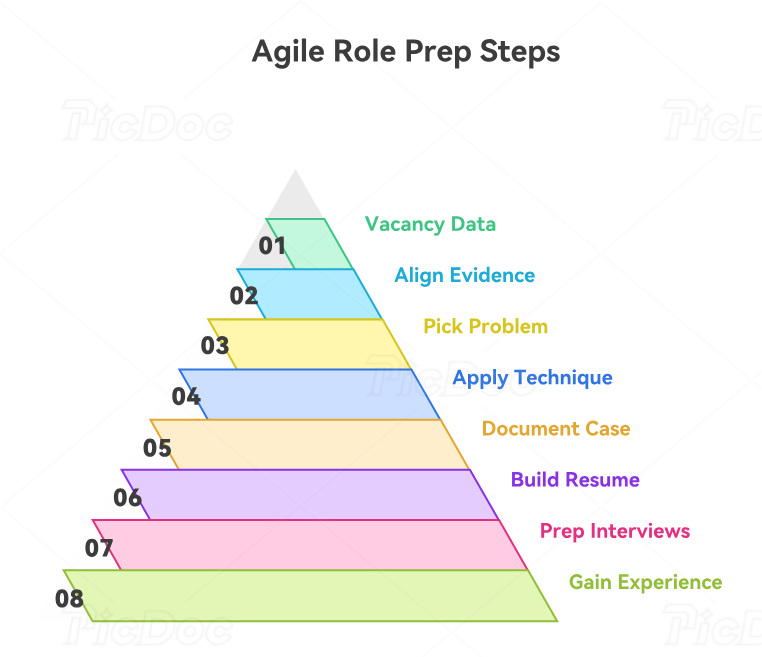
Begin with a target-role audit. Collect 20 relevant vacancies and record the repeated responsibilities, certifications, tools, industries, experience requirements, and business problems. Look beyond the job title because employers may use Scrum Master, iteration manager, delivery lead, Agile project manager, flow manager, or team coach for overlapping positions.
Compare those vacancies with your existing evidence. You may understand risk-management terminology, project budgeting, stakeholder management, contract management, and project reporting, yet your resume may hide those strengths under generic task descriptions.
Next, select one workplace problem that creates visible cost. Examples include repeated carryover, slow approvals, ineffective retrospectives, excessive work-in-progress, unclear sprint goals, stakeholder interruptions, or dependency delays. Establish a baseline before intervening. Measure frequency, duration, age, rework, missed goals, or decision time according to the problem.
Apply one relevant technique from your certification training. Use a focused retrospective, stakeholder workshop, decision protocol, working agreement, flow policy, backlog-refinement structure, or impediment-escalation method. Avoid introducing five practices simultaneously because you will struggle to identify which intervention changed the result.
Document the case using six headings: context, problem, evidence, diagnosis, intervention, and result. Support it with an appropriate project template, Agile software platform, Scrum management tool, Kanban application, or reporting dashboard.
Turn the case into resume evidence. Replace “responsible for daily stand-ups and retrospectives” with a statement that identifies the challenge, your intervention, and the result. Accurate numbers carry greater credibility than inflated percentages. A defensible statement showing a modest improvement can survive interview scrutiny, while an impressive number without measurement logic will collapse under one follow-up question.
Prepare interview stories covering team conflict, failed delivery, stakeholder resistance, product-owner coaching, organizational impediments, and personal learning. Scenario-based interviews test whether you can assess context rather than repeat certification language. Your answers should draw from conflict-resolution concepts, team-building terminology, stakeholder-engagement practices, risk-identification methods, and quality-management language.
Build experience where you currently stand. Facilitate a department retrospective, help a community project organize a backlog, support a nonprofit initiative, mentor a colleague, or run a structured improvement experiment. Scrum Alliance’s resume guidance explicitly suggests using success stories from school or community organizations when direct employment history is limited.
Finally, pursue the next certification only when the target role demands deeper knowledge. A new badge should resolve a defined capability or market gap. It should never become a substitute for applying what you already learned.
5. Choosing the Agile Certification Path That Fits Your Career Story
CSM and PSM I commonly support professionals seeking foundational Scrum knowledge and initial Scrum Master credibility. They can be particularly useful for project coordinators, business analysts, developers, testers, operations professionals, and career changers who need a recognizable starting point. The candidate should combine the credential with knowledge of Scrum roles, project communication, team building, issue tracking, and stakeholder engagement.
A-CSM and PSM II are better aligned with practitioners who already understand the framework and need stronger coaching, facilitation, conflict, and organizational-change capability. These candidates should already be able to describe real team challenges. Advanced education becomes valuable when it helps them move beyond ceremony administration into team-development and systems-improvement work.
Product-owner certifications suit professionals who want to make prioritization, customer, backlog, product-goal, and value decisions. Business analysts often find this path attractive because it extends existing stakeholder and requirements skills. Their development plan should include project initiation concepts, RFP and RFI terminology, vendor-management language, project reporting practices, and dashboard tools.
PMI-ACP can suit professionals who operate across Scrum, Kanban, Lean, hybrid delivery, and broader project-management environments. It may be especially relevant where the organization expects practitioners to understand predictive governance alongside adaptive delivery. Candidates moving from PMP-oriented work can strengthen their transition through PMP preparation resources, PMP exam domains, PMP success stories, PMP renewal guidance, and common PMP mistakes.
SAFe credentials are most useful when the target employer uses SAFe or expects familiarity with enterprise-scale coordination. Scaled Agile states that many organizations using SAFe require or prefer a SAFe or Agile certification, particularly for Scrum Master, product-owner, and Release Train Engineer roles. It also stresses that compensation gains are strongest when certification is combined with experience and demonstrable impact.
International candidates should also consider regional demand, dominant industries, employer maturity, and local salary structures. The certification landscape can differ across Germany, Ireland, Malaysia, South Africa, and New Zealand.
Your best certification is the one that strengthens a career story employers in your chosen market already need.
6. Frequently Asked Questions About Agile Certification Career Growth
-
A foundational certification can help you understand the framework, gain recognizable vocabulary, and pass initial screening requirements. Career changers still need evidence of facilitation, teamwork, problem-solving, adaptation, and stakeholder communication.
Translate experience from previous roles using project-management terminology, stakeholder concepts, risk-management language, communication techniques, and team-building practices.
-
CSM, PSM I, and SAFe Scrum Master are common options. Employer demand, organizational framework, geography, training preference, exam style, and existing experience should guide the selection. Study actual vacancies before enrolling.
Use the target descriptions to identify whether employers emphasize Scrum software, Agile tools, reporting platforms, Kanban systems, or team communication platforms.
-
Certification creates an additional professional signal and may strengthen a promotion or salary discussion. The outcome also depends on experience, industry, location, employer demand, performance, role availability, and evidence of impact.
Scrum Alliance reports that some organizations are willing to pay more for role-relevant certification and demonstrated Agile skills. Scaled Agile similarly emphasizes that compensation gains are strongest when certification is paired with experience and demonstrable results.
-
Begin preparing before the course ends. Update your positioning, build one applied case, practice scenario questions, and start targeted applications once you can explain how your prior experience connects with the role.
Avoid waiting until you feel completely prepared. Use project templates, issue-tracking tools, reporting terminology, and stakeholder language to produce stronger evidence while applying.
-
Your resume may emphasize badges and duties while leaving business impact unclear. Recruiters need to see the role you are targeting, relevant keywords, domain knowledge, transferable experience, and evidence that you can solve the employer’s problems.
Reduce unrelated credentials, strengthen the headline, quantify outcomes, and show examples involving conflict resolution, risk assessment, resource allocation, quality management, and project communication.
-
Start with Agile-compatible problems. Visualize workflow, limit work-in-progress, run a retrospective, introduce shorter feedback cycles, clarify priorities, and measure one improvement. You can demonstrate adaptability without forcing every Scrum event into an unsuitable environment.
A small experiment supported by Kanban software, communication tools, dashboard platforms, and issue-tracking software can become credible portfolio evidence.
