
Career Path to SAFe Agilist: How to Navigate Your Agile Project Management Career
A SAFe Agilist career grows through three assets: recognized knowledge, enterprise delivery exposure, and evidence that your decisions improved value flow. The credential can strengthen a traditional project management career, support a move into Agile project leadership, and create pathways toward Scrum leadership, product management, Release Train Engineer, portfolio, coaching, and transformation roles. This guide explains how to select the right route, earn the credential, build practical proof, and align your development with the future skills expected from project managers.
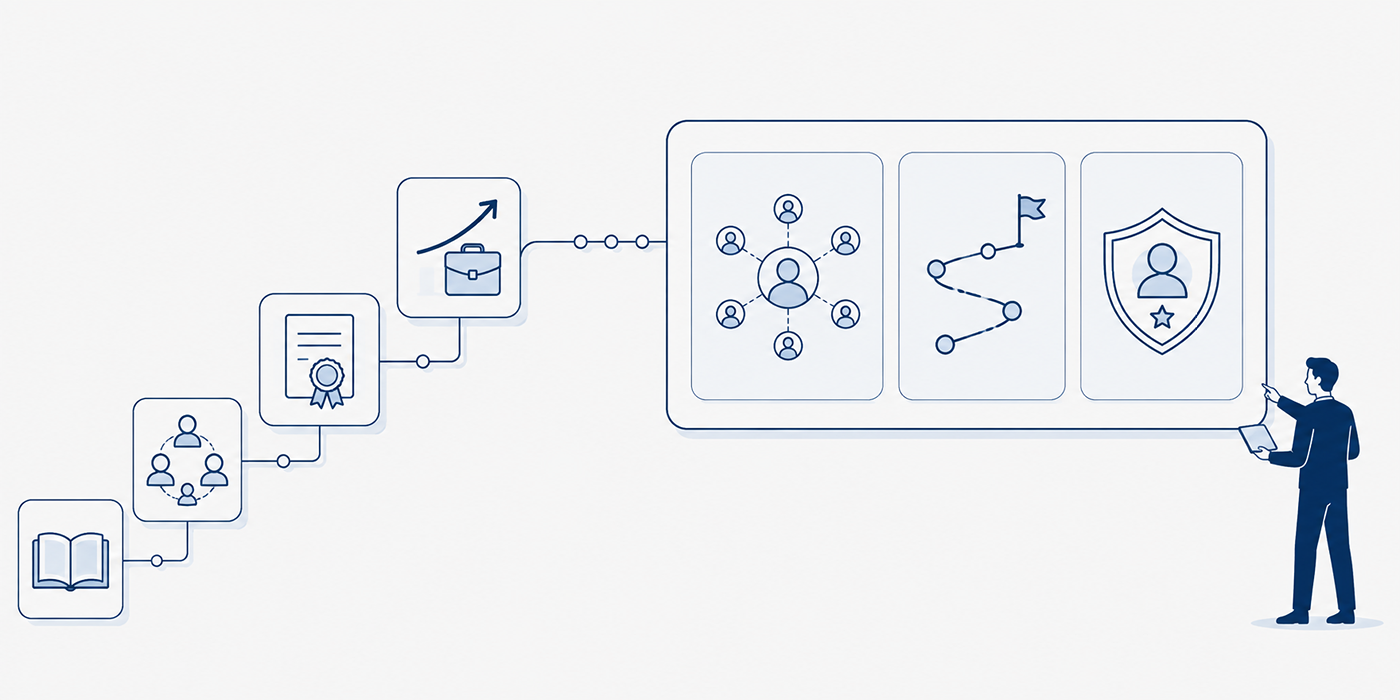
1. What the SAFe Agilist Career Path Looks Like in 2026
The SAFe Agilist credential introduces the enterprise-level principles used to align strategy, portfolios, Agile Release Trains, products, and delivery teams. It gives professionals a common operating language for Agile planning, product backlog management, portfolio governance, and organizational change leadership.
The current official credential is presented as the AI-Empowered SAFe Agilist certification. Scaled Agile describes it as foundational, lists no prerequisites, and currently allows candidates to purchase a proctored exam without completing the training course. The exam contains 45 questions, lasts 90 minutes, and requires an 80% passing score.
This accessibility creates a common career trap. Candidates pass the exam, add the badge to LinkedIn, and immediately target senior Agile Coach or Release Train Engineer positions. Hiring teams then ask about PI Planning, dependency management, flow metrics, portfolio alignment, backlog economics, and transformation resistance. The candidate possesses vocabulary while lacking defensible examples.
The 2026 SAFe Careers Snapshot emphasizes practical outcomes, hybrid leadership, continuous learning, and AI capabilities across roles such as Scrum Master, Product Owner, Product Manager, Release Train Engineer, Architect, Agile Coach, SAFe Practice Consultant, and SAFe Agilist. The report also indicates that evidence of outcomes carries greater weight than titles alone.
A strong SAFe career path therefore has four layers:
Framework literacy: understanding Lean-Agile principles, value streams, ARTs, PI Planning, flow, customer centricity, DevOps, and Lean Portfolio Management.
Role capability: applying the framework through delivery management, product ownership, facilitation, architecture, governance, coaching, or portfolio work.
Business evidence: showing improvements in cycle time, predictability, quality, decision speed, stakeholder alignment, or economic outcomes.
Enterprise influence: helping multiple teams improve the system through resource allocation, risk response planning, project governance, and portfolio prioritization.
Your starting role determines which layer requires the most attention. A project manager may already understand scheduling, budgets, stakeholders, and delivery controls while needing deeper experience with decentralized decision-making and product flow. A Scrum Master may understand team facilitation while needing exposure to portfolio economics and cross-team coordination. A business analyst may bring strong requirements expertise while needing experience connecting features to strategic themes and measurable outcomes.
The credential has the greatest career value when it translates existing strengths into an enterprise Agile context. A project manager can reframe dependency control around ART execution. A PMO analyst can connect project reporting with portfolio flow. A product owner can strengthen prioritization through cost of delay. A change manager can connect adoption activities with the SAFe implementation roadmap.
2. Choosing the Right SAFe Entry Route for Your Existing Experience
Your fastest route uses capabilities you already possess. Starting from zero wastes valuable career capital. Begin by translating your current experience into the language of value streams, flow, customer outcomes, ART execution, and Lean-Agile leadership.
Route A: Traditional Project Manager to SAFe Delivery Leader
Traditional project managers usually bring strong experience in scope, schedules, budgets, vendors, governance, and stakeholder communication. These strengths remain useful inside a scaled Agile environment. The required adjustment concerns how work is planned, governed, and measured.
A predictive project plan may organize delivery around phases and baseline dates. SAFe organizes work around value, backlogs, cadence, synchronization, and economic prioritization. A traditional manager should therefore strengthen Agile estimation techniques, backlog terminology, Agile performance metrics, and hybrid project delivery.
The strongest first target may be Agile Project Manager, Delivery Manager, Program Manager, Scrum Master, or an ART coordination role. Your resume should show how you handled uncertainty, shortened feedback loops, coordinated multiple teams, resolved dependencies, and adjusted plans using evidence.
Route B: Scrum Master to Enterprise-Level Facilitator
A Scrum Master entering SAFe should expand beyond a single team. Enterprise roles require visibility across teams, products, architecture, suppliers, governance groups, and strategic priorities. Facilitation remains valuable, while system-level problem-solving becomes the career differentiator.
Build practical understanding of ART events, PI Objectives, dependency management, Inspect and Adapt, system demos, flow acceleration, and program-level risks. Strengthen your command of Scrum concepts, Kanban flow controls, conflict-resolution techniques, and leadership communication.
A credible progression could move from Scrum Master to SAFe Scrum Master, Advanced Scrum Master, ART facilitator, and Release Train Engineer. The official RTE certification is positioned at an advanced level and expects familiarity with SAFe Agilist and SAFe Scrum Master responsibilities.
Route C: Business Analyst to Product Ownership
Business analysts often possess highly transferable strengths: stakeholder discovery, process analysis, requirements decomposition, acceptance criteria, traceability, and value clarification. The career shift requires greater ownership of prioritization and outcomes.
Develop the ability to convert customer problems into epics, features, stories, hypotheses, and measurable benefits. Learn WSJF, cost of delay, capacity allocation, product roadmaps, design thinking, and customer centricity. Connect your requirements engineering knowledge, PMI-PBA preparation, stakeholder engagement skills, and project reporting capability with product economics.
Your portfolio should show a before-and-after example: a poorly defined request, the discovery process, the resulting backlog structure, the prioritization method, and the measurable customer or business outcome.
Route D: Product Professional to ART or Portfolio Leadership
Product Owners and Product Managers can use SAFe Agilist knowledge to connect team execution with portfolio strategy. The major career hurdle usually appears when product decisions depend on multiple teams, shared platforms, architecture constraints, regulatory obligations, and limited investment capacity.
Build evidence around customer research, feature prioritization, roadmap trade-offs, PI Planning, benefit hypotheses, and strategic alignment. Strengthen portfolio management knowledge, financial management terminology, resource allocation controls, and project governance principles.
Your next role may involve a larger product area, an ART backlog, multiple value streams, or portfolio-level investment decisions.
Route E: PMO or Program Leader to Lean Portfolio Management
PMO professionals frequently encounter a painful contradiction. Leadership expects agility while retaining annual funding, project-based governance, utilization targets, and document-heavy approvals. A Lean-Agile PMO leader must redesign these mechanisms without losing financial discipline or executive visibility.
Develop portfolio Kanban, strategic themes, Lean budgets, guardrails, epic hypothesis statements, capacity allocation, outcome-based governance, and flow metrics. Combine these with PMO effectiveness analysis, earned value knowledge, monitoring and control practices, and future PMO operating models.
The portfolio route suits professionals who enjoy strategy execution, governance design, investment decisions, and enterprise-wide improvement.
3. Earning the SAFe Agilist Credential and Building Proof Around It
Scaled Agile has moved away from framework version numbers for current course releases. Its support guidance identifies courseware through dated releases, and the current AI-Empowered SAFe Agilist materials integrate AI skills into leadership, portfolio, backlog, and decision-making activities.
The exam blueprint concentrates heavily on Lean-Agile leadership, Agile product delivery, and Lean Portfolio Management. Candidates should study according to exam weight and career usefulness.
Build Your Study Plan Around Six Capability Blocks
1. Digital-age business agility: Understand why organizations organize around value, how business agility changes decision speed, and how SAFe connects teams with enterprise strategy.
2. Lean-Agile leadership: Learn the Lean-Agile mindset, core values, principles, decentralized decision-making, systems thinking, and leadership behaviors. This domain deserves significant preparation because it accounts for a major part of the exam.
3. Team and technical agility: Understand cross-functional teams, ARTs, Built-in Quality, DevOps, and the Continuous Delivery Pipeline. Support your study with Agile terminology, Scrum platform knowledge, Kanban tools, and project integration concepts.
4. Agile product delivery: Focus on customer centricity, design thinking, ART backlogs, WSJF, PI Planning, cadence, release on demand, and DevOps. This is one of the most heavily weighted exam areas.
5. Lean Portfolio Management: Study strategic themes, portfolio vision, Lean budgets, guardrails, portfolio Kanban, epics, and portfolio flow. Connect these concepts with project financial controls, portfolio trends, resource planning, and executive reporting.
6. Leading change: Learn how leaders create urgency, build coalitions, communicate the transformation vision, reduce resistance, and reinforce new behaviors.
Use a 30-Day Preparation Schedule
During days 1–5, map the framework and learn the relationships among portfolios, development value streams, ARTs, Agile teams, epics, capabilities, features, and stories.
During days 6–10, concentrate on Lean-Agile principles and leadership scenarios. Create an example for each principle using your own experience.
During days 11–15, study PI Planning, ART execution, DevOps, Built-in Quality, customer centricity, and prioritization.
During days 16–20, study Lean Portfolio Management, budgeting, portfolio Kanban, strategic themes, and epic evaluation.
During days 21–25, complete practice assessments and classify every error by domain. The official certification process includes an unlimited practice test with question-level feedback.
During days 26–30, revisit weak domains, complete timed simulations, and practice eliminating plausible distractors. The exam uses multiple-choice, single-select questions, and unanswered questions receive no credit.
Create Six Proof Assets After Passing
The credential proves framework knowledge. Your career portfolio should demonstrate application.
Create a PI Planning preparation pack containing objectives, capacity assumptions, dependencies, risks, milestones, and decision requirements.
Create a WSJF prioritization model showing user or business value, time criticality, risk reduction, opportunity enablement, and job size.
Create an ART dependency map showing upstream inputs, downstream impacts, owners, dates, and escalation thresholds.
Create a flow dashboard covering lead time, cycle time, WIP, throughput, blocked time, and aging work. Align it with Agile metrics, schedule controls, risk indicators, and quality measures.
Create an Inspect and Adapt case study documenting the problem, root-cause analysis, countermeasure, owner, target date, and measured result.
Create a Lean-Agile transformation map covering stakeholders, current constraints, desired behaviors, enablement activities, adoption risks, and success measures.
Rewrite Your Resume Around Evidence
A weak resume bullet says:
Participated in Agile ceremonies and supported PI Planning.
A stronger bullet says:
Coordinated PI Planning inputs across six teams, resolved 18 cross-team dependencies before execution, and increased committed-objective completion from 71% to 86%.
Another strong formula is:
Action + scale + delivery problem + SAFe practice + measurable outcome
Examples include:
Introduced portfolio Kanban across 24 initiatives, reducing executive prioritization time by 35%.
Redesigned backlog refinement for four product teams, cutting story carryover across three consecutive iterations.
Implemented dependency aging and escalation rules, reducing unresolved cross-team blockers from 14 days to five.
Connected project governance, risk reporting, resource forecasting, and stakeholder communication within one ART operating cadence.
4. Moving From SAFe Agilist Certification Into High-Impact Roles
The next step should deepen a role capability. Collecting several foundational badges without practical application creates weak differentiation. Choose the role where your current experience already produces credible evidence.
Scrum Master and Advanced Scrum Master Path
This route suits facilitators, team coaches, delivery coordinators, and professionals skilled at resolving impediments. The role requires event facilitation, team coaching, flow improvement, conflict management, and support for ART execution.
Build mastery in Scrum terminology, sprint planning, Agile metrics, and conflict resolution. Then demonstrate measurable improvements in blocked work, predictability, team health, quality, and retrospective action completion.
Product Owner and Product Manager Path
This path suits business analysts, product analysts, customer-experience professionals, and domain specialists. The strongest candidates make economic decisions, clarify customer problems, maintain coherent backlogs, and connect features with measurable outcomes.
Your evidence should include product discovery, feature decomposition, WSJF analysis, benefit hypotheses, roadmap trade-offs, acceptance criteria, and outcome measurement. Combine requirements engineering, backlog management, Agile estimation, and stakeholder engagement.
Release Train Engineer Path
The RTE path suits experienced Scrum Masters, program managers, delivery managers, and enterprise facilitators. The work involves PI Planning, ART execution, systemic impediments, cross-team dependencies, continuous improvement, leadership coaching, and flow optimization.
Scaled Agile currently positions its RTE certification as advanced. The exam contains 60 questions, lasts 120 minutes, and requires an 82% passing score. Familiarity with SAFe Agilist and SAFe Scrum Master roles is listed as expected preparation.
Career evidence should show scale. Facilitating one retrospective proves team-level capability. Coordinating planning for eight teams, resolving shared dependencies, improving PI predictability, and facilitating Inspect and Adapt demonstrates RTE potential.
Lean Portfolio Management Path
Portfolio roles suit PMO leaders, finance professionals, strategy managers, senior program managers, and transformation leaders. The work connects strategy with investment, capacity, governance, epics, value streams, and portfolio flow.
Strengthen your understanding of project financial management, portfolio management trends, PMO transformation, and executive project governance.
Strong evidence includes portfolio Kanban implementation, reduced approval lead time, clearer capacity allocation, improved epic governance, and faster termination of low-value initiatives.
SAFe Practice Consultant Path
The SPC route is designed for experienced professionals who can teach, coach, launch ARTs, guide transformation, and influence leaders. Scaled Agile categorizes SPC as advanced and recommends prior exposure to SAFe for Teams and Leading SAFe. Its guidance identifies project management, consulting, product leadership, portfolio management, RTE, and other SAFe-role experience as useful foundations. SPC holders gain authority to teach eligible SAFe courses.
Pursue this route after building substantial implementation evidence. Organizations expect an SPC to diagnose systemic constraints, coach executives, identify value streams, prepare ART launches, design transformation roadmaps, and sustain adoption.
Industry-Specialized SAFe Leadership
Domain experience can create stronger differentiation than another general badge. A professional who understands financial regulation, healthcare operations, government procurement, cloud engineering, automotive development, or construction technology can connect SAFe practices with constraints that generic candidates miss.
A government specialist can combine SAFe with governance practices, procurement terminology, supplier management, and ISO controls. A construction technology manager can combine SAFe with construction project management, CCM preparation, cost controls, and schedule compression.
AI-Empowered Agile Leadership
AI capability is becoming integrated into SAFe role expectations. The 2026 career guidance highlights AI use across Scrum Master, Product Owner, Product Manager, RTE, Architect, Coach, and SPC paths. The current SAFe Agilist course includes role-specific prompting, portfolio transparency, backlog support, organizational artifacts, and human validation of AI-generated insights.
Career value comes from controlled application. Useful proof could include an AI-assisted risk-classification workflow, a validated meeting-to-action process, a portfolio insight dashboard, or an automated backlog-quality check. Connect these examples with AI adoption in project management, project automation trends, machine-learning estimation, and future project software.

5. Your 12-Month SAFe Agilist Career Roadmap
Months 1–2: Establish the Foundation
Complete a skills inventory covering Agile principles, Scrum, Kanban, product delivery, flow, DevOps, portfolio management, change leadership, facilitation, metrics, and AI fluency.
Select one target role. Study its job descriptions and extract recurring capabilities, tools, responsibilities, industries, and experience requirements. Compare those requirements with your current evidence.
Prepare for the SAFe Agilist exam using a domain-weighted plan. Reinforce the material through Agile glossaries, Scrum terminology, Kanban concepts, and Agile certification comparisons.
Months 3–4: Build Inspectable Proof
Create four portfolio assets aligned with your target role. A Scrum Master candidate might build a facilitation plan, impediment dashboard, flow analysis, and retrospective improvement case. A Product Owner candidate might build a product vision, feature decomposition, WSJF model, and outcome dashboard. An RTE candidate might build a PI Planning pack, dependency network, ART risk board, and predictability dashboard.
Use realistic data and document assumptions. Hiring managers should be able to inspect how you think, prioritize, structure information, and connect work with outcomes.
Months 5–6: Gain Live Application Experience
Volunteer for an Agile transformation workstream, cross-team planning event, product discovery initiative, delivery improvement project, or internal community of practice.
Professionals outside SAFe organizations can apply relevant practices to existing work. Introduce visual flow management, explicit WIP limits, outcome-based prioritization, regular system demos, structured retrospectives, or dependency aging. Connect these interventions with project execution, monitoring and control, project risk management, and quality management.
Capture the baseline, intervention, resistance, decisions, outcome, and lesson. This becomes a valuable interview story.
Months 7–9: Position Yourself for the Market
Rewrite your resume around outcomes. Add the credential, portfolio link, relevant tools, industry expertise, and role-specific keywords. Remove vague statements such as “worked in an Agile environment” or “attended Scrum ceremonies.”
Prepare six interview stories:
A prioritization conflict
A cross-team dependency
A resistant stakeholder
A delivery risk
A quality or flow problem
A failed improvement and subsequent correction
Each story should explain context, diagnosis, action, measurement, and learning. Use stakeholder terminology, leadership communication, conflict resolution, and project reporting practices to make your examples precise.
Target organizations whose delivery environment matches your evidence. A regulated-industry project manager may gain faster traction in banking, healthcare, insurance, aerospace, or government than in an unfamiliar consumer-product environment.
Months 10–12: Deepen One Career Specialization
Choose the next capability according to your target role:
Scrum Master: advanced facilitation, coaching, flow, and team dynamics
Product Owner: discovery, backlog economics, customer research, and outcome measurement
RTE: ART facilitation, dependency management, systems coaching, and PI execution
Portfolio professional: Lean budgeting, portfolio Kanban, epics, and investment governance
SPC candidate: transformation design, teaching, coaching, ART launches, and executive influence
AI-enabled leader: responsible automation, validation, data governance, and decision augmentation
Review progress through a personal career scorecard:
Career Measure12-Month TargetTarget role selected1Certification completed1Portfolio assets produced4–6Live improvement initiatives2Measurable outcomes documented3Interview stories prepared6SAFe practitioners contacted20Relevant applications submitted30–50Role-specific interviews completed5+Advanced capability selected1
The most damaging career delay comes from indefinite preparation. Candidates keep studying while avoiding visible application. Set a date for the credential, a date for the first portfolio asset, a date for live practice, and a date for entering the market.
6. Frequently Asked Questions About the SAFe Agilist Career Path
-
The official certification is categorized as foundational and currently lists no prerequisites. A beginner still needs practical context to compete for roles. Start with Agile fundamentals, team workflows, backlog concepts, flow, stakeholder communication, and one applied improvement project.
Career changers can strengthen preparation through the complete Agile glossary, Scrum terminology guide, Agile estimation guide, and Agile certification comparison.
-
Relevant roles can include Agile Project Manager, Scrum Master, Delivery Manager, Product Owner, Product Manager, Program Manager, PMO Analyst, transformation analyst, portfolio analyst, and ART coordinator. Senior paths include RTE, Agile Coach, portfolio leader, and SPC after substantial experience.
Select roles that match your existing evidence. Strong project execution experience supports delivery roles. Strong requirements experience supports product ownership. Strong PMO experience supports portfolio work. Strong leadership experience supports transformation pathways.
-
Employers evaluate certification alongside delivery experience, industry knowledge, role capability, communication, leadership, and measurable outcomes. Scaled Agile’s 2026 career guidance specifically emphasizes practical business impact and continuous development.
Increase your conversion rate by pairing the credential with portfolio assets, live improvement work, role-specific interview stories, and measurable results. Your application should show how you used Agile metrics, risk controls, resource planning, and stakeholder engagement to improve delivery.
-
Choose SAFe Agilist when your work involves leadership, enterprise alignment, product delivery, portfolio thinking, transformation, or understanding the overall framework. Choose SAFe Scrum Master when your immediate goal centers on team facilitation, coaching, ART events, impediment removal, and Scrum Master responsibilities.
Project managers, executives, product managers, directors, and transformation professionals frequently gain broader context from SAFe Agilist. Team facilitators can benefit from the role focus of SAFe Scrum Master. Review your target vacancies before selecting a credential, then compare the decision with PMP and Agile pathways, Scrum terminology, and future certification trends.
-
The current exam contains 45 questions, provides 90 minutes, and requires an 80% passing score. It is delivered online as a closed-book assessment.
Difficulty usually comes from scenario interpretation and closely related options. Memorizing terms provides limited protection when a question tests economic prioritization, Lean-Agile leadership, portfolio behavior, or PI execution. Prepare through domain-weighted study, timed practice, error classification, and applied examples.
-
Apply transferable practices within your existing environment. Map a value stream, visualize workflow, introduce WIP limits, create outcome-based objectives, improve dependency management, build a portfolio Kanban, or run an Inspect and Adapt-style workshop.
Document the business problem, intervention, data, stakeholder response, and result. These examples demonstrate systems thinking and Agile leadership even when the organization uses a hybrid methodology, Waterfall system, traditional PMO, or industry-specific delivery model.
