
Top Agile Certifications Reviewed: PMI-ACP vs. CSM vs. SAFe
Agile certification decisions become expensive when candidates compare badges instead of job outcomes. PMI-ACP validates multi-framework Agile experience, CSM builds foundational Scrum Master capability, and SAFe Agilist targets enterprise-scale coordination and transformation. Each credential serves a different career problem, requires a different level of experience, and sends a different signal to employers. This guide compares eligibility, exam difficulty, training, renewal, practical value, role alignment, and career return so you can invest in the credential that strengthens your weakest professional evidence.
1. PMI-ACP vs. CSM vs. SAFe: What Each Certification Actually Proves
The central distinction is scope. PMI-ACP assesses your ability to work across Agile approaches, CSM concentrates on the Scrum framework and Scrum Master accountability, and SAFe Agilist focuses on coordinating Agile delivery across teams, portfolios, value streams, and enterprise leadership structures. Understanding that distinction prevents a common career mistake: paying for a respected credential whose curriculum does not match the work you want to perform.
PMI-ACP is the strongest of the three for experienced practitioners who need a framework-neutral credential. Its coverage reaches beyond Scrum into Lean, Kanban, adaptive planning, stakeholder engagement, team performance, problem detection, continuous improvement, and value delivery. Candidates who already understand essential Scrum roles, use Kanban workflow tools, manage project risks, and apply disciplined stakeholder engagement can use PMI-ACP to consolidate that experience into one broader credential.
CSM is designed as an accessible entry point into Scrum. The curriculum covers Scrum accountabilities, events, artifacts, values, principles, facilitation, impediment removal, and team coaching. It works particularly well for professionals moving from project coordination, business analysis, development, quality assurance, operations, or traditional project management into a Scrum environment. CSM candidates benefit from studying team-building terminology, conflict-resolution practices, project communication techniques, and modern Scrum management platforms.
“SAFe certification” can refer to several credentials. This comparison uses SAFe Agilist, earned through Leading SAFe, because it provides the broadest comparison with PMI-ACP and CSM. Scaled Agile also offers SAFe Scrum Master, Product Owner/Product Manager, Release Train Engineer, DevOps, Lean Portfolio Management, and other role-specific credentials. SAFe Agilist is therefore best understood as an enterprise agility and transformation credential rather than a direct substitute for a Scrum Master qualification.
Leading SAFe covers Lean-Agile leadership, Agile Release Trains, portfolio alignment, product-development flow, PI Planning, customer centricity, built-in quality, DevOps, and organizational change. The current version also incorporates AI-assisted leadership and portfolio work. Scaled Agile positions the credential for executives, directors, product managers, Agile coaches, and aspiring transformation leaders. Its examination currently contains 45 questions, allows 90 minutes, requires an 80% score, has no formal prerequisites, and can be attempted without completing the training course.
The fastest decision can be made through four questions:
Do you need broad proof of applied Agile experience? Choose PMI-ACP.
Do you need structured Scrum training and an entry-level Scrum Master credential? Choose CSM.
Does your employer use SAFe or recruit for enterprise Agile transformation? Choose SAFe Agilist.
Are you trying to compensate for having no practical delivery evidence? Build experience alongside whichever credential you choose.
A badge cannot rescue a CV that lacks measurable delivery outcomes. Hiring panels still need evidence that you can refine priorities, facilitate difficult conversations, expose delivery risk, improve flow, protect quality, and connect work to customer value. Strengthen your portfolio with project-reporting practices, dashboard and visualization tools, issue-tracking software, and practical project-management templates.
Agile Certification Decision Matrix: 28 Factors That Determine the Right Choice
| Decision Factor | PMI-ACP | CSM | SAFe Agilist | Best Choice |
|---|---|---|---|---|
| Primary purpose | Validate applied knowledge across multiple Agile and Lean approaches. | Build foundational Scrum Master knowledge and facilitation capability. | Understand enterprise-scale Lean-Agile transformation and alignment. | Depends on target role |
| Experience level | Experienced Agile practitioners. | Beginners and early-career Scrum practitioners. | Professionals entering or working in SAFe enterprises. | CSM for beginners |
| Framework breadth | Scrum, Lean, Kanban and broader Agile practices. | Primarily Scrum. | SAFe framework and enterprise agility. | PMI-ACP |
| Scrum depth | Scrum appears within broader Agile coverage. | Strong foundational Scrum focus. | Scrum within Agile Release Train structures. | CSM |
| Enterprise scaling | Broad organizational agility concepts. | Limited emphasis on multi-team scaling. | Core focus on portfolios, ARTs and value streams. | SAFe |
| Formal prerequisites | Education, Agile experience and Agile training requirements. | No prior Scrum experience required, though approved training is mandatory. | No formal prerequisites for SAFe Agilist. | CSM or SAFe |
| Training requirement | 21 hours of formal Agile training. | 16-hour trainer-led course required. | Training optional for the current proctored SAFe Agilist exam route. | SAFe for flexibility |
| Agile experience | Normally two years, with alternative qualifying routes. | Experience is unnecessary for certification. | Experience is recommended for application value, though no prerequisite applies. | CSM for accessibility |
| Exam questions | 120 items. | 50 multiple-choice questions. | 45 questions. | CSM or SAFe for shorter exams |
| Exam duration | 180 minutes. | 60 minutes. | 90 minutes. | CSM |
| Question complexity | Scenario-heavy and judgment-oriented. | Foundational Scrum knowledge. | Framework terminology, application and enterprise concepts. | PMI-ACP is hardest |
| Passing requirement | PMI does not publish a simple fixed public percentage. | 37 correct answers out of 50. | 80% for the current SAFe Agilist exam. | CSM is most approachable |
| Learning format | Self-paced or instructor-led options. | Certified Scrum Trainer-led experience. | Course or independent proctored-exam preparation. | PMI-ACP for flexibility |
| Facilitation skills | Covered through team performance and adaptive delivery. | Central to the Scrum Master role. | Applied to PI Planning and enterprise coordination. | CSM for team facilitation |
| Portfolio alignment | Value and organizational alignment appear within broader coverage. | Limited portfolio-management depth. | Lean Portfolio Management is a major component. | SAFe |
| Product focus | Value-driven delivery and stakeholder outcomes. | Scrum product and Sprint structures. | Product flow across teams and portfolios. | PMI-ACP or SAFe |
| Project manager fit | Strong for PMs moving toward hybrid and Agile delivery. | Useful when moving specifically into Scrum Master work. | Strong for PMs joining large SAFe organizations. | PMI-ACP |
| Scrum Master fit | Useful for experienced Scrum Masters seeking broader recognition. | Direct entry credential for the role. | Useful when facilitating teams inside a SAFe environment. | CSM |
| Transformation leader fit | Supports broader Agile leadership credibility. | Provides a team-level foundation. | Directly aligned with enterprise transformation. | SAFe |
| Vendor-neutral signal | Broad, methodology-inclusive certification. | Scrum Alliance-specific Scrum credential. | Scaled Agile framework credential. | PMI-ACP |
| Renewal cycle | Every three years. | Every two years. | SAFe Agilist is renewed yearly. | PMI-ACP for longer cycle |
| Continuing education | 30 PDUs per three-year cycle. | SEUs plus the applicable renewal fee. | Current SAFe Agilist requirements include annual CEUs. | Compare ongoing workload |
| Training-cost predictability | Varies by provider and study route. | Varies considerably by trainer, region and format. | Varies by training or exam-purchase route. | Verify total checkout cost |
| Portfolio proof needed | High, because experience claims should translate into delivery evidence. | High when competing for a first Scrum Master role. | High when claiming enterprise-change capability. | Essential for all three |
| Best complementary skill | Hybrid delivery and stakeholder management. | Coaching, facilitation and conflict resolution. | Portfolio management and organizational change. | Role-dependent |
| Biggest misuse | Applying without meaningful Agile experience. | Expecting the certificate alone to secure a Scrum Master role. | Taking it when target employers do not use SAFe. | Avoid role mismatch |
| Fastest certification path | Slower because eligibility and preparation are more demanding. | Course followed by a short online test. | Can be pursued through the current proctored-exam pathway. | CSM or SAFe |
| Strongest overall verdict | Best broad credential for experienced Agile professionals. | Best structured starting point for Scrum Master development. | Best when enterprise SAFe adoption is central to the role. | Choose by career evidence gap |
2. PMI-ACP Review: Best for Experienced Multi-Framework Agile Practitioners
PMI-ACP carries the most demanding eligibility profile in this comparison. Candidates need a secondary-school qualification or higher, 21 hours of formal Agile training, and an eligible Agile-experience route. The standard route requires two years of Agile experience during the previous five years. Alternatives include one year of Agile experience plus an eligible third-party Agile certification, one year plus a degree from a PMI Global Accreditation Center program, or an active PMP certification.
This eligibility barrier gives PMI-ACP an advantage for experienced professionals. The credential signals that the holder has already participated in Agile work rather than completing training from a purely theoretical starting point. That makes it particularly relevant for project managers, Scrum Masters, delivery leads, product managers, developers, Agile coaches, and team leads who already use Agile project-management tools, understand resource-allocation practices, manage project quality, and communicate through reliable project-reporting methods.
The current examination contains 120 items and allows three hours. Question formats include multiple choice, multiple response, drag-and-drop items, and exhibits. Twenty questions are unscored pretest items, and candidates receive a ten-minute break after completing and reviewing questions 1–60. The examination can be taken at an eligible test centre or through online proctoring.
Why PMI-ACP is harder
PMI-ACP questions often require candidates to choose the most appropriate action from several technically possible options. Memorizing definitions from an Agile glossary, learning Scrum responsibilities, or reviewing Kanban platforms provides a foundation, while passing requires contextual judgment.
A strong candidate must recognize when to facilitate discovery, remove an impediment, coach a stakeholder, protect self-organization, inspect flow, address technical debt, improve feedback, or escalate an organizational constraint. Weak candidates often select actions associated with command-and-control project management because those actions feel decisive. Agile examinations frequently reward transparency, collaboration, early feedback, empowered teams, incremental learning, and root-cause treatment.
Preparation should include a decision log containing every mock question answered incorrectly. Record the missing clue, the principle being tested, the tempting distractor, and the reason the preferred answer creates better flow or learning. Combine that process with risk-identification terminology, stakeholder terminology, conflict-management concepts, and team communication techniques.
PMI-ACP renewal and long-term value
PMI-ACP holders must earn 30 professional development units during each three-year renewal cycle. Qualifying activities can include learning, teaching, presenting, reading, volunteering, and creating content.
The three-year cycle can be convenient for professionals who already maintain a PMP because learning activities may support a broader continuing-development strategy. Review PMP renewal requirements, maintain expertise through schedule-management concepts, strengthen budget-management knowledge, and build practical familiarity with dashboard software.
PMI-ACP delivers its strongest return when the candidate can show work across multiple approaches. A portfolio containing Scrum delivery, Kanban flow metrics, hybrid governance, risk controls, stakeholder feedback, and continuous-improvement evidence supports the credential’s broad promise. A candidate whose experience is limited to attending Daily Scrums may struggle to defend the depth implied by the certification.
3. CSM vs. SAFe Review: Team-Level Scrum Mastery or Enterprise Agility
CSM and SAFe Agilist solve different problems. CSM teaches how Scrum teams operate and how a Scrum Master supports team effectiveness. SAFe Agilist teaches how an organization coordinates strategy, portfolios, products, Agile Release Trains, and delivery flow across a much larger system.
CSM review
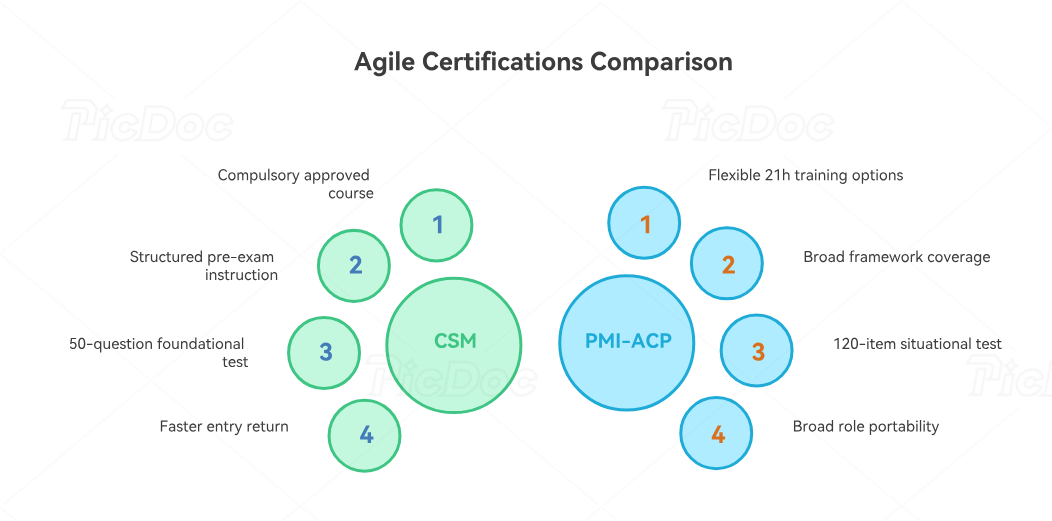
CSM requires candidates to complete a 16-hour course delivered by a Certified Scrum Trainer. Classes commonly run across two or three days. After training, candidates receive access to a one-hour online test containing 50 multiple-choice questions. Passing requires 37 correct answers, and the course fee includes two attempts. Candidates have 90 days after completing the course to pass.
The trainer-led structure creates value for beginners who need discussion, exercises, simulations, and feedback. A capable trainer can demonstrate how poor facilitation, weak Sprint Goals, uncontrolled interruptions, hidden dependencies, or an absent Product Owner damage team performance. That practical context complements independent study of Scrum software platforms, team-building terminology, conflict-resolution methods, and communication platforms.
CSM’s accessibility also creates its biggest career risk. Many candidates complete the course, pass the test, update LinkedIn, and immediately apply for Scrum Master vacancies without evidence that they have coached a team, improved flow, handled conflict, or changed delivery behavior. Recruiters may see hundreds of similarly certified applicants. The candidate who can explain a retrospective intervention, an impediment pattern, a deteriorating Sprint Goal, or a Product Owner coaching conversation holds the stronger position.
Create a CSM portfolio containing a team charter, facilitation plan, impediment log, retrospective experiment tracker, Definition of Done assessment, Sprint health dashboard, and coaching reflection. Support those artifacts with project dashboard tools, issue-tracking software, quality-management terminology, and stakeholder-engagement practices.
CSM certifications renew every two years. Scrum Alliance requires continuing education through Scrum Education Units and payment of the applicable renewal fee. Each qualifying hour of relevant learning, reading, volunteering, webinars, or events can count as one SEU.
SAFe Agilist review
SAFe Agilist targets enterprise contexts where multiple teams must align around shared value streams, product objectives, portfolio priorities, architecture, compliance, and release coordination. The curriculum covers Lean-Agile principles, Agile Release Trains, PI Planning, product-development flow, customer centricity, continuous delivery, portfolio management, and change leadership. The 2026 curriculum also incorporates AI-assisted decision-making and role-specific prompting.
The credential is valuable when job descriptions explicitly mention SAFe, Agile Release Trains, PI Planning, Lean Portfolio Management, enterprise transformation, Release Train Engineers, or value-stream coordination. It can complement expertise in workforce-management software, resource-allocation platforms, project integrations, and reporting analytics.
SAFe becomes a weaker investment when the candidate works in a small organization with one or two independent Scrum teams and no intention of adopting SAFe. The terminology and coordination mechanisms may add little immediate value. A CSM or PMI-ACP pathway would usually align more closely with team facilitation or framework-neutral delivery.
The current SAFe Agilist examination lasts 90 minutes, contains 45 questions, and requires an 80% passing score. Scaled Agile states that formal training is no longer required for the listed proctored-exam pathway, though training remains available. The credential renews yearly, and the current SAFe Agilist page lists a minimum requirement of 20 continuing-education units each year.
Candidates should distinguish this from the SAFe Scrum Master renewal model. Scaled Agile’s February 2026 guidance states that SAFe Scrum Master currently requires 24 CEUs across a two-year certification cycle, plus a renewal fee.
What Is Your Biggest Barrier to Choosing an Agile Certification?
4. Cost, Difficulty, Renewal, and Return on Investment
Certification cost should be evaluated as total ownership rather than examination price. Include mandatory training, examination access, practice resources, retakes, taxes, currency-conversion charges, travel, membership, renewal fees, and continuing education. Training prices can change by country, delivery format, trainer, provider, and promotion, so candidates should verify current official checkout totals before purchasing.
CSM usually creates the most visible upfront training commitment because the approved course is compulsory. Scrum Alliance states that trainers set their own prices and that costs vary by region, format, class size, and included resources. Its published page lists a very broad historical course-price range, reinforcing the need to compare specific instructors and packages rather than relying on one advertised average.
When comparing CSM providers, examine trainer experience, class size, interactive exercises, post-course support, mock questions, community access, and whether the instructor has coached teams in your industry. A cheap class that rushes through slides can leave you unable to explain Scrum accountabilities, resolve team conflict, apply quality-management principles, or use Agile project tools.
PMI-ACP preparation can be structured more flexibly. Candidates may use qualifying third-party Agile training, a PMI Authorized Training Partner course, or PMI’s own preparation route to satisfy the 21-hour requirement. This flexibility can reduce cost, though the examination demands deeper preparation. Budget for realistic scenario practice, error analysis, and sufficient time away from work.
SAFe cost depends on whether you purchase training or use the available proctored-exam route. Training may provide simulations, instructor interpretation, practice tools, and organizational examples that independent study cannot reproduce easily. Independent examination access may suit experienced SAFe practitioners who already work with PI Planning, ART execution, portfolio flow, and transformation leadership.
Which exam is hardest?
PMI-ACP is the most demanding overall because it combines experience eligibility, broad framework coverage, situational judgment, 120 examination items, and a three-hour test. CSM presents the most accessible route because candidates receive structured instruction before a 50-question foundational assessment. SAFe Agilist sits between them: eligibility is open, though the 80% passing requirement and framework-specific vocabulary demand disciplined study.
Difficulty should also be measured against your background. A senior Scrum Master may find PMI-ACP intuitive and struggle with SAFe portfolio terminology. A transformation consultant may understand SAFe quickly and find detailed Scrum accountability questions unfamiliar. Diagnose your gaps through Agile software comparisons, Kanban platform guidance, risk-management terminology, and stakeholder-engagement concepts.
Which certification produces the highest return?
PMI-ACP generally creates the broadest portability because it spans multiple approaches and fits project, product, Scrum, coaching, and delivery roles. CSM can generate a faster return for someone entering a Scrum team or formalizing an existing Scrum Master responsibility. SAFe Agilist can produce the strongest return when a target employer already operates through SAFe.
The wrong credential produces poor return even when it is prestigious. Search 30–50 realistic vacancies before enrolling. Record which certifications appear, which job titles request them, the experience employers expect, the tools mentioned, and the industries hiring. Compare those requirements with your current evidence. Use Scrum tool reviews, workforce-management platforms, project integration guidance, and reporting software comparisons to close recurring tool gaps.
5. Which Agile Certification Should You Choose for Your Career?
Choose PMI-ACP when you already possess substantial Agile experience and need broad professional validation. It fits project managers moving into hybrid delivery, experienced Scrum Masters seeking framework breadth, delivery leads managing different Agile approaches, product professionals coordinating value, and Agile coaches who want a recognized practitioner credential.
A strong PMI-ACP candidate can discuss adaptive planning, stakeholder feedback, Lean flow, servant leadership, team performance, uncertainty, quality, and continuous improvement. Build those capabilities through project scheduling terminology, schedule-compression concepts, risk-identification methods, and project communication practices.
Choose CSM when you need an instructor-led introduction to Scrum, want to become a Scrum Master, or have recently joined a Scrum team. It also suits managers, analysts, developers, testers, marketers, and operations professionals who need a shared Scrum language. Scrum Alliance explicitly presents CSM as an introductory credential that covers the framework, accountabilities, events, artifacts, principles, and values.
After earning CSM, seek responsibilities that create evidence. Facilitate a retrospective, improve an impediment workflow, help establish a meaningful Sprint Goal, track aging work, strengthen the Definition of Done, or coach a stakeholder on mid-Sprint interruption. Document the intervention through issue-tracking tools, team communication platforms, dashboard software, and project-reporting methods.
Choose SAFe Agilist when your organization uses SAFe, your target vacancies require SAFe, or you plan to work in enterprise transformation, portfolio alignment, product leadership, or large-scale delivery. The credential fits professionals who must understand how strategic priorities move through portfolios, Agile Release Trains, backlogs, PI Planning, execution, and feedback.
SAFe candidates should strengthen knowledge of resource-allocation software, workforce-management systems, project reporting analytics, and project-management integrations. Enterprise agility depends on more than ceremonies. It requires funding logic, governance, dependencies, architecture, compliance, leadership behavior, and organizational change.
A practical 90-day certification-to-career plan
Days 1–15: Analyze target vacancies, select the credential, verify eligibility, calculate total ownership cost, and complete a diagnostic assessment.
Days 16–45: Finish training, build structured notes, study official objectives, and practice through scenarios. Connect Agile concepts with stakeholder-management terminology, team-building practices, quality-management terms, and conflict-resolution techniques.
Days 46–65: Complete timed practice, maintain an error log, revisit weak domains, and schedule the examination only after performance stabilizes.
Days 66–80: Build six proof assets: an impediment log, flow dashboard, retrospective experiment, stakeholder map, prioritization example, and delivery improvement case.
Days 81–90: Rewrite your CV, professional profile, and interview stories around measurable outcomes. Use project-management templates, dashboard tools, communication platforms, and Agile software reviews to create polished, sanitized evidence.
The final verdict is straightforward. PMI-ACP wins for breadth and experienced-practitioner credibility. CSM wins for structured Scrum entry and team-level facilitation. SAFe Agilist wins for enterprise-scale alignment and transformation. Your best choice is the credential whose curriculum matches the decisions you expect to make at work.
6. Frequently Asked Questions About PMI-ACP, CSM, and SAFe
-
PMI-ACP offers broader coverage and requires qualifying Agile experience, making it stronger for established practitioners. CSM offers a more accessible, trainer-led route into Scrum and Scrum Master work. A beginner may gain more immediate value from CSM, while an experienced practitioner can gain stronger cross-framework recognition from PMI-ACP. Compare your role against Scrum responsibilities, Agile tools, Kanban systems, and stakeholder practices.
-
A beginner can begin studying Agile principles, though PMI-ACP eligibility requires qualifying education, training, and Agile experience. The standard experience route requires two years of Agile experience during the previous five years, with alternative routes available for certain credential holders and graduates. Beginners can start with CSM, join an Agile team, and build evidence through Scrum tools, issue tracking, team communication, and project reporting.
-
CSM can satisfy a certification requirement and improve your understanding of Scrum. Employers may still expect facilitation, coaching, conflict resolution, stakeholder communication, and delivery-improvement evidence. Build examples using conflict-resolution terminology, team-building concepts, quality-management practices, and project dashboards.
-
A Scrum Master working inside a SAFe environment should examine SAFe Scrum Master because it focuses directly on team facilitation within an Agile Release Train. SAFe Agilist provides broader enterprise and leadership coverage. Study the vacancy carefully and identify whether it emphasizes team coaching, PI Planning, ART execution, portfolio alignment, or transformation leadership. Support your preparation with Scrum role guidance, resource-allocation tools, workforce platforms, and reporting analytics.
-
CSM has the most accessible assessment structure in this comparison. Candidates complete mandatory training and then answer 50 multiple-choice questions in one hour, with 37 correct answers required. Ease should remain secondary to role relevance. Improve practical knowledge through Scrum software, communication methods, team-building terms, and issue-management tools.
-
Yes. PMI-ACP includes Scrum within a broader Agile and Lean practitioner framework. Candidates also need to understand adaptive delivery, team performance, stakeholder engagement, value, problem detection, continuous improvement, and flow. Prepare with Scrum role terminology, Kanban software, risk-management concepts, and stakeholder-engagement terms.
