
Complete Guide to Certified Cost Professional (CCP) Certification Exam
The Certified Cost Professional credential validates advanced capability across cost estimating, planning, forecasting, project controls, performance analysis, risk, change management, and executive communication. Professionals preparing for CCP need broader command than formula recall. Strong candidates can interpret incomplete project data, connect cost with schedule and risk, recommend defensible action, and communicate the commercial consequences clearly. Build that capability through project budgeting terminology, cost management principles, project scheduling concepts, and risk management vocabulary.
1. Understand What the CCP Certification Actually Validates
AACE International positions the Certified Cost Professional as a professional-level credential for experienced practitioners who apply Total Cost Management principles across project planning, execution, control, and organizational decision-making. Its scope reaches across cost estimating, project scheduling, performance reporting, and stakeholder communication. The exam therefore evaluates whether a candidate can integrate disciplines rather than operate within a narrow estimating or accounting lane.
The CCP fits cost engineers, project controls managers, commercial managers, estimators, planners, schedulers, quantity surveyors, cost analysts, program controls leads, and project managers with substantial cost responsibility. It can also support professionals working in construction, infrastructure, energy, manufacturing, engineering, defense, technology implementation, capital programs, and government contracting. Before committing, compare the CCP’s broad scope with specialist paths in critical path management, earned-value reporting, project risk assessment, and procurement management.
CCP eligibility requirements
AACE currently requires either eight years of industry-related experience or four years of industry-related experience plus four years of relevant education. An industry-related degree can replace up to four years of the experience requirement. Applicants must provide employer verification showing dates of service, job title, and a concise description of duties. AACE states that résumés, job descriptions, employment offers, and credentials issued by other organizations do not satisfy employment-verification requirements. Education evidence must generally consist of diplomas or transcripts, with official English translations where required.
Treat eligibility documentation as a project controls exercise. Build a chronological record covering employer, role, dates, responsibilities, project type, budget exposure, estimating contribution, schedule interface, forecasting work, change control, and reporting authority. Use precise language from project initiation terminology, contract management terminology, project quality management, and resource management principles.
A candidate who spent eight years around projects may still struggle to demonstrate cost-engineering competence. Strong experience descriptions identify decisions and outputs: preparing estimates, establishing baselines, analyzing variance, forecasting final cost, evaluating change, supporting claims, quantifying risk, reconciling progress, or advising management. Review project reporting practices, vendor management terminology, schedule compression concepts, and stakeholder engagement techniques to express that experience accurately.
Current CCP exam structure
The June 2026 candidate handbook lists 119 simple and scenario-based multiple-choice questions plus one written memo. Seven scored domains contribute to the overall result:
Managing Project Costs — 43 questions
Interfacing with Other Disciplines — 28 questions
Creating Reports and Documentation — 13 questions
Conducting Performance Measurement and Analysis — 20 questions
Supporting or Informing the Scheduling Process — 6 questions
Informing the Risk Management Process — 9 questions
Communication Competency — one memo
Candidates need an overall score of at least 70%. AACE reports final outcomes on a pass-or-fail basis and does not provide individual numerical scores.
This weighting should determine your study allocation. Managing project costs and interfacing with other disciplines account for most multiple-choice questions, so candidates need deep control of budget development, contract administration, project procurement, and schedule-cost integration. The smaller domains still affect the composite score and frequently expose weak professional judgment.
| Capability | What Mastery Looks Like | Common Failure Pattern | Practice Asset | APMIC Resource |
|---|---|---|---|---|
| Estimate classification | Matches estimate maturity to scope definition and decision purpose | Treating every estimate as equally reliable | Estimate-basis comparison sheet | Project budgeting terms |
| Basis of estimate | Documents scope, assumptions, exclusions, methodology, pricing, and risk | Providing a number without traceable logic | One-page basis-of-estimate template | Project initiation terms |
| Cost breakdown structure | Organizes cost consistently with scope, accounts, and reporting needs | Using categories that cannot reconcile with the schedule | CBS-to-WBS mapping exercise | Core PM terminology |
| Cost baseline | Separates approved scope, contingency, reserves, and later changes | Comparing actual cost with an unstable target | Baseline reconciliation worksheet | Cost management terms |
| Contingency analysis | Connects identified uncertainty to quantified cost exposure | Adding an arbitrary percentage without rationale | Risk-to-contingency register | Risk assessment terms |
| Cash-flow forecasting | Time-phases expected expenditure using schedule and commercial data | Spreading the budget evenly across months | Monthly cash-flow curve | Scheduling terminology |
| Forecast at completion | Uses actuals, commitments, trends, remaining scope, and risk | Assuming the remaining budget equals remaining cost | Monthly forecast bridge | Reporting and analytics tools |
| Variance analysis | Separates timing, volume, rate, productivity, scope, and accounting effects | Reporting variance without explaining its driver | Variance-cause decision tree | Project reporting practices |
| Trend management | Captures emerging cost exposure before formal change approval | Waiting for invoices before recognizing exposure | Trend log with probability weighting | Issue-tracking systems |
| Change control | Traces request, estimate, impact, authority, approval, and baseline update | Mixing proposed, pending, and approved changes | Change-control workflow map | Contract management terms |
| Commitment control | Reconciles purchase orders, contracts, invoices, accruals, and remaining exposure | Confusing committed value with incurred cost | Commitment reconciliation report | Contract lifecycle tools |
| Procurement interface | Understands inquiry, bid, award, delivery, payment, and closeout timing | Forecasting supplier cost without commercial milestones | Procurement milestone calendar | RFP, RFQ, and RFI guide |
| Vendor performance | Links supplier progress, commercial status, quality, and schedule exposure | Accepting supplier-reported progress without validation | Supplier scorecard | Vendor management guide |
| Schedule interface | Connects activity timing, progress, productivity, forecast, and cash flow | Analyzing cost separately from schedule status | Integrated cost-schedule review | Critical path terms |
| Schedule compression | Quantifies cost, resource, quality, and risk consequences of acceleration | Recommending overtime without productivity analysis | Crash-versus-fast-track comparison | Schedule compression terms |
| Resource forecasting | Converts quantities and production rates into time-phased labor demand | Forecasting headcount from historical averages alone | Resource-loaded forecast | Resource allocation tools |
| Productivity analysis | Distinguishes performance loss from scope growth and reporting lag | Blaming labor when quantity growth caused the overrun | Quantity-hours variance model | Workforce management systems |
| Performance measurement | Uses valid progress rules and consistent status dates | Reporting optimistic subjective completion | Progress-measurement rulebook | Dashboard tools |
| Earned-value interpretation | Explains indices, variances, trends, and forecast implications | Calculating metrics without management interpretation | EVM narrative exercise | Project analytics software |
| Risk identification | Writes specific cause-event-effect statements with accountable owners | Listing vague concerns that cannot be quantified | Cause-event-effect risk register | Risk management glossary |
| Risk quantification | Applies probability, impact, ranges, correlation, and confidence correctly | Treating the most likely result as guaranteed | Three-point estimate workbook | Risk identification guide |
| Quality-cost interface | Evaluates prevention, appraisal, failure, rework, and lifecycle cost | Selecting the cheapest option without quality exposure | Cost-of-quality comparison | Quality management terms |
| Economic analysis | Compares alternatives using lifecycle cash flows and stated assumptions | Comparing options using initial price alone | Alternative-selection model | Cost analysis terminology |
| Management reporting | Presents status, cause, exposure, decision, owner, and timing concisely | Filling reports with data while hiding the decision | One-page executive report | Reporting best practices |
| Stakeholder alignment | Tailors commercial information to decision rights and information needs | Sending identical reports to every audience | Stakeholder reporting matrix | Stakeholder terminology |
| Conflict resolution | Uses evidence, contracts, governance, and negotiation to resolve disputes | Escalating before clarifying facts and authority | Commercial conflict scenario | Conflict resolution glossary |
| Memo analysis | Summarizes the issue, analyzes options, recommends action, and transfers ownership | Writing a technical essay without a decision | Timed four-paragraph memo | Communication techniques |
| Exam time control | Allocates time using question value, uncertainty, and memo requirements | Spending excessive time proving one calculation | Full timed simulation | Exam mistake prevention |
2. Break the CCP Exam Blueprint Into High-Value Study Domains
The largest exam domain, managing project costs, requires control of estimating, budgeting, baseline development, cost accounting, forecasting, change management, economic analysis, and lifecycle cost. Study each topic as a connected workflow. Scope definition drives the estimate, the estimate supports authorization, authorization establishes the baseline, performance creates actual and earned data, and forecasting translates those signals into expected final outcomes. Reinforce this chain through budget management terms, cost control terminology, project initiation principles, and quality management concepts.
Avoid studying formulas as isolated equations. A cost performance index has limited value until you can explain the data quality, status date, progress-measurement method, baseline stability, and remaining-work assumptions behind it. For every calculation, answer four questions: What decision does this result inform? Which input carries the greatest uncertainty? Which project condition could invalidate the conclusion? What action should management consider? Apply that reasoning while studying reporting analytics, project dashboards, issue-tracking systems, and resource allocation.
Interfacing with other disciplines carries the second-largest question allocation. Cost professionals rarely control scope, schedule, procurement, engineering, construction, accounting, contracts, and risk directly. They create value by reconciling information from those functions. A procurement delay changes expected commitment timing. A design revision affects quantity and productivity. A critical-path delay can increase supervision, equipment, escalation, and financing cost. Strengthen these interfaces through procurement terminology, vendor-management principles, critical-path concepts, and contract lifecycle tools.
Performance measurement requires more than earned-value equations. Candidates should understand how scope is organized, budgets are assigned, progress is measured, actual costs are recorded, accruals are handled, and forecasts are updated. Poor input governance can produce precise calculations with weak commercial value. Build exercises around project reporting terms, dashboard visualization, workforce management, and project quality controls.
The scheduling domain has fewer questions, although its concepts influence cost forecasting, delay analysis, cash flow, and resource demand. Learn activity sequencing, calendars, constraints, float, critical path, progress updating, resource loading, and schedule recovery. Practice translating schedule information into financial consequences through Gantt chart terminology, schedule compression methods, scheduling terminology, and critical-path analysis.
Risk questions require disciplined distinctions among risk, issue, assumption, uncertainty, contingency, management reserve, mitigation, transfer, acceptance, and residual exposure. Practice three-point estimates, expected-value reasoning, sensitivity analysis, scenario comparison, and risk-adjusted forecasting. Connect these concepts with risk identification terms, project risk management, contract management, and stakeholder engagement.
3. Build a Realistic CCP Application, Budget, and 16-Week Study Plan
The June 2026 handbook lists an initial examination fee of US$525 for AACE members and US$690 for non-members. It lists reduced resit pricing of US$260, subject to the candidate’s registration window and attempt limits. Recommended materials are purchased separately, and the handbook lists different member and non-member prices for the CCP study guide, Skills & Knowledge of Cost Engineering, the Total Cost Management Framework, Recommended Practice 11R-88, and AACE’s review course. Prices can change, so confirm them when applications reopen.
Build a total-cost budget before enrolling. Include application fees, membership, reference materials, review training, practice questions, calculator, internet or travel requirements, currency conversion, taxes, and a resit contingency. Compare the purchase against your actual gap. Candidates with weak foundational knowledge may benefit from structured instruction. Experienced professionals with narrow exposure may gain more from targeted study in project budgeting, scheduling, risk analysis, and contract management.
Weeks 1-2: Conduct a diagnostic and eligibility audit
Map your work history against the eligibility requirement and collect employer verification early. Complete a closed-book diagnostic covering estimating, cost control, finance, contracts, scheduling, risk, statistics, performance measurement, and written communication. Record weaknesses by competency rather than book chapter. Use project management terminology, project initiation terms, cost terminology, and scheduling concepts to standardize your vocabulary.
Weeks 3-5: Master estimating and baseline development
Study estimate purpose, classification, methodologies, quantities, rates, escalation, location factors, productivity, allowances, contingency, and basis-of-estimate documentation. Build a small estimate from scope through approval, then convert it into a cost baseline and time-phased budget. Add assumptions, exclusions, risks, and change rules. Support this work with budgeting terminology, quality management, procurement concepts, and vendor-management principles.
Weeks 6-8: Master control, forecasting, and performance analysis
Practice commitments, accruals, actual costs, earned value, variance decomposition, trend management, estimate at completion, and forecast reconciliation. Build a monthly cost report showing baseline, approved change, pending change, actual cost, commitment, forecast, variance, risk, and decision required. Use reporting best practices, analytics software, dashboard tools, and issue-tracking systems.
Weeks 9-10: Integrate cost with schedule, procurement, and contracts
Create scenarios involving delayed equipment, design growth, productivity loss, acceleration, supplier default, and disputed change. Quantify the effect on cost, schedule, risk, and forecast. Determine who owns the decision and which evidence supports the recommendation. Review critical-path terminology, schedule compression, contract terminology, and procurement management tools.
Weeks 11-12: Strengthen risk and economic decision-making
Practice expected monetary value, probability ranges, three-point estimates, alternative comparison, lifecycle cost, present-value reasoning, sensitivity, and scenario analysis. Your answer should explain the decision consequence alongside the numerical result. Reinforce the work through risk-management terminology, risk-identification concepts, budget management, and cost management terminology.
Weeks 13-14: Practice the CCP memo under time pressure
Complete at least eight timed memos. Every memo should identify the problem, explain its project impact, analyze available options, make an unambiguous recommendation, and hand the final decision or implementation action to the appropriate stakeholder. AACE’s current guidance recommends a traditional business memo structure and a concise response no longer than one typewritten page.
Improve memo quality through project communication techniques, stakeholder-engagement language, conflict-resolution terminology, and project reporting practices.
Weeks 15-16: Complete full simulations and close recurring gaps
Run realistic timed simulations using your planned calculator and testing setup. Track calculation errors, interpretation errors, knowledge gaps, rushed decisions, and memo weaknesses separately. Stop collecting new resources during the final days. Rework repeat failures using exam mistake-prevention principles, schedule terminology, cost management terms, and risk assessment concepts.
4. Master CCP Calculations, Scenarios, and the Written Memo
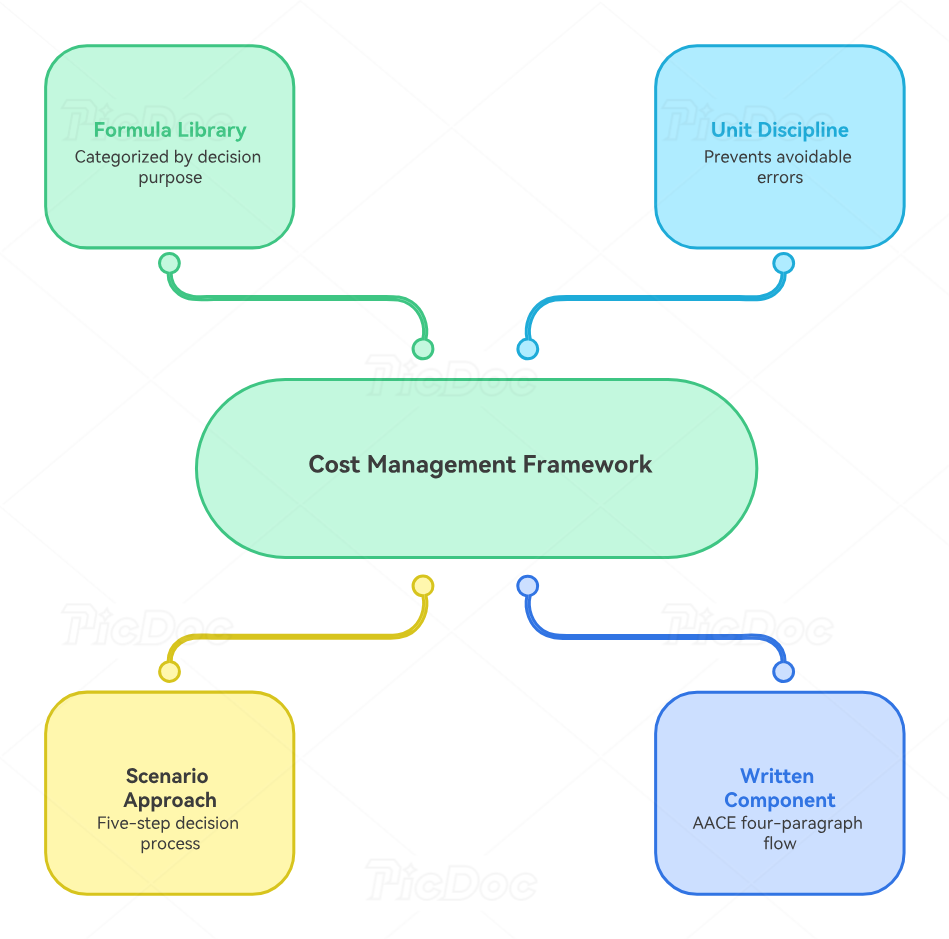
Create a formula library organized by decision purpose. Group equations under estimating, escalation, economic analysis, probability, earned value, forecasting, productivity, and statistics. Every entry should include the formula, variable definitions, units, a worked example, interpretation, and a warning about misuse. Connect each calculation to cost management terminology, project risk concepts, scheduling principles, and reporting practices.
Unit discipline prevents avoidable errors. Write currency, time period, quantity unit, and percentage basis beside every input. Distinguish annual escalation from total escalation, hours from days, thousands from millions, present value from future value, and cost variance from cost performance. Estimate the expected answer range before calculating. A result outside that range signals a likely input, sign, exponent, or unit error. Practice with project budgeting terms, resource allocation concepts, workforce planning, and schedule compression methods.
Scenario questions often contain extra information, imperfect data, and several technically plausible actions. Use a five-step approach:
Identify the decision being requested.
Separate facts, assumptions, and missing information.
Determine the controlling baseline, contract, procedure, or authority.
Calculate only the information required to compare the options.
Select the response that protects project objectives and produces an actionable decision.
This method becomes stronger when grounded in stakeholder terminology, conflict-resolution principles, contract-management terminology, and risk-identification language.
For the written component, AACE asks candidates to communicate a project problem, its impact, analysis, and a recommendation based on the scenario data. The guidance expects the candidate to work within the information provided, even when professional experience suggests additional possibilities. AACE recommends a four-paragraph flow: issue and impact, option analysis, clear recommendation, and operational handoff.
Use this memo framework:
Paragraph 1 — Problem and impact: Identify the condition, its cause where supported, and its effect on cost, schedule, risk, quality, or project objectives.
Paragraph 2 — Analysis: Compare the available options using the scenario’s quantitative and qualitative evidence.
Paragraph 3 — Recommendation: State one clear action and explain why it provides the strongest project outcome.
Paragraph 4 — Handoff: Summarize the action, identify the decision owner, and offer technical support for implementation.
Keep the language direct. Replace “There are several factors that may potentially need to be considered” with a quantified statement identifying the relevant cost, delay, exposure, or decision. Improve that discipline through communication terminology, executive reporting practices, stakeholder engagement, and conflict-resolution techniques.
5. Plan for Exam Day, Results, Retakes, and Career Use
The handbook states that cleared candidates can ordinarily select either a Kryterion testing center or online proctoring. Testing-center candidates must arrive early, provide two forms of identification, and bring their authorization information. A stand-alone, battery-operated calculator is permitted. The CCP is a closed-book examination. Online candidates must complete the required secure-testing installation, biometric setup, and system checks in advance.
Prepare your exam environment as carefully as the content. Use the same calculator throughout practice, learn its memory and exponent functions, and verify that every key operates reliably. Online candidates should use a private computer with administrator access, stable internet, a clear workspace, and no second monitor. Testing-center candidates should confirm route, identification, arrival rules, and authorization details. Protect the final week with exam-day preparation principles, mistake-prevention techniques, project communication practices, and risk-management planning.
AACE’s normal registration period runs for six months from clearance. The handbook allows up to three attempts within that period, including two reduced-fee resits, provided the candidate remains inside the expiration window. Scheduling the first attempt late can eliminate practical retake capacity because written responses require a monthly grading cycle. Current CCP scheduling remains affected by the temporary 2026 pause, and AACE has said affected timelines will be extended where appropriate.
Under the normal process, CCP results are delayed because the memo requires human grading. The handbook describes a monthly grading cycle beginning around the 15th, followed by estimated results roughly two to three weeks later. A candidate who tests after a cycle cutoff may wait until the following month’s cycle. AACE reports a pass-or-fail outcome, so your preparation records should remain detailed enough to guide a retake without relying on a numerical score report.
After certification, convert the credential into visible professional proof. Build a portfolio containing a basis of estimate, cost breakdown structure, baseline reconciliation, change log, forecast bridge, risk-adjusted estimate, schedule-cost analysis, and executive cost report. Remove confidential data while preserving the logic. Use project templates, reporting software, dashboard tools, and contract-management systems to present the work professionally.
Prepare interview stories around estimate uncertainty, forecast deterioration, scope growth, supplier failure, acceleration, disputed change, productivity loss, and risk exposure. Each story should show the original condition, evidence analyzed, recommendation made, stakeholder response, and commercial result. Strengthen those stories through vendor-management terminology, stakeholder-engagement concepts, conflict-resolution terminology, and project reporting principles.
AACE professional-level certifications generally require recertification every three years. Current AACE guidance allows eligible certificants to maintain certification through 12 continuing-education units accumulated across specified categories or through examination. One CEU represents ten contact hours under AACE’s stated conversion. Certificants should begin recording activities immediately and submit before expiration.
Build a three-year development plan around cost management, project scheduling, risk management, and professional reporting. Choose activities that improve your actual project-control capability alongside satisfying recertification requirements.
6. Frequently Asked Questions About the CCP Certification Exam
-
AACE temporarily closed new CCP applications and paused CCP examination activities in July 2026 while reviewing an examination-integrity concern. Its latest official update provides no confirmed resumption date. Affected candidates are expected to receive direct communication, and AACE has said it will adjust registration or eligibility periods where necessary.
Candidates can continue developing cost management knowledge, risk analysis skills, schedule-control capability, and memo-writing discipline during the pause.
-
AACE requires eight years of industry-related experience, or four years of industry-related experience combined with four years of relevant education. A qualifying degree can substitute for up to four years of experience. Applicants must provide acceptable employer and education verification.
Build evidence around project budgeting, cost forecasting, contract administration, and project risk management.
-
The current handbook lists 119 multiple-choice questions and one written memo. The multiple-choice questions are distributed across project cost management, discipline interfaces, reporting, performance analysis, scheduling, and risk. Communication competency is assessed through the memo.
Prepare using project cost terminology, scheduling terminology, reporting concepts, and risk-identification terms.
-
Candidates need an overall score of at least 70%. AACE combines the scored domains to determine the result and releases the outcome as pass or fail. Candidates do not receive a detailed numerical score report.
Readiness should therefore be measured through timed simulations, recurring-error rates, memo quality, and balanced domain performance. Use exam mistake-prevention strategies, budgeting concepts, critical-path analysis, and conflict-resolution skills.
-
The CCP is delivered as a closed-book professional-level examination. AACE allows a stand-alone, battery-operated calculator. Open-book permissions listed in the handbook apply to specific other certifications.
Closed-book preparation should emphasize formula selection, unit control, interpretation, and decision-making. Practice with cost management terminology, risk analysis concepts, project scheduling, and resource forecasting.
-
Practice a four-paragraph business memo covering the issue and impact, option analysis, recommendation, and operational handoff. Use only the scenario information, quantify consequences where possible, and keep the recommendation direct. AACE’s current guidance advises candidates to keep the completed memo within one typewritten page.
Improve performance through project communication terms, stakeholder engagement, executive reporting, and conflict resolution.
