
Essential Resources & Tools for CAPM Exam Preparation
CAPM preparation becomes easier when you stop collecting random study material and start building a focused exam system. A serious candidate needs the current exam blueprint, practical terminology support, timed question practice, agile confidence, business analysis clarity, and a repeatable review process. This guide gives you the exact resource stack to use, how to use each tool, and how to avoid wasting weeks on passive reading while building a stronger foundation for a future project management career, entry-level PM path, PMP preparation journey, and long-term project management certification growth.
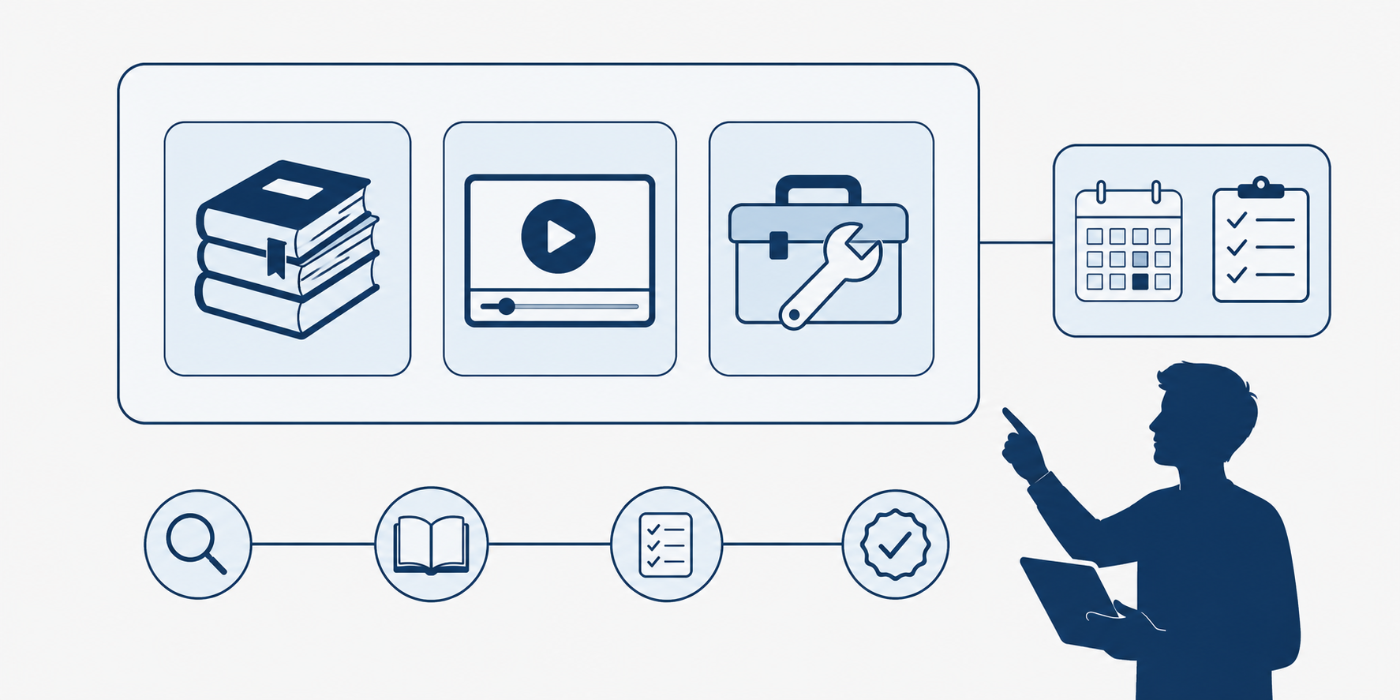
1. Start With the CAPM Blueprint Before Buying Any Study Resource
The first resource for CAPM exam preparation should always be the official exam outline because it tells you what the test is built to measure. Many candidates begin with a long video course, a random question bank, or a thick project management book, then panic when practice questions feel different from what they studied. The smarter path is to map every resource against the four CAPM knowledge areas: project management fundamentals, predictive approaches, agile frameworks, and business analysis. That makes your study time more precise than simply “reading PMBOK” from front to back.
Use the exam outline as your control document. Then connect each domain to supporting resources such as project execution terms, monitoring and control concepts, risk register examples, earned value management terms, and stakeholder engagement language. This prevents the most common CAPM failure pattern: recognizing terms in isolation while missing how they behave inside a scenario.
A good CAPM prep stack should include five layers. The first is the official exam content outline. The second is a core study guide that explains concepts in clean language. The third is a glossary system for fast recall. The fourth is a timed question bank with explanations. The fifth is a review tracker that forces you to fix weak areas instead of repeating comfortable topics. Candidates who already read about PMP exam domains, common PMP exam mistakes, PRINCE2 exam pitfalls, and project management templates usually understand this faster because they already see exam preparation as a system.
| Resource / Tool | What It Helps You Fix | Best Way to Use It | Danger Sign | Helpful APMIC Link |
|---|---|---|---|---|
| Exam outline | Prevents scattered study and shows the real CAPM domain structure. | Turn every domain into a checklist before opening any paid course. | You study every chapter equally and ignore exam weight. | exam domain planning |
| PMBOK concepts | Builds the language of value delivery, principles, tailoring, and project performance. | Read for understanding, then convert ideas into scenario notes. | You memorize definitions without linking them to project decisions. | project execution terms |
| Process guide | Clarifies predictive flow, planning discipline, baselines, and control logic. | Use it with workflow diagrams and artifact examples. | You confuse lifecycle, phase, process, and deliverable language. | waterfall glossary |
| Agile guide | Improves understanding of Scrum, Kanban, adaptive planning, and team cadence. | Compare agile terms with predictive terms every study week. | You treat agile as a vocabulary list rather than a delivery mindset. | agile glossary |
| Scrum glossary | Fixes confusion around product owner, sprint backlog, events, increments, and ceremonies. | Make one-page flashcards for each role and event. | You mix Scrum Master duties with project manager duties. | Scrum terms |
| Kanban terms | Explains visual flow, WIP limits, queues, bottlenecks, and pull systems. | Draw a sample board and label how work moves. | You recognize “WIP” but miss how it affects delivery speed. | Kanban terms |
| Business analysis guide | Builds skill in requirements, stakeholders, elicitation, traceability, and solution fit. | Pair every BA term with a project scenario. | You study requirements as admin work instead of value protection. | stakeholder engagement terms |
| Requirements log | Helps you understand traceability, scope control, and acceptance criteria. | Create a tiny mock project and track five sample requirements. | You confuse requirements with tasks, features, and assumptions. | project reporting terms |
| Risk register | Sharpens risk identification, ownership, response planning, and monitoring. | Practice risk cause-event-impact wording until it feels natural. | You call every problem a risk after it has already happened. | risk registers |
| Issue log | Separates current problems from future uncertainties. | Compare issue handling with risk response examples. | You answer scenario questions with future planning when action is required now. | monitoring and control terms |
| EVM sheet | Strengthens schedule variance, cost variance, CPI, and SPI confidence. | Use formula drills, then explain what each result means. | You calculate correctly but choose the wrong management response. | EVM terms |
| Gantt chart | Clarifies dependencies, sequencing, critical path thinking, and schedule visibility. | Read a simple chart and explain what should be watched first. | You see bars without understanding constraints and dependencies. | Gantt chart terms |
| Schedule compression | Explains crashing, fast tracking, trade-offs, and schedule risk. | Compare the cost and risk impact of each technique. | You choose speed without noticing quality, budget, or dependency pressure. | schedule compression terms |
| Quality terms | Builds confidence with prevention, inspection, acceptance, and improvement language. | Link each quality term to a project deliverable. | You treat quality as testing only. | TQM terms |
| ISO basics | Adds structure to quality, compliance, standardization, and audit thinking. | Use it to understand why processes need evidence. | You ignore documentation questions because they feel administrative. | ISO standards terms |
| Resource plan | Explains people, equipment, capacity, availability, and allocation pressure. | Practice matching resource constraints to schedule responses. | You assume every delay can be fixed by adding people. | resource allocation terms |
| Communication plan | Improves scenario answers about stakeholders, reporting cadence, and escalation. | Map who needs what information, when, and why. | You over-communicate to everyone instead of targeting the right audience. | communication terms |
| Conflict guide | Builds judgment for team tension, negotiation, listening, and problem solving. | Study conflict scenarios through cause, people, and project impact. | You jump to escalation before understanding the conflict source. | conflict resolution terms |
| Procurement terms | Clarifies RFP, RFQ, RFI, vendor selection, contracts, and supplier control. | Use a procurement mini-case to compare buyer and vendor responsibilities. | You confuse procurement documents with project planning documents. | RFP, RFQ, and RFI terms |
| Vendor guide | Shows how suppliers affect scope, schedule, risk, and quality. | Practice questions where vendor delay changes the control response. | You treat vendors as outside the project system. | vendor management terms |
| Agile estimation | Explains story points, relative sizing, velocity, and estimation uncertainty. | Compare agile estimation with predictive schedule estimation. | You try to convert every story point into fixed hours. | agile estimation techniques |
| Backlog guide | Clarifies product backlog, sprint backlog, refinement, prioritization, and increments. | Build a sample backlog with priority reasons. | You treat a backlog as a static task list. | product and sprint backlog terms |
| Agile metrics | Helps with velocity, cycle time, burn charts, throughput, and improvement signals. | Use metrics to explain team flow rather than team blame. | You memorize metric names without understanding what decision they support. | agile metrics |
| Practice exams | Shows whether you can answer timed, scenario-based questions under pressure. | Review every wrong answer and every lucky correct answer. | Your score rises because you remember questions, not concepts. | exam success habits |
| Mistake log | Turns weak performance into a targeted study plan. | Tag mistakes by domain, concept, trap, and correction. | You keep retaking tests without repairing the reason you missed questions. | exam mistake prevention |
| Template library | Makes abstract artifacts easier to understand through real document structure. | Open one template each week and explain its project purpose. | You study artifact names without knowing what they contain. | PM templates |
| Software demos | Connects exam concepts to boards, timelines, dashboards, tasks, and reports. | Use free trials only to visualize concepts, not to distract yourself. | You spend more time testing tools than learning project logic. | agile PM tools |
| Career map | Keeps motivation high by showing where CAPM can lead after the exam. | Connect each exam domain to real entry-level PM responsibilities. | You prepare only to pass and forget to build employable project language. | PM career path |
2. Choose Core CAPM Study Resources That Explain, Then Test
The strongest CAPM study resources do two jobs: they explain the concept clearly, then force you to apply it under exam conditions. A book or course that only explains can make you feel productive while hiding weak recall. A question bank that only tests can create frustration because you keep missing items without understanding the pattern. Start with one structured CAPM prep course, one official-style study guide, one glossary set, and one quality practice bank. Add supporting APMIC resources on agile terminology, Scrum language, Kanban systems, predictive project management, and business stakeholder terms.
For the official-style layer, prioritize resources aligned with the current CAPM exam content outline instead of older material built around outdated process memorization. CAPM candidates now need comfort with predictive, agile, and business analysis thinking, which means your resources should cover lifecycle selection, scope control, requirements, adaptive planning, team roles, value delivery, and performance measurement. This is where supplementary reading helps. A candidate who understands product owner responsibilities, Scrum Master career logic, Agile Coach responsibilities, IT project management expectations, and project consultant skills will read exam scenarios with stronger context.
Use video courses carefully. A video course helps when it simplifies difficult ideas, shows diagrams, and gives quick quizzes after each module. It becomes weak when you watch for hours and call that studying. After every video lesson, write three things: the concept, the exam trap, and a workplace example. For example, after studying risk, write how a risk differs from an issue, how a response plan differs from a workaround, and how a risk register supports monitoring. Reinforce that with risk mitigation terms, risk register examples, project reporting practices, and monitoring control language.
Practice exams should enter your plan early, not at the end. Take a small diagnostic test before deep study so you know your baseline. Then take weekly domain quizzes to measure improvement. Save full mock exams for the second half of your plan, when you have enough knowledge to make the score meaningful. The best practice banks explain why the right answer is right, why the wrong choices are tempting, and which exam domain the question belongs to. That same discipline appears in strong PMP exam preparation, PMP mistake prevention, PMP success stories, and certification renewal planning.
3. Use Tools That Convert Reading Into Recall
CAPM candidates often lose time because they confuse exposure with mastery. Reading a definition once gives you familiarity. Answering a question correctly two weeks later gives you usable recall. Your tools should close that gap. Use flashcards for terms, a spreadsheet for mistakes, a calendar for study blocks, a timer for exam stamina, and simple project templates for artifacts. The goal is to make terms like baseline, deliverable, assumption, constraint, stakeholder, variance, increment, WIP limit, and acceptance criteria feel operational. You can support that with project financial terms, Gantt chart concepts, resource allocation terms, and quality management language.
Your flashcards should use three sides mentally, even if the app gives you two. The first side is the term. The second is the clean definition. The third is a situation where the term changes the project manager’s decision. For example, “fast tracking” is easier to remember when you connect it to overlapping tasks, schedule risk, and dependency pressure. “Crashing” becomes clearer when you connect it to adding resources, increasing cost, and protecting the deadline. Use schedule compression terms, EVM concepts, earned value signals, and project closure terms to build practical memory.
A mistake log is more powerful than another pack of practice questions. Create columns for question source, domain, missed concept, trap type, corrected explanation, and next review date. Trap types might include “ignored stakeholder,” “confused risk with issue,” “chose predictive answer for agile scenario,” “missed business value,” or “calculated but misread interpretation.” This gives you evidence instead of emotion. When your score drops, you know exactly what to fix. This method also connects CAPM preparation to real project habits like project reporting, stakeholder communication, leadership and communication terms, and conflict resolution.
Project management software can help if you use it as a visual learning tool. Build a sample project in a free board or timeline tool. Add tasks, dependencies, risks, stakeholders, status fields, and a simple dashboard. Then study how the artifact supports decisions. This makes abstract content easier, especially for candidates with limited work experience. Compare agile boards through agile project management tools, Kanban workflows through Kanban software tools, Scrum setups through Scrum PM platforms, and predictive schedules through waterfall PM software.
4. Build a CAPM Study Plan Around Time, Domains, and Feedback
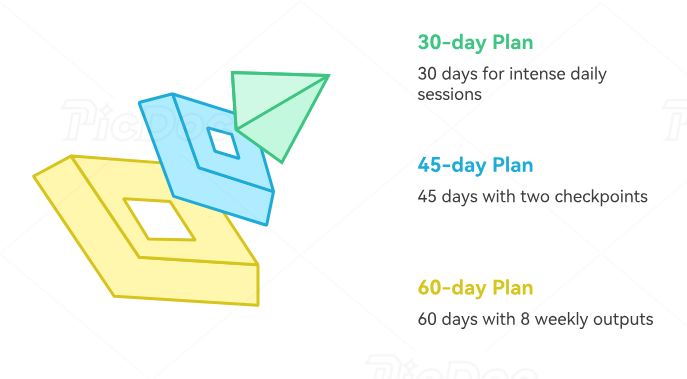
A strong CAPM study plan begins with your available timeline. A 30-day plan needs focus and daily discipline. A 45-day plan gives room for concept building and weekly testing. A 60-day plan works well for candidates new to project management or returning to study after a long break. In every version, split time across the four domains instead of letting your favorite topic dominate. Fundamentals deserves heavy attention, but business analysis and agile can decide your score if you keep treating them as secondary topics. Support each week with agile estimation, backlog terms, agile metrics, and project execution language.
For a 30-day plan, use days 1–7 for fundamentals, days 8–13 for predictive methods, days 14–19 for agile, days 20–24 for business analysis, days 25–27 for mixed practice, and days 28–30 for review and stamina. Keep sessions short but intense: one concept block, one quiz block, one mistake review block. This schedule works best for candidates who already understand workplace basics from roles connected to IT project management, construction project management, healthcare project management, or government project management.
For a 45-day plan, add two diagnostic checkpoints. Take one mixed quiz after day 15 and one half-length mock around day 30. Use the results to rebalance your study time. If agile questions are weak, study roles, events, backlogs, prioritization, and metrics. If predictive questions are weak, return to scope, WBS, schedules, baselines, risk, procurement, and quality. If business analysis is weak, focus on stakeholder needs, requirements, traceability, acceptance criteria, and solution evaluation. Useful reinforcements include RFP and procurement terms, vendor management terms, project financial management terms, and ISO project standards.
For a 60-day plan, build one weekly deliverable. Week one produces your domain checklist. Week two produces your glossary deck. Week three produces your predictive artifact map. Week four produces your agile comparison sheet. Week five produces your business analysis tracker. Week six produces your formula and controls sheet. Week seven produces your mock exam review log. Week eight produces your final readiness checklist. This style is especially useful if CAPM is part of a bigger move toward remote project management roles, freelance PM work, international project management, or project portfolio management.
5. Avoid Resource Overload and Study With Exam-Day Judgment
Resource overload is one of the biggest CAPM preparation traps. Candidates buy three courses, download five guides, join several groups, collect hundreds of flashcards, and still feel behind. The problem is usually resource switching. Every new resource restarts your learning rhythm. Pick one main course, one main guide, one main question bank, and one glossary system. Then use APMIC articles as targeted support when a concept needs reinforcement. This keeps your preparation deep enough to handle scenario questions and broad enough to support future paths such as Agile Project Manager, Project Management Consultant, Project Management Director, and Project Portfolio Manager.
Judge every resource by four tests. Does it match the current CAPM domains? Does it explain concepts in scenario language? Does it include answer explanations? Does it help you correct weak patterns? A resource that fails those tests may still look polished, but it can drain time without improving performance. Be especially careful with outdated summaries that over-focus on memorizing process groups while under-serving agile and business analysis. Strong CAPM prep should make you comfortable with hybrid thinking because real project environments blend approaches. That same future-facing mindset appears in hybrid project management trends, AI in project management, future PM skills, and PM software evolution.
Your final two weeks should feel different from your first two weeks. Early preparation is about learning. Final preparation is about decision speed, trap recognition, and emotional control. Use timed sets, mixed quizzes, and mock exam reviews. Stop rewriting notes unless the note fixes a real mistake. Practice reading the full question, identifying the project context, eliminating attractive wrong answers, and choosing the response that best protects project value. Candidates who understand project governance, PMO value, leadership trends, and sustainability project management often read situational questions with better business judgment.
The best CAPM resources do more than help you pass. They give you the vocabulary to speak like a project professional in interviews, entry-level roles, internships, coordinator jobs, analyst positions, and cross-functional team meetings. That is why your study system should include career context, not just exam content. When you learn stakeholder registers, reporting cadence, risks, baselines, backlogs, quality checks, and resource allocation, you are also learning how project teams operate. That foundation supports the next steps into project coordinator-style career growth, consulting pathways, VP-level PM growth, and chief project officer leadership.
6. FAQs About CAPM Exam Preparation Resources and Tools
-
The best first resource is the current CAPM exam content outline because it protects you from studying blindly. Use it to create a domain checklist before choosing a course or book. Then support each domain with targeted resources on project fundamentals, predictive project terms, agile project management terms, and stakeholder engagement.
-
Free resources can help with terminology, basic concepts, and early review, but most candidates benefit from at least one structured course or high-quality question bank. The exam rewards applied understanding, so explanations matter more than the number of questions. Use free APMIC resources for risk registers, EVM terms, Gantt chart terms, and agile metrics, then add timed practice.
-
Quality matters more than a fixed number, but a serious candidate should complete enough questions to see repeated patterns across all domains. Review every missed question and every guessed answer. A 300-question journey with deep review can beat a 1,000-question sprint with shallow review. Track mistakes by domain, concept, and trap type, then use targeted references like exam mistake prevention, PMP study resources, and exam success habits.
-
You should learn the core concepts first, but early diagnostic quizzes are useful because they reveal how the exam thinks. Read in short blocks, then test immediately. This prevents passive reading and builds recall. Use PMBOK-style concepts with practical support from project monitoring terms, quality terms, resource allocation terms, and communication terms.
-
Any flashcard app can work if your cards are scenario-based. Weak cards ask, “What is a risk register?” Strong cards ask, “A vendor delay might occur next month; which artifact tracks probability, impact, owner, and response?” That style builds exam judgment. Create cards for risk response planning, schedule compression, procurement documents, and backlog management.
-
A CAPM course is worth considering when it follows the current exam outline, teaches predictive, agile, and business analysis content, includes quizzes, explains wrong answers, and gives a realistic study structure. Avoid judging by video length alone. A shorter course with better explanations can outperform a long course that leaves you with unclear notes. Compare the course against APMIC’s coverage of agile tools, Scrum tools, Kanban tools, and waterfall tools.
