
Detailed Preparation Guide for Certified Construction Manager (CCM)
The Certified Construction Manager credential rewards more than textbook recall. Candidates must connect construction decisions to owner interests, contract obligations, cost exposure, schedule consequences, safety, quality, and project governance. Effective preparation therefore begins with an eligibility audit, continues through evidence-based study, and ends with disciplined scenario practice. This guide combines construction project management fundamentals, cost-control terminology, schedule-management concepts, and risk-response techniques into a preparation system designed around the current CCM examination.
1. Confirm Your CCM Eligibility Before Building a Study Plan
The Certified Construction Manager, or CCM, is administered by the Construction Manager Certification Institute, an independent administrative body of the Construction Management Association of America. The credential is accredited under the ISO/IEC 17024 personnel-certification standard through the ANSI National Accreditation Board. That distinction matters because applicants must prove professional experience before taking the examination; completing a course or memorizing a study guide cannot replace the required construction-management responsibility.
The first preparation question is therefore whether your experience qualifies as responsible-in-charge, commonly abbreviated as RIC. CMCI describes RIC experience as work in which the candidate carried meaningful accountability for construction-management personnel, project decisions, service delivery, coordination, and protection of the owner’s interests. Supporting a project team may contribute valuable experience, but eligibility depends on the authority and accountability you personally exercised.
A candidate who prepared reports without owning the resulting decision may struggle to establish RIC. A candidate who maintained a construction risk register, approved resource-allocation decisions, controlled project reporting, and coordinated vendor-management activities can present a much stronger accountability narrative—provided those responsibilities are verified by appropriate references.
CMCI requires at least 48 non-overlapping months of RIC experience for the standard qualifying pathway. “Non-overlapping” is critical. Managing three simultaneous projects for twelve months produces twelve months of elapsed RIC experience, rather than thirty-six. Candidates sometimes discover this only after paying for training, collecting books, and planning an exam date. Build a chronological experience ledger before submitting anything. Record each project’s start and finish dates, delivery method, owner, contract arrangement, construction value, phases covered, decisions controlled, and verifier.
Educational background determines whether additional experience is required:
A qualifying four-year architecture, engineering, or construction-related degree can accompany the standard 48 months of RIC experience.
A qualifying two-year degree may be used with four additional years of general design or construction experience that do not overlap the 48 RIC months.
A four-year degree outside the qualifying AEC categories generally requires at least 72 non-overlapping RIC months.
Applicants without an accepted degree may qualify through an active CACM credential, additional general experience, or at least 96 non-overlapping RIC months, depending on the pathway selected.
Qualifying degree fields listed in the current handbook include construction management, construction science or technology, architecture, architectural engineering, civil engineering, industrial engineering, mechanical engineering, electrical engineering, and chemical engineering. International qualifications require an approved foreign-degree equivalency evaluation.
Your job title has limited evidentiary value. “Construction manager” can describe anything from coordination support to full owner representation. CMCI focuses on what you controlled. Convert vague résumé language into decision-based evidence:
“Assisted with schedule management” is weak.
“Reviewed monthly CPM updates, challenged unsupported logic changes, evaluated critical-path movement, and advised the owner on recovery requirements” demonstrates accountability.
Apply the same standard to earned value management, schedule compression, stakeholder engagement, and conflict resolution. Every application statement should show the decision, the information considered, the action taken, and the owner or project outcome protected.
At least two client, supervisor, or current CCM references must verify the applicant’s experience. Where one project covers the entire qualifying period, two separate references are still required. Contact references before submitting the application. Give them a one-page project chronology and confirm that they can verify the dates, authority, functions, and phases claimed. Reference silence, contradictory dates, incomplete educational documentation, and ambiguous responsibility descriptions can delay or derail an otherwise capable applicant.
The current fee structure separates the application from the examination. The application costs $350 for CMAA members and $450 for non-members; approved candidates then pay a $300 exam-registration fee. A retake costs $150. CMAA membership is optional, so calculate the broader value of membership rather than joining solely to reduce one fee. Approved candidates receive a one-year testing window and may attempt the examination up to three times during that period.
Before moving into study mode, assemble five files: your experience chronology, project-by-project responsibility matrix, reference tracker, education evidence, and decision-focused résumé. This same discipline strengthens applications for construction-management roles, cost-professional certification, requirements-management positions, and business-analysis certification.
| Capability | What Strong Preparation Looks Like | Exam and Project Value | Evidence or Tool | Primary Alignment |
|---|---|---|---|---|
| Eligibility pathway | Match your degree, general experience, CACM status, and RIC months to one official pathway. | Prevents an avoidable application rejection. | Eligibility worksheet | CMCI requirements |
| RIC chronology | Calculate elapsed, non-overlapping months and document decisions personally controlled. | Proves responsibility rather than participation. | Project timeline ledger | Owner and verifier |
| Reference readiness | Pre-brief at least two verifiers using consistent dates, scopes, phases, and responsibilities. | Reduces delays and contradictory verification. | Reference confirmation sheet | Client, supervisor, or CCM |
| Decision-based résumé | Write bullets around authority, analysis, decisions, corrective action, and owner impact. | Makes RIC responsibility auditable. | Two-page targeted résumé | Application reviewer |
| Education evidence | Collect transcripts, degree copies, accreditation details, and foreign-equivalency evidence where applicable. | Supports the selected eligibility route. | Credential file | University and evaluator |
| Program governance | Connect governance levels, decision rights, escalation paths, reporting, and owner objectives. | Supports the largest exam domain. | Governance map and RACI | Owner and program board |
| Cost baseline | Distinguish estimates, budgets, contingencies, allowances, commitments, forecasts, and actuals. | Prevents misleading cost conclusions. | Cost report and control accounts | Owner and cost manager |
| Cost forecasting | Interpret variances, productivity, estimate at completion, commitments, and trend exposure. | Turns historical reporting into forward control. | EAC worksheet and trend log | Project controls |
| Schedule logic | Read relationships, constraints, calendars, float, critical paths, baselines, and update narratives. | Reveals whether a schedule is credible. | CPM network and update checklist | Scheduler and contractor |
| Schedule recovery | Compare resequencing, resource changes, crashing, fast-tracking, and scope alternatives. | Balances acceleration against cost and risk. | Recovery options matrix | Owner, designer, and contractor |
| Procurement strategy | Relate procurement documents, delivery methods, selection criteria, competition, and schedule needs. | Improves commercial and delivery decisions. | Procurement plan and RFP | Owner and procurement counsel |
| Contract administration | Track submittals, RFIs, notices, payment, changes, records, deliverables, and compliance. | Protects entitlement and procedural fairness. | Contract-administration log | Owner, designer, and contractor |
| Change control | Trace origin, scope, entitlement, pricing, schedule effect, approval, funding, and implementation. | Prevents unauthorized scope and budget leakage. | Change register | Owner and contract authority |
| Claims management | Separate notice, entitlement, causation, impact, damages, records, negotiation, and resolution. | Avoids premature acceptance or rejection. | Claims chronology | Owner, counsel, and technical experts |
| Quality planning | Translate requirements into inspections, tests, acceptance criteria, records, and assigned responsibility. | Builds quality into execution. | Quality-management plan | Designer, contractor, and inspector |
| Nonconformance control | Document the condition, contain exposure, assess cause, approve disposition, and verify closure. | Stops defective work from becoming concealed risk. | NCR and corrective-action log | Quality authority |
| Safety planning | Understand responsibility, preplanning, hazard controls, reporting, escalation, and verification. | Protects people while preserving proper contractual roles. | Safety plan and responsibility matrix | Contractor and owner |
| Risk governance | Define cause, event, effect, probability, impact, owner, response, trigger, and residual exposure. | Converts uncertainty into managed decisions. | Risk register | Risk owner and project leadership |
| Uncertainty analysis | Distinguish deterministic assumptions, ranges, sensitivity, contingency, and confidence levels. | Improves forecast credibility. | Assumption and sensitivity log | Project controls and owner |
| Professional judgment | Prioritize ethics, competence, disclosure, impartiality, documentation, and owner interests. | Guides decisions where technical options compete. | Ethical decision checklist | Public and professional duty |
| Communication control | Match audience, authority, urgency, evidence, confidentiality, and required action. | Prevents informal messages from creating commercial exposure. | Communication matrix | All project participants |
| Sustainability integration | Connect owner goals to design criteria, procurement, construction controls, commissioning, and operations. | Moves sustainability beyond isolated reporting. | Sustainability requirements matrix | Owner, designer, and contractor |
| Construction technology | Select technology around workflows, information ownership, controls, integration, access, and adoption. | Prevents tool selection from replacing process design. | CDE, BIM, dashboard, or field platform | Project team and IT |
| Information governance | Control permissions, versioning, retention, cybersecurity, naming, approvals, and audit trails. | Protects the reliability and admissibility of records. | Document-control protocol | Owner, legal, and IT |
| Program interfaces | Identify dependencies across contracts, sites, utilities, permits, stakeholders, funding, and operations. | Reduces failures between otherwise successful work packages. | Interface register | Program leadership |
| Commissioning and closeout | Plan turnover requirements early and track testing, training, records, deficiencies, warranties, and acceptance. | Protects operational readiness and final payment. | Closeout matrix | Owner operations team |
| Performance reporting | Report status, variance, forecast, cause, exposure, decisions, ownership, and deadlines. | Makes reports usable for governance. | Executive dashboard | Owner and steering group |
| Resource selection | Use the current handbook, content outline, study guide, standards, guidelines, and varied practice questions. | Prevents dependence on one incomplete source. | Controlled study bibliography | Candidate |
| Domain diagnostics | Track accuracy by domain, error type, confidence, and time consumed. | Directs study toward measurable weakness. | Error log and score dashboard | Candidate or study group |
| Mock-exam control | Complete timed mixed-domain sets, review every uncertain answer, and retest recurring weaknesses. | Builds endurance and judgment under pressure. | Full-length simulation | Candidate |
| Exam-day execution | Verify identification, appointment, route or system readiness, pacing checkpoints, breaks, and guessing strategy. | Protects months of preparation from logistical failure. | Exam-day checklist | Candidate and testing provider |
2. Build a Weighted Study Plan Around the Ten CCM Domains
The CCM exam contains 175 multiple-choice questions, of which 150 are scored and 25 are unidentified pilot questions. Candidates receive 240 minutes, producing an average of roughly 82 seconds per question. The examination is currently delivered in English as a computer-based test, uses four-option single-best-answer questions, and requires an overall score of at least 67 percent.
The word overall changes how you should prepare. You do not need identical mastery in every domain, but weakness across several medium-weight domains can erase strength in your favorite subject. A field manager may feel comfortable with safety and quality while losing points in professional practice, sustainability, or technology. A project-controls specialist may understand earned value terminology, schedule monitoring, financial controls, and resource allocation yet misread questions involving contractual authority or owner representation.
The current content weighting is:
Program and Project Management: 19%
Safety Management: 10%
Technology: 10%
Cost Management: 9%
Time Management: 9%
Contract Administration: 9%
Quality Management: 9%
Risk Management: 9%
Professional Practice: 9%
Sustainability: 7%
These percentages derive from a construction-manager job-task analysis and determine the approximate distribution of questions across the examination.
Allocate Time by Weight and Weakness
A candidate planning 100 focused study hours could begin with nineteen hours for program and project management, ten each for safety and technology, nine each for the six 9-percent domains, and seven for sustainability. That initial allocation should then be adjusted using diagnostic performance.
Use this formula:
Adjusted study priority = domain weight × knowledge gap × error consequence
Suppose you score 82 percent in cost management and 55 percent in contract administration. Both carry 9 percent, so contract administration deserves substantially more attention. Suppose technology is also weak at 55 percent but most mistakes come from unfamiliar terminology, while contract mistakes reveal confusion about authority, notices, and change entitlement. Contract administration remains the greater risk because the errors reflect a faulty decision model rather than missing vocabulary.
Study the RFP, RFQ, and RFI distinctions, vendor-management lifecycle, requirements-control process, and conflict-resolution framework together. On real projects, procurement, contract administration, change management, documentation, and disputes operate as one commercial chain. Studying them as isolated definitions makes scenario questions harder.
Use a 12-Week Preparation Cycle
Weeks 1–2: Establish the baseline. Read the current application handbook and examination outline. Complete mixed diagnostic questions without studying first. Record every missed, guessed, and slow answer. Classify each error as a knowledge gap, application error, terminology confusion, calculation mistake, or question-reading failure.
Create a glossary using agile project-management terms, project-execution terminology, monitoring and control concepts, and project-closeout definitions. Use it to resolve terms that alter authority or sequence, rather than copying every definition you encounter.
Weeks 3–4: Master program, project, cost, and time management. Program and project management deserves early attention because it is the heaviest domain and supplies the context for other questions. Study governance, stakeholder alignment, delivery planning, communication, reporting, interfaces, decision authority, and phase transitions.
For cost and time, connect cost-management principles, earned value calculations, Gantt-chart logic, and schedule-compression choices. Do more than calculate a variance. Explain what caused it, whether it is recoverable, which records support it, what decision is required, and how the response affects cost, risk, safety, quality, and contract entitlement.
Weeks 5–6: Integrate contract administration, risk, and quality. Build one fictional project and carry it through procurement, submittals, RFIs, changes, claims, inspections, nonconformances, and closeout. Maintain a risk register, response plan, quality-management framework, and supplier-control log for the same project.
This integrated exercise exposes gaps that reading hides. For example, an unresolved design issue may begin as a technical RFI, become a schedule threat, require a risk response, generate a proposed change, affect inspection sequencing, and eventually support a claim. The CCM candidate must identify the correct action at the current stage without prematurely deciding later questions.
Weeks 7–8: Study safety, professional practice, sustainability, and technology. Safety questions often test roles, process, prevention, communication, and escalation. Avoid simplistic answers that make the construction manager perform duties assigned to another party without considering immediate danger, contractual responsibility, documentation, and owner protection.
Professional-practice questions require ethical judgment, disclosure, competent performance, records, and appropriate communication. Link those principles to leadership and communication terminology, stakeholder engagement, project governance, and PMO accountability.
For sustainability and technology, study integration. A sustainable target must influence requirements, design reviews, procurement, submittals, installation, commissioning, measurement, and turnover. A technology solution must support a defined workflow, reliable data, access control, interoperability, adoption, and records. Use construction-management software comparisons, project-management integration guidance, cybersecurity risk analysis, and AI-enabled project-management forecasts to understand the managerial consequences of technology.
Weeks 9–10: Complete timed domain sets. Begin with 20-question blocks, then move to 50-question mixed sets. Track confidence beside each answer: high, medium, or low. A correct low-confidence answer still represents risk. A high-confidence wrong answer is more serious because it exposes a misconception that may repeat.
Weeks 11–12: Simulate, repair, and taper. Complete at least two full-length timed simulations under controlled conditions. Review every uncertain question, including correct guesses. During the final week, stop collecting new resources. Consolidate decision rules, formulas, error patterns, and exam logistics. The goal is dependable execution, rather than last-minute information accumulation.
3. Use an Evidence-First Preparation System Instead of Passive Reading
CMAA identifies the CCM Study Guide, Professional Construction Management Course, CCM Build Up program, professional guidelines, practice questions, Standards of Practice, and Body of Knowledge among the available preparation resources. CMAA also warns that no single publication or course guarantees success and recommends varied resources.
Buying every resource can create the illusion of progress while producing no measurable improvement. Each source should perform a defined job:
The application handbook controls eligibility, fees, examination rules, and administrative requirements.
The exam content outline defines the domains and weighting.
The Standards of Practice and professional guidelines build the governing decision framework.
The study guide structures review and identifies relevant subject matter.
Practice questions test whether you can apply concepts under ambiguity.
Your error log determines what to study next.
This hierarchy resembles effective project portfolio management, resource-allocation planning, project-monitoring systems, and quality-control processes: requirements define success, resources support execution, performance data reveals variance, and corrective action targets the cause.
Build an Error Log That Changes Your Behavior
A useful error log needs six fields:
Domain
Concept tested
Why your answer was attractive
Why the better answer was stronger
Decision rule to remember
Retest date
“Did not know” is rarely sufficient. Better diagnoses include:
I solved the technical problem before checking contractual authority.
I selected the fastest response without considering owner approval.
I treated a forecast as an approved budget change.
I confused quality assurance with inspection.
I escalated before documenting and attempting resolution at the proper level.
I accepted a contractor’s proposed recovery plan without testing cost, safety, quality, and feasibility.
I chose software functionality without checking information governance.
These diagnoses can be repaired through contract-administration study, cost-control practice, risk-response planning, and technology-management analysis.
Convert Work Experience Into Exam Cases
Experienced construction professionals sometimes underperform because they answer according to one employer’s habits. The CCM examination asks for the best response within a professional construction-management framework. Your current organization may tolerate verbal approvals, weak baseline control, delayed notices, undocumented direction, incomplete closeout, or reactive risk management. Familiarity does not make those habits defensible.
Select five projects from your career and reconstruct one difficult decision from each:
What information was available?
Which party held authority?
Which contract requirement controlled?
Which owner objective was at risk?
What should have been documented?
Which preventive action could have reduced the problem?
What downstream cost, time, quality, safety, or claims consequences followed?
This reflection strengthens project-execution judgment, stakeholder communication, conflict management, and project-closeout discipline. It also produces sharper application descriptions because you begin expressing experience through responsibility and impact.
Track Readiness With Leading Indicators
A practice-test average alone can hide fragility. Track:
Mixed-domain accuracy
Accuracy in each domain
Accuracy by error category
High-confidence error rate
Average seconds per question
Percentage of questions marked for review
Accuracy after changing an answer
Performance during the final hour
Repeat-error frequency
A candidate scoring 74 percent with many lucky guesses and several repeated misconceptions remains exposed. A candidate scoring 72 percent with stable pacing, low high-confidence error, and improving weak domains may be closer to exam readiness.
Use the same evidence culture promoted by project reporting best practices, agile metrics, earned value analysis, and risk-register management: measure what predicts the outcome, investigate variance, assign corrective action, and verify closure.
Fix the highest-risk blocker first. More study hours cannot compensate for an unverified application, a broken decision model, or unmanaged exam logistics.
4. Learn the CCM Decision Framework for Scenario Questions
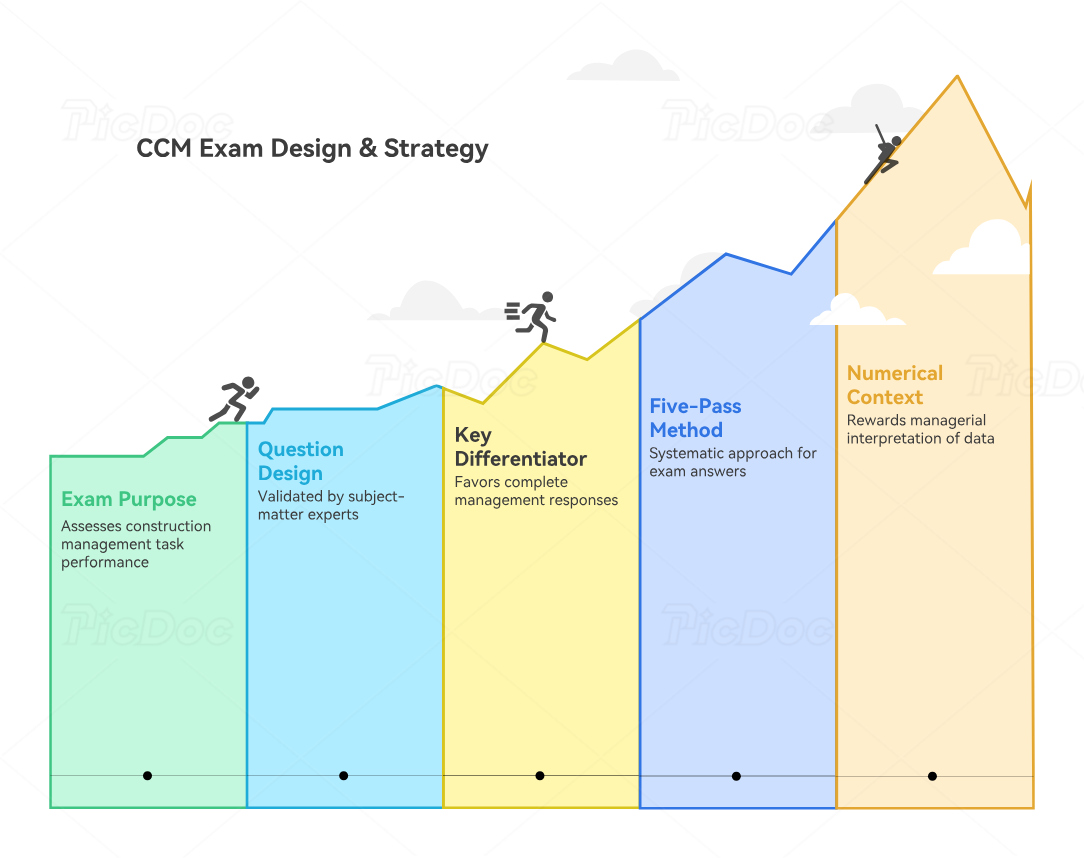
The exam is designed to test whether candidates can perform construction-management job tasks, rather than merely recall isolated facts. Questions are developed around a job-task analysis and validated by subject-matter and test-development experts.
That design explains why two answers may look technically possible. One may solve the immediate symptom; another protects the owner, follows authority, obtains missing evidence, preserves contractual rights, and reduces downstream exposure. The stronger CCM answer usually reflects the complete management obligation.
Use the following five-pass method.
Pass 1: Identify the Project Phase
A response appropriate during pre-design may be inappropriate during construction. During pre-design, the construction manager may clarify owner objectives, delivery strategy, budget, risk tolerance, procurement timing, and governance. During design, the focus may shift to constructability, cost verification, coordination, schedule, value analysis, and requirements control. During construction, the candidate must consider contract administration, documentation, safety, quality, changes, payment, schedule control, and field coordination.
Questions involving project requirements, cost estimates, procurement documents, and project closure become easier once the phase is clear.
Pass 2: Identify the Owner Objective at Risk
The visible problem may be a late submittal, failed inspection, unsafe condition, cost increase, design conflict, missing record, or disputed change. The management question concerns the owner impact: operational readiness, budget authority, completion date, public safety, legal exposure, quality, funding compliance, or continuity of service.
Consider a contractor reporting a four-week delay. Choosing “accelerate immediately” ignores cause, responsibility, feasibility, cost, and authority. The construction manager should first validate the update, determine critical-path effect, identify causation, review contractual requirements, assess recovery options, and present the owner with a documented recommendation. That reasoning combines schedule-control terminology, schedule-compression techniques, risk-response planning, and financial-impact analysis.
Pass 3: Identify Authority and Responsibility
Ask who is contractually authorized to direct work, approve payment, accept a change, interpret design intent, stop unsafe activity, certify completion, or modify requirements. Construction managers coordinate and advise extensively, but their authority depends on the agreement and project structure.
The exam may punish both passivity and unauthorized action. Waiting while an imminent safety hazard continues is indefensible. Issuing commercial direction outside delegated authority can also expose the owner. The best response may require immediate protective action, notification of the responsible party, documentation, escalation, and formal owner authorization.
Use a RACI-style responsibility framework, stakeholder-engagement map, contract-administration process, and governance model when reviewing difficult scenarios.
Pass 4: Look for Missing Evidence
Strong construction-management decisions rely on verified information. Before selecting a response, ask what has been confirmed:
Is the reported delay actually on the critical path?
Was the alleged change authorized?
Does the contractor’s price separate labor, material, equipment, overhead, and schedule impact?
Was proper notice provided?
Does the inspection record establish nonconformance?
Has the root cause been investigated?
Is the budget figure a baseline, forecast, commitment, or actual cost?
Does the proposed technology comply with access, retention, and cybersecurity requirements?
The most professional next action is often to gather, preserve, or validate the decisive evidence. This logic is central to project reporting, monitoring and control, risk-register maintenance, and quality management.
Pass 5: Choose the Least-Regret Professional Action
A least-regret action protects safety, preserves rights, respects authority, keeps options open, and creates a documented route to resolution. Examples include verifying before approving, documenting before memory degrades, notifying before deadlines expire, escalating through established governance, and controlling immediate exposure while a full investigation continues.
Beware of answers containing absolute language such as “always terminate,” “immediately approve,” or “reject without review.” Construction decisions depend on contracts, evidence, authority, phase, urgency, and owner objectives. Also distrust answers that create unnecessary confrontation where structured clarification, documentation, negotiation, or escalation remains available. Review conflict-resolution concepts, stakeholder communication, risk mitigation, and professional leadership terminology to strengthen this judgment.
Handle Numerical Questions Without Losing the Management Context
Memorize essential formulas, but attach each formula to a decision. A cost variance alone does not explain whether the project is improving, deteriorating, or incorrectly baselined. A negative schedule variance does not automatically reveal contractual delay. Total float does not prove entitlement. A contingency balance does not authorize unrestricted use.
For every calculation, ask:
What does the result mean?
Which assumption drives it?
Is the underlying data reliable?
Who needs the information?
Which decision follows?
What risk remains?
Practise using earned value formulas, project-finance definitions, agile estimation principles, and resource-allocation terminology. The examination rewards managerial interpretation, rather than arithmetic performed in isolation.
5. Execute the Final 30 Days and Exam Day Without Preventable Failure
Thirty days before the examination, your preparation should shift from coverage to control. Freeze the core resource list. Schedule two full simulations. Verify the testing appointment, identification name, route, parking, equipment, internet, room conditions, and applicable testing rules. Build a one-page final review sheet containing formulas, decision rules, recurring errors, domain reminders, and pacing checkpoints.
A useful final-month sequence is:
Days 30–22: Complete the first full simulation and repair the three largest domain gaps.
Days 21–15: Complete targeted mixed sets and retest every repeated misconception.
Days 14–8: Complete the second simulation under realistic timing and break conditions.
Days 7–4: Review error patterns, contract processes, formulas, governance, safety, and ethics.
Days 3–2: Complete light mixed review and confirm logistics.
Day 1: Stop heavy study, prepare identification and materials, eat normally, and protect sleep.
Exam day: Execute the rehearsed plan.
This is the same control logic used in project closeout, risk mitigation, quality assurance, and project reporting: verify prerequisites, remove defects, close open actions, and protect the final delivery.
Use Fixed Pacing Checkpoints
With 175 questions and 240 minutes, allowing every difficult question to consume unrestricted time is dangerous. Use approximate checkpoints:
Question 45 by minute 60
Question 90 by minute 120
Question 135 by minute 180
Question 158 by minute 210
Question 175 by approximately minute 230
That leaves roughly ten minutes for flagged questions and unanswered items. Checkpoints are warning triggers, rather than rigid commands. A calculation-heavy stretch may temporarily slow progress, but you should know immediately when recovery is required.
Answer every question. The CCM handbook states that all questions carry equal weight, unanswered items provide no advantage, and guessing carries no penalty. Mark difficult questions for review, select the best available answer, and continue.
When two answers remain, compare them against the five-pass framework: phase, owner objective, authority, evidence, and least-regret action. Avoid changing an answer solely because it feels uncomfortable. Change it when you identify a specific fact, responsibility, or principle that makes the alternative stronger.
Protect Admission and Testing Compliance
The first and last names on your identification must match the application exactly. Accepted identification examples include a driver’s licence, state ID, passport, passport card, permanent-resident documentation, or national identification card. Candidates arriving after the appointment time may be treated as absent and required to pay a reinstatement fee before rescheduling.
For in-person testing, the handbook recommends arriving at least thirty minutes early. Personal electronics, watches, reference materials, and other prohibited items cannot enter the testing area. Restroom breaks count against the 240-minute examination time.
Live remote proctoring is subject to CMCI approval and specified accommodation criteria. Approved remote candidates must meet technical and room requirements, complete identity and room checks, and follow strict webcam, break, scratch-paper, device, and workspace rules. CMCI recommends using a personal computer because workplace security restrictions may interfere with the required testing software.
Treat these requirements like a project risk register. Assign each failure mode a preventive control: identification mismatch, traffic delay, unsupported computer, firewall restriction, poor internet, room interruption, prohibited device, or missed rescheduling deadline.
Plan Beyond the Passing Result
Candidates who pass are informed that they successfully completed the examination; CMCI does not report a detailed high score because the exam is designed to distinguish candidates who meet the competency threshold. Candidates who fail receive an overall score and diagnostic performance by content area, which can be used to plan a retake.
Earning the credential begins a professional-development cycle. CCM certification must be renewed every three years. Current renewal requirements include 25 renewal points, at least one professional-development activity point addressing construction safety or ethics, and a $225 recertification fee.
Create a renewal plan immediately after passing. Record eligible activities quarterly, retain certificates and supporting evidence, and choose development that strengthens your actual responsibilities. Valuable directions include construction technology, sustainability and ESG, project governance, and future construction-management practices.
The credential becomes more valuable when you convert it into visible professional evidence. Update your résumé with owner-side decisions, quantified outcomes, delivery methods, project values, and controlled risks. Apply the credential through stronger leadership communication, financial management, stakeholder governance, and technology adoption. The letters after your name create initial credibility; your documented decisions determine whether that credibility survives scrutiny.
6. Frequently Asked Questions About CCM Preparation
-
The credentials address overlapping management capabilities but serve different professional contexts. The CCM focuses specifically on construction-management practice, including program and project management, cost, time, contract administration, quality, safety, risk, professional practice, sustainability, and technology. Its eligibility model also requires verified responsible-in-charge construction-management experience.
The PMP has broader cross-industry application and is often associated with general project-management domains, PMP preparation resources, PMP renewal requirements, and project-management career development. Construction professionals may benefit from either credential, or both, depending on the roles, clients, procurements, and employer expectations they pursue.
-
A four-year degree outside the listed qualifying AEC disciplines may be used, but the current handbook requires a minimum of 72 non-overlapping months of responsible-in-charge experience for that route. The decisive issue remains whether the applicant can document qualifying construction-management responsibility across the required functions and phases.
Start by mapping your experience against project-execution functions, cost-management responsibilities, schedule-control duties, and contract-administration activities. Confirm the pathway through the current CMCI handbook before paying an application or training fee.
-
A practical preparation period is eight to twelve weeks for an experienced candidate who can protect six to ten focused hours each week. Candidates with major contract, technology, sustainability, or project-controls gaps may need longer. Calendar duration matters less than completed outputs: handbook review, diagnostic assessment, domain notes, practice sets, error-log closure, and full simulations.
Build the plan like a controlled project using resource allocation, schedule monitoring, risk response, and performance metrics. Candidates working on demanding construction programs should include recovery weeks because shutdowns, claims, inspections, and project emergencies can disrupt study time.
-
Program and Project Management carries the highest current weighting at 19 percent. Safety Management and Technology each account for 10 percent. Six domains carry 9 percent each, while Sustainability carries 7 percent.
Weight alone should not dictate preparation. Combine it with diagnostic weakness. A candidate strong in program governance but weak in contract administration, risk-register management, and quality control should redirect time toward those weaknesses. Use domain weight to establish the baseline and practice data to refine it.
-
The current CCM Application Handbook states that the examination requires an overall passing score of 67 percent or higher. The test contains 175 questions, but only 150 contribute to the score; 25 unidentified questions are being evaluated for possible future use. Candidates cannot identify which questions are unscored, so every item should receive full attention.
Aim above the threshold in practice. A stable mixed-domain performance around the mid-to-high 70s provides more protection against exam pressure, unfamiliar wording, and domain variation than repeatedly scoring near 67 percent. Use practice-resource discipline, exam-mistake analysis, performance monitoring, and risk-based preparation to build that margin.
-
CMCI provides a live remote-proctoring pathway subject to approval and stated accommodation criteria. The handbook identifies circumstances such as excessive distance from a test location, testing-site closure, medical conditions, and other undue burdens considered by CMCI. Candidates without approved live remote-proctoring accommodations are directed toward in-person testing.
Remote testing requires a compliant computer, broadband connection, webcam, microphone, private room, identity verification, room scan, restricted materials, and strict break procedures. Treat remote readiness like a technology implementation, cybersecurity control, risk-management exercise, and quality-verification process. Test the actual equipment and environment well before examination day.
