
How to Become a Certified Professional in Requirements Engineering (CPRE)
Projects lose money long before delivery fails. The damage often begins with unclear objectives, missing stakeholders, contradictory expectations, weak acceptance criteria, and requirements that cannot be tested. The Certified Professional for Requirements Engineering pathway gives business analysts, project managers, product owners, developers, testers, and consultants a structured method for controlling those risks. This guide explains the current CPRE certification structure, Foundation Level examination, preparation strategy, study resources, career applications, and practical steps required to turn the credential into credible requirements-engineering capability.
1. What Is the CPRE Certification, and Who Should Pursue It?
The Certified Professional for Requirements Engineering program is developed by the International Requirements Engineering Board, commonly known as IREB. Its purpose is to create a consistent professional framework for eliciting, documenting, validating, managing, and improving requirements across predictive, iterative, and Agile environments. These capabilities connect directly with disciplined project initiation, accurate stakeholder engagement, controlled project risk management, and reliable project quality management.
The current CPRE pathway contains four progressive levels:
Foundation: Establishes core knowledge of Requirements Engineering.
Practitioner: Develops deeper knowledge in a selected specialization.
Specialist: Demonstrates advanced practical competence within that specialization.
Expert: Validates broad, cross-functional mastery and substantial professional experience.
The Practitioner and Specialist levels currently offer four specialization routes: Requirements Elicitation, Requirements Management, Requirements Modeling, and RE@Agile. The Expert credential sits at the highest level and targets professionals capable of advising organizations, coaching practitioners, and improving Requirements Engineering processes.
Most candidates begin with CPRE Foundation Level. It has no formal admission restrictions and serves as the prerequisite for progressing into the Practitioner pathway. The Foundation curriculum covers Requirements Engineering principles, work products, documentation, elicitation, validation, conflict resolution, process design, requirements management, and tool support.
CPRE suits professionals whose work depends on converting uncertain business needs into deliverables that teams can understand, estimate, build, test, accept, and maintain. That group includes:
Business analysts
Requirements engineers
Systems analysts
Project and program managers
Product owners and product managers
Software developers
Quality assurance professionals
Test analysts
UX and CX specialists
Solution architects
Process analysts
Consultants
Domain experts
Procurement and vendor-management professionals
A project manager may use CPRE skills to establish a defendable scope baseline, improve project scheduling, protect the project budget, and prevent uncontrolled requests from disrupting the critical path. A business analyst may apply the same framework to stakeholder interviews, process models, requirement specifications, traceability, and acceptance criteria.
Product professionals gain a common method for connecting user problems, business goals, product requirements, constraints, and measurable value. These skills complement Scrum roles and responsibilities, modern Agile project-management tools, structured Kanban software, and effective team communication platforms.
The certification can be especially valuable when your organization repeatedly experiences:
Requirements that change without impact assessment
Stakeholders who disagree after development begins
Acceptance criteria that cannot be objectively tested
Teams building different interpretations of the same request
Scope documents filled with vague language
Missing regulatory or operational constraints
Rework caused by assumptions that were never validated
Product backlogs containing solutions without clear user needs
Vendor proposals that answer incomplete specifications
Change requests with no traceability to business objectives
These failures frequently appear later as schedule delays, budget overruns, defects, contract disputes, and failed acceptance. Learning change-control discipline, conflict-resolution methods, project reporting practices, and stakeholder terminology helps expose those problems before they become expensive.
CPRE Competency Matrix: 28 Skills You Should Build Before and After Certification
| Competency | What You Must Be Able to Do | Typical Failure It Prevents | Practical Proof Asset | Where It Is Used |
|---|---|---|---|---|
| Business objective analysis | Translate strategy, problems, opportunities, and desired outcomes into a clear project purpose. | Teams delivering outputs that create little measurable value. | Business objective map | Initiation, product discovery, business cases. |
| System context | Identify users, external systems, interfaces, processes, regulations, and environmental constraints. | Missing integrations and overlooked operational dependencies. | Context diagram | Software, infrastructure, digital transformation. |
| System boundary | Define which capabilities belong inside the solution and which remain external. | Scope disputes and unowned responsibilities. | Boundary model | Scoping, procurement, architecture. |
| Stakeholder identification | Find decision-makers, users, operators, regulators, funders, maintainers, and affected groups. | Late objections from overlooked stakeholders. | Stakeholder register | Every project and product environment. |
| Requirements-source analysis | Determine which people, systems, laws, documents, and observations provide reliable information. | Requirements based on one person’s incomplete perspective. | Requirements-source map | Discovery, compliance, modernization. |
| Interview planning | Prepare objectives, participant roles, questions, evidence, and follow-up actions. | Long conversations that produce unusable notes. | Interview guide | Business analysis, consulting, service design. |
| Workshop facilitation | Structure group discovery, control dominant voices, surface disagreements, and capture decisions. | Meetings ending with artificial consensus. | Workshop plan and decision log | Cross-functional and enterprise projects. |
| Observation | Study real work, exceptions, workarounds, handoffs, and environmental constraints. | Documented processes that differ from actual operations. | Observation findings report | Operations, manufacturing, healthcare, logistics. |
| Document analysis | Extract requirements from policies, contracts, manuals, reports, standards, and existing specifications. | Missing obligations already recorded elsewhere. | Document-source traceability sheet | Regulated and contract-heavy projects. |
| Natural-language requirements | Write precise statements with clear actors, behavior, conditions, objects, and outcomes. | Ambiguous specifications interpreted differently by each team. | Requirements specification | Business, software, procurement, compliance. |
| Requirement templates | Use structured sentence patterns to improve consistency and reduce missing information. | Requirements with unclear conditions or responsibilities. | Requirement-writing template | Large teams and repeatable documentation. |
| Model-based documentation | Select models that clarify structure, behavior, data, processes, states, or interactions. | Dense documents that hide relationships and exceptions. | Process, state, or data model | Complex systems and transformation programs. |
| User stories | Express user needs with meaningful context, value, and supporting acceptance conditions. | Backlogs filled with technical tasks disconnected from outcomes. | Refined product-backlog sample | Agile product and software teams. |
| Acceptance criteria | Define observable conditions that determine whether a requirement has been satisfied. | Arguments during testing and customer acceptance. | Acceptance-criteria catalogue | Development, testing, contracts, handover. |
| Quality checking | Review requirements for clarity, consistency, necessity, feasibility, traceability, and testability. | Defects entering design and development. | Requirements-quality checklist | Reviews, quality assurance, governance. |
| Validation | Confirm that documented requirements represent stakeholder needs and project objectives. | Correctly documented requirements solving the wrong problem. | Validation report | Discovery, prototypes, specifications. |
| Prototyping | Use prototypes to expose assumptions, usability problems, missing rules, and conflicting expectations. | Late discovery that users expected different behavior. | Prototype-feedback log | Digital products, interfaces, service design. |
| Conflict identification | Recognize factual, interest-based, value-based, relationship, and structural conflicts. | Contradictions being buried inside documentation. | Conflict register | Multi-stakeholder programs and procurement. |
| Conflict resolution | Facilitate evaluation, negotiation, compromise, escalation, or evidence-based decisions. | Requirements remaining permanently disputed. | Conflict-resolution record | Governance, product, vendor, policy projects. |
| Prioritization | Rank requirements through value, urgency, risk, dependency, effort, and stakeholder importance. | Everything being declared equally critical. | Prioritized requirements catalogue | Release planning, procurement, phased delivery. |
| Traceability | Connect objectives, sources, requirements, designs, tests, changes, and delivered components. | Teams being unable to assess change impact. | Traceability matrix | Regulated, safety-critical, contract-based work. |
| Version control | Maintain requirement versions, status, history, authorship, approvals, and baselines. | Teams building from obsolete information. | Version and baseline register | Formal projects and distributed teams. |
| Change management | Evaluate the value, risk, cost, schedule, design, test, and contract impact of changes. | Silent scope expansion and uncontrolled rework. | Requirement-change assessment | Every evolving project environment. |
| Requirements lifecycle | Control proposed, analyzed, approved, implemented, verified, rejected, and retired requirements. | Requirements remaining in unclear states. | Lifecycle workflow | Product management and governance. |
| Process tailoring | Adapt Requirements Engineering activities to project size, risk, domain, lifecycle, and team structure. | Heavy documentation on simple work or weak control on complex work. | Tailored RE approach | Agile, predictive, hybrid, regulated work. |
| Tool evaluation | Assess repository, modeling, collaboration, traceability, workflow, reporting, and integration needs. | Buying software that creates administrative burden. | Requirements-tool scorecard | Enterprise analysis and PMO environments. |
| Supplier requirements | Convert business needs into specifications, evaluation criteria, deliverables, and acceptance rules. | Vendors pricing and delivering different interpretations. | Tender requirements package | Procurement and outsourced delivery. |
| Requirements reporting | Report volatility, approval status, defects, coverage, traceability gaps, and unresolved decisions. | Leadership receiving activity updates without delivery insight. | Requirements dashboard | PMO, program governance, product operations. |
2. CPRE Foundation Eligibility, Exam Format, Cost, and Certification Levels
The CPRE Foundation Level has no formal examination prerequisites. Candidates can prepare independently or attend a training course, then register with an IREB-recognized certification body. The examination is based on the official syllabus and handbook, and every educational unit may be examined. Training is recommended for candidates who need structure, while self-study remains a valid route.
The Foundation examination currently has approximately 45 multiple-choice questions, lasts 75 minutes, and requires at least 70% of the available points to pass. Questions may carry between one and three points depending on difficulty. The regulations include single-choice and multiple-answer formats, so candidates must read how many responses are required before selecting options.
Candidates taking the examination in a language other than their native language may request additional time. The Foundation examination can be extended from 75 to 90 minutes when the request is justified and accepted by the certification body. Many recognized certifiers also offer online examination options.
Exam costs vary by certification body, country, currency, delivery format, and whether training is purchased. IREB does not publish one universal candidate fee because certifiers and training providers determine their respective prices. Before purchasing, compare the complete cost of:
Examination registration
Classroom or virtual training
Study materials
Taxes
Currency-conversion charges
Retake fees
Travel to a test center
Rescheduling
Language options
Technical requirements for online proctoring
A low-cost course deserves careful evaluation. Confirm that the material follows the current syllabus, especially version 3.3.0 dated April 1, 2026. The current syllabus includes seven educational units and reflects both plan-driven and Agile approaches to specifying and managing requirements.
Candidates should also verify access to the latest handbook, glossary, practice exam, and examination regulations. Outdated notes may contain older terminology, removed learning objectives, or a previous certification structure. Build your wider knowledge through project-management terminology, project initiation concepts, communication terminology, and quality-management definitions.
The seven CPRE Foundation syllabus areas
The current Foundation curriculum covers:
Introduction to and overview of Requirements Engineering
Fundamental principles of Requirements Engineering
Work products and documentation practices
Practices for requirements elaboration
Process and work structure
Practices for requirements management
Tool support
The syllabus distinguishes cognitive levels such as knowing, understanding, and applying. That distinction affects your preparation. Terminology requires accurate recall, while templates, modeling, documentation, and elaboration practices may require application to examples.
What happens after Foundation Level?
Foundation certification opens the route to Level 2 Practitioner. Candidates may specialize in:
Requirements Elicitation: Sources, interviews, workshops, observation, creativity, and stakeholder involvement
Requirements Management: Versioning, traceability, prioritization, change, lifecycle control, and reporting
Requirements Modeling: Structured representations of context, behavior, information, and system properties
RE@Agile: Requirements Engineering within iterative product and Agile environments
These specializations connect with practical areas such as stakeholder-management terminology, project issue tracking, project dashboard tools, and Agile delivery platforms.
The Level 3 Specialist credential demonstrates advanced application within one specialization. Level 4 Expert represents broad professional mastery across Requirements Engineering and includes experience-based assessment. This progression allows candidates to start with a common foundation and deepen the area most relevant to their work.
CPRE certificates are valid for life, so holders do not face periodic recertification requirements for the certificate itself. IREB also offers a registry where certificate holders can voluntarily publish and verify their credentials. More than 95,000 people are currently CPRE-certified worldwide, according to the official registry page.
3. Step-by-Step Plan to Become CPRE Foundation Certified
Step 1: Define the career problem the certification must solve
Start with a target role, capability gap, or project problem. A business analyst may need formal validation. A project manager may need better scope control. A product owner may struggle with backlog quality. A tester may want to participate earlier in requirement validation. A procurement specialist may need stronger specifications and acceptance conditions.
Study vacancies and record recurring requirements such as stakeholder workshops, process modeling, user stories, acceptance criteria, traceability, change control, UML, BPMN, product discovery, and requirements-management tools. Compare those findings with RFP, RFQ, and RFI terminology, vendor-management practices, contract-management terminology, and procurement-management tools.
Step 2: Download the official learning package
Use the current IREB download center to obtain the syllabus, handbook, glossary, practice examination, fact sheet, and examination regulations. The official process page also provides access to an online self-assessment. These materials define the examinable scope and should remain your primary preparation source.
Create one study folder containing:
Current syllabus
Current handbook
CPRE glossary
Exam regulations
Practice exam
Personal notes
Error log
Flashcards
Requirements examples
Revision calendar
Avoid building your plan around random question banks. Unofficial questions may simplify concepts, use old terminology, or teach incorrect answer patterns. Your broader reading can include project risk terminology, project scheduling terms, stakeholder engagement, and conflict-resolution terminology.
Step 3: Choose self-study or accredited training
Self-study works well for candidates with business analysis, systems analysis, product, testing, or software-development experience. It offers flexibility and can lower the total cost. The candidate must provide structure, maintain momentum, and correct misunderstandings independently.
Instructor-led training can help candidates who need examples, feedback, group exercises, and explanation of models or terminology. IREB states that structured courses commonly run for around three days, though provider formats vary.
Evaluate providers using these questions:
Does the course follow syllabus version 3.3.0?
Is the trainer experienced in real Requirements Engineering work?
Does the course include application exercises?
Are practice questions explained in detail?
Can you access recordings or materials afterward?
Does the provider cover all seven educational units?
Are models and templates taught through examples?
Is the exam included in the package?
What happens if the exam date changes?
Which language is used for teaching and examination?
Training quality affects your understanding of subtle distinctions. Similar problems arise when candidates select PMP preparation resources, compare PRINCE2 training providers, choose CAPM study resources, or evaluate project-management templates.
Step 4: Build an eight-week study schedule
A realistic schedule for a working professional can follow this structure:
Week 1: Learn the purpose, role, context, and principles of Requirements Engineering.
Week 2: Study work products, abstraction levels, documentation structures, and quality criteria.
Week 3: Practice natural-language and template-based requirements.
Week 4: Study model-based work products and create simple context, process, state, and data examples.
Week 5: Study requirements sources, elicitation techniques, validation, and conflict resolution.
Week 6: Learn process configuration, lifecycle choices, tailoring, and work structure.
Week 7: Study requirements management, prioritization, traceability, change, and tool support.
Week 8: Complete practice exams, analyze mistakes, revise weak areas, and perform final timed simulations.
Connect each week to wider delivery controls. Elicitation supports project communication, prioritization informs resource allocation, traceability supports project reporting, and validation reinforces project quality.
Step 5: Create a requirements portfolio while studying
Use a realistic case, such as an appointment-booking system, e-commerce return process, learning-management platform, clinic registration service, procurement portal, or employee leave system.
Produce:
Business objective statement
System context diagram
Stakeholder register
Requirements-source map
Interview plan
Workshop agenda
Functional requirements
Quality requirements
Constraints
User stories
Acceptance criteria
Process model
Requirements-quality review
Conflict register
Prioritization matrix
Traceability matrix
Change request
Status dashboard
This portfolio converts theoretical preparation into demonstrable skill. It can also be built using issue-tracking software, reporting and analytics tools, dashboard platforms, and project-management integrations.
Step 6: Register and verify examination conditions
Book through a recognized certification body. Confirm the exam language, time zone, identity requirements, delivery method, cancellation terms, technical checks, result timing, and retake policy. Many certifiers provide online options. Candidates may also take examinations independently of formal training.
The examination can be retaken twice without a waiting period. A candidate who fails the third attempt must wait one year before trying again. Use the first attempt only after your timed performance and terminology accuracy become stable.
What Is Your Biggest CPRE Preparation Problem?
4. How to Study the CPRE Syllabus and Pass the Foundation Exam
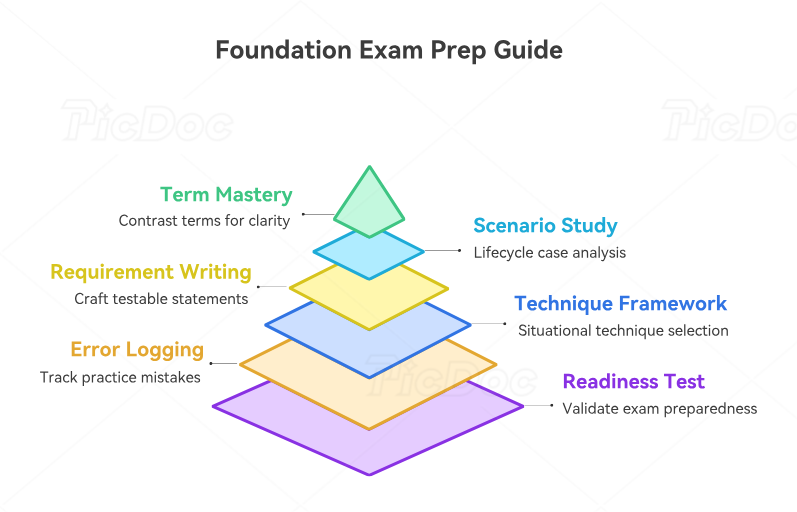
The Foundation exam rewards precise understanding. Several answer options may sound reasonable, while the correct choice reflects the terminology, principles, and distinctions defined in the official learning materials. Build your preparation around active recall, comparison, application, and error analysis
Master the terminology through contrasts
Definitions become easier when studied in pairs or groups
Requirement versus design decision
Functional requirement versus quality requirement
Requirement versus constraint
System context versus system boundary
Requirements source versus stakeholder
Verification versus validation
Elicitation versus documentation
Requirement attribute versus requirement content
Baseline versus version
Prioritization versus approval
Traceability versus dependency
Conflict identification versus conflict resolution
For each term, record its definition, purpose, example, related terms, and common confusion. This approach also improves your command of project risk terms, stakeholder terminology, project budgeting language, and quality-management concepts.
Study requirements through complete scenarios
Choose one case and follow it through the entire lifecycle. Identify objectives, stakeholders, sources, boundaries, interfaces, requirements, conflicts, priorities, changes, and acceptance conditions. This reveals how topics connect.
For example, an online appointment system may involve patients, receptionists, doctors, administrators, payment providers, identity services, data-protection rules, notification systems, and existing medical records. Each source may introduce requirements or constraints. Every change may affect interfaces, tests, security, operations, and stakeholder expectations.
Scenario work complements Agile Scrum platforms, Waterfall project software, team communication tools, and workforce-management systems.
Practice writing testable requirements
Weak requirement:
The system should quickly send useful notifications to users.
Stronger requirement:
When an appointment is created, rescheduled, or cancelled, the system shall send an email notification to the registered patient address within two minutes.
The stronger version identifies the trigger, system responsibility, action, recipient, channel, and measurable performance condition. Additional requirements may define delivery-failure handling, language, privacy, logging, accessibility, and message content.
Use a quality checklist to test each statement for:
Necessity
Clarity
Unambiguity
Completeness
Consistency
Feasibility
Verifiability
Traceability
Modifiability
Appropriate level of detail
These checks reinforce Six Sigma terminology, project quality concepts, project reporting standards, and issue-management practices.
Build a technique-selection framework
Avoid memorizing elicitation techniques as a flat list. Organize them by situation.
Use interviews when individual expertise, confidentiality, or deep follow-up is important.
Use workshops when stakeholders must build shared understanding, resolve disagreement, or make decisions together.
Use observation when actual behavior differs from documented processes or users struggle to explain tacit knowledge.
Use document analysis when regulations, policies, contracts, legacy specifications, or manuals contain relevant obligations.
Use prototypes when stakeholders need something visible to evaluate interaction, layout, workflow, or feasibility.
Use surveys when input is required from a large, distributed population and the questions can be standardized.
Use creativity techniques when the team must generate alternatives, discover innovative features, or challenge existing assumptions.
Your selection should consider time, stakeholder availability, sensitivity, project risk, required depth, geographic distribution, and maturity of the problem. Similar judgment supports vendor selection, RFP development, contract planning, and procurement management.
Use an error log for practice examinations
After each practice session, record:
Question topic
Your selected answer
Correct answer
Reason your answer looked attractive
Relevant syllabus section
Missing distinction
Correct decision rule
Date for review
Classify mistakes as knowledge gaps, terminology confusion, rushed reading, overthinking, missed negative wording, or selecting the wrong number of answers. The examination regulations state that checking more answers than required results in zero points for that question. Careful instruction reading therefore affects your score directly.
Apply a final readiness test
Schedule the examination when you can:
Explain every syllabus area without notes
Distinguish similar glossary terms accurately
Write clear functional and quality requirements
Select suitable elicitation and validation techniques
Recognize requirement conflicts
Explain prioritization and traceability
Apply lifecycle and change-management concepts
Choose suitable work products and models
Complete timed practice comfortably
Maintain stable scores above the minimum threshold
A passing score represents one milestone. Your career value grows when those skills improve project planning, schedule control, stakeholder decisions, and project reporting.
5. How to Turn CPRE Certification Into Career Growth
Add the certification to your CV with its complete name, level, issuing body, and award year. Place it near the top when requirements work is central to the target vacancy. Registering the certificate in the voluntary CPRE Registry can provide an additional verification route for employers.
The credential should appear alongside evidence. Build CV bullets around the consequences of better requirements:
Reduced requirement defects before development
Improved stakeholder approval time
Lowered change-request volume
Increased test coverage
Improved traceability
Reduced rework
Clarified procurement specifications
Accelerated backlog refinement
Resolved conflicting stakeholder expectations
Improved acceptance and handover
A strong bullet could state:
Facilitated requirements workshops across operations, finance, and technology teams, resolved 14 conflicting rules, and produced approved acceptance criteria before vendor development began.
Another could state:
Introduced objective requirement-quality reviews and traceability controls, allowing the project team to assess change impact before approving scope adjustments.
These outcomes connect CPRE knowledge with conflict-resolution practices, stakeholder engagement, project reporting, and contract-management terminology.
Roles strengthened by CPRE
Business Analyst: CPRE provides a structured foundation for discovery, documentation, modeling, validation, and lifecycle management.
Requirements Engineer: The certification directly validates the professional discipline and creates a route into deeper specialization.
Project Manager: Better requirements improve scope, estimation, schedule credibility, risk assessment, procurement, testing, and acceptance.
Product Owner: CPRE strengthens stakeholder discovery, backlog quality, acceptance criteria, prioritization, and value alignment.
Tester or QA Professional: Requirements knowledge helps detect ambiguity earlier and improves testability, coverage, and defect prevention.
Solution Architect: Clear requirements support architectural decisions, interfaces, constraints, quality attributes, and trade-offs.
Procurement Professional: Structured requirements improve specifications, evaluation criteria, supplier comparability, contractual clarity, and acceptance.
Consultant: The framework provides repeatable terminology and methods for diagnosing client needs and structuring recommendations.
These roles also benefit from Agile project tools, Scrum project platforms, reporting analytics software, and dashboard solutions.
Choose the right post-Foundation specialization
Select Requirements Elicitation Practitioner when your work centers on discovery, interviews, workshops, stakeholder analysis, observation, and resolving incomplete or conflicting needs.
Select Requirements Management Practitioner when you control versions, approvals, priorities, traceability, changes, baselines, attributes, and requirement lifecycles.
Select Requirements Modeling Practitioner when complex systems require visual representations of context, processes, data, behavior, states, and relationships.
Select RE@Agile Practitioner when you work with product backlogs, iterative delivery, continuous discovery, user stories, changing priorities, and frequent stakeholder feedback.
Your choice should reflect the work you perform weekly. A procurement analyst may gain stronger value from Management or Elicitation. A systems analyst may prefer Modeling. A product owner may prefer RE@Agile. A consultant working across discovery and stakeholder alignment may choose Elicitation.
The certification can also complement PMP, CAPM, PRINCE2, Scrum, Agile, testing, architecture, and product-management credentials. A PMP holder gains deeper requirements control. A Scrum Master gains stronger discovery and documentation knowledge. A tester gains earlier influence over requirement quality. Continue developing through PMP exam domains, CAPM career guidance, PMP and PRINCE2 comparisons, and Scrum-role guidance.
6. Frequently Asked Questions About CPRE Certification
-
CPRE stands for Certified Professional for Requirements Engineering. The program is governed by IREB and provides a progressive certification pathway covering Foundation, Practitioner, Specialist, and Expert levels. The knowledge supports stakeholder engagement, project initiation, risk management, and project quality.
-
The Foundation examination has no formal prerequisites. Candidates from business, technology, product, project management, testing, procurement, operations, and consulting backgrounds may register. Basic familiarity with systems development, Agile delivery, project terminology, stakeholder communication, and quality concepts makes preparation easier.
-
The official examination regulations specify approximately 45 questions completed in 75 minutes. Candidates need at least 70% of the available points to pass. Prepare through the official syllabus, handbook, glossary, practice exam, and self-assessment while strengthening requirements-related project terms, stakeholder concepts, conflict-resolution terminology, and reporting practices.
-
Many recognized certification bodies offer online examinations. Availability, technical requirements, languages, identity checks, and scheduling rules can differ, so confirm these details with the selected certifier before payment. Online candidates should also prepare their workspace, internet connection, identification, and examination system while organizing project tools, communication platforms, issue trackers, and study resources.
-
The Foundation examination is manageable with disciplined preparation, though the terminology and multiple-answer formats require precision. Candidates commonly struggle with similar concepts, model selection, quality criteria, requirement types, conflict resolution, and requirements-management distinctions. Study the official materials and apply concepts through stakeholder scenarios, risk examples, quality reviews, and change-control exercises.
-
IREB states that structured training commonly lasts around three days, while self-study duration depends on experience and preparation method. Many working professionals benefit from six to eight weeks of study that combines reading, terminology review, application exercises, and timed questions. Organize preparation with project scheduling principles, Gantt chart concepts, resource-allocation tools, and project reporting methods.
