
Complete Guide to Earned Value Management Certification (EVMP)
Earned Value Management Professional certification can help experienced project professionals convert cost, schedule, scope, and performance data into defensible management decisions. It is particularly relevant for people working in project financial management, project monitoring and control, scheduling, government contracting, engineering, construction, defense, and complex program delivery. This guide explains the EVMP pathway, eligibility rules, assessment structure, essential formulas, preparation strategy, career value, and the practical evidence employers expect from someone claiming advanced earned value management capability.

1. What EVMP Certification Validates and Whether It Fits Your Career
EVMP stands for Earned Value Management Professional. The credential is offered by the Earned Value Management Institute and targets professionals who work across EVM, project controls, cost management, scheduling, risk, financial analysis, contract oversight, and Earned Value Management System implementation. Its published curriculum includes performance measurement baselines, control accounts, work packages, forecasting, variance analysis, Integrated Baseline Reviews, re-baselining, corrective action, and the application of EIA-748-D EVMS guidelines.
The central skill being validated is management interpretation. Memorizing that CPI equals EV divided by AC carries limited value when a project director asks why efficiency deteriorated, whether the baseline remains credible, and how much additional funding will be required. A capable practitioner connects earned value metrics with the risk register, resource allocation, procurement conditions, approved scope, accounting periods, and the current schedule forecast.
EVMP therefore suits professionals such as:
Project controls analysts moving toward senior or lead responsibilities.
Cost engineers responsible for budgeting, forecasting, or variance analysis.
Schedulers who need stronger cost-and-schedule integration.
Control Account Managers who own measurable scope, budget, and corrective action.
Program managers supervising large, regulated, or capital-intensive work.
PMO professionals developing reporting standards and governance controls.
Consultants implementing or assessing an organizational EVMS.
Contract, procurement, finance, and engineering professionals supporting major programs.
The credential has particular relevance where clients require structured baselines, formal surveillance, auditable change control, and disciplined reporting. These conditions frequently appear in government programs, aerospace, defense, infrastructure, energy, transportation, engineering, and major construction. Professionals preparing for such environments should strengthen their understanding of project governance, project reporting, vendor management, and RFP, RFQ, and RFI terminology.
The credential makes the strongest career sense when target job descriptions explicitly mention EVM, EVMS, project controls, integrated cost and schedule management, EIA-748, Integrated Baseline Reviews, Estimate at Completion, variance analysis, or Control Account Management. Review 20–30 target vacancies before enrolling. Count the recurring requirements and identify whether employers request EVMP specifically, another earned value credential, or practical EVM experience. This prevents an expensive certification decision from being based on reputation claims alone.
2. EVMP Eligibility, Application, Cost, Exam, and Renewal
The published EVMP pathway requires candidates to demonstrate relevant education or experience before entering the certification process. EVMI states that applicants typically need a bachelor’s degree plus at least four years of related work experience, or a high-school diploma plus at least eight years of work experience. Relevant fields include project or program management, engineering, finance, accounting, business analysis, information technology, contracts, procurement, acquisitions, and EVM. Candidates who fall outside the stated route may be directed to the EVMA prerequisite course. Active PMP holders and certain engineering-qualified applicants may qualify for a prerequisite waiver.
Treat eligibility as a documented claim. Prepare a role-by-role experience record showing how you contributed to project execution, baseline development, scheduling, financial control, reporting, forecasting, stakeholder engagement, procurement, risk, or corrective action. Job titles frequently hide relevant experience. A project engineer may have owned control accounts, while a project manager may have spent years coordinating work without performing rigorous EVM analysis.
Application requirements
The provider’s current instructions request a completed certification application, résumé, affidavit of identity, photographs, and payment documentation. The site also describes a group-based requirement for the Part B case study, with 25 participants working together. Individual applicants should obtain written confirmation of cohort placement, case-study arrangements, course dates, refund terms, assessment deadlines, and the exact documents required before paying.
This confirmation matters because the published page contains older and newer pricing references in different sections. The current registration area states that the price increased to US$5,499 per participant from July 1, 2025, including course materials, instruction, exam and case-study grading, administrative processing, credential preparation, and mailing. Verify the final invoice directly with the provider because schedules, delivery arrangements, prices, and cohort rules can change.
Assessment structure
EVMP assessment has two major components:
Part A: Theory. The provider describes 36 hours of theory, followed by a four-hour, closed-book examination. Candidates must achieve at least 80 percent. The examination follows the program’s treatment of general project management, controls, financials, EVM analytics, EVMS application, ethics, and professional responsibility.
Part B: Case study. The provider describes a 24-hour group case study completed by a team of 25 participants. The group analyzes a major project, records a presentation, and responds to questions involving accountability, oversight, leadership, quality, risk, Control Account Management, contracts, change, crisis management, EVMS gap analysis, and EIA-748-D compliance. A score of at least 80 percent is required for Part B as well.
The practical difficulty comes from synthesis. Candidates must combine cost control, schedule analysis, quality terminology, conflict resolution, contract conditions, risk exposure, and governance into one coherent management response.
Certification maintenance
EVMI currently requires 60 Professional Development Units over a three-year certification period. Its published policy states that credential holders who fail to meet the requirement must reapply after expiration. Build a renewal plan immediately after certification, record activity evidence as it occurs, and avoid reconstructing three years of development history near the deadline.
Relevant development may include deeper study of project portfolio management, PMO development, project governance, scheduling, cost engineering, risk analysis, software implementation, leadership, and industry-specific project controls. Confirm approved categories and evidence rules with EVMI before relying on an activity for renewal credit.
3. EVMP Curriculum: What You Must Actually Master
A candidate can remember every common EVM equation and still struggle with the EVMP assessment. Formula knowledge provides the arithmetic layer. Certification-level performance requires a defensible explanation of data quality, measurement method, baseline integrity, variance cause, forecast assumptions, corrective action, and decision ownership.
Establish the measurement architecture
Earned value begins with authorized scope. The WBS decomposes that scope, the OBS identifies organizational ownership, and the responsibility assignment structure connects the two. Control accounts create management points where scope, schedule, budget, actual cost, and accountability meet. Work packages hold near-term executable scope, while planning packages preserve future budget for work awaiting detailed planning.
Weak candidates jump directly to CPI and SPI. Strong candidates first ask whether the underlying scope is measurable, the schedule is logically connected, the budget is time-phased, and the earned-value method reflects observable accomplishment. Review project initiation and execution terminology, resource-allocation concepts, and project financial management together because those disciplines converge inside the Performance Measurement Baseline.
Understand the core data elements
Planned Value (PV) is the authorized budget for work scheduled by the status date.
Earned Value (EV) is the authorized budget assigned to work actually completed by that date.
Actual Cost (AC) is the recorded cost of completed work.
Budget at Completion (BAC) is the total authorized performance budget for the defined work.
These definitions reveal why reported percent complete can become dangerous. A team can report 80 percent completion while deliverables remain unaccepted, actual costs lag through delayed invoices, and schedule logic hides unfinished predecessor work. EV should come from an approved measurement method tied to objective completion evidence.
Interpret variances and indices
Cost Variance: CV = EV − AC. A negative result indicates that completed work has cost more than its budgeted value.
Schedule Variance: SV = EV − PV. A negative result indicates that the project has earned less value than planned by the status date.
Cost Performance Index: CPI = EV ÷ AC. A CPI below 1.00 indicates unfavorable cost efficiency.
Schedule Performance Index: SPI = EV ÷ PV. An SPI below 1.00 indicates unfavorable schedule performance in earned-value terms.
The examiner or hiring panel may ask what a CPI of 0.82 means. An effective answer states that the project is earning 82 cents of budgeted value for every dollar spent, then investigates labor productivity, material pricing, rework, unplanned complexity, subcontractor performance, estimate quality, accounting timing, and scope execution. The response should connect the metric to the risk register, vendor controls, quality management, and current forecast.
SPI also needs careful interpretation. Since both EV and PV are expressed in budget units, schedule variance does not directly equal calendar delay. Near project completion, SPI tends toward 1.00 as all planned value is eventually earned, even when the completion date remains late. Pair SPI with critical-path analysis, milestone trends, float erosion, and schedule-compression options.
Select the right forecast
Common EAC formulas answer different management assumptions:
EAC = BAC ÷ CPI assumes current cost efficiency will broadly continue.
EAC = AC + (BAC − EV) assumes remaining work will perform according to the original budget rate.
EAC = AC + (BAC − EV) ÷ (CPI × SPI) applies combined cost and schedule efficiency pressure to remaining work.
EAC = AC + bottom-up ETC uses a fresh estimate of the remaining work.
Formula selection should follow operational reality. A one-time supplier claim may support an atypical-cost adjustment. Persistent engineering rework may justify CPI-based forecasting. A major redesign may require a bottom-up ETC. An executive forecast should present a primary EAC, a reasonable range, key assumptions, and major uncertainty drivers rather than a single unexplained number.
Estimate to Complete: ETC = EAC − AC shows the additional expected cost required to finish.
Variance at Completion: VAC = BAC − EAC shows the expected final budget overrun or underrun.
TCPI based on BAC = (BAC − EV) ÷ (BAC − AC) calculates the efficiency required on remaining work to hit the original budget.
TCPI based on EAC = (BAC − EV) ÷ (EAC − AC) calculates the efficiency required to achieve the current forecast.
TCPI exposes management fantasy. A project with a historical CPI of 0.79 and a TCPI of 1.18 would need an extraordinary efficiency reversal to meet BAC. A credible practitioner says this clearly, identifies the assumptions behind possible recovery, and recommends forecast revision when evidence cannot support the target.
Master corrective action and baseline discipline
A useful variance report answers six questions: What happened? What caused it? What is the quantified impact? What action will be taken? Who owns that action? When will the forecast reflect the outcome? Generic statements such as “the team will monitor closely” provide no control value.
Corrective action may involve resequencing, supplier intervention, resource reassignment, defect prevention, estimate revision, scope clarification, or decision escalation. Each response should align with stakeholder responsibilities, communication controls, procurement obligations, and approved change procedures.
Re-baselining also requires discipline. Routine replanning should never erase poor performance. Baseline changes require authorization, traceability, impact analysis, and reconciliation. Over-Target Baselines and Over-Target Schedules belong to severe situations where the existing plan has lost operational credibility and formal management action is required.
Your fastest route is to isolate the main blocker and build one measurable proof asset around it.
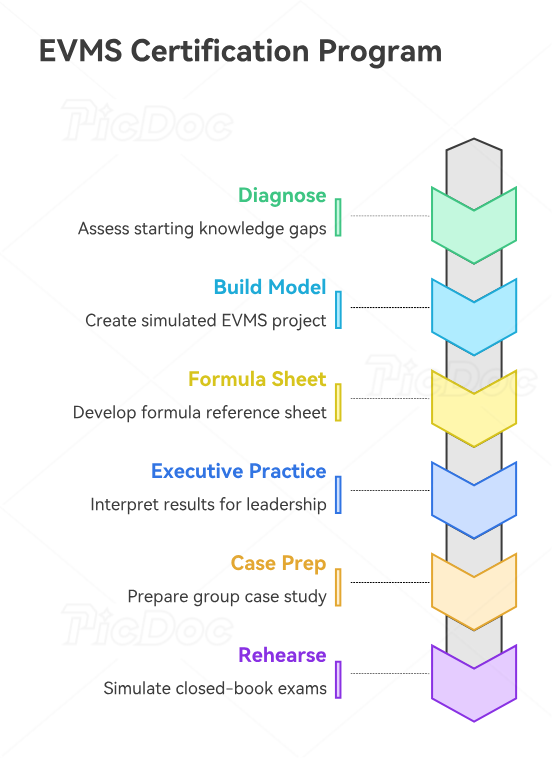
4. A High-Probability EVMP Preparation Plan
A five-day certification program concentrates instruction and assessment preparation. It cannot replace the professional context required to understand integrated controls. Candidates should complete structured pre-study so course time can be used for integration, difficult questions, and case analysis.
Phase 1: Diagnose your starting point
Begin with a closed-book diagnostic covering EVM terminology, WBS and OBS integration, control accounts, scheduling, budgeting, EV methods, CPI, SPI, EAC, ETC, VAC, TCPI, variance reporting, change control, IBRs, and EVMS surveillance.
Classify every missed item into one of four categories:
Recall gap: You forgot a definition or formula.
Interpretation gap: You calculated correctly but could not explain the result.
Application gap: You understood the concept but chose the wrong method for the scenario.
System gap: You failed to connect scope, schedule, budget, accounting, risk, and governance.
Most candidates spend too much time repairing recall gaps because flashcards feel productive. Application and system gaps create the greatest assessment risk.
Phase 2: Build a working EVMS model
Create a small simulated project with 20–30 activities. Develop its WBS, responsibility assignment, control accounts, work packages, schedule logic, time-phased budget, earned-value methods, actual costs, status updates, and forecast.
Use a familiar project such as a software implementation, facility upgrade, product launch, renewable-energy installation, or construction package. Candidates interested in capital programs can study construction project management trends, renewable-energy project opportunities, and project financial controls while designing the scenario.
During each status cycle, introduce a realistic disturbance: delayed equipment, engineering rework, labor shortage, scope clarification, supplier insolvency, or quality failure. Calculate the effect, revise the forecast, write a variance narrative, and recommend action. This single model produces deeper understanding than hundreds of disconnected formula questions.
Phase 3: Create a formula-and-assumption sheet
Your formula sheet should contain five columns:
Formula.
Meaning.
Assumption.
Warning sign.
Management decision.
For example, BAC divided by CPI is useful when current cost efficiency is expected to persist. Its warning sign appears when past inefficiency came from a nonrecurring event or when remaining work has a materially different cost structure. The associated management decision may involve selecting a bottom-up ETC instead.
Practice calculations manually before depending on Excel. The published exam is closed book, so retrieval speed and accurate setup matter.
Phase 4: Practice executive interpretation
For every problem, answer beyond the calculation:
What does the result say?
Which data could be misleading?
What caused the condition?
Will the condition continue?
Which forecast is appropriate?
Which corrective action is realistic?
Who owns the action?
What approval or escalation is required?
This format strengthens project leadership communication, reporting quality, risk response planning, and exam performance simultaneously.
Phase 5: Prepare for the case study
A group case can fail through coordination problems even when participants understand EVM. Agree on roles for data validation, schedule analysis, cost analysis, risk, compliance, corrective action, presentation design, quality review, and final submission.
Use one shared issue log with columns for evidence, cause, consequence, recommendation, owner, and presentation location. Establish a single version of all calculations. Conflicting EAC figures, inconsistent status dates, and contradictory corrective actions damage credibility quickly.
The presentation should move from problem to decision:
Baseline condition.
Current performance.
Root causes.
Forecast exposure.
EVMS or governance weaknesses.
Corrective actions.
Accountable owners.
Decision requests.
Monitoring cadence.
Expected recovery evidence.
Phase 6: Complete two closed-book rehearsals
At least twice, simulate four hours under closed-book conditions. Use unfamiliar scenarios, complete all calculations, write full explanations, and reserve time for review. Afterward, create an error log identifying the exact reasoning failure behind each mistake.
A useful final-week split is 30 percent formulas and calculations, 30 percent applied scenarios, 20 percent EVMS architecture and standards, 10 percent ethics and governance, and 10 percent case-study coordination. Adjust this distribution according to diagnostic results rather than treating every topic equally.
5. Turning EVMP Into Career and Business Value
Certification creates value when it changes the evidence you can present to an employer, client, or executive. Add EVMP to a résumé alongside quantified project-control outcomes instead of leaving the credential as a standalone acronym.
A stronger résumé bullet would read:
Developed an integrated cost-and-schedule performance model across 14 control accounts, identified a forecast overrun three reporting cycles earlier, and supported corrective actions that reduced projected exposure by 11 percent.
This statement demonstrates EVM application, analytical timing, scope of responsibility, and business effect. Similar evidence can be built around baseline quality, forecasting accuracy, reporting-cycle reduction, subcontractor control, reserve governance, IBR readiness, surveillance findings, or automated dashboards.
Build an EVMP proof portfolio
A credible portfolio can contain sanitized or simulated versions of:
A WBS–OBS responsibility matrix.
A control-account plan.
A time-phased Performance Measurement Baseline.
An EVM dashboard containing trends and thresholds.
A three-scenario EAC model.
A TCPI feasibility assessment.
A variance analysis and corrective-action report.
An IBR preparation checklist.
An EVMS gap-analysis matrix.
A baseline-change and reconciliation log.
A one-page executive performance briefing.
Pair the technical material with knowledge of project management software, PM APIs and integrations, AI in project management, and machine-learning forecasting. Technology can automate collection and visualization, while accountable professionals still need to verify data structure, baseline integrity, assumptions, and management meaning.
Evaluate recognition in your target market
EVMP is one route into advanced earned value capability. AACE International offers the Earned Value Professional credential, while APMG International offers its own Earned Value Management certification pathway. Their eligibility rules, assessments, market recognition, costs, and intended audiences differ.
Choose through job-market evidence:
Search target roles by geography and industry.
Record every requested certification.
Identify whether employers emphasize EVMP, AACE EVP, PMP, scheduling credentials, cost credentials, or direct EVMS experience.
Contact practitioners in comparable roles.
Compare total cost, preparation time, renewal obligations, and employer reimbursement.
Select the credential that closes the largest documented credibility gap.
Professionals with broad project-management responsibilities may pair an EVM credential with PMP, while earlier-career candidates may begin with CAPM or a foundational project-controls route. Review PMP exam domains, PMP preparation resources, CAPM career advancement, and the PMP versus PRINCE2 comparison before building a stacked certification plan.
EVMP can also support movement into project controls leadership, PMO governance, program assurance, cost engineering, planning management, consulting, contract oversight, or Control Account Management. The strongest candidates combine technical analysis with future-ready project-management competencies, commercial judgment, concise communication, and the ability to challenge an unrealistic forecast without creating defensive conflict.
6. FAQs About Earned Value Management Certification (EVMP)
-
EVMP is the Earned Value Management Professional credential offered by the Earned Value Management Institute. Its published scope covers project management, project controls, scheduling, cost management, financial controls, earned value analytics, forecasting, Control Account Management, variance analysis, EVMS implementation, EIA-748-D practices, and corrective action.
Candidates should distinguish EVMP from AACE International’s EVP credential and other earned value certificates. Compare each option against the terminology used in your target vacancies, employer procurement documents, and professional-development policies.
-
EVMI currently describes a typical route involving a bachelor’s degree plus four or more years of related work experience. It also describes a route involving a high-school diploma plus at least eight years of experience. Candidates outside those conditions may need the EVMA prerequisite, while active PMP holders and certain engineering-qualified applicants may receive a waiver. Confirm your personal eligibility directly with the provider before enrollment.
-
The current registration section lists US$5,499 per participant, including certification materials, instruction, assessment grading, administrative processing, credential preparation, and mailing. Since older figures remain visible in portions of the provider’s page, request a dated written quotation stating the complete fee, taxes, payment method, refund conditions, case-study arrangements, and any additional expenses.
The return should be assessed against employer reimbursement, promotion potential, consulting opportunities, salary impact, and the frequency with which EVMP appears in relevant vacancies or contract requirements.
-
The exam can be demanding because candidates must achieve at least 80 percent on a four-hour, closed-book theory assessment and at least 80 percent on a group case-study component. The curriculum extends beyond basic EVM formulas into baseline construction, financial controls, EVMS implementation, surveillance, Integrated Baseline Reviews, forecasting, corrective action, ethics, and management judgment.
Candidates with extensive project experience may still struggle when their work has relied on dashboards without understanding how the underlying scope, schedule, budget, and actual-cost systems were constructed.
-
Preparation length depends on existing project-controls exposure. An experienced cost or controls professional may need four to eight weeks of structured review before the course. A project manager with limited EVMS experience may need eight to twelve weeks to build sufficient capability in scheduling, cost integration, forecasting, control accounts, and EIA-748 concepts.
Track readiness through performance criteria: complete unfamiliar calculations accurately, select the correct EAC assumption, explain results in management language, diagnose baseline weaknesses, write corrective actions, and complete closed-book simulations within time.
-
You should know the core formulas well enough to retrieve and apply them under closed-book conditions. Equal attention should go to assumptions. EAC formulas can produce different answers because each one models remaining work differently. Certification-level judgment means selecting and defending the formula that fits the scenario.
Build fluency in PV, EV, AC, BAC, CV, SV, CPI, SPI, EAC, ETC, VAC, and TCPI, then connect them to earned value terminology, schedule logic, risk, accounting timing, and forecast credibility.
